
Making the switch to a golf cart lithium battery is a bit like trading in an old, clunky suitcase for a sleek, modern spinner. Suddenly, everything is lighter, easier to handle, and you can go a lot further with way less effort. It's a simple change that gets rid of all the usual headaches that come with old-school golf cart batteries.
Why Golfers Are Switching to Lithium Batteries

For years, golfers just put up with heavy, high-maintenance lead-acid batteries because there wasn't another choice. We all know the drill: constantly checking water levels, cleaning up messy acid spills, and waiting all night for the cart to charge. Thankfully, those days are over.
The move to lithium isn't just a small tweak—it’s a total game-changer for how a golf cart feels and performs. When you drop hundreds of pounds of lead, your cart gets quicker off the line, feels more nimble, and is even gentler on the turf. This massive performance boost is exactly why the market for these batteries is exploding.
The global lithium golf cart batteries market is projected to hit $1,250 million by 2025 and continue its rapid growth at a robust 18% CAGR. This surge is driven by golfers and course managers moving away from outdated lead-acid technology for these lighter, more powerful alternatives. You can explore additional market insights from Data Insights Market.
This trend is all about real, tangible benefits that make a day on the course better. To really get why this shift is happening, it helps to understand the evolution of EV battery technology that paved the way for these incredible improvements.
Lead-Acid vs Lithium At a Glance
Sometimes, seeing the difference side-by-side makes it crystal clear. This quick breakdown shows exactly why more and more golfers are making the switch every single day.
| Feature | Lead-Acid Battery | Lithium Battery |
|---|---|---|
| Weight | Extremely heavy (300+ lbs) | Lightweight (Under 100 lbs) |
| Lifespan | 3-5 years (500 cycles) | 10+ years (5,000+ cycles) |
| Charging Time | 8-12 hours | 2-4 hours |
| Maintenance | Regular watering and cleaning | Zero maintenance required |
| Performance | Fades as it discharges | Consistent power until empty |
Once you see the numbers, it’s hard to ignore. From a practical standpoint, lithium simply outclasses lead-acid in every category that matters to a golfer.
How a Lithium Battery Upgrade Transforms Your Golf Cart
Switching to a golf cart lithium battery isn't just a simple swap-out. It's a full-blown performance upgrade that changes how your cart feels and handles on and off the course. The benefits go way beyond the spec sheet, giving you a faster, more reliable, and just plain more fun experience every time you head for the first tee.
One of the first things you'll feel is the massive weight difference. A typical set of old-school lead-acid batteries can easily top 300 pounds, but a comparable lithium pack often weighs less than 100. That’s like kicking two adult passengers out of your cart for good.
Dropping over 200 pounds has an immediate effect on acceleration, making your cart feel snappier and far more responsive. It's also a huge relief for the turf, cutting down on soil compaction and keeping the fairways looking pristine. Your groundskeeper is going to love you.
More Power, Less Waiting
Beyond just being lighter, lithium technology delivers power differently. Lead-acid batteries are notorious for getting sluggish and weak as they drain. A lithium battery, on the other hand, provides consistent, fade-free power right up until it’s nearly empty. Your cart will charge up hills on the 18th hole just as hard as it did on the first.
And the improvements don't stop when your round is over. Lithium batteries are built for speed and efficiency from start to finish.
- Go the Distance: A single charge can easily last for 36 holes or more. Range anxiety becomes a thing of the past, letting you play back-to-back rounds without a second thought.
- Charge in a Flash: Forget those 8-12 hour overnight charges. A lithium battery can be fully topped off in just 2-4 hours, meaning less downtime and more time enjoying your cart.
Time and again, research shows lithium batteries running circles around lead-acid in every key metric. They're up to 70% lighter, charge exponentially faster, and can last for over 5,000 cycles compared to just 500 for lead-acid. This means years of dependable power, whether for your personal cart or an entire commercial fleet. You can discover more insights on the lithium golf cart batteries market to see the data for yourself.
The True Meaning of "Set It and Forget It"
Maybe the best part of going lithium is waving goodbye to routine battery maintenance forever. All those tedious chores are completely off the table. No more checking water levels, no more cleaning up corrosive acid spills on your garage floor, and no more wrestling with heavy, messy terminals.
This "set it and forget it" approach means your cart is always ready to roll when you are. The longevity is just as impressive; with a lifespan often topping 10 years, a single lithium battery can easily outlast three or four sets of lead-acid batteries. This long-term reliability and freedom from constant upkeep fundamentally changes the ownership experience, giving you more time to focus on your game.
How to Choose the Right Lithium Battery
Choosing the right golf cart lithium battery feels like a huge commitment, but it’s actually pretty straightforward once you know what to look for. Think of it like picking the right engine for a car—you need to match the power and range to how you drive, without paying for extras you'll never use.
The trick is to cut through the technical jargon so you can shop like a pro. We'll break it down into four key areas: voltage and capacity, battery chemistry, physical size, and the internal brain of the battery. Get these right, and you'll find the perfect match for your cart.
Matching Voltage and Amp Hours
First things first: voltage (V) is the raw power, and capacity, measured in Amp Hours (Ah), is the size of your fuel tank. Most golf carts run on either a 36V or 48V system, and it is absolutely critical to match this number exactly. Using the wrong voltage can cause poor performance or, worse, fry your cart’s electronics.
Capacity, on the other hand, is all about range. A bigger Ah number means more miles on a single charge. For most golfers, a 100Ah battery is the sweet spot, easily delivering 40-50 miles of range. But if you’ve got a lifted cart with big tires or live in a hilly community, stepping up to a 150Ah battery will give you the extra juice you need for peace of mind.
To make it even simpler, this decision tree highlights common issues that a lithium upgrade solves instantly.
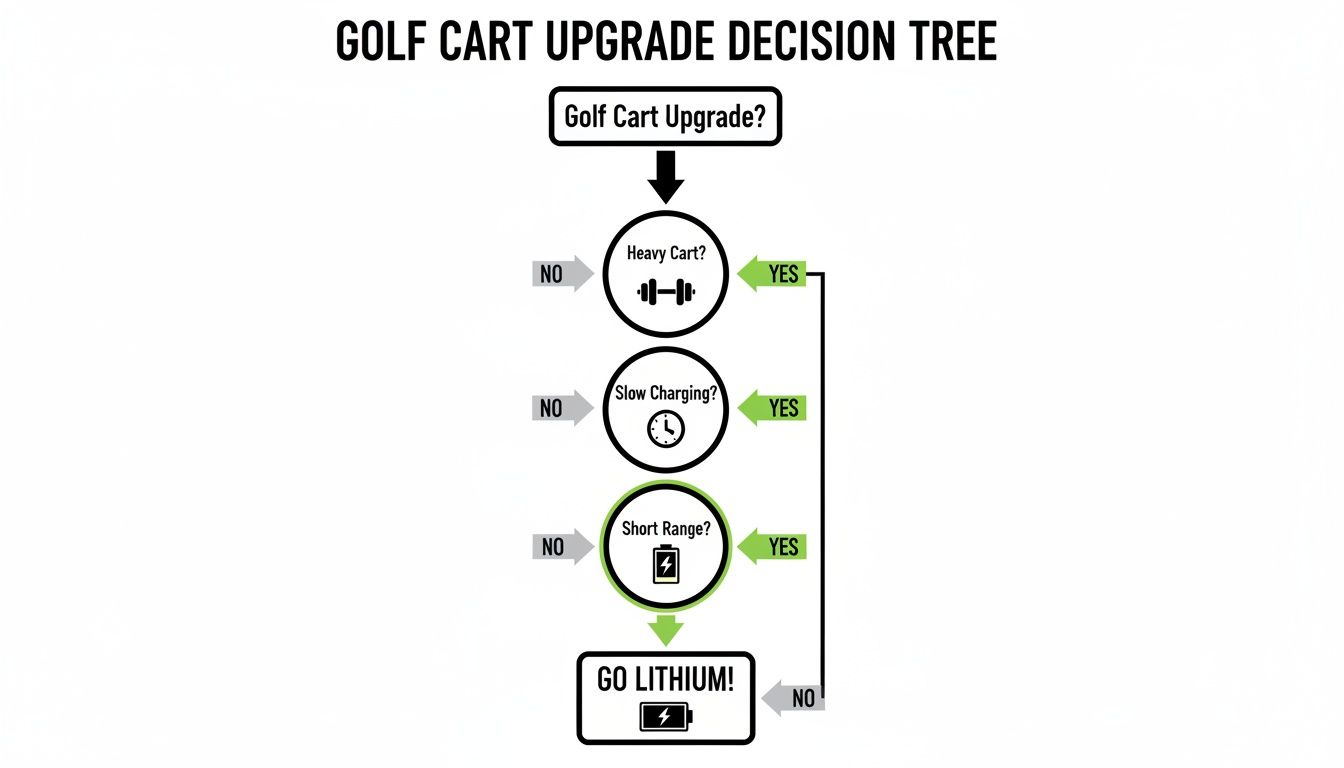
As you can see, if you're struggling with a heavy cart, frustratingly slow charging, or a battery that dies halfway through a long day, lithium is your answer.
Understanding Battery Chemistry and BCI Sizing
Not all lithium is created equal. For golf carts, the undisputed champion is Lithium Iron Phosphate (LiFePO4). This chemistry is the gold standard because it’s incredibly safe, stable even in high heat, and boasts a ridiculously long lifespan—often lasting more than 5,000 charge cycles. It’s the most reliable and durable choice for the tough demands of a golf cart.
Just as important as the electrical specs is the physical fit. Batteries are organized by BCI group sizes, which are just standardized dimensions ensuring the battery drops right into your cart’s tray. Many lithium batteries are designed as "drop-in replacements" for common lead-acid sizes like the GC2, making the swap a breeze. Always double-check your battery compartment dimensions before you buy.
For a complete rundown of the best options out there, take a look at our guide to the best lithium batteries for golf carts.
The Importance of the Battery Management System
The Battery Management System (BMS) is the hidden hero inside every quality lithium battery. It’s the onboard computer, the brain of the operation, that constantly monitors and protects each individual cell from anything that could go wrong.
A high-quality BMS is non-negotiable. It prevents over-charging, over-discharging, and overheating—the three biggest threats to a lithium battery’s health. Think of it as built-in insurance that protects your investment and guarantees safe, reliable power for years to come.
A great BMS also keeps all the cells balanced, which maximizes both the battery’s performance and its total lifespan. When you're comparing different batteries, pay close attention to the quality of the BMS. It is the single most important feature for safeguarding your battery and making sure you get every last one of those thousands of charge cycles you’re paying for.
Analyzing the True Cost of an Upgrade
It’s easy to get sticker shock when looking at a golf cart lithium battery. There’s no denying it—the upfront investment is higher than what you’d pay for a fresh set of lead-acid batteries. But focusing only on that initial price tag is like comparing the cost of a single high-quality tire to a set of cheap retreads. It just doesn't tell the whole story.
To get the real picture, you have to look at the Total Cost of Ownership (TCO). This isn't just about what you pay on day one; it's about every single dollar you'll spend over the entire life of the battery. Once you start crunching the numbers, the financial landscape shifts dramatically, and lithium quickly reveals itself as the smarter long-term play.
Think about it this way: a single premium lithium battery is built to last for more than a decade, easily handling 5,000+ charge cycles. In that same period, you’d be lucky to get by with just three sets of lead-acid batteries. More realistically, you’re looking at four complete replacements, since they typically give up the ghost after just 500 cycles.
Beyond the Purchase Price
The ongoing expenses of lead-acid batteries are where the real budget-draining happens. These aren't just one-off costs; they're recurring headaches that add up surprisingly fast and are completely eliminated by switching to lithium.
These "hidden costs" include things like:
- Replacement Labor: You're not just buying new batteries; you're paying a technician to haul out the old, heavy set and install the new ones—multiple times.
- Maintenance Supplies: Get used to buying distilled water, terminal cleaners, and anti-corrosion sprays. It’s a constant chore with a constant cost.
- Wasted Electricity: Lead-acid batteries are notoriously inefficient. They can lose up to 30% of the energy you pay for as heat while charging. In stark contrast, lithium batteries are over 95% efficient, which means a noticeably lower electricity bill.
- Potential Damage: Acid spills are a real risk. They can eat away at your cart’s frame and permanently stain your garage floor, leading to some seriously expensive repairs.
When you add up the cost of multiple replacements, ongoing maintenance, and all that wasted energy, the total expense of running lead-acid batteries can easily double or even triple their initial price over a 10-year span. Suddenly, that one-time purchase of a lithium battery looks far more economical.
A Clear Financial Winner
Let's break it down with a simple scenario. A new set of lead-acid batteries might run you $800, while a comparable lithium battery costs $1,500. On the surface, lead-acid looks like the bargain.
But remember the lifespan. If you have to replace those lead-acid batteries three times over the life of that one lithium battery, your total cost jumps to $2,400. And that’s before you factor in a single cent for maintenance supplies or wasted electricity. You can dive deeper into these numbers in our complete golf cart battery replacement cost guide.
This simple math makes it clear. The higher initial investment in a golf cart lithium battery isn’t just buying you better performance and zero maintenance; it's buying you significant long-term savings. Over its life, a lithium battery consistently delivers a lower total cost of ownership, making it a sound financial decision for any serious golfer.
Best Practices for Charging and Maintenance

One of the biggest perks of upgrading to a golf cart lithium battery is just how little you have to think about it. The old days of topping off water levels and scrubbing away corrosive acid buildup are officially behind you. Still, a few simple charging and care habits will go a long way in making sure you get every ounce of performance and life out of your investment.
Think of it less like a chore and more like a quick check-up to protect your battery's health. The whole point is to reinforce that amazing "set it and forget it" feeling, not add more work to your plate.
It's no surprise that golfers are flocking to these low-maintenance power sources. In fact, the market for golf cart batteries is projected to hit $135.2 million by 2034, with lithium-ion leading the charge. This growth is all thanks to players who value performance that doesn't demand constant attention. You can read the full analysis on the golf cart battery market to see just how quickly this trend is taking over the industry.
Smart Charging For Maximum Lifespan
If you remember one thing, make it this: always use the right charger. Your old lead-acid charger just isn't built for the job and can seriously damage a new lithium battery. A dedicated lithium charger is designed to communicate with the battery’s internal Battery Management System (BMS), ensuring every charge is safe, efficient, and perfectly balanced.
Follow these simple charging ground rules:
- Avoid Running on Empty: Lithium batteries are tough, but they don't like being drained completely. It's best to plug it in when you get down to around 20% charge.
- Top-Offs Are Welcome: Unlike old-school batteries, you don't need to wait for a full discharge. Feel free to plug in after a quick 9-hole round—this "opportunity charging" won't hurt its long-term health one bit.
- Use the Right Gear: A quality charger is your battery's best friend. For a deeper dive, check out our guide on choosing the best lithium battery charger for your golf cart.
Following these practices helps your battery operate exactly as it was designed. The BMS is the brain, but using the correct charger is like giving it the right instructions—preventing overcharging and helping you get the maximum lifespan.
Storing Your Battery During The Off-Season
When you're hanging up the clubs for a month or more, proper storage is the key to preserving your battery's health. You don't want to leave it sitting fully charged or totally empty for an extended period.
The sweet spot for long-term storage is between 50% and 80% state of charge. Just get it to that level, turn off the main power switch if your battery has one, and you're good to go. Park the cart in a cool, dry place away from extreme hot or cold, and it’ll be ready to roll as soon as the season starts back up.
To keep things simple, here’s a quick checklist to help you get the most out of your battery.
Lithium Battery Care Checklist
This table breaks down the essentials for charging, storage, and general maintenance to ensure your battery stays in top condition year after year.
| Task | Frequency | Best Practice |
|---|---|---|
| Use Correct Charger | Every Charge | Only use a charger specifically designed for your lithium battery's chemistry and voltage. |
| Routine Charging | After Use | Recharge when the battery is around 20%. Avoid letting it die completely. |
| Check Connections | Monthly | Ensure battery terminals are tight and free of debris. No corrosion to worry about! |
| Long-Term Storage | Off-Season | Charge to 50-80%, turn off the main power switch, and store in a cool, dry place. |
| Visual Inspection | Periodically | Check for any signs of physical damage to the battery casing or cables. |
By following these straightforward steps, you're not just maintaining your battery—you're protecting your investment and ensuring your cart is always ready for the next round.
Will It Fit My Cart? A Guide to Compatibility
One of the biggest reliefs for golfers considering a switch to lithium is how simple the process really is. You're not signing up for a massive, custom fabrication project. High-quality golf cart lithium batteries are almost always designed as “drop-in replacements” for the clunky lead-acid batteries that came with your cart.
What does that mean for you? For the vast majority of carts from major brands like EZGO, Club Car, and Yamaha, the new lithium battery is engineered to slide right into the existing battery tray. No cutting, no drilling, no headaches. The goal is to make the upgrade as painless as possible, so you can spend less time in the garage and more time on the course.
Powering More Than Just Your Main Ride
The lightweight power of lithium isn't just for traditional golf carts. It's also a game-changer for motorized push carts, like the Caddie Wheel, which help golfers walk the course without the strain of pushing their gear. For this kind of equipment, every ounce counts.
A compact lithium battery is the only real choice here, delivering some serious advantages:
- Less Weight, More Agility: It keeps your push cart feeling nimble and easy to steer around the greens.
- Go the Distance: A single charge delivers more than enough juice for 36 holes, so you never have to worry about running out of power on the back nine.
- Steady Power: You get consistent, reliable performance from the first tee to the very last putt.
Whether you’re overhauling your primary golf cart or just looking for a better power source for your electric caddie, the needs are the same. You want a battery that’s dependable, lightweight, and doesn't require constant attention. Lithium technology checks every one of those boxes, hands down.
Frequently Asked Questions
Even with all the benefits laid out, you probably still have a few questions floating around before you pull the trigger on a golf cart lithium battery. That’s perfectly normal. This final section tackles the most common queries we hear from golfers, giving you clear, straight-up answers to help you decide with total confidence.
Can I Use My Old Lead-Acid Charger?
This is a big one, and the answer is a hard no. You absolutely cannot use a lead-acid charger on a lithium battery. Think of it like trying to put diesel in a gasoline engine—it just won't work and will cause serious damage.
Lithium batteries require a specific charging algorithm to communicate with their internal Battery Management System (BMS). Using the wrong charger is a surefire way to ruin your new battery and void the warranty. Always use the charger designed specifically for your lithium battery.
How Long Does a Golf Cart Lithium Battery Really Last?
Get ready for a serious upgrade in longevity. While you might be used to replacing lead-acid batteries every 3-5 years, a high-quality LiFePO4 lithium battery is built to last for over 10 years.
They are rated for 5,000 or more charge cycles, which for the average golfer, translates into a decade or more of reliable, zero-maintenance performance. It’s a true one-and-done upgrade that lets you focus on your game, not your battery.
Are Lithium Batteries Safe in My Cart?
Yes, they are incredibly safe, especially the LiFePO4 (Lithium Iron Phosphate) chemistry used in quality golf cart batteries. This particular chemistry is the gold standard for a reason—it's extremely stable and isn't prone to overheating like other lithium types.
On top of that, every quality lithium battery includes a sophisticated BMS that acts as a full-time safety watchdog. It constantly monitors the cells to prevent overcharging, over-discharging, and short-circuiting.
Think of the BMS as a dedicated bodyguard for your battery. It constantly monitors every cell to ensure safe operation, protecting your investment and giving you complete peace of mind on and off the course.
Will I Need to Modify My Cart?
For most modern carts from major brands like Club Car, EZGO, and Yamaha, the answer is no. The best golf cart lithium batteries are engineered as "drop-in replacements." This means they're designed to fit perfectly into the existing battery tray without any cutting, drilling, or custom fabrication. The whole conversion is a straightforward job that usually takes just a couple of hours.
Beyond daily care, understanding the long-term lifecycle of your battery, including its eventual disposal, is important. For broader insights, you can review this general guidance on battery disposal.
At Caddie Wheel, we believe in making golf more enjoyable and accessible. Our lightweight electric power assist transforms your push cart, letting you walk the course with less effort and more focus on your game. Discover how the Caddie Wheel can elevate your round today.
Share:
The Ultimate Guide to 4 Wheel Push Golf Carts
How to Make an Electric Golf Cart Faster A Proven Guide