

As a senior golfer, your passion for the game remains as strong as ever, even if your body and swing have evolved over the years. The secret to enjoying golf for decades to come isn't about chasing the power of your youth; it's about playing smarter, not harder. This means adapting your approach with intelligent strategies that align with your current physical capabilities, ensuring you can play comfortably, competitively, and consistently.
This guide provides a comprehensive collection of actionable tips for senior golfers, designed specifically to help you conserve energy, prevent common injuries, and refine your on-course strategy. Forget generic advice; we are diving deep into practical, modern solutions that address the real challenges mature players face. You will learn how to optimize your game by leveraging smart equipment choices, making subtle yet powerful swing modifications, and adopting targeted fitness and warm-up routines.
Our goal is to equip you with the knowledge to not only maintain your skills but to enhance them through efficiency and precision. We will explore everything from game-changing equipment, such as electric push-cart assists that eliminate physical strain, to specific course management tactics that save strokes and energy. By embracing these targeted techniques, you can effectively lower your scores, significantly extend your playing years, and rediscover a profound sense of enjoyment and confidence in every single round you play. This list is your blueprint for a more sustainable, enjoyable, and successful future on the golf course.
1. Use Equipment That Reduces Physical Strain
As the body changes with age, the physical demands of a round of golf can become a significant barrier to enjoying the game. One of the most effective tips for senior golfers is to adopt equipment specifically designed to minimize physical exertion and joint stress. Traditional methods of carrying a heavy bag or manually pushing a cart over uneven terrain can strain the back, shoulders, knees, and hips, leading to fatigue and increasing the risk of injury.
This is where modern technology provides a powerful solution. Electric-assist push carts, such as the innovative Caddie Wheel, transform a standard push cart into a self-propelled caddie. This allows you to walk the course and reap its cardiovascular benefits without the exhausting work of pushing 30-40 pounds of equipment, especially up hills. By conserving energy between shots, you can focus more on your swing and strategy, maintaining physical and mental stamina throughout all 18 holes.
Why It's a Game-Changer
For seniors dealing with arthritis, mobility limitations, or post-surgery recovery, an electric-assist cart isn't just a convenience; it's an enabler. A player with arthritic knees, for example, can continue their weekly foursome without the pain that pushing a cart would cause. Similarly, golfers who have undergone hip or knee replacements can return to the game sooner, as the motorized assistance removes the primary source of strain that could compromise their recovery. This technology bridges the gap between wanting to walk for health and needing to ride for comfort.
Practical Tips for Implementation
To get the most out of motorized assistance, consider these actionable steps:
- Test it on Hills First: Start by using your electric-assist on a hilly course to immediately feel the difference in energy conservation.
- Match Your Pace: Use the variable-speed controls to find a setting that matches your natural walking gait, making the experience feel seamless.
- Gradual Transition: If you typically use a riding cart, begin by walking nine holes with the electric assist and gradually build up to a full 18 to improve your fitness.
- Master the Controls: Practice using the remote control functions in an open area before navigating a crowded or unfamiliar course.
By strategically incorporating strain-reducing equipment, senior golfers can extend their playing years, improve their on-course performance, and continue to enjoy the health benefits of walking the fairways. To see how these devices are making a difference, you can read more about why electric push carts are a game-changer for senior golfers.
2. Modify Your Swing Technique for Reduced Torque
As golfers age, a natural decrease in flexibility and core strength can make the powerful, high-torque swing of a younger player both inefficient and dangerous. Attempting to replicate that same level of rotation often leads to strain on the lower back, hips, and shoulders. One of the most impactful tips for senior golfers is to adapt their swing mechanics to work with their body, not against it, by focusing on a technique that reduces torque. This means prioritizing rhythm and control over raw power.

A modified swing typically involves a shorter backswing, a wider and more stable stance, and a fluid tempo. Instead of a deep turn that puts maximum pressure on the spine, a three-quarter backswing can generate ample clubhead speed through better timing and solid contact. This approach minimizes the physical stress of the game, preventing chronic pain and injuries that could otherwise take you off the course. It shifts the goal from hitting the ball as far as possible to hitting it consistently and accurately.
Why It's a Game-Changer
Adopting a reduced-torque swing is a strategic move for longevity in golf. A senior player dealing with lumbar stenosis or spinal arthritis can continue playing comfortably by taking rotational stress off the back. Players who have lost some balance can use a wider stance to create a solid foundation, improving their ball-striking without the risk of an unsteady finish. Senior PGA Tour professionals have long demonstrated that a controlled, rhythmic swing consistently outperforms a strained, over-powered one, proving that smart mechanics can keep you competitive at any age.
Practical Tips for Implementation
To integrate a lower-torque swing into your game, consider these specific steps:
- Widen Your Stance: Start by setting your feet slightly wider than shoulder-width for drivers and woods. This provides a more stable base and naturally limits hip turn.
- Shorten the Backswing: On the range, consciously stop your backswing when your lead arm is parallel to the ground (a "nine o'clock" position). Focus on making solid contact from this shorter position.
- Focus on Tempo: Develop a consistent rhythm by counting "one-two" during your swing. "One" is the takeaway, and "two" is the smooth transition through the ball.
- Film Your Swing: Use your phone to record your swing from the side and behind. This will help you see if you are over-rotating or making jerky movements.
By modifying your swing, you can protect your body while maintaining performance. While adjusting your technique for reduced torque is key, further enhancing your overall play can be achieved through understanding simple steps to improve your golf swing. To dive deeper into injury prevention, you can find more on playing pain-free golf and addressing back pain.
3. Implement Targeted Flexibility and Mobility Training
As golfers age, a gradual loss of flexibility is inevitable, with studies showing a potential decline of 1-3% annually after age 30. This directly impacts the golf swing, restricting rotation, shortening the swing arc, and reducing power. One of the most impactful tips for senior golfers is to implement a targeted flexibility and mobility program that counteracts these age-related changes, preserving swing mechanics and preventing injury.
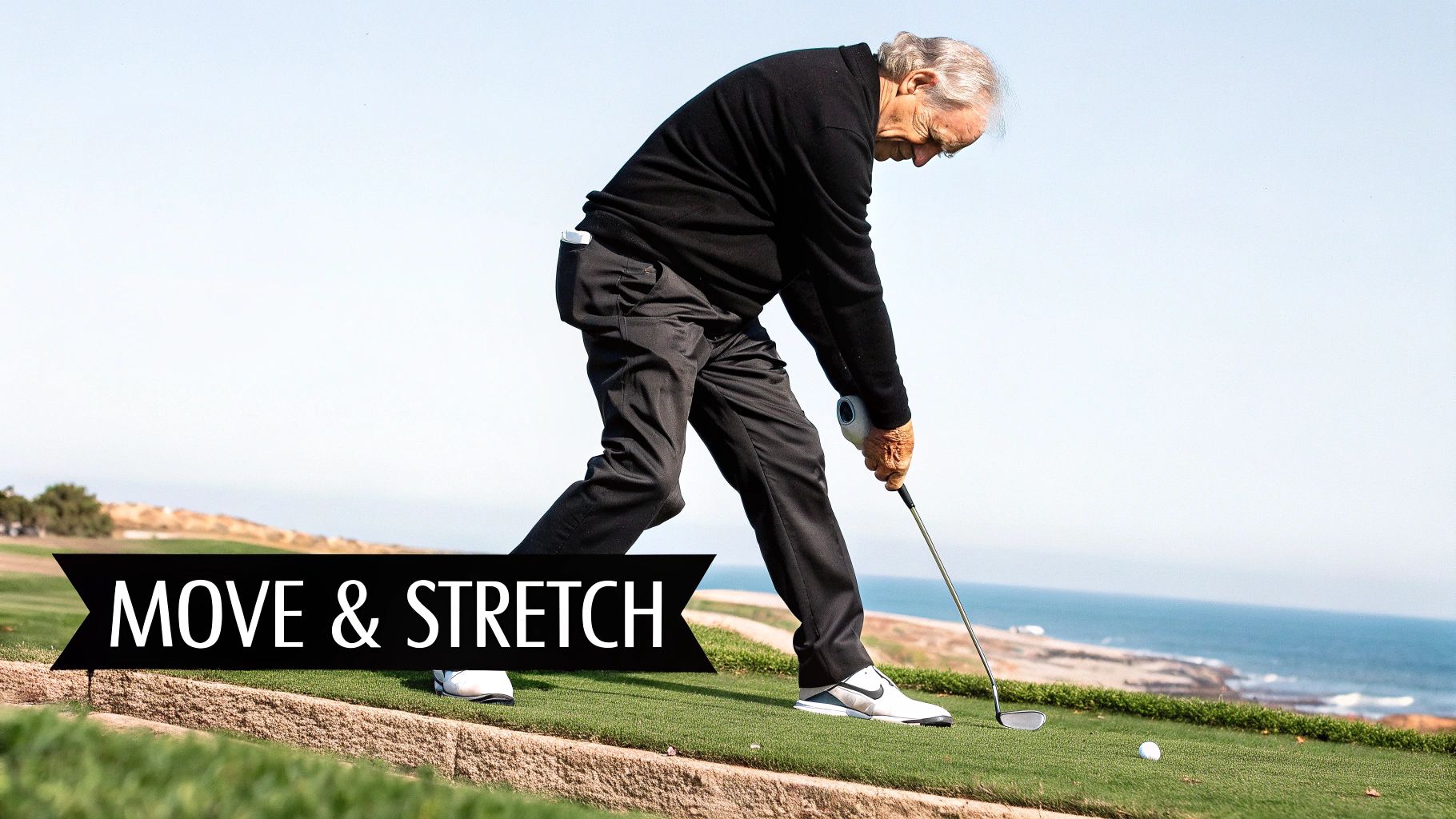
This approach moves beyond generic stretching by focusing on the specific areas critical to the golf swing: hip mobility, thoracic (mid-back) spine rotation, and shoulder flexibility. By restoring range of motion in these key joints, you can execute a more fluid, powerful, and repeatable swing without putting compensatory strain on vulnerable areas like the lower back. This targeted training builds a foundation for a healthier and more enjoyable golf game for years to come.
Why It's a Game-Changer
For many seniors, chronic lower back pain or stiff shoulders are accepted as part of the game. However, these issues are often symptoms of mobility limitations elsewhere. A golfer with tight hips, for instance, will force their lower back to over-rotate, leading to pain and inconsistency. By committing to a consistent flexibility routine, players can see dramatic improvements. It's not uncommon for senior golfers to regain 15° or more of torso rotation after just a few weeks of dedicated hip mobility work, leading to a longer backswing and more clubhead speed.
Practical Tips for Implementation
To integrate this crucial practice into your routine, focus on consistency and proper technique:
- Dynamic Warm-Up: Before every round, perform a 5-10 minute dynamic stretching routine. Include leg swings, torso twists, and arm circles to prepare your muscles for the game.
- Focus on Key Areas: Prioritize stretches that target the hips (hip flexors, glutes), thoracic spine, and shoulders. These are the primary engines of the golf swing.
- Post-Round Static Stretches: After your round, hold static stretches for 30-60 seconds to improve long-term flexibility and aid muscle recovery. Never bounce or force a stretch.
- Use Supportive Practices: To implement targeted flexibility and mobility training effectively, consider exploring resources on Pilates for seniors, which is renowned for its benefits for older adults.
By making flexibility a non-negotiable part of your golf preparation and recovery, you can maintain a high level of performance and significantly reduce your risk of injury. To discover specific exercises tailored for this purpose, you can explore these essential golf fitness exercises for seniors.
4. Develop a Structured Pre-Round Warm-Up Protocol
As the body ages, muscles, ligaments, and joints require more thorough preparation before any athletic activity, and golf is no exception. A critical tip for senior golfers is to implement a structured, 15 to 30-minute pre-round warm-up. This isn't just a few casual stretches; it's a systematic protocol combining dynamic movements, light cardio, and graduated club exercises to prime the body for the demands of the golf swing. A consistent routine increases core temperature, enhances blood flow to key muscle groups, and activates the nervous system, leading to better performance and a significant reduction in injury risk.
This disciplined approach moves the body from a state of rest to a state of readiness. By gradually increasing the intensity, from a brisk walk to full swings with a driver, you prepare the muscles and joints for the explosive, rotational forces of the golf swing. Research and data from organizations like the Titleist Performance Institute (TPI) show that a proper warm-up can not only prevent common injuries like back strain and tendonitis but also improve scoring on the crucial first few holes.
Why It's a Game-Changer
For senior golfers, the difference between a good and bad round often starts before the first tee. Many amateurs arrive, pull out their driver, and immediately begin swinging at full speed, a recipe for poor shots and potential injury. In contrast, consider a 70-year-old golfer who, by adopting a consistent warm-up protocol, plays an entire season injury-free while lowering their average score on the first three holes by two strokes. The warm-up provides the physical readiness and mental transition needed to start the round with confidence and control, rather than spending several holes "finding your swing." It transforms the beginning of your round from a period of inconsistency into a strong, reliable start.
Practical Tips for Implementation
To build an effective warm-up protocol that becomes a non-negotiable part of your game, follow these steps:
- Arrive Early: Get to the course at least 45 minutes before your tee time to allow for a relaxed, unrushed warm-up.
- Start with Cardio: Begin with 5-10 minutes of light cardio, such as a brisk walk or gentle jogging in place, to elevate your heart rate and warm your muscles.
- Dynamic Stretching: Perform dynamic stretches like leg swings, torso twists, and arm circles to promote mobility without over-stretching cold muscles.
- Graduate Your Clubs: Start your range session with a short iron (like a wedge or 9-iron), making easy, half-swings. Gradually progress to mid-irons and finally your woods and driver, increasing swing speed as your body loosens.
- Focus on the Short Game: Dedicate at least five minutes to chipping and putting. This fine-tunes your feel and builds confidence before you step onto the first tee.
5. Prioritize Injury Prevention Through Smart Course Management
For senior golfers, staying in the game long-term is as much about smart decisions on the course as it is about the swing itself. Injury prevention extends beyond warm-ups and into strategic course management. This means making conscious choices before and during your round to minimize physical stress, prevent acute injuries, and avoid the cumulative strain that can lead to chronic pain. By playing smarter, not harder, you can significantly reduce the risk of sidelining yourself.
Smart course management involves a proactive approach to your game, recognizing your current physical capabilities and adjusting your strategy accordingly. This could mean choosing the right tees, avoiding high-risk shots that strain your back or knees, or even selecting a course that better suits your mobility. This mindset shifts the focus from battling the course to working with it, ensuring you finish 18 holes feeling challenged but not beaten down.
Why It's a Game-Changer
Adopting intelligent course management is a powerful tool for longevity in golf. A player with recurring shoulder pain, for example, can strategically lay up on a hole that requires a long, strenuous carry over water, preserving their joint for the rest of the round and the rest of the season. Similarly, a golfer recovering from a minor knee issue can opt for a flatter, more walkable course, allowing them to continue playing their weekly game without aggravating the injury.
This strategy is one of the most effective tips for senior golfers because it empowers them to control their physical destiny on the course. It prevents small aches from becoming chronic problems and allows for more consistent play by managing fatigue. It’s the difference between playing for one more season and playing for another decade.
Practical Tips for Implementation
To integrate smart course management into your routine, consider these actionable steps:
- Play from the Right Tees: Move up to the senior or forward tees. The course is designed to be challenging from every tee box, and this adjustment reduces strain by shortening holes without diminishing the game's strategic elements.
- Identify "Risk Holes": Before your round, identify 2-3 holes that pose a physical challenge, whether due to elevation, hazards, or length. Plan a conservative strategy for these holes, such as laying up or using a higher-lofted club.
- Assess the Terrain: If you struggle with hills, check the course layout beforehand. Opting for flatter courses can be the key to playing regularly without excessive fatigue or joint pain.
- Stop at the First Sign of Sharp Pain: Never "play through" a sharp, sudden pain. Finishing the hole isn't worth a long-term injury. Stop immediately, rest, and seek medical advice if it persists.
- Schedule Recovery: Establish a maximum number of rounds per week that allows for adequate recovery. For most seniors, playing two to three times a week with rest days in between is a sustainable and healthy schedule.
6. Cultivate a Resilient Mental Approach to Age-Related Changes
As physical abilities evolve with age, the mental game of golf often becomes the biggest challenge. A loss of distance, fluctuating consistency, and new physical limitations can lead to immense frustration. One of the most impactful tips for senior golfers is to cultivate a resilient mental approach, shifting focus from past capabilities to present enjoyment and strategic success. This means accepting age-related changes while refusing to let them diminish the competitive spirit or love for the game.
This mental shift involves redefining what a "good" round looks like. Instead of measuring success by how far you hit the ball, you can prioritize accuracy, course management, and the quality of your short game. By focusing on the elements you can still control, such as strategy and putting, you can maintain a high level of performance and satisfaction, preventing the discouragement that causes many to leave the sport.
Why It's a Game-Changer
For seniors, mental resilience is the key to longevity in golf. A player who obsesses over their 20-yard loss in driving distance may quit in frustration, while another who accepts it and focuses on hitting more fairways will continue to thrive and compete. This mindset transforms potential frustration into a new, engaging challenge. For example, a former club champion might find renewed purpose in winning their flight by leveraging their short game and course knowledge rather than overpowering the course.
This approach directly combats the negative self-talk that can ruin a round. Instead of thinking, "I used to be able to make that shot," a resilient golfer thinks, "What is the smartest way for me to play this hole today?" This change in perspective keeps the game fun, competitive, and mentally stimulating, which is crucial for long-term enjoyment and participation.
Practical Tips for Implementation
To build a more resilient mental game, consider these actionable steps:
- Redefine Your Metrics: Shift your focus from distance to stats like fairways hit, greens in regulation, and putts per round. These are better indicators of skillful play for seniors.
- Focus on Process, Not Outcome: Concentrate on executing a solid pre-shot routine for every shot. The process is within your control; the final result is not always.
- Practice Self-Compassion: Acknowledge and accept imperfect shots without harsh self-criticism. Saying, "That was a good swing for my current ability," is far more productive than dwelling on a past standard.
- Keep a Positivity Journal: After each round, write down three things you did well, regardless of your final score. This could be a great sand save, a well-judged lag putt, or a smart strategic decision.
By adopting a resilient mental framework, senior golfers can navigate the natural changes of aging with grace and confidence. This mindset is one of the most valuable tips for senior golfers, ensuring the game remains a source of joy and accomplishment for many years to come.
7. Execute Deliberate Practice Drills for Skill Maintenance
As golfers age, maintaining consistency and a competitive edge often shifts from a game of power to a game of precision. One of the most impactful tips for senior golfers is to embrace deliberate practice, which means trading mindless range sessions for targeted, purposeful drills with specific goals. Instead of hitting a large bucket of balls with no clear objective, this focused approach identifies weaknesses and builds repeatable skills, especially in the short game, where finesse trumps force.

This method, championed by golf psychologists and elite instructors, emphasizes quality over quantity. For seniors, the highest return on investment comes from honing skills within 100 yards of the hole. A sharp short game can easily compensate for a loss in driving distance, keeping scores low and confidence high. Deliberate practice is about making every ball count by setting measurable targets, tracking results, and progressively increasing the difficulty.
Why It's a Game-Changer
Deliberate practice directly addresses the physical changes that affect a senior's game. While regaining 20 yards off the tee might be unrealistic, becoming an exceptional putter or chipper is entirely achievable. This is how a 70-year-old player can outscore a younger, more powerful opponent. A senior golfer who dedicates their practice to making 8 out of 10 putts from six feet will save more strokes than one who spends an hour trying to hit their driver like they did at 30. It transforms practice from a physical grind into a mental and strategic exercise, sharpening the skills that have the biggest impact on the scorecard.
Practical Tips for Implementation
To integrate deliberate practice into your routine, focus on structure and measurement:
- Prioritize the Short Game: Dedicate at least 60% of your practice time to chipping, pitching, and putting. This is where you can gain the most strokes.
- Create Specific Drills: Instead of just chipping, set up a challenge: hit three balls from 15, 20, and 25 feet, and track how many you get within a three-foot circle.
- Practice Under Pressure: Simulate on-course nerves with drills like the "gate drill" for putting or trying to make a set number of consecutive short putts before you can leave.
- Limit Full Swing Practice: Cap your full swing practice to 20-30 minutes, focusing primarily on rhythm, balance, and consistent contact rather than pure distance.
By adopting a deliberate practice mindset, senior golfers can maintain their skills, lower their handicaps, and continue to compete effectively for years to come. This approach ensures that every minute spent practicing is a minute spent getting better.
8. Select and Optimize Equipment Specific to Age-Related Physical Changes
As physical attributes like swing speed and flexibility naturally decline with age, using the same equipment from your prime can become counterproductive. One of the most impactful tips for senior golfers is to select and optimize clubs, balls, and accessories specifically engineered for age-related changes. Sticking with stiff shafts or heavy clubs meant for a faster swing can rob you of distance, accuracy, and enjoyment, while also increasing physical strain.
Modern golf technology offers a wealth of solutions designed to work with, not against, a changing body. Lightweight driver heads, flexible graphite shafts, higher-lofted fairway woods, and soft-compression golf balls are all designed to help senior players maximize their performance. These innovations help generate clubhead speed, increase launch angle, and reduce spin, allowing golfers to maintain distance and control even with a more moderate swing.
Why It's a Game-Changer
For senior golfers, the right equipment isn't just about a few extra yards; it's about extending a playing career and preventing injury. A golfer struggling with arthritis in their hands can find renewed comfort and a more secure hold with oversized, ergonomic grips. Similarly, a player whose swing speed has dropped below 90 mph can regain significant distance and a higher ball flight by switching from a "regular" to a "senior" flex shaft. This isn't an admission of defeat; it's a strategic adjustment that allows you to play smarter and score better.
Practical Tips for Implementation
To properly update your gear for your current game, consider these actionable steps:
- Get a Professional Fitting: Don't guess which shaft or clubhead is right for you. A professional club fitter can use launch monitor data to identify the optimal equipment for your specific swing dynamics.
- Prioritize Senior Flex Shafts: Be honest about your swing speed. A senior or super-senior flex shaft is designed to load and release properly for moderate swing speeds, maximizing distance and feel.
- Choose Soft-Compression Balls: A softer golf ball (typically with a compression rating below 80) is easier to compress at slower swing speeds, resulting in less spin off the driver and more distance.
- Re-Grip for Comfort: Invest in oversized or ergonomic grips to reduce hand and wrist tension. Ensure they are replaced annually, as worn grips force you to squeeze harder, causing fatigue.
- Reassess Annually: Your body and swing can change from one year to the next. Make it a habit to have your equipment needs re-evaluated each season to ensure it's still the right fit.
8-Point Senior Golf Tips Comparison
| Strategy | 🔄 Implementation Complexity | ⚡ Resource Requirements | 📊 Expected Outcomes | 💡 Ideal Use Cases | ⭐ Key Advantages |
|---|---|---|---|---|---|
| Use Equipment That Reduces Physical Strain (electric-assist push carts) | Low–Medium — simple install, small learning curve | Moderate — purchase cost, battery charging | Maintain walking rounds; greatly reduced joint strain | Seniors with arthritis, hilly courses, wanting to walk | Preserves cardio benefits while lowering exertion; compatible with existing carts |
| Modify Your Swing Technique for Reduced Torque | Medium — coaching and deliberate practice needed | Low — coaching time and practice sessions | Lower injury risk; improved consistency; modest distance loss | Seniors prioritizing spinal/joint health and accuracy | Protects spine/joints and improves shot control |
| Implement Targeted Flexibility and Mobility Training | Medium — requires daily consistency | Low — minimal equipment, time commitment (4–6×/wk) | Increased ROM, reduced back/shoulder pain, better rotation | Seniors with stiffness or limited rotation | Improves mechanics and injury resilience with low cost |
| Develop a Structured Pre-Round Warm-Up Protocol | Low — routine is simple but time-consuming | Low — 15–30 minutes, minimal gear | Fewer early-round injuries; better early-hole performance | Morning players or those with morning stiffness | Rapidly reduces injury risk and primes performance |
| Prioritize Injury Prevention Through Smart Course Management | Low–Medium — needs experience and discipline | Low — planning, tee selection, pacing | Fewer acute/overuse injuries; sustained play frequency | Players managing chronic issues or fatigue | Extends playing life via strategy and energy management |
| Cultivate a Resilient Mental Approach to Age-Related Changes | Medium — ongoing mindset work, possible coaching | Low — practice, journaling, possible psychologist | Greater enjoyment, longer career, better decisions under pressure | Players struggling with distance loss or frustration | Sustains motivation, reduces frustration, improves choices |
| Execute Deliberate Practice Drills for Skill Maintenance | Medium — structured sessions and tracking required | Moderate — practice time, facilities, targeted drills | Faster short-game gains; measurable scoring improvements | Seniors seeking efficient handicap reduction | High ROI on scoring; maintains sharpness with less physical demand |
| Select and Optimize Equipment Specific to Age-Related Changes | Medium — professional fitting recommended | High — equipment cost, periodic refitting | Increased distance/forgiveness; reduced vibration and strain | Seniors with reduced swing speed or joint sensitivity | Maximizes performance and comfort when properly fitted |
Integrating Smart Strategies for a Lifetime of Better Golf
The journey of a senior golfer is not about battling the clock or reclaiming a swing from decades past. Instead, it is a sophisticated exercise in adaptation, strategy, and intelligent optimization. The eight core principles detailed in this guide are not just isolated suggestions; they are interconnected components of a comprehensive system designed to extend your golfing prime, enhance your enjoyment, and safeguard your physical health. Thriving on the course in your later years is about working smarter, not harder, and embracing the evolution of your game with confidence and purpose.
The most profound realization for many experienced players is that the biggest gains come from a holistic approach. You cannot expect a new, lighter driver to single-handedly fix a swing that lacks proper warm-up and flexibility. Similarly, even the most dedicated mobility routine will be undermined by poor course management that forces you into physically taxing shots. The true power lies in synergy, where each positive change amplifies the benefits of the others.
Weaving the Threads of a Sustainable Golf Game
Think of these tips as a blueprint for long-term success. The foundation is built upon protecting your body and conserving precious energy, allowing you to perform at your best from the first tee to the eighteenth green.
- Protect Your Engine: Implementing targeted flexibility training and a structured pre-round warm-up is non-negotiable. These practices are the preventative maintenance that keeps your "engine" - your muscles, joints, and ligaments - running smoothly and significantly reduces the risk of game-sidelining injuries.
- Refine Your Technique: Modifying your swing to reduce torque is a powerful act of self-preservation. It is a strategic shift away from raw power and toward efficient, repeatable mechanics that produce consistent results without placing undue stress on your back and hips.
- Optimize Your Tools: Your equipment must evolve with you. Lighter shafts, more forgiving clubheads, and higher-lofted woods are not crutches; they are specialized tools engineered to complement a mature golfer's swing speed and physical capabilities. A professional club fitting is one of the wisest investments you can make in your game.
- Embrace Strategic Assistance: The most overlooked aspect of physical strain is the cumulative fatigue from walking 18 holes. Utilizing an electric push-cart assist, like the Caddie Wheel, is one of the most impactful tips for senior golfers. It transforms a physically demanding walk into a refreshing one, preserving your energy for the shots that truly matter.
From Knowledge to Action: Your Path Forward
Mastering these concepts requires a shift in mindset from simply "playing golf" to "managing your game." It involves being a student of your own body, understanding its new limits, and celebrating its enduring capabilities. The resilient mental approach we discussed is the glue that holds it all together. Accepting that a 230-yard drive is just as effective as a 280-yard drive was twenty years ago is a sign of wisdom, not weakness.
Your next steps should be deliberate and methodical. Start by assessing your current routine. Where are the biggest gaps? Perhaps you consistently skip your warm-up, or you have been using the same stiff-shafted irons for over a decade. Pick one or two areas to focus on first. Schedule a club fitting. Dedicate just ten minutes each morning to the flexibility exercises. Make a conscious effort on your next round to choose the safer, smarter shot.
By integrating these strategies, you are not just hoping to play golf for a few more years. You are actively engineering a future where the game remains a vibrant, challenging, and deeply rewarding part of your life. You are taking control, making intelligent adjustments, and setting the stage for countless more sunrises on the fairway, friendly competitions, and the pure joy of a well-struck shot. This is how you ensure that your best rounds are still ahead of you.
Ready to make your walk on the course effortless and save your energy for your swing? The Caddie Wheel converts your existing push cart into a powerful, remote-controlled electric caddy, embodying the smart strategies discussed here. Explore how this simple upgrade can transform your game at Caddie Wheel.
Share:
How to Make an Electric Golf Cart Faster A Proven Guide
A Golfer's Guide to Electric Golf Push Cart Conversion Kits