
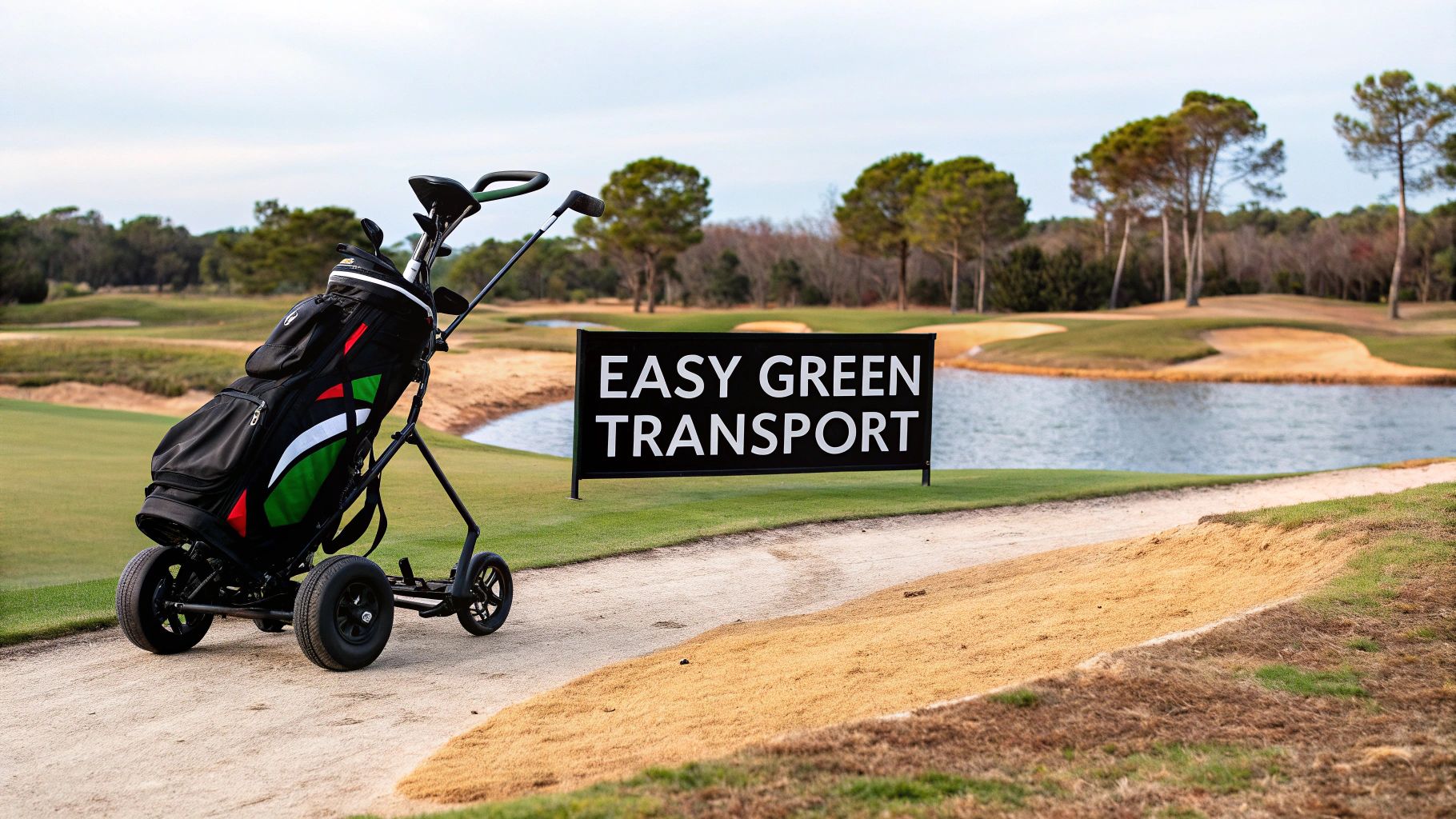
Picture this: you're walking up the 18th fairway feeling just as fresh as you did on the first tee. That’s what a modern lightweight golf push cart brings to your game. They’re designed to take the physical strain of a heavy bag off your shoulders, freeing you up to focus purely on your next shot. This isn't just about making the walk easier; it's a strategic move to save energy and shoot lower scores.
Why Smart Golfers Are Switching to Lightweight Push Carts

Walking the course is one of golf's simple joys. You get some great exercise and really connect with your surroundings. But let's be honest, lugging a 30-pound bag for four or five hours is a grind. It takes a serious toll, and by the back nine, that fatigue shows up in your swing. Tired shoulders and an aching back are a recipe for sloppy shots and extra strokes.
That’s the exact problem lightweight golf push carts were designed to solve. They shoulder the burden for you, letting you enjoy the walk without paying the physical price.
The True Cost of On-Course Fatigue
Fatigue is more than just a feeling—it’s a performance killer. As your body gets tired, your mental game is the first thing to crumble. You might rush a critical putt, second-guess your club selection, or lose the delicate touch needed for a chip shot. Saving your physical energy is directly tied to keeping your mind sharp over all 18 holes.
Today’s push carts are a far cry from the clunky, stubborn relics you might remember. The new breed is engineered for effortless movement, thanks to a few key upgrades:
- Advanced Materials: Frames built from lightweight aluminum or even carbon fiber make the carts themselves incredibly easy to manage.
- Ergonomic Design: Smart handle designs and smooth-rolling wheels cut down on the effort needed to get around the course, even on hills.
- Electric Assistance: Motorized options have completely changed the game. They turn your push cart into a self-propelled caddie that practically glides up inclines on its own.
By offloading your gear, you’re doing more than just saving your back—you’re investing in your scorecard. The energy you conserve on the front nine is exactly what you'll need to close out your round with confidence.
More Than Just Convenience—A Strategic Advantage
Choosing the right cart is a strategic decision. It’s about accepting that your stamina is a limited resource during a round. Instead of draining it by carrying a heavy load, you can redirect that energy where it counts: your swing. For a deeper dive, you can explore the top benefits of electric push carts for golfers and see the technology in action.
This change in thinking is why so many players, from casual weekend golfers to serious competitors, are making the switch. They get it: a fresher body leads to a sharper mind and, ultimately, a better score.
From Manual Push to Electric Glide: The Cart's Big Leap Forward
To really get why today's lightweight electric carts are such a big deal, you have to look at where they came from. The story starts with the simple, trusty manual push cart. For years, this was the go-to for any golfer who preferred walking, and it was a massive improvement over slinging a heavy bag over your shoulder. It was straightforward, reliable, and got the job done.
As technology and materials got better, so did the carts. We saw manufacturers move to lightweight aluminum and even high-strength titanium, making frames that were not only tougher but a whole lot easier to push around for 18 holes. This was a great step, making the walk less of a workout and more of a pleasure.
The Electric Revolution
But the real game-changer? Adding a motor. Think of it like the jump from a regular bicycle to an e-bike. A standard bike is all you, every single pedal stroke. An e-bike, on the other hand, gives you a powered boost that flattens out hills and makes long rides feel effortless.
An electric golf cart does the exact same thing for your round. It completely takes the "push" out of the equation.
This isn't just about making life easier; it's a strategic move. When you let a motor handle the heavy lifting, you save your physical and mental gas for what really counts: executing the perfect shot.
And this isn't just a trend—it's a fundamental shift in how golfers are choosing to play. The global market for golf push carts is on track to hit US$817.0 million by 2030. What’s really telling is that the electric cart segment is growing at a 4.5% CAGR, blowing past the growth of manual carts. Golfers are voting with their wallets, and they're choosing power.
How an Electric Cart Pulls It Off
At its heart, an electric cart runs on a simple but powerful duo: a compact motor and a lightweight lithium-ion battery. Together, they turn your cart into your own personal, self-driving caddie.
- The Motor: Tucked away quietly near the axle or wheels, the motor delivers the muscle needed to haul a fully-stocked bag up steep hills and over bumpy fairways without you breaking a sweat.
- The Battery: Modern lithium-ion batteries are the unsung heroes. They're incredibly light compared to older tech but pack enough juice to easily last 36 holes or more on a single charge.
- The Controls: Whether it’s a simple dial on the handle or a full-blown remote control, you get to be the pilot. You can set the speed and direction, letting it cruise ahead to your ball while you soak in the walk.
This kind of personal electric mobility is popping up everywhere. Beyond the course, you see it in things like innovative electric bikes like the Bezior X500 Pro, showing a broader move toward smart, electric-powered convenience.
The Smartest Upgrade: A Retrofit Solution
So, what if you already have a manual push cart that you love? Maybe it’s the perfect size, folds up just right, and you don’t want to part with it. This is where a retrofit kit comes in, offering a brilliant way to get electric power without buying a whole new setup.
Instead of dropping a ton of cash on a brand-new electric trolley, a conversion kit lets you add a motorized wheel to the frame you already own. It's a move that saves you money and is surprisingly simple to do. If you're curious, our guide on how to convert a push cart to electric for an easy DIY walkthrough breaks it down. It’s the perfect way to get the best of both worlds: the cart you're comfortable with and the electric power you crave.
Essential Features of a High-Performance Golf Cart
Choosing the right lightweight golf push cart isn’t just about hunting for the lowest price. The best ones are defined by a handful of features that work together to make your round easier, not more complicated. Getting a handle on these core elements is the key to picking a cart that feels less like a piece of gear and more like a trusted caddie.
When you start comparing models, you'll be hit with a lot of different specs and marketing buzz. To cut through that noise, let's break down the five most important features that separate an average cart from a great one. Prioritizing these will ensure you get a cart that actually fits your game, your course, and your car.
This flowchart helps visualize the main choices you'll face when deciding between manual, electric, or even retrofitting your current cart.
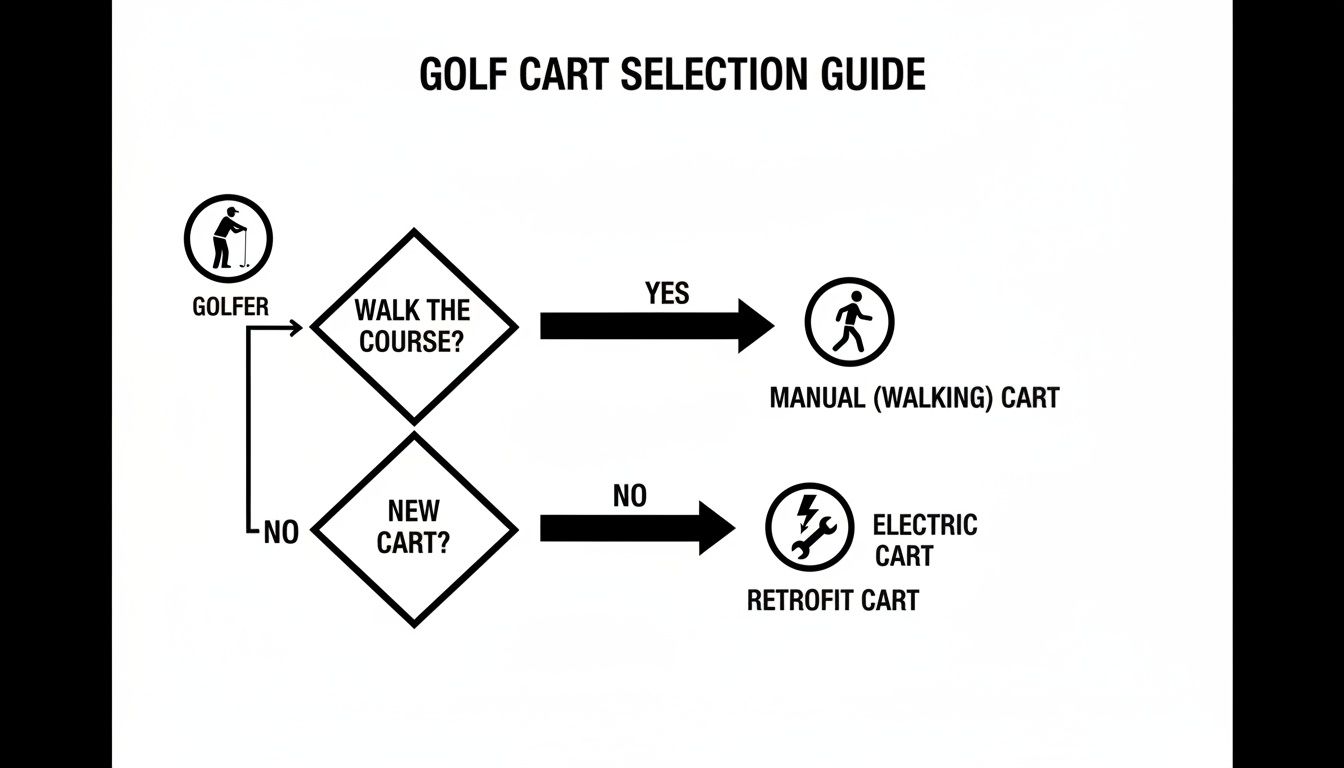
As you can see, the first big decision—manual effort, a fully integrated electric system, or upgrading a cart you already own—sets the stage for everything else.
Portability and Weight
A cart’s number one job is to make your life easier, and that starts before you even get to the first tee. Portability is non-negotiable. A cart that’s a nightmare to fold or too heavy to lift into your trunk completely defeats the purpose. Keep an eye out for models with simple one-click folding mechanisms.
The best lightweight golf push carts, especially the electric ones, are now giving manual versions a run for their money in the weight department. For instance, some high-end carbon fiber electric models weigh as little as 18 lbs, making them a breeze to load and unload. That combination of a light frame and a compact folded size means it’ll fit comfortably in your trunk with room to spare.
Battery Life and Power
For electric models, the battery is the heart of the machine. The industry standard is usually measured in how many holes it can last, with two main options on the market:
- 18-Hole Batteries: These are perfect for a single round. They're typically lighter and less expensive, making them a great choice for golfers who consistently play one round before heading home.
- 36-Hole Batteries: Offering enough juice for two full rounds on a single charge, these batteries provide serious peace of mind. This is especially true on hilly courses where the motor has to work harder and drains more power. Modern high-capacity lithium-ion batteries can deliver this extended range without adding a ton of bulk.
A powerful motor is just as crucial. A quality motor, often around 180W or more, ensures the cart can tackle steep inclines without slowing down or straining, even when your bag is fully loaded.
Controls and Maneuverability
How you "drive" your cart has a huge impact on your experience out on the course. Simple handlebar controls with speed dials are common and effective, but remote-controlled systems offer a whole new level of freedom. With a remote, you can send your cart ahead to the next tee while you walk to the green, saving you time and steps.
This freedom lets you focus completely on your walk and planning your next shot, almost like having a real caddie by your side. The best remotes are intuitive, with simple buttons for forward, reverse, stop, and easy speed adjustments.
The ultimate goal of any control system is to be so intuitive that you forget you're using it. It should feel like a natural extension of your walk, not a distraction from your game.
Stability and Wheel Design
A cart’s stability all comes down to its wheelbase and wheel setup. The classic debate between three and four-wheel designs is really a trade-off between agility and pure balance.
Before we dive into the nitty-gritty of wheel configurations, let's look at a quick comparison between a traditional manual cart and its electric-assisted counterpart. This will help frame the stability discussion and highlight what you gain with a powered option.
Manual Push Cart vs Electric Assist Cart Comparison
| Feature | Manual Push Cart | Electric Assist Cart |
|---|---|---|
| Effort Required | You provide 100% of the power. | Minimal effort; motor does the work. |
| Upfront Cost | Lower ($150 - $350) | Higher ($500 - $1,500+) |
| Weight | Generally lighter and simpler. | Slightly heavier due to battery and motor. |
| Key Features | Basic storage, hand brake. | Remote control, speed settings, hill assist. |
| Ideal User | Golfers on flatter courses or those seeking a workout. | Golfers on hilly courses or those wanting to save energy. |
With that in mind, let's look at how the number of wheels affects performance.
| Wheel Configuration | Primary Advantage | Best For |
|---|---|---|
| 3-Wheel Carts | Maneuverability. A single front wheel makes tight turns effortless. | Golfers who play on flatter courses and prioritize nimble handling. |
| 4-Wheel Carts | Stability. A wider, four-point base prevents tipping on uneven terrain. | Golfers with heavier bags or who frequently play on hilly and rugged courses. |
No matter the number, look for large, smooth-rolling wheels that can handle different ground conditions without getting bogged down. A low center of gravity is also key, as it keeps the cart planted and secure, especially on tricky sidehill lies.
Warranty and Customer Support
Finally, a solid warranty is a direct reflection of the manufacturer's confidence in their product. You should expect a minimum 12-month warranty on any quality cart or electric conversion kit. This protects your investment against defects and gives you a safety net.
Just as important is accessible customer support. Look for companies with a reputation for being responsive and genuinely helpful. If an issue pops up, knowing you can easily get in touch with a support team that can actually provide solutions makes all the difference.
How Upgrading Your Cart Can Transform Your Game
What if you could get all the perks of a high-end electric caddie without ditching the trusty push cart you already know and love? That simple question is behind one of the smartest upgrades in golf today: the electric conversion kit. It's more than just a product—it's a clever solution born from a frustration every walking golfer understands.
Many of these kits were actually designed by avid players who wanted the luxury of a motorized cart but just couldn't stomach the high cost of a brand-new system. They spotted a chance to build something simple, powerful, and affordable for the thousands of golfers who already had a perfectly good manual cart sitting in their garage.
The result is a fresh approach that makes electric cart technology accessible to everyone. Instead of a complete overhaul, you get to keep your current cart and just add the power.
The Power of a Simple Upgrade
The real magic of a conversion kit is its elegant simplicity and broad compatibility. The goal is to motorize your cart in minutes, not hours. Systems like the Caddie Wheel were engineered with a "drop-on" philosophy in mind, meaning no tools and no messy wiring.
This approach keeps the familiar feel and function of your cart while adding a powerful new layer of convenience. You still have the storage you like and the folding mechanism you're used to, but now the toughest part of the walk—pushing the cart up hills and down fairways—is completely handled for you. It’s the ultimate smart upgrade.
A conversion kit doesn't just add a motor to your cart; it adds energy back into your game. It’s the difference between ending your round feeling drained and finishing with enough stamina to sink that final putt with confidence.
Experiencing Effortless Control
Once it's on, the experience is seamless. A lightweight, variable-speed remote puts total control right in your palm. You can send your cart ahead to the next tee, slow it down on a tricky slope, or bring it to a gentle stop with the tap of a button.
This hands-free freedom lets you walk the fairway unburdened, focusing on your next shot instead of wrestling with your equipment. The confidence of a long-lasting, high-capacity battery is another huge plus. A quality kit will easily power through 36 holes, even on hilly courses, so you never have to worry about running out of juice mid-round.
This growing preference for powered assistance is easy to spot in the market. The global push-pull golf cart market, valued at USD 420 million, is expected to climb to USD 738.1 million by 2035. Electric models are clearly driving this growth, claiming 61.0% of the total market share as more golfers choose efficient, energy-saving solutions. You can dig deeper into these trends in the push-pull golf cart market analysis and see for yourself how players' preferences are shaping the future of getting around the course.
Ultimately, this upgrade path gives you the performance of a premium motorized caddie at a fraction of the cost, making it one of the most cost-effective ways to improve your on-course experience.
Real-World Scenarios Where an Electric Cart Excels

Features and specs are one thing, but the real magic of a lightweight electric push cart happens out on the course. To really see how these carts solve everyday problems for real golfers, let's walk a few holes in their shoes. Each player here faces a unique challenge, but for all of them, a little electric assistance is the perfect solution.
These stories aren't about luxury; they're about practical performance. It’s all about playing the game you love, only better—and for a lot longer.
Meet Bob The Senior Golfer
Bob is in his late sixties and walks the course for the exercise and the friendships. He's fit and breezes through the front nine, but his home course is known for a killer back nine loaded with hills. By the time he gets to the 15th, pushing his cart up yet another steep incline leaves him gassed, wrecking his focus and his swing.
For Bob, an electric cart isn't just nice to have; it's a game-changer. It takes the strain of the hills completely out of the equation, letting him walk the full 18 with steady energy. He still gets his workout, but he finishes the round feeling strong, not wiped out.
This means he can actually enjoy the walk and have enough in the tank—physically and mentally—to stay competitive through the final hole.
An electric cart helps golfers like Bob extend their time in the game, turning tough terrain from an obstacle into just part of the scenery.
Meet Sarah The Competitive Player
Sarah is a serious golfer who plays in her club championship every year. She walks to stay loose and feel the rhythm of the round, but she also knows that during a tournament, every single ounce of energy counts.
From her perspective, muscling a manual push cart around is an unnecessary energy leak. That little bit of physical effort might not seem like much on the front nine, but it could be the difference between a pure iron shot on 17 and a tired, sloppy swing that costs her the match.
An electric cart lets Sarah conserve 100% of her physical energy for what actually matters: hitting good shots. Her cart just glides along, leaving her totally free to think about her next move. For a competitive player, that's not just a convenience—it’s a real strategic advantage that helps her stay sharp from the first tee to the last putt.
Meet Tom The Savvy Golfer
Finally, let's talk about Tom. He’s seen his buddies with their fancy, all-in-one electric caddies and loves the idea. He wants to be free from pushing his bag, but he just can’t bring himself to drop that kind of cash on a brand-new, top-of-the-line model. Besides, he already has a great three-wheel push cart that he loves.
Tom is like a huge number of golfers out there: he wants an upgrade, not a complete do-over. For him, a retrofit solution like an electric conversion kit is the perfect answer.
- Cost-Effective: He gets all the benefits of a motorized cart for a fraction of what a new one would cost.
- Keeps His Gear: He gets to keep using the cart he already knows and trusts.
- Simple Upgrade: The installation is a breeze—no tools needed—and transforms his manual cart in minutes.
Tom’s choice is a great example of how smart tech makes the perks of an electric cart available to way more players. It’s a practical, wallet-friendly way to get a more enjoyable and less tiring round of golf.
Simple Maintenance for Long-Lasting Performance
Your lightweight golf push cart is a trusty partner on the course, and just like your clubs, a little TLC goes a long way. Protecting your investment doesn’t mean you need to be a mechanic—it’s all about building a few simple, consistent habits.
Think of it as a quick pre-round check. A few minutes of care prevents minor annoyances from turning into major headaches mid-round, ensuring your cart is always ready to roll. It’s the easiest way to guarantee your gear never lets you down.
Keeping the Frame and Wheels in Top Shape
The body of your cart takes a beating, from bumpy cart paths to damp, grassy fairways. The single most effective thing you can do is give it a quick wipe-down after your round. Getting rid of dirt, grass, and sand stops gunk from building up in the folding joints and wheel hubs, which is what causes sticking and grinding over time.
For a slightly deeper clean, focus on these spots:
- Wheels and Axles: Pop the wheels off and clear out any grass or debris wrapped around the axles. This is key to keeping them spinning freely and quietly.
- Moving Parts: A light spray of silicone-based lubricant on the folding joints once or twice a season will keep the action buttery smooth.
- Tire Pressure: If you’ve got air-filled tires, check the pressure regularly. Properly inflated tires give you a much smoother ride and make the cart easier to push.
A clean cart is a reliable cart. Taking just five minutes to wipe it down after each use is the easiest way to ensure every component, from the brake to the folding latch, works exactly as it should.
Maximizing Battery Life and Motor Health
For electric models, the battery is the heart of the whole operation. Good habits are essential for keeping it healthy and making sure you get that full 36-hole range for years to come. The main goal is to avoid the little things that slowly kill a battery’s capacity.
Start by just following the manufacturer's charging instructions. Try to avoid letting the battery drain completely before you plug it in, and definitely don’t leave it on the charger for days after it’s full.
For a deeper dive, our guide on 6 essential golf cart maintenance tips for 2025 has you covered. During the off-season, store the battery somewhere cool and dry, aiming to keep its charge around 50-75%. Extreme heat or cold can permanently wreck a lithium-ion battery’s ability to hold a charge, so never leave it in a hot car trunk or an uninsulated garage in the winter. A little proactive care makes a huge difference.
Got Questions About Golf Push Carts? We've Got Answers.
Stepping into the world of lightweight and electric push carts can bring up a few last-minute questions. You might be wondering if an electric caddie will actually help your scorecard, or how it’ll hold up on that notoriously hilly back nine. Getting those final details ironed out is key to choosing with confidence.
Let's clear up the most common questions golfers have so you can see exactly how the right cart will fit into your game.
Will An Electric Push Cart Actually Help My Game?
Without a doubt. The single biggest advantage of an electric push cart is how much energy it saves you. Think about it: instead of muscling a 30-pound bag up and down hills for five miles, you’re just walking. All that saved stamina goes directly into your swing.
This means you’ll step up to the 18th tee feeling just as sharp and physically ready as you did on the first. Less fatigue translates to better focus, a more consistent swing, and, ultimately, a lower score. It’s a direct investment in your performance on the course.
The impact of walking the course is undeniable, and it’s a big reason the golf cart market just keeps growing. The North American market alone was valued at USD 0.68 billion and is expected to hit USD 1.13 billion by 2033. With over 26.6 million Americans playing on more than 16,000 courses, gear that makes walking better is more in-demand than ever. You can find more insights on the golf cart market in North America to see how these trends are shaping the future of the game.
How Hard Is It to Install an Electric Conversion Kit?
This is a really common worry, but the best modern conversion kits are designed to be incredibly simple. You don’t need a toolbox or a degree in engineering. Top-tier systems are made for a "drop-on" installation that literally takes minutes.
The process usually looks something like this:
- Pop one of your cart's original wheels off.
- Slide the new motorized wheel onto the axle.
- Click it into place with a snap-on bracket or a simple locking pin.
That’s it. There’s no complex wiring or permanent changes to your cart. You get to upgrade the push cart you already know and love, turning it into a self-driving caddie without any of the mechanical headaches.
The real beauty of a conversion kit is that it makes electric cart technology accessible to everyone. It gives you all the perks of a high-end system without needing to be a tech wizard to set it up.
What’s the Real-World Battery Life on a Hilly Course?
While it's true that hilly terrain uses more juice, a quality lithium-ion battery is built for the job. When you see a cart or conversion kit advertised with a "36-hole" battery, that means it has been tested to reliably power through two full rounds on a typical course—hills and all.
It all comes down to the battery's capacity and the motor's efficiency. A well-designed system will have more than enough power to climb the steepest fairways without you ever worrying about running out of battery on the back nine. It gives you the freedom to walk any course, no matter how tough the layout.
Are Lightweight Push Carts Stable On Uneven Ground?
Absolutely. Stability is a massive focus in modern cart design. Today's lightweight push carts, whether manual or electric, are built with a low center of gravity and a wide wheelbase specifically to prevent them from tipping over.
You’ll generally find two main designs, and both offer fantastic stability for different reasons:
- Three-Wheel Carts: These are champions of agility. They make tight turns a breeze while staying firmly planted on the ground.
- Four-Wheel Carts: With an even wider base, these carts offer maximum stability. They’re a perfect match for seriously hilly courses or for golfers who carry heavier tour bags.
No matter which style you choose, both are engineered to roll smoothly and stay upright over bumpy cart paths, uneven fairways, and tricky side slopes, keeping your clubs safe and secure all round long.
Ready to make every walk on the course effortless? The Caddie Wheel electric conversion kit transforms your favorite push cart into a powerful, remote-controlled caddie in minutes. Conserve your energy for your swing and enjoy the game more than ever before. Upgrade your cart today at CaddieWheel.com.
Share:
Why Four Wheel Push Golf Carts Offer Superior Stability
How to Charge a Golf Cart for Maximum Battery Life