
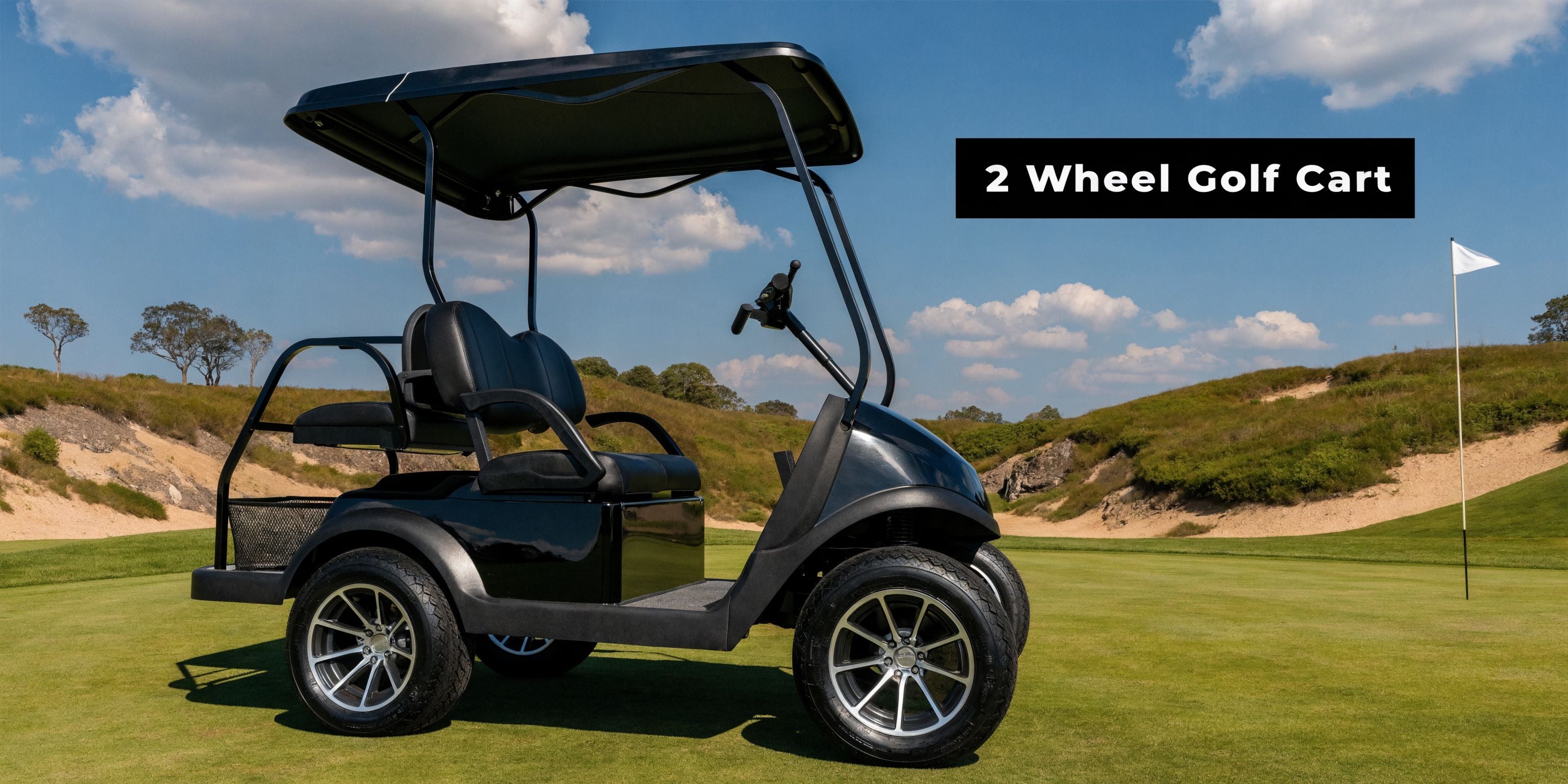
You’re probably in one of two spots right now.
Either you like walking the course, but you’re tired of feeling your shoulders and hands by the back nine. Or you’ve looked at a 2 wheel golf cart before, dismissed it as old-school, and figured a 3-wheel or electric all-in-one cart had to be the smarter play.
I get that instinct. A lot of golfers see two wheels and think “basic.” On the course, though, basic can be a strength. Less frame, less weight, less fuss, less to wrestle into the trunk. And if you enjoy walking, that matters more than most gear buyers realize.
That timing isn’t random. The golf cart market reached USD 2.12 billion in 2025 and is projected to reach USD 3.70 billion by 2034, while over 40% of rounds are now walked, according to Fortune Business Insights. Walking golfers aren’t a niche anymore. They’re a major part of where golf transport is headed.
The problem is that most guides still focus on riding carts or 3-wheel push carts. The 2 wheel golf cart gets treated like a leftover from another era. That sells the category short.
A modern 2 wheel cart can be light, stable, compact, and surprisingly capable on uneven ground when you use it correctly. Add a motorized assist, and it turns into something else entirely: a walking setup that saves energy without forcing you into a bulky electric unit.
The Underrated Joy of the 2 Wheel Golf Cart
A familiar round goes like this.
You step onto the first tee feeling good. You wanted the walk. The weather’s decent, the course is quiet, and you know you play better when you move. Then by the fourth or fifth hole, the cart starts feeling heavier than it should, especially on the long climbs between green and tee.
That’s where the 2 wheel golf cart makes sense.
It doesn’t try to be a rolling command center. It does one job well. It carries your bag with as little extra bulk as possible, and it lets you move naturally instead of steering a wide frame around every collar, bridge, and cart path edge.
Why some golfers come back to two wheels
Golfers who return to a 2-wheel setup usually say the same thing. They missed the simplicity.
You unfold it fast. You strap in the bag. You start walking. There’s less hardware between you and the round.
The best walking setup is often the one you stop thinking about after the first hole.
That sounds small, but it changes the rhythm of a day. A cart that’s awkward to store, slower to fold, or clumsy in tight spots can wear on you before the turn. A lighter 2-wheel design often feels more direct.
Minimal gear, better walk
This is also why the category still matters now, not just in the past.
Walking golf is growing, personal-use electric golf transport is expanding, and more players want options between “carry everything” and “ride all day.” The overlooked sweet spot is the golfer who wants to walk, conserve energy, and keep the setup lean.
That golfer could be a senior trying to reduce strain. It could be a budget-conscious player who doesn’t want to buy a full electric caddie. It could be the regular weekend walker who wants less drag on the round.
A 2 wheel golf cart fits all three better than people expect.
Defining the Modern 2 Wheel Golf Cart
A modern 2 wheel golf cart is not just the clunky pull cart you remember from years ago.
It’s better to think of it as a lightweight bag transport frame built around simplicity. Two main wheels carry the load. You guide the cart by pushing or pulling through the handle, and the bag sits in a position that keeps the overall setup narrow and easy to manage.

What makes modern versions different
The biggest change is materials.
Modern 2-wheel carts use aluminum frames, and some come in as light as 5.8 lbs, with reduced push effort tied to lower weight. The same product data also notes that for every 1 lb of weight saved, push effort decreases by about 5 to 10% on flat terrain on this style of lightweight cart, as referenced by Pyle’s SLGCX5 product information.
That matters over an entire round. A cart doesn’t need to be heavy to feel sturdy. In fact, extra frame weight often works against the walking golfer. Every unnecessary pound becomes something you guide, stop, start, and correct.
The design philosophy
A good 2 wheel golf cart follows a simple logic:
- Keep the frame light: Less cart weight means less effort over every fairway and path.
- Keep the footprint narrow: A slimmer setup is easier around tee boxes, bag-drop areas, and tight storage spaces.
- Keep folding simple: If you dread loading it into the car, you’ll use it less.
- Keep the handling natural: The cart should follow your line, not fight it.
A useful comparison is a road bike versus a full-suspension mountain bike. The mountain bike does more things. It also weighs more and takes up more space. The road bike feels quicker and cleaner when you’re using it for the job it was built to do.
That’s the modern 2-wheel cart.
Push or pull
Golfers sometimes get confused in this area.
They hear “2 wheel cart” and think “pull cart.” In practice, many golfers alternate between a light pull on uphill transitions, a guided push on flatter stretches, and a mix of both around awkward lies or side slopes. The best ones let you do that without strain.
Practical rule: Don’t judge a 2-wheel cart in the parking lot. Judge it after a full walking round with your actual bag on your actual course.
A modern 2 wheel golf cart is engineered for a very specific kind of golfer. Someone who values mobility, compact storage, and direct control more than extra accessories and frame complexity.
Stability and Performance Showdown 2 vs 3 vs 4 Wheels
The biggest question golfers ask isn’t about weight. It’s about trust.
Will a 2 wheel golf cart feel planted enough on hills? Is a 3-wheel easier to live with? Does a 4-wheel cart solve stability but create new headaches in maneuvering and storage?
The honest answer is that each design wins in different places.

At a glance comparison
| Feature | 2-Wheel Cart | 3-Wheel Cart | 4-Wheel Cart |
|---|---|---|---|
| Stability feel | Active, user-guided stability | Balanced and forgiving | Most planted on flat ground |
| Maneuverability | Very agile in tight spaces | Easy steering with good control | Usually wider and less nimble |
| Weight and portability | Often the lightest and simplest | Mid-range | Usually the bulkiest |
| Storage footprint | Small and easy to pack | Moderate | Largest footprint |
| Best fit | Walkers who value simplicity and low weight | Golfers wanting all-around balance | Golfers prioritizing static stability |
What a good 2-wheel cart does well
High-end 2-wheel carts have more built-in stability than many golfers assume.
Models in this class use wide wheelbases from 25 to 31 inches and a low center of gravity, which allows them to stay stable with a 33-lb bag on cross-slopes up to 12%. Their trailing-wheel design also produces a turning radius under 5 feet, which is a 30% reduction compared with many 4-wheel models, according to Clicgear Model 6.0 specifications and benchmark details.
That’s the part many buyers miss. A quality 2-wheel cart isn’t unstable by definition. It’s interactive. It asks the golfer to guide it, but rewards that input with cleaner turns and a lighter feel.
2 wheels on flat ground and gentle terrain
On normal fairways, path edges, and moderate transitions, a 2 wheel golf cart feels quick.
You don’t need a lot of steering effort. You can angle it through narrow gaps and around greenside traffic without making broad turns. If you play a course with bridges, curbs, or tight walk-offs, that agility becomes obvious fast.
A 3-wheel cart is still easy to handle here. It usually tracks more passively, which some golfers prefer. You push it and let the front wheel lead.
A 4-wheel cart tends to feel more planted, but also more cart-like. It’s not usually the setup people describe as fun to walk with.
Hills and side slopes
This is the section where 2-wheel carts get unfairly judged.
A 2-wheel model can feel less secure on a side slope if the golfer lets the handle float and stops actively guiding the bag. That’s not a flaw so much as a technique issue. The cart remains stable when the load is balanced and the player keeps the uphill side under control.
A 3-wheel cart often feels easier for newer push-cart users on mixed slopes because the platform does more of the work. It gives confidence quickly.
A 4-wheel cart offers the strongest static stance, especially if you stop on a flatter patch and leave it alone. But extra wheels don’t automatically make every hill easier. A wide, heavier cart can still be awkward when you’re trying to turn across an uneven lie.
On side hills, the key question isn’t “How many wheels?” It’s “Where is the bag weight sitting, and how well can I guide it?”
Tight turns and path control
If you walk courses with narrow cart paths, mature trees, short cut-throughs, or crowded weekend traffic, maneuverability matters more than many reviews admit.
A 2-wheel cart shines here. It follows your hands with less lag. You can pivot quickly and change direction without wrestling the frame.
A 3-wheel cart is the middle ground. It’s still easy to steer, and for many golfers it feels intuitive right away.
A 4-wheel cart tends to ask for wider arcs. That’s fine on open, groomed layouts. It’s less ideal when space is tight.
For golfers comparing broader push-cart categories, this guide to three wheel carts is useful because it shows where 3-wheel designs sit between the compact feel of two wheels and the planted stance of four.
Storage and transport
This is an area where the 2 wheel golf cart keeps winning.
Two-wheel designs are often easier to fold, easier to lift, and easier to fit into a trunk with clubs, shoes, and a rangefinder case already bouncing around. If you play often, those little convenience points become big quality-of-life points.
3-wheel carts vary. Some fold well, some stay awkwardly wide.
4-wheel carts usually ask for the most storage planning. If trunk space is tight, that can become the deciding factor.
Who wins overall
There isn’t a universal winner.
- Choose 2 wheels if you want low weight, direct handling, and easy storage.
- Choose 3 wheels if you want the broadest all-around compromise.
- Choose 4 wheels if your top priority is a very planted feel on flatter, more manicured courses.
If you’re worried that two wheels automatically means unstable, that’s the wrong takeaway. A well-designed 2 wheel golf cart can be stable enough for real-course use while being noticeably more agile and portable than bulkier alternatives.
Key Advantages and Disadvantages of a 2 Wheel Cart
A 2 wheel golf cart makes the most sense when you judge it by what it’s built to do.
It’s not trying to mimic a riding cart or become a full-size rolling workstation. It’s a lean walking tool. If that matches your style, the benefits are strong. If it doesn’t, the drawbacks show up quickly.
Where a 2 wheel cart shines
- Portability is the headline benefit. These carts are usually easier to lift, fold, store, and load than heavier multi-wheel setups.
- The walking feel is more natural. Many golfers like how directly a 2-wheel cart responds to hand position and pace.
- Less frame means less clutter. If you don’t care about stacking accessories all over the cart, that simplicity is a plus.
- They suit golfers who value rhythm. A lighter setup often feels less intrusive over a full round.
Where golfers hesitate
Not every concern is a myth.
Some players need an adjustment period before a 2 wheel golf cart feels intuitive on side slopes. If you’ve only used 3- or 4-wheel push carts, the active guidance can feel unusual at first.
There’s also a perception issue. A 2-wheel cart can appear less advanced than a larger push cart, even when it performs well. That visual bias turns some buyers away before they’ve tested one properly.
The primary trade-off
The trade-off is simple.
You gain lightness, compact storage, and agility. You give up some passive stability and some accessory-heavy convenience. Whether that’s a downside depends on how you walk and what kind of course you play.
A golfer who wants the cart to disappear into the round often prefers two wheels. A golfer who wants the cart to feel like a platform usually prefers three or four.
That’s why the best choice isn’t about trends. It’s about fit.
The Electric Upgrade Transforming Your 2 Wheel Cart
The most overlooked idea in this category is simple.
A lightweight 2 wheel golf cart can be a strong platform for electric assistance. Not because it’s flashy, but because the low overall mass gives the motor less to move.

Why weight matters even more with power assist
A lot of electric caddie advice gets pulled from heavier all-in-one units. That’s where golfers get misled.
Battery claims often sound great until you add hills, uneven ground, and a real bag. As Matt’s Custom Golf Carts notes in its discussion of buyer questions, one of the least-addressed issues in electric caddies is real-world battery performance. A lighter 2-wheel cart with an efficient add-on has an advantage because the system has less mass to propel.
That’s the practical reason many golfers are revisiting this style. You get walking golf without the constant push effort, and you don’t necessarily need to commit to a large dedicated electric chassis.
What to check before adding power
Compatibility matters more than brand hype.
Look at the frame shape, axle area, and how securely the wheel or drive unit attaches. You want the add-on to sit in a way that doesn’t make the bag feel top-heavy or awkward at the handle.
Check these points:
- Frame clearance: Make sure there’s room for the attachment hardware without crowding the bag base.
- Handle comfort: Once powered, you’ll still guide the cart. If the handle is awkward now, power won’t fix that.
- Brake and speed control layout: You want controls that are easy to reach and easy to understand under pressure.
- Wheel quality: Lightweight carts still need decent rolling hardware, especially if the course has rough transitions.
What the round feels like with assist
When the setup is right, the difference is immediate.
Instead of pushing the full load uphill, you’re guiding the cart while the motor handles the drag. That changes fatigue more than golfers expect. Your legs still get the walk. Your shoulders, hands, and lower back do less fighting.
The category also becomes interesting for golfers beyond the usual “tech” buyer at this point. Seniors, players coming back from injury, and regular walkers on hilly courses often don’t need a futuristic machine. They need a familiar cart that no longer asks for repeated force on climbs.
If you want to understand the conversion approach in more practical detail, this overview of an electric golf push cart conversion kit is a useful starting point.
The wider electric context
Electric mobility has moved far beyond cars, and golf gear is part of that wider shift.
If you’re interested in how specialized electric machines are being designed for niche, real-world use cases, this roundup of unique commercially available electric vehicles beyond cars gives good context. It helps explain why compact electric assistance keeps showing up in places where full-size vehicles make less sense.
One practical example
One option in this category is Caddie Wheel, which is a drop-on powered wheel and battery assembly designed to add motorized assistance to standard push carts. Its function is straightforward: attach the unit, use the remote for forward, reverse, and braking control, and let the cart carry more of the load while you walk.
That approach makes sense for golfers who already own a cart they like and don’t want to replace the whole system.
The smartest electric upgrade is usually the one that preserves the walk instead of replacing it.
For many golfers, that’s a significant promise of the powered 2-wheel setup. Less strain. Same course. Same walking rhythm. More energy left for the shots that count.
Is a 2 Wheel Golf Cart the Right Choice for Your Game
Some equipment choices are universal. This one isn’t.
A 2 wheel golf cart suits certain golfers almost perfectly, and for others it’s only a partial match. The easiest way to decide is to picture your own round, your own car trunk, and your own home course.

The minimalist golfer
If you hate bulky gear, the 2-wheel option is a natural fit.
You probably don’t want cup holders everywhere, oversized storage trays, or a complicated folding routine. You want the bag to roll cleanly and the cart to disappear into the day.
For that golfer, two wheels often feels like the most honest setup.
The budget-conscious player
If you’re trying to get into walking golf without overspending, a 2 wheel golf cart deserves a close look.
The category tends to reward simple design. Fewer moving parts can mean fewer things to fuss over. If later you decide you want power, the upgrade path can still stay open through an add-on rather than a full replacement.
The fitness walker
Some golfers want the walk because the walk is part of the point.
They don’t want to carry. They also don’t want a large cart that makes the round feel mechanical. A light 2-wheel setup preserves that “walking with clubs” feel better than bigger frames do.
You still move. You still stay engaged with the ground and the contours of the course. You just reduce the drag.
The hilly course player
This is the most misunderstood buyer profile.
Search behavior shows golfers have major unanswered questions about 2 wheel golf cart stability on hills, and that gap is especially important for buyers who are worried about balance and strain, including seniors, as noted by Golf Cart Safety’s discussion of common unanswered safety questions.
That concern is real. But it often gets aimed at the wrong target.
A good 2-wheel cart on hills isn’t about parking it sideways and expecting it to behave like a four-corner platform. It’s about controlled guidance, balanced loading, and matching the cart to your terrain. If your course is hilly but walkable, two wheels can still work well. If you want help on the climbs, that’s where electric assist changes the equation.
The golfer who may want something else
A 2 wheel golf cart may not be the right call if you want maximum passive stability with minimal input.
If you often stop your cart on awkward lies, load it with lots of extras, or strongly prefer pushing a self-standing frame that feels planted at all times, a 3- or 4-wheel model may suit you better.
A quick gut-check
Ask yourself these questions:
- Do you care a lot about trunk space?
- Do you prefer light gear over feature-heavy gear?
- Do you enjoy walking but dislike pushing effort?
- Are you open to guiding the cart more actively on slopes?
If you answered yes to most of those, a 2 wheel golf cart is probably more compatible with your game than you first assumed.
What to Look For When Buying and How to Maintain It
A 2 wheel golf cart can look simple enough that golfers rush the buying decision. That’s a mistake.
The little details decide whether the cart feels smooth for years or becomes garage clutter after a month.
What to inspect before buying
A short checklist helps.
- Wheel quality: Look for wheels that roll smoothly and don’t feel sloppy at the axle. Better wheel construction usually means less drag and less wobble.
- Frame material: Aluminum matters because it keeps weight down without making the cart feel flimsy.
- Handle shape: Grip comfort matters more than people think. You’ll notice a bad handle long before you notice a fancy accessory.
- Bag straps: Weak straps can ruin an otherwise good cart. The bag should sit tight without shifting.
- Folding mechanism: Open and close it more than once. If it’s awkward in the shop, it’ll be annoying in the parking lot too.
If you want a broader shopping framework before narrowing down to two wheels, this guide on how to choose a golf push cart is a useful reference.
Simple maintenance that helps
You don’t need a workshop routine.
A few habits will keep a 2 wheel golf cart rolling well:
- Wipe down the wheels after muddy rounds. Dirt buildup changes how smoothly the cart tracks.
- Check axle tightness now and then. A little looseness becomes a lot of wobble.
- Inspect straps for wear. Frayed or stretched straps let the bag shift at the worst time.
- Store it dry. Moisture doesn’t help wheels, hardware, or fabric components.
- Test the fold joints occasionally. If something starts sticking, deal with it early.
A push cart lasts longer when you treat it like golf gear, not yard equipment.
One buying mistake to avoid
Don’t buy based on a parking-lot impression alone.
A cart can feel fine empty and become awkward once your real bag, balls, water, and extra layers are on it. If possible, test it loaded or at least judge it with the weight and shape of your actual setup in mind.
Frequently Asked Questions About 2 Wheel Carts
Can I use a stand bag on a 2-wheel cart
Usually, yes.
The key is whether the bag straps secure the stand bag tightly enough that the legs don’t shift or rattle. Some stand bags sit perfectly. Others have leg brackets or base shapes that don’t nest cleanly against certain cart frames. Always check bag fit, not just cart quality.
What’s the best technique on a steep sidehill
Keep the heavier side of the bag from leaning downhill and maintain light control through the handle.
Don’t let the cart drift broadside across the slope with no guidance. Shorter, controlled movements are better than trying to muscle it in one motion. If a slope feels awkward, angle your route more gradually instead of crossing it sharply.
Are 2-wheel carts only for older or old-school golfers
Not at all.
That’s one of the biggest misconceptions in this category. Plenty of golfers prefer two wheels because they want less weight, quicker setup, and a cleaner walking experience. It’s a design preference, not an age category.
Are there brands worth watching in this space
Yes, but the better approach is to evaluate the frame, wheel quality, and bag fit before chasing a logo.
Golfers often overbuy based on appearance and underbuy on handling. The cart that works best for your course and your bag is the right one, even if it’s less flashy than another model.
Is a 2 wheel golf cart harder to use than a 3-wheel cart
For some golfers, only at first.
If you’re used to a push-first setup that tracks itself, a 2-wheel cart may take a round or two to feel natural. After that, many golfers end up liking the direct control.
Is it a good idea for seniors
It can be, especially if low weight and easy transport matter.
The important part is matching the cart to the player’s strength, balance, and course conditions. If hills are a concern, a power-assist approach may be more comfortable than relying on manual pushing alone.
If you like the idea of walking without the usual pushing fatigue, take a look at Caddie Wheel. It adds electric power assist to a standard push cart, which can make a lightweight walking setup far easier to manage on long or hilly rounds.
Partager:
Cart Golf Manual: Your Caddie Wheel User Guide
Optimize Your Golf Cart Charge & Extend Battery Life