

Think of your golf cart less like a single vehicle and more like a well-oiled machine where every single part plays a crucial role. Getting to know these individual golf cart parts is the secret to a reliable ride, smarter upgrades, and dodging those eye-watering repair bills that always seem to pop up at the worst times. This guide is all about giving you the practical knowledge to keep your cart running smoothly for years.
Why Understanding Your Golf Cart Parts Matters
Your golf cart is a complex system of interconnected components, a lot like the human body. The battery is its heart, the controller acts as the brain, and the chassis is the skeleton holding it all together. When one part starts to fail, the entire system can feel the effects. Gaining a basic understanding of these pieces transforms you from just an owner into a confident operator.
This isn't about becoming a certified mechanic overnight. It’s about building the confidence to diagnose that weird clunking sound, choose the right replacement part, and make informed decisions about routine maintenance. Just knowing the difference between a failing solenoid and a dead battery can easily save you hundreds in diagnostic fees alone.
From Maintenance to Smart Upgrades
A solid grasp of your cart’s anatomy directly leads to better care and smarter enhancements. When you know how the suspension is supposed to work, you can spot worn-out shocks before they start ruining your ride quality. When you understand the electrical system, you can perform simple checks that dramatically extend your battery's life—which is almost always the most expensive component to replace.
This knowledge also opens the door to meaningful upgrades. You can confidently pick out new tires that give you better traction on the course or add a lift kit for improved clearance around the neighborhood. More importantly, you can explore modern enhancements like retrofitting an electric-assist caddie wheel to a standard push cart, adding powerful new functionality without the cost of a whole new vehicle.
Understanding what each part does empowers you to move beyond basic repairs. You can start customizing your cart to perfectly fit your needs, whether you're on the course or just cruising around the community.
Building Your Mechanical Confidence
Let's be honest—the fear of the unknown keeps a lot of owners from trying even the simplest maintenance tasks. By demystifying the core systems of your cart, we want to tear down that barrier. This guide breaks down complex topics into simple, digestible explanations, using real-world analogies to make them stick.
For a broader look at how different components work and are managed in recreational vehicles, you might find a practical guide to RV parts to be a helpful resource. The core principles of identifying, maintaining, and choosing the right components often carry over across different types of vehicles.
Ultimately, this guide is your starting point. It's a foundation for troubleshooting problems, planning your next upgrade, and making sure your golf cart remains a reliable and enjoyable asset for countless rounds to come. You won't just learn what the parts are, but why they matter.
The Three Core Systems of Your Golf Cart
Every golf cart, whether it runs on gas or electricity, is really a machine built around three fundamental systems working together. Getting a handle on these is the first step to diagnosing problems, picking the right golf cart parts, and keeping your ride in top shape.
Think of it like this: you've got the nervous system, the muscular system, and the skeleton.
When you know how the electrical, drivetrain, and chassis systems work, you can zero in on problems with surprising accuracy. This knowledge helps you talk to repair shops without feeling lost, or even tackle some maintenance yourself. You’ll save time, and money, and feel confident every time you hit the course or cruise around the neighborhood.
This diagram shows how knowing the basics is the foundation for everything else—better reliability, smarter upgrades, and long-term savings.
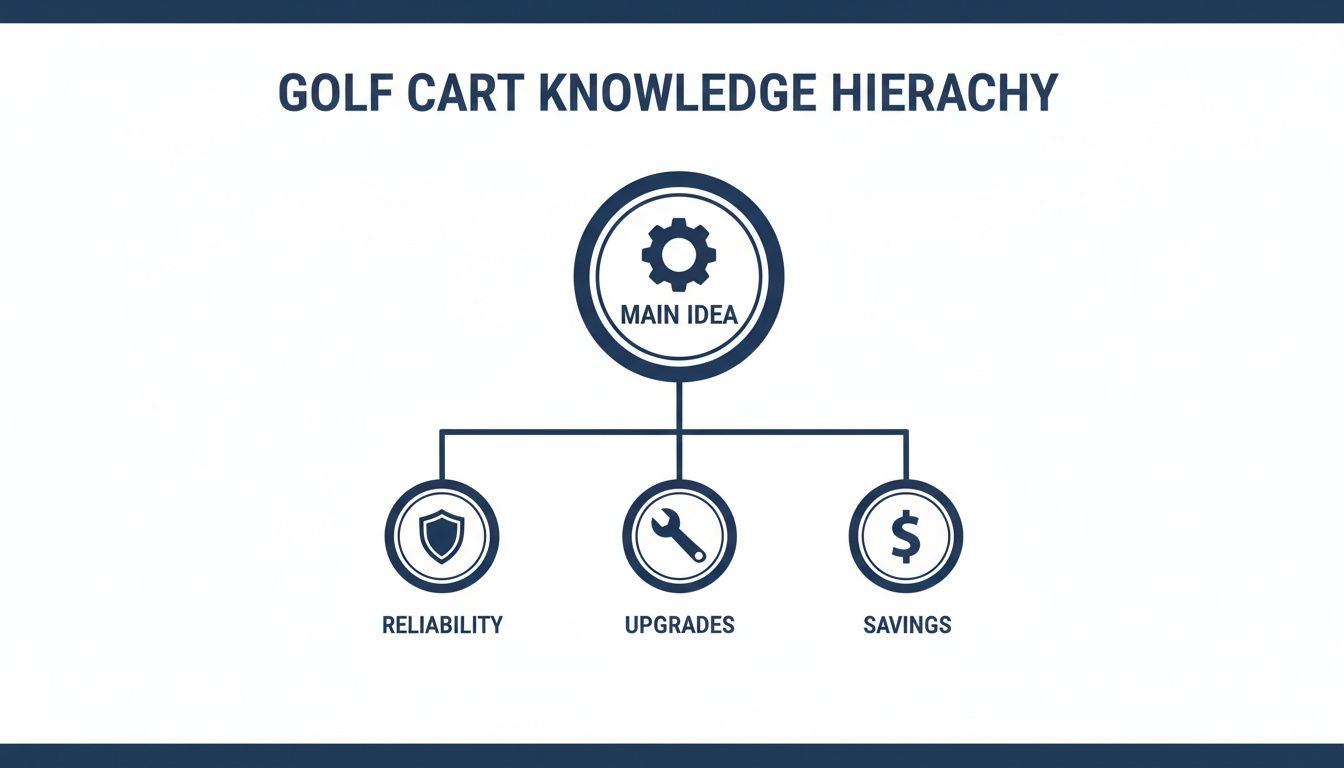
As you can see, a solid understanding is the root of effective ownership. It empowers you to make decisions that boost performance and head off those expensive, unexpected breakdowns.
To break it down even further, here's a quick look at the core parts within each system and what they do.
Key Golf Cart Systems and Their Core Parts
| System | Key Parts | Primary Function |
|---|---|---|
| Electrical | Battery, Controller, Solenoid, Motor | Stores, regulates, and delivers power to create motion. |
| Drivetrain | Transaxle, Clutch, Drive Shafts | Transfers power from the motor or engine to the wheels. |
| Chassis & Suspension | Frame, Shock Absorbers, Leaf Springs, Tires | Provides structural support and absorbs bumps for a stable ride. |
Now, let's dig into what makes each of these systems tick.
The Electrical System: The Nerves of Your Cart
The electrical system is the command center, especially for electric models. It’s way more than just the battery; it’s a whole network of parts that store, manage, and send power exactly where it needs to go. A healthy electrical system is non-negotiable for consistent performance.
Think of the controller as the brain. When you press the accelerator, it gets the signal and tells the motor precisely how much juice to pull from the batteries.
The solenoid, on the other hand, is like a heavy-duty switch—or the system's heartbeat. It handles the massive electrical current that the controller can't, making that classic "click" you hear just before the cart lurches forward.
And finally, the motor is what turns all that electrical energy into actual mechanical force. Common signs of electrical trouble include sluggish acceleration, a cart that won't move at all, or that dead silence when you expect to hear the solenoid click. For a deeper dive into the most vital component, check out our complete guide to the battery golf cart system.
The Drivetrain: The Muscle That Moves You
If the electrical system is the brain, the drivetrain is the brawn. This system grabs the power generated by the motor (or engine, in a gas cart) and gets it to the wheels to create motion. It’s where raw energy becomes real-world speed and torque.
Key components here include:
- Transaxle: This clever unit combines the axle and transmission, managing gear ratios and pushing power to the drive wheels. If you hear grinding or the cart struggles to move, the transaxle is a good place to look.
- Clutch (Gas Carts): This connects and disconnects the engine from the drivetrain, which is what allows the cart to idle and then accelerate smoothly.
- Drive Shafts: These are the rods that physically connect the transaxle to the wheels, turning them to propel the cart.
A well-maintained drivetrain ensures power gets from point A to point B efficiently, giving you a smooth, responsive ride. Letting it go can lead to power loss and, eventually, major mechanical failures.
Chassis and Suspension: The Skeleton and Joints
The chassis is the cart's backbone—the foundational frame that everything else bolts onto. Paired with the suspension system, it forms the skeleton that supports the whole vehicle and soaks up all the bumps and jolts from the terrain.
The suspension's main job is to keep the tires glued to the ground for maximum grip while giving you a stable, comfortable ride. Important golf cart parts in this system include:
- Shock Absorbers: These dampen vibrations, stopping the cart from bouncing all over the place on uneven ground.
- Leaf Springs: These flexible arches support the cart's weight and absorb big impacts from potholes or fairway bumps.
- Tires: As your cart's only connection to the ground, tires are absolutely critical for traction, handling, and safety.
A worn-out suspension leads to a rough, unstable ride and can even cause other parts to wear out faster from all the shaking. This is why reliable performance parts are in such high demand. The global golf cart market was valued at around USD 2.0 billion and is projected to climb to USD 3.3 billion by 2032-2034.
This growth is fueled by electric models, which are expected to create an extra USD 1,097.1 million in opportunities. For owners, this means better access to high-demand parts like advanced lithium-ion batteries, which are becoming standard for both riding carts and push-cart assists like the Caddie Wheel.
Choosing the Right Parts for Your Cart
Picking the wrong golf cart part is more than just a minor hiccup—it's a frustrating and often expensive mistake. We've all been there. Getting it right the first time saves you a ton of time, money, and the headache of a second trip to the shop or an online return.
The whole process really boils down to two key things: figuring out your cart’s specific identity and understanding the difference between OEM and aftermarket parts.
Think of it like getting an oil change for your car. You can use the manufacturer's official filter or a third-party brand. Both can get the job done, but they come with different guarantees, price tags, and performance expectations. Making the right call depends entirely on your budget, what part you actually need, and how much you value a perfect, no-fuss fit.
OEM vs. Aftermarket Parts
The first big choice you'll have to make is whether to buy an OEM (Original Equipment Manufacturer) part or an aftermarket one.
OEM parts are made by the same company that built your golf cart—think Club Car, E-Z-GO, or Yamaha. They are, for all intents and purposes, a direct, factory-spec replacement for what was on your cart when it rolled off the assembly line.
Aftermarket parts, on the other hand, are produced by third-party companies. They're designed to function as a replacement for the original but aren't made by the cart's manufacturer. This market is huge, and it thrives on offering variety and competitive pricing.
To make the best decision for your situation, here’s what you need to weigh:
- Guaranteed Fit: OEM parts are guaranteed to fit and function exactly like the original. There's no guesswork, which is a massive relief for complex electrical or drivetrain components.
- Cost Savings: Aftermarket parts are almost always easier on the wallet. For common wear-and-tear items like tires, mirrors, or light kits, this can add up to some serious savings.
- Quality and Warranty: OEM parts come with the manufacturer's quality assurance and warranty. While many reputable aftermarket brands also offer warranties, the quality can vary wildly from one company to the next.
- Availability and Variety: The aftermarket offers a much broader selection, especially for custom or cosmetic upgrades. If you're hunting for unique wheels or a custom seat cover, the aftermarket is where you'll find it.
Pro Tip: A smart strategy many cart owners use is to stick with OEM parts for critical, performance-defining components like motor controllers or transaxles. For accessories and non-critical items, high-quality aftermarket options provide excellent value without compromising safety or performance.
Your Cart’s Unique ID
Before you can buy any part—OEM or aftermarket—you have to know your cart's exact identity. Golf cart models change subtly from year to year, and a part designed for a 2015 model might not fit a 2016. The key to unlocking perfect compatibility is finding your cart's serial number.
This number is your golden ticket. It tells a parts dealer everything they need to know: the make, model, year of manufacture, and sometimes even the specific trim package.
So, where can you find it? It's usually in one of these spots:
- Club Car: Look for a sticker inside the glove compartment on the passenger side or on the frame just below it.
- E-Z-GO: Check the passenger-side glove box or look on the frame under the driver's seat.
- Yamaha: The serial number is often found under the rear bumper on the frame or tucked inside the glove compartment.
Once you have this number, you can confidently shop for golf cart parts knowing they will fit your vehicle perfectly.
Upgrading with Universal-Fit Solutions
Beyond direct replacements, the world of golf cart parts also includes some really smart upgrades designed for broad compatibility. These parts can add modern functionality to an older cart or even a standard piece of equipment, completely changing how you use it.
A perfect example of this is motorizing a standard push cart. Instead of buying an entirely new electric caddie, you can use a universal-fit system like the Caddie Wheel. This type of product is engineered to attach to a huge variety of existing push cart frames, adding electric-assist power with a super simple installation.
It just goes to show that you can gain significant new features without having to start from scratch. Whether you need specific replacements or you're looking for a clever upgrade, you can find a variety of golf cart parts to fit almost any need. This approach lets you enhance what you already own, saving money while boosting performance on the course.
A Practical Guide to Installation and Maintenance
Alright, it’s time to get your hands dirty. Having the right golf cart parts is just half the battle. Knowing how to install them safely and keep your cart humming for the long haul is where you really take control of your investment.
This section is all about actionable advice to empower you, starting with the most important rule of them all.

Before you even think about touching a wire or loosening a bolt, safety comes first. The absolute, non-negotiable first step for any electrical work is to disconnect the battery. This one simple move prevents short circuits that can fry sensitive components like your controller or—far more importantly—cause serious injury.
Think of it like shutting off the main water valve before you start fixing a leaky pipe. It's a foundational step that makes the whole process safe and predictable. Once that power is cut, you're ready to get to work.
A Universal Installation Process
While every part has its own quirks, there’s a universal approach you can apply to most installation jobs, whether you're swapping out a headlight or replacing a solenoid. Sticking to a consistent process cuts down on mistakes and gives you a professional result every time.
Here's a simple, five-step framework that works for most part installations:
- Prepare Your Workspace: Get all your tools, the new part, and any screws or bolts ready. A clean, well-lit space makes everything easier and safer.
- Disconnect the Power: Like we said, always disconnect the negative terminal of your battery pack first. No exceptions.
- Remove the Old Part: Before you start yanking things out, take a quick photo with your phone. This gives you a perfect visual reference for how everything should be wired and connected when you install the new part.
- Install the New Part: Secure the new component in place, then carefully reconnect any wires or linkages exactly as they were. This is where that reference photo you took becomes a lifesaver.
- Reconnect and Test: Reconnect the battery (this time, do the positive terminal first, then the negative) and test the new part to make sure it’s working as it should.
This methodical approach applies to nearly all golf cart parts and turns what could be a confusing task into a totally manageable project.
Your Preventative Maintenance Checklist
The secret to dodging expensive repairs isn't about being a master mechanic—it's about consistent, simple preventative maintenance. A few minutes of inspection each month can head off an estimated 90% of common failures, keeping you on the course instead of stuck in the garage.
A proactive maintenance schedule is your cart’s long-term health plan. It's the difference between catching a loose wire and being stranded with a dead cart halfway through the back nine.
This checklist hits the essentials that make the biggest difference:
- Battery Terminals: Look for corrosion—that fuzzy, whitish-blue gunk—and make sure all connections are snug. A quick scrub with a wire brush and a baking soda/water mix will ensure a solid electrical flow.
- Tire Pressure: Grab a gauge and check that all your tires are inflated to the manufacturer’s recommended PSI, which you can usually find on the tire’s sidewall. The wrong pressure causes uneven wear and messes with your cart's handling.
- Brake Inspection: Give the brake cables a visual check for any fraying and test how the brake pedal feels. It should be firm, not spongy.
- Lights and Indicators: Do a quick walk-around and test your headlights, taillights, and turn signals. It only takes a second and is a huge safety check.
Sometimes, looking at how other vehicles are maintained can give you a fresh perspective. For example, learning some practical maintenance tips for vehicle components like trailers can offer useful ideas on caring for tires, wiring, and structural parts that apply to your cart, too.
By sticking to these simple installation and maintenance habits, you'll extend the life of your golf cart, make it far more reliable, and save a ton of money over time.
Troubleshooting Common Part Failures
So, your golf cart is acting up. That sudden, dead silence when you hit the pedal, or that brand-new grinding noise—it can be a little intimidating. The big question is always the same: "Where do I even start?"
Don't worry. This isn't a mechanic's manual. It's a simple diagnostic roadmap for owners, designed to help you pinpoint the problem without getting overwhelmed.
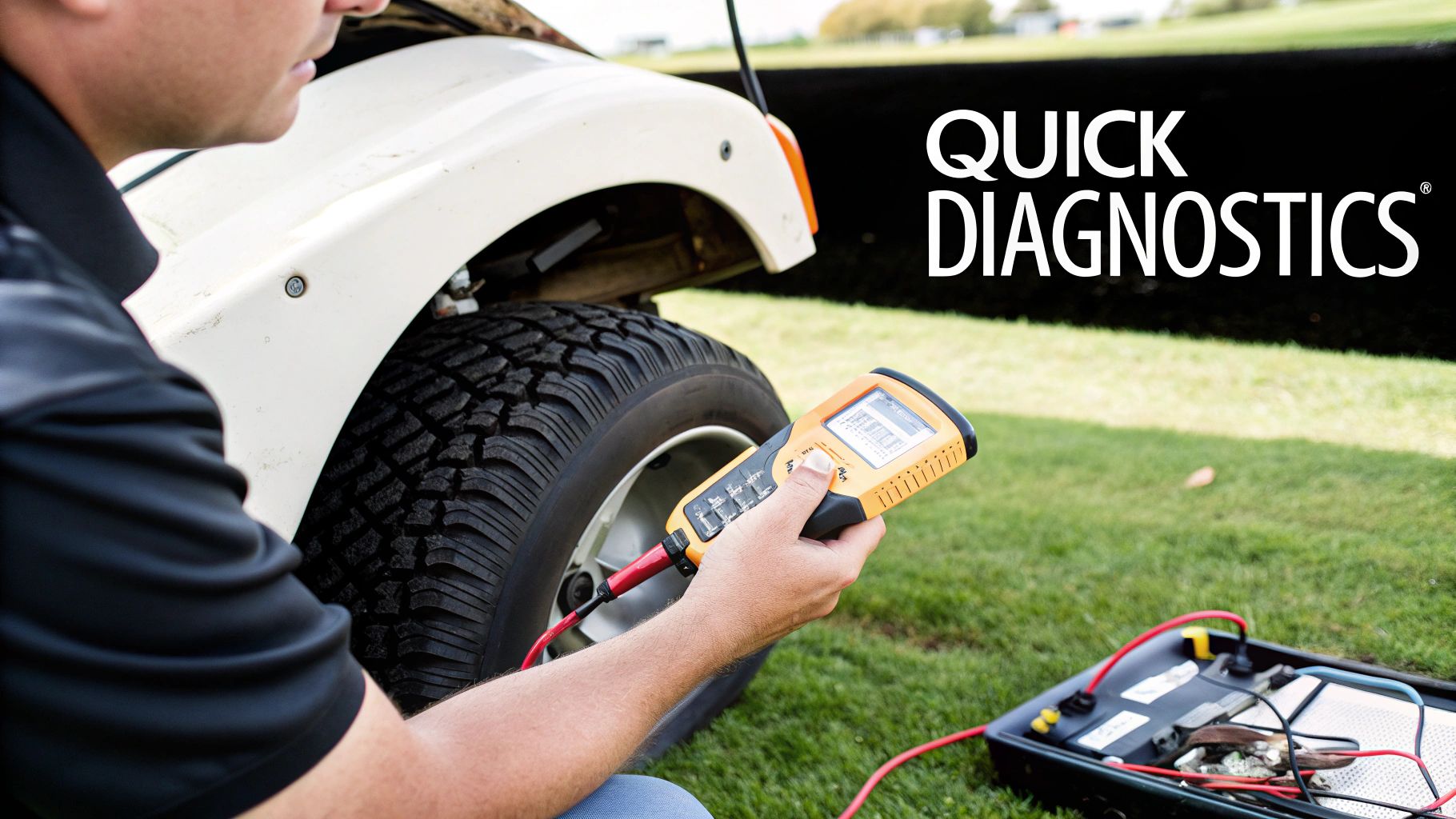
We're going to tackle this by looking at the symptoms first. By figuring out what the cart is doing (or not doing), you can quickly narrow down the list of potential culprits. This builds your confidence and might just save you a costly trip to the repair shop for a simple fix.
Your Cart Won't Start at All
You turn the key, press the accelerator, and… nothing. No click, no hum, just silence. This is one of the most common headaches for any cart owner, but it almost always points to an issue right at the start of the electrical power path.
Before you start worrying, run through this quick checklist:
- Check the Obvious First: Is the cart switched to "Run"? Is the charger completely unplugged? You’d be surprised how often it's something this simple.
- Look at the Battery Connections: Pop the seat and take a peek at the main battery terminals. Are they snug? Do you see any fuzzy white or blue corrosion? A bad connection is like a locked gate—electricity can't get through.
- Listen for the Solenoid "Click": When you press the pedal, you should hear a clear "click" from the solenoid. If you hear nothing, the solenoid itself might be dead, or the signal telling it to activate isn't getting there.
- Inspect the Key Switch and Fuses: A faulty key switch can stop power in its tracks. Carts also have fuses that can blow and cut off the power completely. For a deeper dive, check out our helpful guide on finding and testing your golf cart fuses.
If you hear that "click" but the cart still refuses to move, the problem is likely further down the line—maybe the motor or controller. But if there’s no click, your problem is almost certainly one of these initial components.
Your Cart Feels Sluggish or Is Losing Power
It moves, but it feels weak. It struggles to climb hills or dies way faster than it used to. This is the classic symptom of a power problem, and it usually points straight to the heart of your electrical system: the batteries and the parts that control their output.
Start at the source. Grab a multimeter and check the voltage of the entire battery pack, then test each battery individually. Just one bad battery can drag down the performance of the whole set.
A healthy, fully charged 36-volt system should read just over 36 volts, while a 48-volt system should be a little above 48. If you see a big voltage drop when you press the accelerator, that's a huge red flag that your batteries are on their last legs.
If the batteries seem fine, the next parts to check are the motor controller (the cart's brain) or worn-out motor brushes. A failing controller might not be sending enough juice to the motor, leading to that frustratingly sluggish ride.
You Hear a Grinding or Whining Noise When Moving
Strange noises are your cart's way of screaming for help, and they almost always signal a mechanical issue. A grinding or high-pitched whine that gets louder as you speed up usually comes from the drivetrain—the parts that get power to the wheels.
The most common culprit here is the transaxle or differential. First things first, check the fluid level. Low or dirty gear oil will cause parts to grind together. If the fluid looks good, the noise could be a sign of worn bearings or gears inside the transaxle, which is a more serious repair. Another possibility is failing motor bearings, which can make a similar whining sound.
Common Golf Cart Problems and Potential Part Causes
When you’re not sure where to begin, a quick reference chart can be a lifesaver. Use this table to connect the symptom your cart is showing with the most likely parts that need a closer look.
| Symptom | Potential Part to Check First | Secondary Parts to Inspect |
|---|---|---|
| No Power, No Click | Battery Terminals & Main Fuse | Key Switch, Solenoid, Pedal Microswitch |
| Solenoid Clicks, No Movement | Motor Controller | Motor Brushes, High-Amperage Cables |
| Sluggish Performance | Batteries (check voltage under load) | Motor Controller, Motor Brushes, Tire Pressure |
| Short Run Time | Batteries (bad cell or overall age) | Battery Charger, Corroded Cables |
| Grinding or Whining Noise | Transaxle/Differential Fluid Level | Motor Bearings, Wheel Bearings, Input Shaft |
| Jerky Acceleration | Potentiometer (throttle sensor) | Motor Controller, Solenoid |
This table should help you narrow down the suspects quickly, so you can focus your efforts on the right components instead of guessing.
The golf cart market in North America is massive, making up 95% of global revenue. With around 70% of carts being electric, there's a huge demand for quality parts like advanced lithium-ion batteries and durable wheels that can handle all sorts of terrain. You can learn more about the golf cart market and its growth on gminsights.com.
Common Questions About Golf Cart Parts
When you're trying to fix a problem or plan an upgrade, it's natural to have a few questions. The world of golf cart parts can be a bit confusing at first, but a little know-how goes a long way. Let's tackle some of the most common questions we hear from owners just like you.
Think of this as your cheat sheet for making smarter decisions about your cart. Whether you're stuck on the side of a path or dreaming up your next custom build, the right information makes all the difference.
What Parts Will I Be Replacing Most Often?
Just like your car, certain parts on your golf cart are designed to wear out with use. Knowing what they are ahead of time helps you budget for maintenance and spot trouble before it leaves you stranded.
Your two most frequent replacements will be batteries and tires. No surprise there. Batteries have a limited number of charge cycles and typically last three to seven years, depending on the type and how well you treat them. Tires wear down with every trip on the pavement or fairway.
Beyond those usual suspects, you’ll also run into:
- For Gas Carts: Keep an eye on spark plugs, drive belts, and filters (both fuel and air). These are regular maintenance items that are crucial for a smooth-running engine.
- For Electric Carts: The solenoid is a common culprit. It's the heavy-duty switch that delivers the juice to your motor, and it takes a lot of abuse. Motor brushes can also wear down, causing sluggish performance.
- For All Carts: Brake shoes and cables are non-negotiable safety items. They wear down over time and need regular checks to ensure you can stop when you need to.
Should I Go With OEM or Aftermarket Parts?
This is the classic debate every cart owner has. The right answer really comes down to your budget and which specific part you're replacing. You're essentially choosing between a guaranteed fit and potential savings.
OEM (Original Equipment Manufacturer) parts are made by your cart’s brand—think Club Car, E-Z-GO, or Yamaha. They promise a perfect, factory-spec fit but almost always come with a higher price tag. On the other hand, aftermarket parts from third-party companies offer way more variety and are much easier on the wallet.
Here's a solid rule of thumb: Stick with OEM for mission-critical electronic or drivetrain components. We’re talking motor controllers, transaxles, or anything where a perfect fit is non-negotiable. For accessories like lights, mirrors, tires, and cosmetic bits, high-quality aftermarket parts deliver fantastic value.
No matter which way you lean, always buy from a trusted dealer. A quality component from a reputable source is always the smart play.
How Can I Add a Motor to My Push Cart?
You don't have to shell out for a brand-new electric caddie to get a powered boost on the course. You can easily motorize the push cart you already love with an electric-assist wheel kit—a brilliant example of a modern retrofit part.
These kits are built for simple, DIY installation. The whole process usually just involves clamping a lightweight, motorized wheel onto your cart’s frame with a simple bracket. Most people have it done in just a few minutes.
A good kit will come with everything you need: a long-lasting battery and a remote control that puts forward, reverse, and braking power right in your hand. It's a seriously cost-effective way to get all the perks of an electric caddie while saving hundreds of dollars.
What’s the Secret to Making My Golf Cart Batteries Last Longer?
Good maintenance is everything. Your batteries are the single most expensive component on your cart, so taking care of them pays off big time. A few simple habits can easily add years to their life and save you a massive replacement bill.
First off, always use the right charger for your specific battery type, whether it’s a traditional lead-acid set or a modern lithium-ion pack. A mismatched charger is a fast way to cause permanent damage.
Here are a few other must-do tips for battery longevity:
- Charge After Every Use: Don't wait. Plug your cart in and get it back to a full charge after every single outing. Letting batteries sit in a discharged state is one of the worst things you can do.
- Keep the Terminals Clean: Pop the seat and check the terminals for corrosion. That crusty white or blue buildup chokes off the flow of electricity. Clean it off with a wire brush and a simple paste of baking soda and water.
- Check Water Levels (Lead-Acid Only): If you have lead-acid batteries, you need to check the water levels in each cell every month or so. When they get low, top them off with distilled water only. Never use tap water—its minerals will destroy the battery plates over time.
- Store It Smart: Your batteries hate extreme heat and cold. Storing your cart in a temperate, dry place like a garage helps preserve their health and performance.
Ready to make walking the course effortless? The Caddie Wheel offers a simple, powerful electric-assist upgrade for your existing push cart, letting you conquer hills and play more holes without fatigue.
Learn more about the Caddie Wheel and motorize your round today!
Partager:
A Golfer's Guide to Choosing the Right Golf Cart Wheels
The Ultimate Guide to Four Wheel Golf Push Carts