
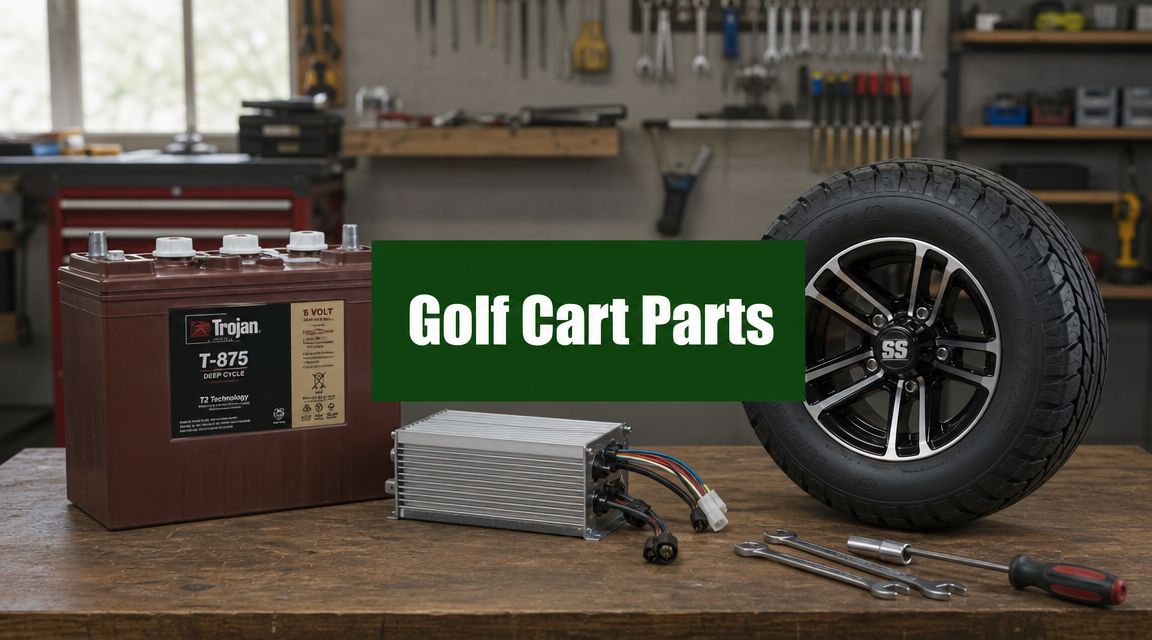
A lot of people start looking for golf cart parts in the USA the same way. The cart slows down on a hill, the charger acts strange, a tire goes soft again, or a steering component starts clunking, and suddenly a simple Saturday fix turns into a fitment puzzle.
That's where most buyers get tripped up. The hard part usually isn't finding a part. It's figuring out whether the part is right for your exact cart, whether aftermarket is a bargain or a headache, and whether the cheapest fix today will create a bigger repair next season.
Your Guide to the American Golf Cart Parts Market
If you're shopping for golf cart parts USA suppliers, you're buying into a very large and very active market, not a tiny niche. The U.S. is the dominant market for golf cart accessories, representing about 91% of North America's golf cart accessories revenue in 2025, or roughly USD 299.2 million out of a USD 428.7 million global market, and that market is projected to reach USD 884.4 million by 2035 according to GM Insights golf accessories market data.
That matters for one reason. A big market gives you options, but it also floods the search results with broad claims, mixed-quality listings, and parts that look interchangeable when they aren't.
In practice, most buyers fall into one of three situations:
- Break-fix repair: Your cart won't run right, and you need the failed component fast.
- Planned maintenance: You're replacing wear items before they strand you.
- Upgrade work: You want better range, stronger hill performance, more comfort, or a cleaner look.
Each situation calls for a different buying mindset. Emergency repairs favor correct fitment and fast delivery. Maintenance work rewards careful parts matching. Upgrades require system thinking, because one new part can expose weakness somewhere else.
Practical rule: Buy parts in the same order the cart depends on them. Power, steering, braking, and rolling components come before cosmetic upgrades.
That's also why catalog shopping alone usually isn't enough. The better approach is to treat the cart as a machine with linked systems, then buy parts based on fitment, load, use case, and long-term cost. That's how you avoid installing a shiny new component while the actual failure point stays hidden underneath.
Understanding Key Golf Cart Part Categories
A golf cart looks simple from the outside, but the parts that matter most usually sit in a few connected systems. If you understand those systems, shopping gets easier and troubleshooting gets faster.

Power and drive parts
Start with the components that make the cart move. On electric carts, the battery subsystem is the heart of the vehicle. It supplies propulsion energy, and battery chemistry, charger compatibility, and voltage architecture are the first things to verify before you buy replacement electrical parts. Aftermarket catalogs commonly support both 36V and 48V systems, so voltage matching is not optional. A mismatched charger can undercharge or overstress the pack, and that shortens service life while hurting day-to-day performance, as explained in A Quality Parts Co.'s breakdown of key golf cart components.
The next critical piece is the controller. Think of it as the traffic manager between battery and motor. If the controller is failing, the cart may hesitate, surge, lose climbing strength, or feel weak under load. A controller problem can also look like a battery problem, which is why careless parts swapping gets expensive.
Then there's the motor itself. Motors don't always fail first, but when they do, symptoms often include heat, reduced pulling power, or rough operation under repeated load. Before condemning the motor, check the parts feeding it. Battery health, cables, and controller output all affect how the motor behaves.
Rolling and ride components
Tires and suspension parts tell you a lot about how the cart is used. The highest-frequency replacement categories in the golf-cart parts ecosystem are tires, batteries, controllers, shocks, battery cables, and tune-up kits, which makes sense because those parts directly affect uptime, range, and ride quality according to Golf Cart Tire Supply's overview of golf cart parts.
Tires seem basic, but they change more than appearance. Tire size, tread, and wheel setup affect steering feel, clearance, speed behavior, and fitment under the body. A larger wheel and tire package may look great, but it can create rubbing issues if the cart isn't built for it.
Shocks, springs, and front-end hardware are where comfort meets control. If the cart bounces, wanders, dives on braking, or feels unsettled with passengers, the suspension deserves a closer look. On older carts, worn steering and suspension parts often stack together, so replacing only one item may improve the symptom without fully fixing the problem.
For a broader parts overview, this golf cart parts guide from Caddie Wheel is a useful starting point.
Structure, controls, and small parts that cause big headaches
Body panels, seat bases, roofs, windshields, lights, switches, brake components, and wiring don't get the same attention as batteries and motors, but they're often what turns a simple install into a return.
A cracked switch panel might seem minor until it leaves wiring loose. A poor-quality light harness can create electrical gremlins. A cheap body trim piece that almost fits can force drilling, tension, and vibration that eventually breaks mounting points.
Here's the simple way to think about categories:
| System | What to watch | Common buying mistake |
|---|---|---|
| Electrical | battery, charger, controller, cables | buying by brand only, not voltage or connector style |
| Drive | motor, transaxle, pedal components | replacing the visible part before testing the upstream cause |
| Steering and suspension | shocks, tie rods, bushings, hubs | ignoring wheel and tire changes that altered geometry |
| Body and trim | panels, seats, windshields, lights | assuming “universal” means bolt-on with no modification |
A golf cart is not a frame with wheels. It's an electro-mechanical system. If one power part degrades, the neighboring parts usually work harder.
That's the key distinction between a replacement and an upgrade. A replacement restores expected function. An upgrade changes the cart's demands. If you add larger tires, more load, different battery chemistry, or stronger acceleration, you should think through what else in the system needs to keep up.
OEM vs Aftermarket Parts A Crucial Decision
The OEM versus aftermarket decision gets framed as price first. That's usually the wrong way to look at it.
The better question is this. Which option gives you the lowest pain over the life of the repair? That includes fitment, service life, warranty support, install time, downtime, and the risk of damaging neighboring parts.

When OEM earns its higher price
OEM parts make the most sense when the cart is sensitive to exact specs. Controllers, model-specific electrical components, steering hardware, brake parts, and fit-critical body pieces usually fall into this category.
If a part has to plug in cleanly, communicate correctly, or match factory dimensions without guesswork, OEM often saves time and frustration. You pay more up front, but you reduce the odds of a no-start condition, repeat labor, or a return because the mounting points don't line up.
That peace of mind matters most when the cart is a daily-use vehicle around property, a fleet cart, or something you can't afford to have down.
When aftermarket is the smarter buy
Aftermarket parts make sense when you want more choice, more customization, or better availability. They're often a solid option for wheels, tires, seats, light kits, cosmetic trim, and many maintenance items, provided the seller gives clear fitment information.
Performance upgrades also live heavily in the aftermarket world. That's where you'll find alternate battery options, custom body parts, and appearance packages that OEM catalogs don't offer.
The catch is variation. One aftermarket brand may fit and last well. Another may use weaker materials, looser tolerances, or poor hardware. Product photos don't tell you that.
Buy by consequence, not by sticker price
Many golf cart owners are really managing lifecycle economics, not just a shopping cart total. The practical reality is that the cheapest part can become the most expensive choice if it increases downtime or shortens the life of nearby components, a point highlighted by Buggies Unlimited's parts and maintenance perspective.
Use this framework:
- Choose OEM for critical systems: brake parts, steering parts, exact-match electrical components, and anything where a bad fit creates a safety issue.
- Choose aftermarket for sensible upgrades: lights, seating, trim, cargo accessories, and selected performance parts from brands with clear compatibility details.
- Avoid bargain-bin electrical parts: especially chargers, controllers, and major wiring pieces where low quality creates hidden failures.
- Mixing is fine if you're deliberate: many reliable carts run a combination of OEM core parts and aftermarket accessories.
Don't ask whether OEM or aftermarket is better in general. Ask which choice creates fewer problems for this exact repair.
A cheap seat kit that needs minor adjustment may be acceptable. A cheap controller that stresses the battery pack is not.
Ensuring Perfect Fitment and Compatibility
Most returns happen before the box is even opened. The buyer searched by brand, saw a part labeled for Club Car, E-Z-GO, or Yamaha, and assumed that was enough. It usually isn't.
Golf cart parts are not universal. Even within the same brand, parts can vary by model generation, lift kit, wheel setup, and whether the cart is gas or electric, which is why fitment clarity is such a common problem for DIY buyers, as seen in 10L0L's golf cart accessories catalog structure.

The information to gather before you shop
Before you order anything, write down the cart's identifying details. Don't rely on memory and don't trust what the previous owner told you.
Have these ready:
- Brand and model: Club Car, E-Z-GO, Yamaha, or another make, plus the actual model family.
- Model year or serial range: a key factor for numerous fitment distinctions.
- Powertrain type: gas or electric.
- Voltage system for electric carts: confirm whether you're working on a 36V or 48V setup.
- Known modifications: lift kit, wheel size change, body kit, seat conversion, light kit, or battery conversion.
- Existing part number: if the old part still has a readable tag, label, or stamping.
A cart with factory wheels may take one tire size and offset cleanly. The same cart with a lift kit and aftermarket wheels may need a completely different decision on tires, hubs, or fender clearance.
The checks that prevent bad orders
Once you know the cart, compare the part listing against the actual machine. Don't stop at the product title.
Use this quick fitment routine:
- Match the exact cart family first. “Fits Yamaha” isn't enough.
- Read the exclusions. Sellers often hide the most important details there.
- Check connector style and mount shape. Electrical parts and body pieces fail here all the time.
- Measure the old part. Bolt spacing, width, tire size, cable length, and shaft size settle arguments fast.
- Factor in modifications. Lifted carts and converted carts break many “standard fit” assumptions.
Here's a useful visual walk-through before you order model-specific parts:
Fitment mistakes that keep showing up
Some mistakes are so common they're worth memorizing.
- Electrical mismatch: Buyers order by brand and ignore voltage, charger spec, or cable end style.
- Wheel and tire guesswork: They assume a listed combo will clear the body without checking lift, offset, and current ride height.
- Gas versus electric confusion: Same brand, same basic look, completely different supporting parts.
- Year-range oversights: Mid-generation changes can affect mounting, wiring, and hardware even when the cart looks nearly identical.
If a listing doesn't clearly tell you what models, years, and powertrains it fits, treat that as a warning sign, not a minor inconvenience.
Good fitment shopping is slow for ten minutes and fast for the rest of the project.
Where to Buy Golf Cart Parts in the USA
Where you buy matters almost as much as what you buy. Different channels solve different problems, and the wrong buying channel can cost you more than a bad part.
Authorized dealers
Authorized dealers are the safest place to buy when you need OEM parts, exact factory compatibility, or guidance on a model-specific repair. They're also useful when your cart still follows a mostly stock setup.
The trade-off is predictable. Selection may be narrower for custom upgrades, and pricing is usually less forgiving than what you'll see from online specialists.
Dealers are best for:
- Exact-match parts: factory electrical pieces, steering components, brake hardware
- Warranty-sensitive purchases: situations where documentation and support matter
- Buyers who need confirmation: especially if you're unsure about the model split
Online specialty suppliers
Specialty suppliers are often the sweet spot for golf cart parts USA shoppers. They usually understand the category better than general marketplaces, and they carry a wider mix of OEM-style replacements, aftermarket upgrades, and niche accessories.
The strongest ones also provide better fitment notes, serial guidance, and product-level detail. That reduces returns and makes mixed carts easier to support, especially if your cart already has upgrades.
If you're comparing sellers, this roundup of golf cart accessories retailers in 2025 can help you sort through the main options.
Marketplaces and auction sites
Amazon, eBay, and similar marketplaces can work well for basic consumables, common hardware, and some accessories. They're convenient, prices are easy to compare, and shipping can be fast.
But listing quality most often fails in these aspects. Titles get stuffed with every brand name under the sun, compatibility gets oversimplified, and returns eat up any savings if the part is wrong.
Use marketplaces for lower-risk purchases:
- Simple accessories: cup holders, mirrors, seat covers, trim pieces
- Commodity items: some hardware, basic switches, non-critical cosmetic items
- Repeat purchases: parts you've already installed successfully before
Avoid them for fit-critical or safety-critical components unless the listing is unusually detailed.
Local repair shops and cart builders
Independent shops are underrated. A good local shop has seen common failures on your exact platform, knows what fits properly in practice, and can spot previous-owner modifications that online catalogs miss.
They're especially helpful for carts with mixed histories. If your cart has aftermarket batteries, non-stock wheels, front-end changes, or patched wiring, a local expert can save hours of wrong-part guessing.
| Buying channel | Best for | Main drawback |
|---|---|---|
| Authorized dealer | OEM certainty, support | higher cost, less customization |
| Online specialist | broad selection, category expertise | shipping delays can matter on urgent repairs |
| Marketplace | convenience, basic accessories | weak fitment clarity |
| Local shop | diagnosis and real-world compatibility | inventory may be limited |
The right answer depends on urgency. If the cart is down and the part is mission critical, support and fitment usually matter more than squeezing out the last few dollars.
Installation Maintenance and Troubleshooting
A good part can still fail early if the install is sloppy. Most golf cart repair problems after a parts purchase come from three things: loose connections, skipped inspections, or replacing the symptom instead of the cause.
Install it clean or don't install it yet
Before any install, disconnect power appropriately and take photos of the original setup. That sounds basic, but it saves people constantly on wiring, cable routing, and bracket orientation.
Keep your bench setup simple:
- Hand tools that fit correctly: rounded hardware starts with the wrong socket or wrench
- Torque awareness: overtightening cracks housings and strips threads
- Clean contact points: corrosion or paint under a connection can create voltage drop
- Labeling habit: especially for wires, spacers, and hardware that look interchangeable
If you're installing electrical parts on an electric cart, remember the most important rule. The battery subsystem is the heart of the vehicle, so battery chemistry, charger type, and system voltage must match the cart's setup correctly. On these carts, getting the battery and charger pairing wrong hurts both performance and longevity, as covered in this DIY guide to electric golf cart repair.
A maintenance routine that actually prevents breakdowns
The best maintenance plan isn't complicated. It's consistent.
Check these on a regular basis:
- Battery area: look for swelling, corrosion, heat signs, loose hold-downs, and cable condition.
- Cables and terminals: resistance at bad connections steals power before you ever notice a dead component.
- Tires: inspect wear pattern, sidewall condition, and inflation consistency.
- Suspension and steering: listen for clunks, check for looseness, and watch for uneven tire wear.
- Brakes and controls: pay attention to pedal feel, stopping behavior, and linkage movement.
- Chargers and plugs: heat discoloration and loose connections are early warnings.
A cart that runs “just a little weaker” is often giving you an early warning, not an inconvenience.
One smart approach is to inspect by symptom chain. If the cart has poor range, don't jump straight to batteries. Check cable condition, charging behavior, connector fit, and whether the controller is making the battery work harder than it should.
Basic troubleshooting by symptom
When the cart acts up, start with the simplest likely causes first.
If the cart won't start Look at battery state, cable connections, main electrical connections, and obvious switch or control issues before replacing expensive components.
If the cart runs slow Suspect battery condition, cable resistance, charger mismatch, rolling resistance from tires, or a weakening controller before blaming the motor.
If the ride feels rough Inspect shocks, springs, tire condition, wheel hardware, and front-end play. A new tire won't fix worn suspension.
If steering feels vague Check front-end hardware, tie-rod areas, bushings, wheel bearings, and alignment-related wear points.
For walking golfers using electric assist on a push cart rather than a ride-on cart, a product like Caddie Wheel fits into a different category. It adds powered assistance to compatible three- and four-wheel push carts, so the fitment and maintenance questions are more about cart compatibility, bracket attachment, battery charging, and wheel installation than about ride-on cart drivetrains.
Your Complete Golf Cart Parts Buying Checklist
By the time you're ready to order, the right move is usually obvious if you slow the process down and run a final check. Most buying mistakes happen when people skip one detail because the listing “looks close enough.”
Use this list before you click buy.

Final pre-purchase checks
- Identify the cart exactly. Confirm brand, model family, year range, and whether it's gas or electric.
- Confirm the actual failed part. Don't replace a symptom if another component caused the failure.
- Choose OEM or aftermarket based on consequence. Safety-critical and fit-critical parts deserve a stricter standard than cosmetic upgrades.
- Verify compatibility against your real setup. Include lift kits, tire changes, electrical conversions, and other modifications.
- Check the listing for exclusions. Sellers often hide the most useful fitment details in the small print.
- Review shipping and returns. Heavy electrical components, large wheel packages, and special-order items can be harder to return.
- Match the seller to the job. Dealer for exact factory support, specialist for deeper selection, marketplace only when the risk is low.
The long-view decision
One part rarely lives alone. A battery choice affects charger behavior. Tire size affects ride and clearance. A controller choice can change how hard the pack and cables have to work.
That's why smart buying in the golf cart parts USA market comes down to three habits. Know the cart. Know the system. Know the consequence of getting it wrong.
Buy for the cart you actually own, not the one the listing seems to describe.
If you're looking for practical golf gear solutions beyond ride-on cart repairs, Caddie Wheel is worth a look. It focuses on electric power assist for standard golf push carts, along with parts and compatibility guidance, which can be useful if you want an easier walking round without moving to a full ride-on cart.
Partager:
Hippo Golf Cart: Upgrade Your Game in 2026
Golf Cart Windshield Accessories Buyer's Guide 2026