
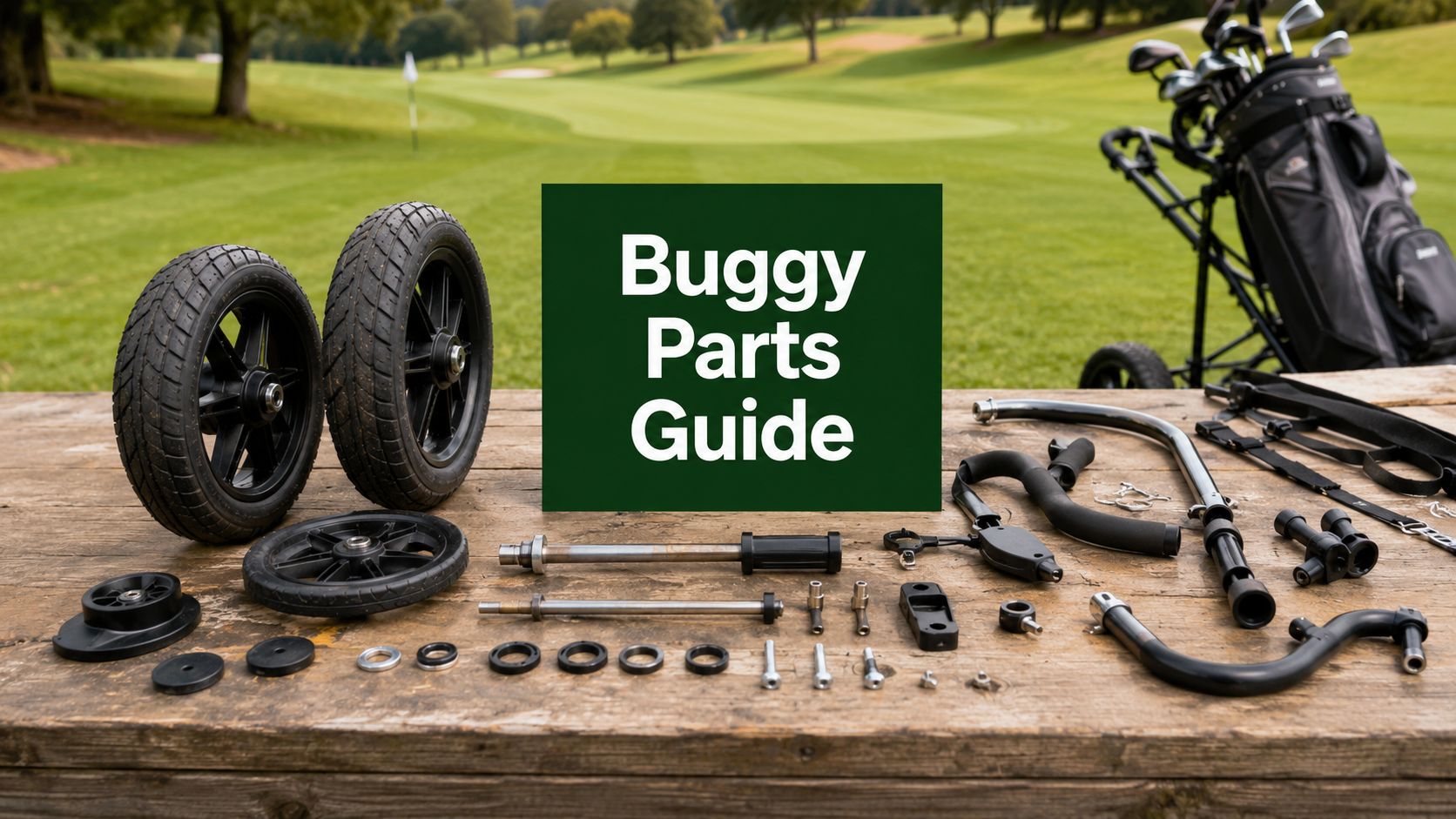
A buggy rarely fails in the garage. It fails when you're halfway through a round, the course is rolling, and one bad wheel, one dragging brake, or one cracked bracket turns a walk into a grind.
That's why buying parts for buggies by price alone is such a mistake. The part that looks fine in a product photo can fit poorly, wear fast, or damage the next component in line. A cheap brake shoe can become a hub problem. A wheel that's close enough on paper can throw off alignment. A battery upgrade can underperform or overload the electronics if the rest of the system isn't matched.
Good workshop habits fix that. Know what part you're looking at. Diagnose the actual failure, not the symptom. Buy for fit, material quality, and long-term reliability. That's how you keep a buggy rolling smoothly and avoid paying twice for the same repair.
Your Complete Guide to Golf Buggy Parts
A common workshop story goes like this. The buggy felt a little heavy for a few rounds, then one wheel started resisting on a slope, and by the back nine it was barely turning. Most golfers assume the wheel itself failed. Sometimes it did. Just as often, the actual issue sits deeper in the hub, the bearing, the brake adjustment, or the axle hardware.
That's the difference between a quick fix and a proper repair. If you only replace the most visible part, the buggy may roll again for a while, but the underlying problem stays in place. Then the new part wears out early and the owner blames the replacement, when the diagnosis was wrong from the start.
The market around push and pull golf equipment keeps expanding, which means golfers have more options than ever. The global push-pull golf cart market is projected to grow from USD 440 million in 2025 to USD 467 million in 2026, with a projected value of USD 855 million by 2036 at a 6.2% CAGR, according to Fact.MR's push-pull golf cart market forecast. More carts on courses means more replacement demand, more accessories, and more aftermarket parts competing for your money.
That sounds good until you start shopping. Search results are crowded with universal wheels, generic straps, replacement hubs, brake parts, folding latches, and motor conversion pieces. Some are solid. Some are made to hit a low price point and nothing else. If you're sorting through golf cart parts options and categories, you need a way to judge what's worth fitting and what isn't.
Practical rule: Don't buy the first part that matches the shape. Buy the part that matches the model, load, and use case.
A reliable buggy isn't complicated, but it is a system. Wheels, hubs, brakes, frame joints, handle hardware, and bag supports all work together. When one part gets sloppy, stressed, or misaligned, the rest of the cart has to compensate. That's when golfers start noticing wobble, drag, squeaks, poor tracking, and broken fittings.
Understanding the Core Components of Your Buggy
If you want to diagnose a buggy properly, do a slow walkaround the same way a mechanic checks a car. Start at ground level and move upward. Most faults show themselves in the wheel and brake area first, then at folding joints, then at the handle and bag supports.

Wheels and rolling hardware
Wheels take the full load of the bag, the frame, and every bump from paths and rough edges. If a buggy wanders, drags, or chatters, look here first. The usual suspects are worn bearings, bent axle hardware, damaged hub bores, or tires that no longer sit true.
Wheel sizing matters more than many golfers realize. Evolution Electric Vehicle's wheel dimension guide notes a typical width of 7 inches, with base models commonly using 8-inch wheels and upscale models reaching 12 inches. It also notes that standard suspensions are engineered to accommodate tires up to 18 inches, which is why wheel diameter should generally stay below 12 inches for compatibility and safety. In plain terms, bigger isn't automatically better. Go too far and you risk clearance issues, altered handling, and stress where the frame or motor mount wasn't designed to carry it.
A close inspection of the wheel hub assembly and related wear points often tells you more than the outside of the tire ever will.
Frame, joints, and handle assembly
The frame is the buggy's spine. If it flexes too much, everything else suffers. Folding joints, hinge pins, locking collars, and handle brackets are the first places to check for play. A buggy that folds nicely can still be structurally tired when loaded.
Materials matter here. If you're comparing replacement brackets, bushings, or custom-fabricated small parts, a resource on available manufacturing materials is useful for understanding why one polymer resists wear better while another alloy handles repeated load and vibration more cleanly. You don't need to be an engineer to benefit from that. You just need to know that material choice changes lifespan.
Brakes and bag-contact parts
Brake systems on push buggies are simple, but simple systems still fail. The lever or pedal actuates the mechanism. The cable or linkage transfers force. The pad, catch, or caliper does the stopping. If one area is misadjusted, the wheel may drag even when the brake seems released.
Then come the parts golfers often ignore until they snap. Upper bag brackets, lower supports, elastic straps, and clamp points don't just hold the bag still. They stop the load from shifting and twisting the frame on uneven ground.
Use this quick visual check before ordering anything:
- Wheel area: Spin each wheel unloaded. Listen for grinding, rubbing, or uneven resistance.
- Brake area: Engage and release the brake. Make sure the wheel locks firmly, then rolls fully free.
- Frame joints: Twist the handle lightly. Any side-to-side play usually means worn hardware or a tired hinge.
- Bag supports: Check for cracked plastic, stretched straps, or brackets that no longer hold the bag square.
How to Find and Source the Right Replacement Parts
The fastest way to waste money is to search for a part by description alone. “Golf buggy wheel,” “cart brake,” and “replacement strap” sound useful, but they're too broad. Good sourcing starts with identification, not shopping.
Start with the exact model
Look for the model name or generation on the frame, handle, axle area, or original paperwork. Spare parts are often organized around precise product families, not generic categories. JS Golf Brands' spare parts listings show this clearly with named models such as Clicgear 4.0, Clicgear 3.5, BagBoy Nitron, and BagBoy Volt Electric Trolley. This is how the repair market functions. The closer your match, the better the fit.
If you're shopping through a broader US-focused catalog, a dedicated guide to golf cart parts suppliers in the USA can help narrow where to look by model and category instead of guessing from photos.
Measure what matters
If the original part number is missing, measurements become your backup. Don't measure casually. Use a tape for larger dimensions and a caliper for axle diameters, bore sizes, bracket thickness, and fastener spacing.
What to record before you order:
- Model and generation if visible on the cart.
- Part location such as left wheel, upper bag bracket, brake cable, or folding latch.
- Key dimensions including diameter, width, hole spacing, axle bore, and mounting depth.
- Photos from multiple angles with one image showing the part installed.
- Failure type such as crack, wobble, stripped thread, drag, or missing piece.
Buy with a measurement in hand, not a hunch. “Looks about right” is how universal parts become return requests.
Choose channels that support fit and durability
Manufacturer parts and established dealers usually cost more than generic marketplace listings, but you're paying for fit control, known compatibility, and fewer surprises. That matters most for hubs, brake parts, wheel hardware, and folding mechanisms.
There's also a place for custom or hard-to-find solutions. If an older buggy has a discontinued plastic bracket or cover, on-demand production replacement parts can be worth exploring for non-critical components where exact replacement stock no longer exists. That route makes sense for covers, clips, or housings. It requires more caution for heavily loaded or high-wear parts.
A practical sourcing split looks like this:
| Part type | Best first option | Why |
|---|---|---|
| Hubs, brake parts, axles | OEM or established specialist dealer | Fit and load handling matter most |
| Wheels and tires | Model-specific replacement first | Universal options vary in bore and offset |
| Brackets and straps | OEM, then quality aftermarket | Simple parts still need proper geometry |
| Covers and cosmetic plastics | Aftermarket or custom production | Lower structural risk if dimensions are right |
Proactive Maintenance to Prevent Common Failures
Most buggy failures aren't sudden. The cart usually gives warning signs first. A little drag in the wheel. A brake that doesn't release cleanly. A folding joint that needs a harder push than it used to. Golfers ignore those signals because the buggy still works. Then one day it doesn't.
That's why maintenance is cheaper than replacement. Ten minutes in the garage beats diagnosing a seized wheel on the course.

The checks that prevent expensive damage
The brake and hub area deserves more attention than it usually gets. Community discussion has flagged improper brake adjustment and low-cost aftermarket parts as frequent suspected causes of premature hub failure, according to this Golf Carts Modified discussion. That lines up with what repair benches see all the time. A buggy owner replaces one cheap wear part, the fit or adjustment is off, and the strain migrates into the hub.
A smart routine looks like this:
- Clean the wheel and axle zone: Dirt, grass, and grit act like grinding paste around bearings and brake contact points.
- Check brake release: The wheel should spin freely when the brake is off. Any rubbing needs adjustment before the next round.
- Inspect hub play: Grab the wheel and rock it side to side. Movement where there shouldn't be movement means stop and inspect.
- Tighten frame hardware: Handles, brackets, and folding joints loosen gradually, especially after transport.
- Lubricate selectively: Use the right lubricant on moving joints and avoid contaminating brake surfaces.
What golfers usually miss
Brakes that are too tight don't always feel dramatic. Sometimes the cart just seems heavier than normal. That extra resistance creates heat and load where the wheel and hub should be rolling freely. The owner often notices the symptom at the wrong end of the problem and replaces the wheel first.
A dragging brake can masquerade as a bad bearing. Always confirm free wheel rotation before blaming the hub.
The same goes for cheap replacement parts. A low-cost part may install without a fight and still be wrong in practice. Poor friction material, rough finishing, loose tolerances, and weak mounting points don't just shorten the life of that part. They can take healthy components down with them.
A simple maintenance rhythm
Don't overcomplicate it. Build a habit around use, not a calendar.
After wet or dirty rounds:
- Rinse lightly and dry fully
- Spin the wheels before storage
- Check the brake before the next outing
Every few rounds:
- Inspect bolts and quick-release points
- Look for cracked plastics and stretched straps
- Test folding action without forcing it
At the first sign of drag:
- Stop using it until you isolate the cause
- Inspect brake alignment
- Check whether the wheel spins freely off load
Retrofitting Your Push Cart for Electric Power
Electric retrofit changes how a buggy works, but the same rule still applies. Compatibility comes first. A motorized setup is only as good as the wheel mount, battery choice, control system, and the health of the cart you're attaching it to.

What changes in an electric setup
A manual buggy mainly asks its wheels, hubs, frame, and brake to carry and control load. Add electric assist and you introduce motor output, battery demand, wiring protection, and control response. That doesn't mean the system becomes fragile. It means each part has to be selected as part of a matched package.
Battery voltage is a good example. For motorized push-cart conversion units, Little Star's technology deep dive explains that battery voltage directly governs maximum motor output. Entry-level 6V batteries offer 1.5 to 3 hours of runtime, while premium 12V models reach 5 km/h versus 3 km/h and run longer. On course, that translates into more confident hill-climbing and less strain under load, assuming the motor controller and protection circuits are built for it.
That last part matters. More voltage without compatible controls is not an upgrade. It's a way to damage electronics.
Where retrofits go wrong
Most failed retrofits come from one of three mistakes:
- Weak base cart: The frame, joints, or wheel hardware already had wear before power was added.
- Mismatched battery and control system: More electrical power was added without matching the motor controller.
- Poor mounting alignment: The powered wheel or drive unit wasn't seated square, which affects tracking and stability.
A clean retrofit should feel predictable. It should track straight, respond smoothly, and climb without surging.
For a clear look at how electric assist fits onto a push cart in practice, this installation video shows the basic concept in action:
What to inspect before adding power
Before fitting any electric assist system, check these points:
| Checkpoint | Why it matters |
|---|---|
| Wheel and hub condition | Existing drag or play gets worse under power |
| Brake function | A dragging brake robs runtime and stresses the drive system |
| Frame rigidity | Flex affects tracking and mount stability |
| Tire condition | Uneven rolling hurts control and efficiency |
If the buggy doesn't roll straight and clean by hand, don't motorize it yet. Fix the base cart first.
Smart Buying Tips for Longevity and Performance
The cheapest part on the page can be the most expensive one you fit. That's the core buying lesson. A bargain isn't a bargain if it wears out early, fits badly, or causes collateral damage.

Judge the part by risk, not just price
Not every replacement deserves the same scrutiny. A cosmetic cover has lower consequence than a hub, brake component, or structural bracket. Spend according to the failure cost.
Use this buying framework:
- High-risk parts: Hubs, bearings, brake parts, axle hardware, wheel mounts. Buy for fit and durability first.
- Medium-risk parts: Folding joints, handle brackets, bag supports. Look closely at stiffness, hardware quality, and wear surfaces.
- Lower-risk parts: Storage accessories, covers, trim pieces, simple clips. These can tolerate more aftermarket experimentation.
Fit quality decides service life
Golfers often talk about “good quality” as if it's only about stronger material. It isn't. A durable part also needs the right tolerances. If the bore is slightly off, the bracket sits crooked, or the mounting faces aren't square, wear starts early even when the material itself is decent.
If you want a better understanding of why tiny dimensional differences matter, a guide to product design tolerance analysis is worth reading. It helps explain why one replacement part drops in and lasts while another creates stress, wobble, or binding from day one.
The right part should fit without persuasion. If you have to force alignment, file mounting points, or overtighten to kill play, something is wrong.
A better way to compare options
Instead of asking which part is cheapest, ask four tougher questions:
-
Does it match the exact model or a proven compatible variant?
Generic fit claims are where many problems begin. -
What material and sealing details can you confirm?
Bearings, bushings, plastics, and brackets live or die by these details. -
Who stands behind it?
A seller who can't answer fitment questions usually won't help after failure. -
What happens if this part fails?
If the answer is “it may damage the hub, wheel, or frame,” don't buy the lowest-tier option.
A solid buyer thinks in systems. That's especially true with parts for buggies because these carts aren't complex enough to hide mistakes. Poor fit shows up quickly. So does smart buying.
Keeping Your Golf Buggy Rolling for Years
A buggy lasts when the owner stops treating every issue as an isolated part swap. The wheel problem might be a brake problem. The broken bracket might have started with bag movement. The poor electric performance might be a worn base cart, not the power unit.
That mindset changes how you maintain and buy. You inspect before ordering. You measure before searching. You choose parts that fit the model, the load, and the way you play. You stop chasing the cheapest fix and start protecting the whole cart.
The golfers who get the most life from their equipment usually do a few simple things well. They keep the wheel area clean. They watch for drag. They tighten hardware before looseness turns into breakage. And when something does wear out, they replace it with a part they trust.
That's how you make parts for buggies pay off over the long run. Not by filling a cart with upgrades. By making fewer, better decisions.
If you want electric assist without replacing the push cart you already like, Caddie Wheel is a smart option to consider. It's built to add lightweight powered help to standard push carts with a simple drop-on design, snap-in bracket, and remote control operation, so you can walk the course with less strain and keep your focus on the next shot.
Partager:
Expert Guide: How to Use Portable Charger for Caddie Wheel
Conquer Winter: Caddie Wheel Cold Weather Performance