
A 4 wheeled golf push cart is your best bet for rock-solid stability and effortless handling, no matter what the course throws at you. Unlike 3-wheel models, its four-point base keeps it from tipping on hills and spreads the weight evenly. This means less physical strain for you and keeps your expensive clubs safe and sound.
Why Four Wheels Are Winning on the Fairway
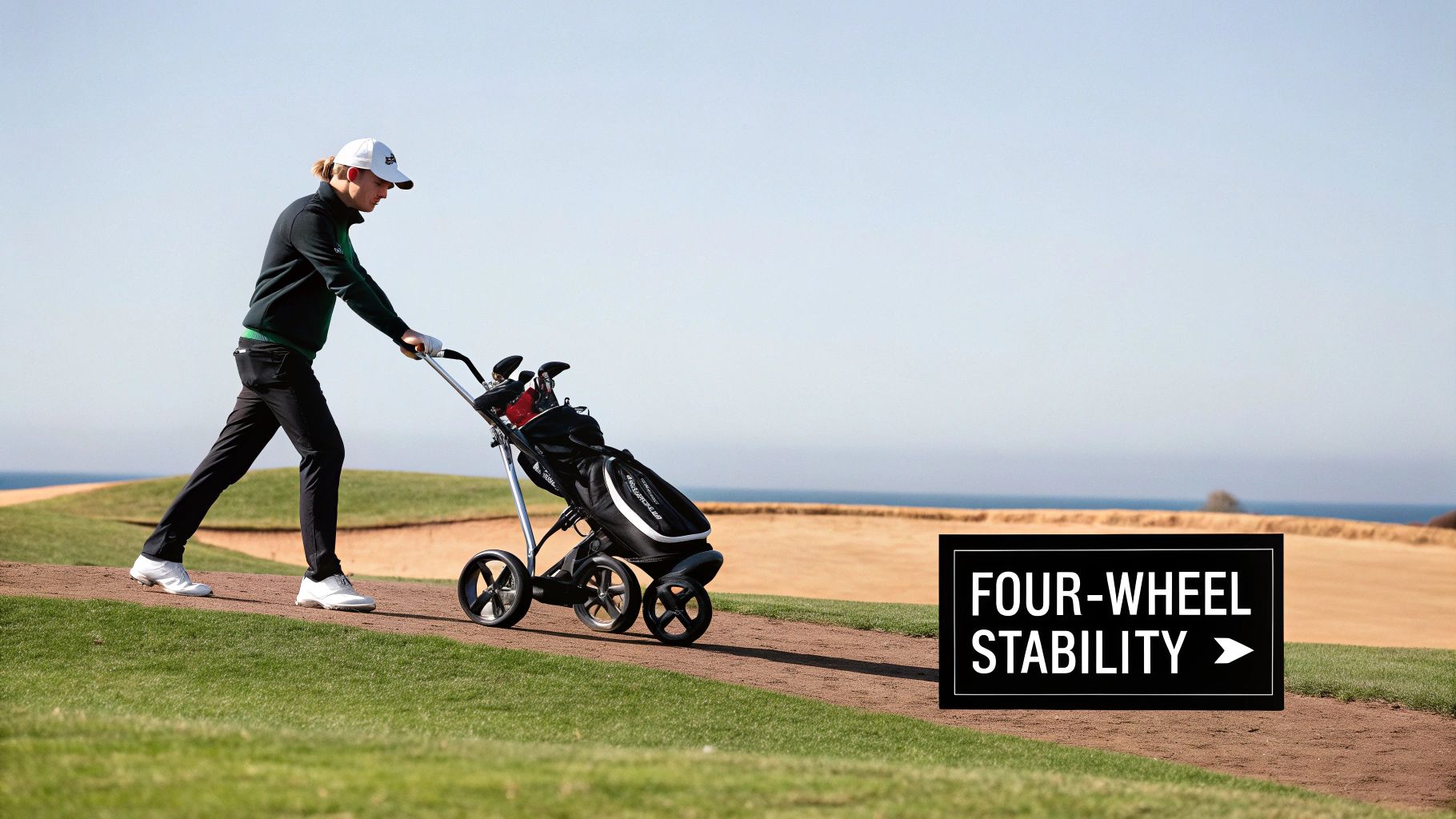
Walking the course is making a huge comeback. More and more players are ditching the motorized cart to enjoy the health benefits and get a better feel for the game. This shift has put a spotlight on a crucial piece of gear: the push cart. While 3-wheel carts have been the go-to for years because of their agility, the 4 wheeled golf push cart is quickly becoming the top choice for golfers who care about stability, security, and pure ease of use.
Think about trying to balance a heavy camera on a tripod versus setting it on a sturdy four-legged table. The table is a far more secure base, right? The same logic applies on the golf course. The four-wheel design creates a wider, more balanced footprint that keeps your cart planted, even when you're navigating tricky sidehills or bumpy cart paths. This isn't just about convenience—it's about protecting the investment you've made in your clubs and gear.
To give you a quick snapshot, here’s how the two styles stack up against each other.
4 Wheel vs 3 Wheel Golf Push Cart At a Glance
| Feature | 4 Wheeled Golf Push Cart | 3 Wheeled Golf Push Cart |
|---|---|---|
| Stability | Exceptional, especially on hills and uneven ground. | Good, but can be prone to tipping on sidehills. |
| Maneuverability | Excellent, many with swiveling front wheels. | Typically very agile and easy to turn. |
| Footprint | Wider base provides a more secure platform for the bag. | More compact, but can be less stable with heavy bags. |
| Folding | Modern designs fold down surprisingly small. | Often folds very compactly. |
| Ideal User | Golfers on hilly courses or those who prioritize stability. | Golfers on flatter courses who value agility. |
While 3-wheel carts are still great, the stability advantage of a 4-wheeler is a game-changer for many players.
The Modern Golfer's Choice
Today's golfer wants equipment that improves the experience without adding any hassle. A modern 4 wheeled golf push cart delivers exactly that, combining its natural stability with features that now match or even beat its three-wheeled cousins.
- Effortless Navigation: Forget the old myth that four wheels are clunky. Many models now come with swiveling front wheels, making them just as nimble as a 3-wheeler.
- Compact Portability: Advanced folding systems allow these carts to collapse into incredibly small footprints, fitting easily into just about any car trunk.
- Reduced Physical Strain: Because the weight is distributed so evenly, you use less energy pushing your bag over 18 holes. That saves your strength for your swing.
The core advantage is simple: a 4 wheeled golf push cart lets you focus completely on your game, not on wrangling your equipment. It stays put where you park it and rolls smoothly where you push it, becoming a reliable partner from the first tee to the final green.
This guide will dive into everything you need to know about choosing and using a 4 wheeled golf push cart. We'll compare it head-to-head with 3-wheel models, break down the essential features to look for, and even show you how to upgrade your cart with powerful electric-assist technology like the Caddie Wheel. By the end, you’ll see why four wheels are becoming the new standard for walking golfers everywhere.
Understanding the Stability Advantage of Four Wheels
The single biggest reason golfers are making the switch to a 4 wheeled golf push cart boils down to one thing: rock-solid stability. This isn't just a minor perk; it's the core benefit that keeps your expensive clubs safe, your gear secure, and ultimately, gives you peace of mind on the course. You can spend less mental energy worrying about your equipment and more time focusing on that next shot.
Think about the difference between a three-legged stool and a four-legged table. The stool works, but it definitely has a tipping point. Lean a little too far, and over it goes. The table, with its wider, rectangular base, is naturally balanced and incredibly tough to knock over. A four-wheeled cart operates on that same simple principle of physics.
Its four points of contact with the ground create an incredibly stable platform. This design distributes the weight of your golf bag more evenly across the frame, which significantly lowers the cart's center of gravity. That makes it far less likely to tip over, especially in situations where three-wheelers tend to struggle.
The Physics of Fairway Stability
The stability of a 4 wheeled golf push cart isn't just a feeling—it’s baked into its engineering. The wider wheelbase, especially between the front two wheels, creates a bigger, more forgiving foundation that resists the kind of sideways forces you run into on uneven ground.
This superior balance really shines in three common scenarios:
- Sidehill Lies: When you park your cart on a slope next to the fairway, a 3-wheel cart's triangular base can easily get off-balance and topple. A 4-wheel cart stays firmly planted, keeping your bag upright and your gear safe.
- Navigating Bumps: Rolling over a curb on the cart path or hitting an unexpected tree root can be enough to send a 3-wheeler tipping. The four-wheel design absorbs these jolts much more effectively.
- Heavy Golf Bags: If you’re the type of golfer who carries a full set, extra balls, rain gear, and a few drinks, you're putting a lot of weight on your cart. A four-wheel platform handles that load without getting top-heavy or wobbly.
This kind of reliability is a major reason why walking the course is booming in popularity. The global market for golf push and pull carts is growing fast, with projections showing it will expand from USD 0.29 billion in 2026 to USD 0.65 billion by 2035. This surge is largely fueled by health-conscious golfers who need the stability of four-wheeled models to handle diverse course terrains.
More Than Just Balance
While stability is the main event, the benefits don't stop there. A secure cart acts as a dependable "home base" for everything you need during your round.
By eliminating the worry of your cart tipping over, you gain a reliable station for your rangefinder, scorecard, and drink. It’s a small but significant detail that makes the entire round feel smoother and more professional.
For example, you can confidently leave your cart on a slight incline to walk over and read a putt without giving it a second thought. This mental freedom lets you stay locked into your game instead of being distracted by your gear. You might be interested in a deeper dive into the specific benefits of four-wheel push carts.
This unwavering stability is the primary reason so many serious walking golfers are making the switch. It transforms the push cart from a simple bag carrier into a trustworthy and essential piece of golf equipment.
Essential Features Every Golfer Should Consider
Choosing the right 4 wheeled golf push cart is a lot like picking the perfect club for a tricky shot—the small details make all the difference. While the four-wheel design gives you a solid base to work from, not all carts are built the same. The difference between a great walk and a frustrating one often boils down to a few key features that impact how you transport, use, and enjoy your cart on the course.
Think of it this way: any old cart will haul your clubs from tee to green. But a great cart feels like a seamless extension of your game. It anticipates what you need, keeps your gear secure, and just makes the entire round more enjoyable. Let's break down the must-have features that separate the best from the rest, so you can invest in a model that truly fits your game.
Folding Mechanism and Portability
One of the first questions every golfer asks is, "Will this thing actually fit in my car?" Thankfully, modern engineering has made this a non-issue for most models. The days of bulky, awkward carts that were a pain to transport are long gone. Today, it’s all about quick, compact folding systems that make storage and transport a breeze.
Look for a cart that collapses with a simple, intuitive motion. The best designs use a one-click or two-step mechanism that lets you fold or unfold it in seconds. You shouldn’t need to pull out a user manual or watch a YouTube tutorial just to get it in your trunk.
A cart’s folded dimensions are your most important metric here. Many 4 wheeled golf push cart models now collapse into a neat, cube-like shape that can be more space-efficient than some longer, flatter 3-wheel designs. Always check the specs to ensure it fits comfortably in your trunk alongside your bag.
Construction Materials and Weight
The materials used for a cart's frame directly impact its weight, durability, and how it feels to push for 18 holes. Most high-quality carts are built from lightweight, aircraft-grade aluminum. This stuff offers the perfect sweet spot between strength and low weight, making the cart easier to push uphill and lift into your car.
While you might see some steel frames, which are definitely durable, they're also significantly heavier. A heavier cart takes more energy to push, which can lead to fatigue creeping in on the back nine. As a general rule, try to find a cart that weighs under 20 pounds. Anything more than that starts to defeat the purpose of using a push cart to conserve energy for your swing.
Braking Systems You Can Trust
A reliable brake is absolutely non-negotiable, especially if you play on a course with even the slightest bit of elevation. Picture this: you park your cart on a small slope to line up a putt, only to see it start rolling away. A good brake prevents that nightmare scenario and keeps your expensive clubs right where you left them.
You’ll generally find two types of braking systems:
- Hand Brakes: Located right on the handle like a bicycle brake, these are super convenient for slowing the cart on a steep downhill walk or locking it in place instantly.
- Foot Brakes: Engaged with a simple press of your foot on a pedal near the back wheels. They're very secure and easy to use once you've come to a complete stop.
The choice often comes down to personal preference, but hand brakes tend to give you more control while you're still moving, which is a huge plus on hilly courses.
This decision tree shows how stability is a key factor, especially on varied terrain.
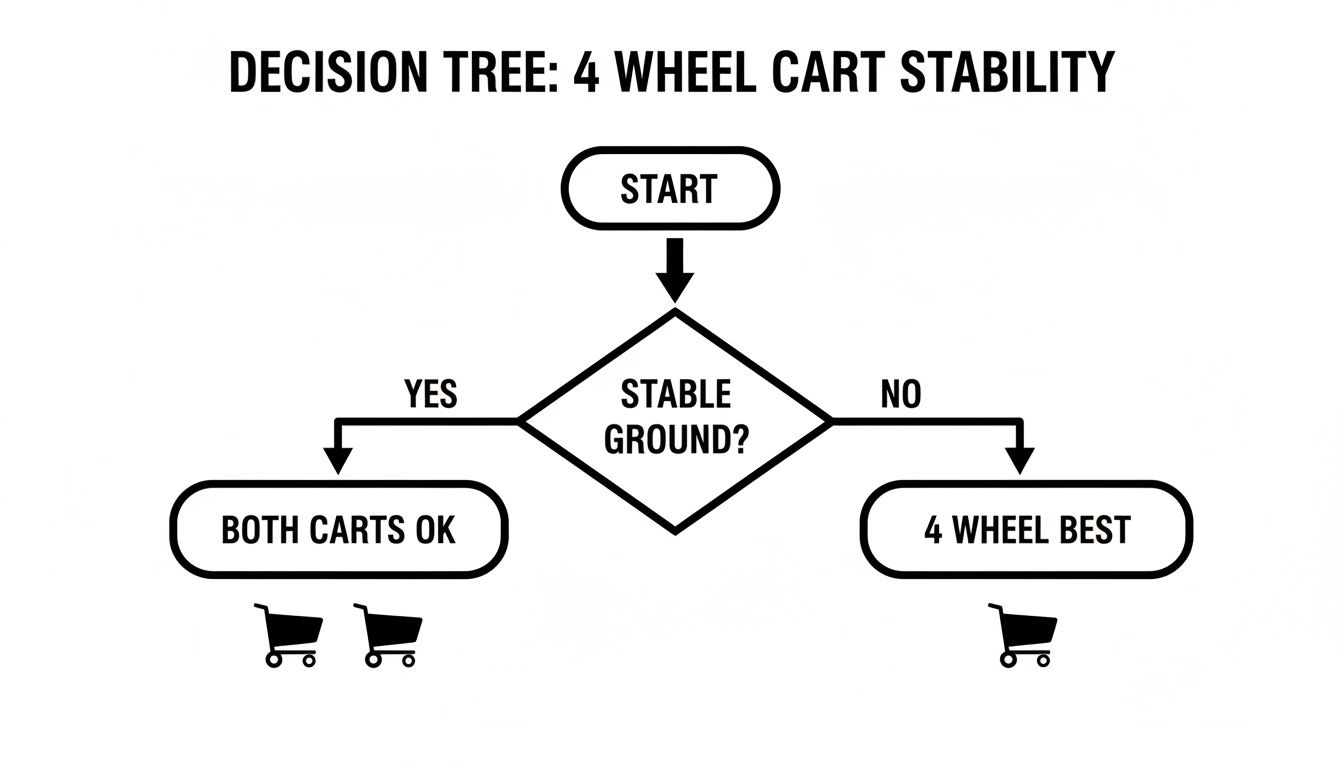
As you can see, while both types of carts handle flat ground just fine, a 4 wheeled golf push cart is the clear winner for staying planted on uneven lies.
Wheels and On-Course Handling
Your cart's wheels are its connection to the turf, and their design affects everything from how easily it turns to how smooth the ride is. Look for wheels made from durable, maintenance-free materials like solid foam or EVA. These airless tires give you a cushioned ride without you ever having to worry about getting a flat.
Another game-changing feature to look for is swiveling front wheels. This allows a 4 wheeled golf push cart to have the same tight turning radius you’d expect from a 3-wheeler, giving you the best of both worlds: unbeatable stability and nimble handling. Most carts with this feature also have a lock to keep the wheels tracking straight when you’re on a long, straight path.
Handle Adjustability and Comfort
Comfort is king during a four-hour round of golf. A cart with an adjustable handle lets you set it to the perfect height for your body, preventing you from hunching over or reaching up awkwardly. It’s a small ergonomic detail that saves your back, shoulders, and wrists from unnecessary strain.
Most modern carts feature multi-position handles that can be changed with a simple button or latch. Look for one with a soft, padded grip that feels good in your hands and gives you solid control, even on a hot, humid day. Getting this right means you can keep your focus on the next shot, not on an uncomfortable cart.
How to Upgrade Your Cart with Electric Power Assist
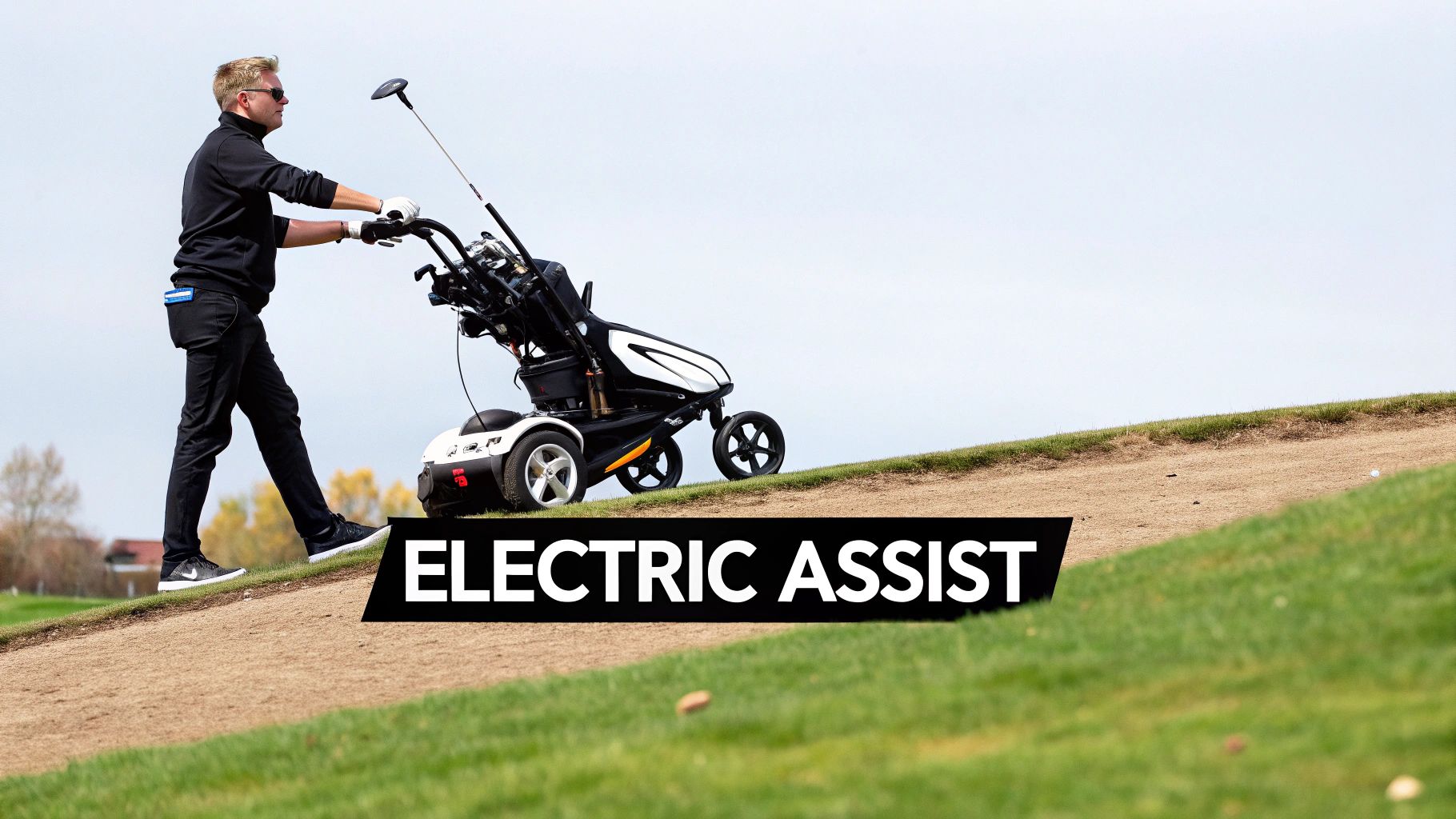
You chose a 4 wheeled golf push cart because you value that rock-solid stability and smooth ride. But what if you could keep that incredible platform and ditch the "push" part entirely? That’s exactly where electric power-assist add-ons are changing the game for walkers.
Imagine cruising up the steepest hill on your course without a second thought, saving every last bit of energy for your next shot. This isn't about replacing the cart you trust; it's about giving it a serious superpower.
This is the perfect middle ground for golfers who love the health benefits of walking but are tired of fighting fatigue on the back nine. It bridges the gap between a standard push cart and a full-on electric caddy, giving you the best of both.
The Power of Conversion Kits
The real magic here is in the conversion kits. Instead of shelling out for a brand-new—and often expensive—electric trolley, you can motorize the cart you already know and love. Products like the Caddie Wheel are built to seamlessly integrate with your existing setup.
Think of it like adding a small, powerful engine to a bicycle. The frame and stability you count on are still there, but now you have an on-demand power source to handle the heavy lifting.
Installation is almost always a breeze and doesn't require a toolbox full of special gear. A motorized wheel simply attaches to your cart’s axle and is powered by a lightweight battery. You get a simple remote to control the speed and direction, turning your manual 4 wheeled golf push cart into your own personal caddy.
The goal is simple: conserve physical energy so you can dedicate it to mental focus and a powerful swing. Golfers who make the switch often report feeling as fresh on the 18th green as they did on the first tee.
This trend is catching fire. In North America, the cart market is projected to see 42% of global growth through 2035, driven by over 25 million millennial golfers in the US alone. This generation values fitness but wants to reduce the strain of playing on the more than 14,500 courses nationwide, many of which are notoriously hilly.
Who Benefits Most from an Electric Upgrade?
While any golfer can appreciate the luxury of a motorized cart, this upgrade is a total game-changer for certain players. It makes the game more accessible and, frankly, more fun for a much wider range of people.
An electric assist could be exactly what you need if you are:
- A senior golfer looking to walk the course comfortably without the physical toll.
- A player with mobility challenges who needs a little help to enjoy the game on foot.
- A fitness-minded golfer who plays on hilly courses and wants to avoid burnout.
- A competitive player who knows that saving energy leads directly to lower scores.
By taking the physical chore of pushing a heavy bag off your plate, you’re not just making the walk easier—you're actively improving your odds of a great round. The energy you save is energy you can pour directly into your performance. For a deeper dive, check out our guide on electric golf push cart conversion kits.
At the end of the day, adding a power-assist kit is the smartest way to enhance your existing 4 wheeled golf push cart. It's a cost-effective upgrade that delivers immediate benefits, transforming your walk from a workout into a strategic advantage on the course.
Simple Maintenance to Keep Your Cart Rolling Smoothly
Your 4 wheeled golf push cart is a workhorse, built to handle round after round. But just like any quality piece of gear, a little TLC goes a long way. Think of it less as a chore and more as protecting your investment.
Consistent, simple maintenance is the secret to making sure your cart rolls as smoothly years from now as it did on day one. It's the difference between a reliable partner and a round-ruining headache. A few minutes after your round, while you're cleaning your clubs, is all it takes.
A well-maintained cart isn't just about reliability—it's about safety. Brakes that work and parts that aren't seizing up are critical, especially when you're navigating a hilly course. You need to trust your equipment.
This kind of proactive care is what ensures your cart has a long, happy life on the links.
Your Routine Maintenance Checklist
Keeping your cart in peak condition is surprisingly easy. Just run through this quick checklist every few rounds, or definitely after playing in wet, muddy, or sandy conditions.
- Clean the Frame and Wheels: Grab a damp cloth and wipe down the entire frame. Get rid of any caked-on dirt, grass, or sand. Pay extra attention to the wheels and axles—this is where grime loves to build up, causing friction and annoying squeaks. A soft brush will help knock loose anything stubborn.
- Inspect and Lubricate Moving Parts: The folding mechanism is the heart of your cart's convenience. Give the hinges and joints a quick look for any stiffness or signs of wear. A light spray of silicone-based lubricant on these points keeps the folding action smooth and effortless.
- Check the Brakes: Your brake is a non-negotiable safety feature. Whether it's a hand lever or a foot pedal, engage and disengage it a few times. Make sure it locks securely and releases without a fight. If it feels sloppy or isn't holding tight, crack open the owner's manual for adjustment instructions.
Advanced and Electric Cart Care
If you've upgraded your setup with an electric assist, there are a couple of extra things to keep in mind. Proper care here ensures the whole system—from the wheels to the power source—stays in perfect sync.
For those with an add-on like a Caddie Wheel, battery care is everything. Always give the battery a full charge after each round and store it somewhere cool and dry. The worst thing you can do is leave it sitting dead for weeks, as that can seriously shorten its lifespan and capacity.
Walking golf is booming, and it's no surprise that manual 4 wheeled golf push cart models are leading the charge in the market. This trend is great for golfers, as it's driving innovation in everything from lightweight alloys to better brakes. Even better, it's opened the door for powerful, snap-in electric assists that require zero tools and offer a 36-hole battery life, making walking the course completely effortless. You can dive deeper into these market trends in Technavio's industry analysis.
Follow these simple steps, and your cart will remain a trusted part of your game for years to come. For an even more detailed breakdown, check out our guide on 6 essential golf cart maintenance tips.
Got Questions About 4-Wheeled Push Carts? We’ve Got Answers.
Even after laying out all the benefits, you might still have a few questions rolling around. That’s completely normal. A 4-wheeled golf push cart is a real investment in your game, and you want to be sure you're making the right call.
This section is all about cutting through the noise. We're tackling the most common questions and myths golfers have about four-wheelers to give you the straight-up, practical info you need to choose with confidence.
Aren't 4-Wheeled Carts Harder to Steer Than 3-Wheelers?
This is probably the biggest misconception out there. The gut reaction is that an extra wheel makes the cart clunky and resistant to turning, like a stubborn shopping cart at the grocery store. But the truth is, modern engineering has left that problem in the dust.
Today’s top-tier four-wheel carts almost all come with swiveling front wheels. This is the game-changer. It gives them an incredibly tight turning radius, letting them pivot just as nimbly as their three-wheeled cousins. You get all the agility you need to navigate a crowded staging area or weave around a greenside bunker, but you don't give up an ounce of stability.
And for those long, straight walks down the fairway? Many of these carts have a simple lock for the front wheels. Just flip a switch, and they track perfectly straight with no drifting. You get the best of both worlds: sharp handling when you need it and rock-solid stability when you don’t. The idea that you have to trade maneuverability for stability is completely outdated.
Is a 4-Wheeled Cart Too Bulky for My Car Trunk?
Not a chance. That’s a worry straight from the era of older, clunkier designs. Cart makers today are obsessed with portability because they know if a cart is a pain to transport, golfers just won't use it. They've poured a ton of R&D into creating clever, space-saving folding mechanisms.
The vast majority of modern four-wheel carts are built from lightweight aluminum and collapse into a surprisingly small package.
Many models fold down into a neat, cube-like shape that’s often less awkward in a trunk than some three-wheelers, which can be long and flat. A four-wheel cart slides neatly into a corner, leaving you plenty of room for your bag, shoes, and anything else.
The proof is in the numbers. Just check the "folded dimensions" in the product specs before you buy. Measure your trunk, and you'll likely be surprised at how easily a 4-wheeled golf push cart fits, even in a smaller sedan.
Will an Electric Assist Kit Fit My Current Push Cart?
For the most part, yes. The best electric assist kits on the market were designed with universal compatibility in mind. The goal isn't to make you buy a whole new cart; it's to upgrade the one you already know and love.
Products like the Caddie Wheel, for instance, use an ingenious snap-in bracket system. It's adjustable and designed to fit the rear axle of nearly every major 3- and 4-wheel push cart brand out there. Better yet, the installation is dead simple—it usually takes just a few minutes with no tools required.
If you want to be 100% sure, here’s a quick checklist:
- Check the Manufacturer's Website: Look for a compatibility list that names specific brands and models.
- Look for a Measurement Guide: Many will have simple instructions for measuring your cart’s axle to guarantee a snug fit.
- Contact Customer Support: When in doubt, a quick email or call can give you a definitive answer and complete peace of mind.
These kits are made to make the jump to electric power as seamless and cost-effective as possible.
What's the Real-World Benefit of a Motorized Upgrade?
In a word: energy. It’s so easy to underestimate how much effort it takes to push a 30- or 40-pound bag over five miles, especially on a course with any kind of elevation change. That physical toll adds up. By the time you're on the back nine, that fatigue starts to creep into your mental game and your swing mechanics.
A motorized assist completely erases that physical drain from the equation. The motor does all the work, letting you enjoy the health benefits of walking the course without sapping your strength. Golfers who switch to a motorized 4-wheeled golf push cart almost universally say they feel as fresh and focused on the 18th hole as they did on the first tee.
That saved energy isn't just a feeling—it translates directly to better golf. Your legs are stronger in your stance, your mind is clearer for making decisions, and your swing feels more fluid and less forced. It’s not just about convenience; it’s a strategic edge that helps you post lower scores and have a much better time doing it.
Ready to feel the effortless stability and game-changing power for yourself? The Caddie Wheel is the perfect upgrade, turning the push cart you already trust into a remote-controlled powerhouse. Save your energy for your swing, not the walk.
Partager:
Choosing Your Perfect Three Wheel Cart A Golfer's Guide
A Guide to Push Carts Golf and How to Walk Smarter