
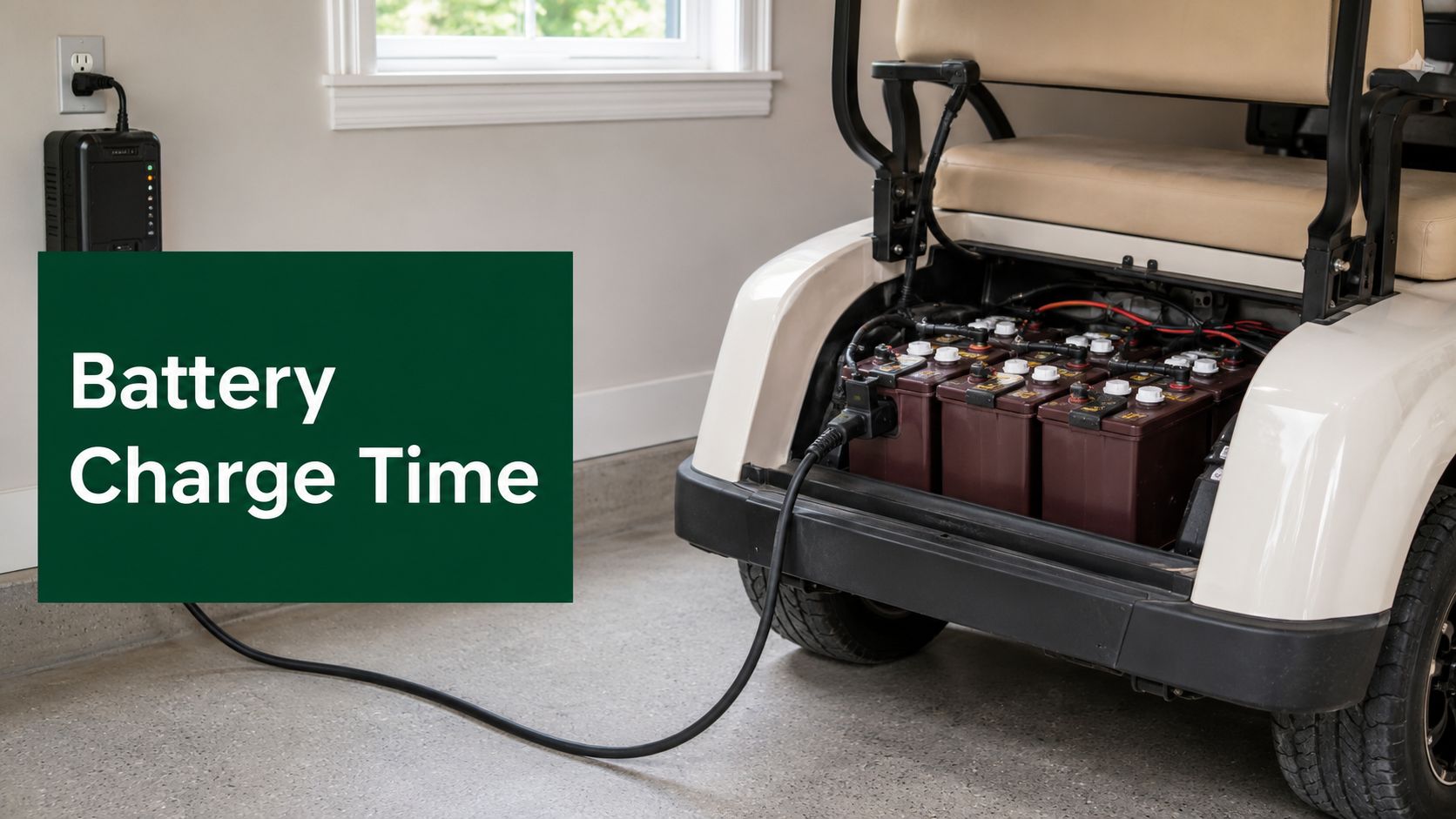
You know the feeling. You've set out your shoes, checked the weather, and you're already thinking about the first tee shot. Then you look at your electric caddie setup and realize the battery never got charged.
That's the sort of mistake that can change the whole round before you've even left the house.
Battery charging time sounds like a dry topic until it affects a Saturday morning tee time. On the course, it's really about something simple. Will your gear be ready when you are? If you walk your rounds and rely on powered assist, understanding charge time helps you avoid surprises, protect the battery, and plan your golf the same way you plan clubs, layers, and arrival time.
Why Understanding Charge Time Matters for Your Game
A lot of golfers treat charging as an afterthought. Plug it in sometime after the round, unplug it whenever you remember, and hope it's ready next time. That works until it doesn't.
On the course, battery charging time matters because golf runs on routine. If you play early, you need confidence that an overnight charge is enough. If you play back-to-back rounds, you need a realistic sense of whether a partial recharge will get you through the next one. If you don't know those answers, you're guessing.
The golf version of being unprepared
Think of battery prep the same way you think about cleaning grooves or replacing a glove before it tears. None of it is exciting, but all of it affects how smooth the day feels.
A dead or half-charged battery can force you to push more than planned, change how you manage hills, or leave you distracted when you should be focused on tempo and target. For many walking golfers, especially seniors or players managing fatigue, that's not a small inconvenience. It changes the round.
Practical rule: If your powered gear matters to your comfort, charging belongs on the same checklist as tees, balls, and rangefinder.
Why charge time confuses so many golfers
It's commonly expected that charging works like filling a bucket. Empty battery, fixed charger, fixed time. But batteries don't behave that neatly.
The charger matters. The battery size matters. The starting charge level matters. Even the last stretch of charging often slows down on purpose. That's where golfers get tripped up. They assume “almost full” means “almost done” at the same speed all the way through.
Once you understand the basics, battery charging time gets much easier to predict. You don't need to become an engineer. You just need the golf equivalent of course management. Know the yardage, pick the right club, and avoid the big mistake.
How Battery Charging Time Is Calculated
At its simplest, battery charging time comes down to one idea. Battery capacity is how much energy the battery can hold, and charging current is how fast energy flows back in.
The easiest way to picture it is a tank and a hose. The battery is the tank. The charger is the hose. A bigger tank takes longer to fill. A faster hose fills it quicker.
The simple formula golfers can remember
The simplified formula is:
Time = Capacity ÷ Charging current
If a battery has more amp-hours, it usually takes longer to charge. If the charger supplies more amps, it usually takes less time. Volts also matter in the overall electrical picture, but for basic charge-time math, golfers can start with the tank-and-hose view and avoid getting lost in technical language.

If you want a clean primer on the numbers behind battery use, this guide on how to calculate power consumption the right way helps connect battery specs to real-world usage.
Why the math is only a starting point
The catch is that real batteries don't charge in a perfectly steady line from empty to full. In practice, real-world charging times are typically 10 to 20% longer than the theoretical calculation because the battery slows down near full charge to protect its internal components, as explained by Roam Charging's overview of battery sizes and charging times.
That's the same reason topping off a fuel tank takes a bit more care at the end. You don't blast the last bit in at full speed. The system eases off.
Charging looks fast early, then more patient near the top. That slower finish is usually normal, not a problem.
A plain-language example
Say your battery is halfway empty. You plug it into the correct charger after your round. Early on, it may seem like the battery jumps back quickly. Then the progress slows as it gets closer to full.
That doesn't mean the charger has stopped working. It means the battery management system is protecting the battery. For golfers, the practical lesson is simple. Don't wait until the last minute and assume the final stretch will finish as quickly as the first stretch.
Factors That Speed Up or Slow Down Charging
Two golfers can plug in similar gear after use and still see different results. That's normal. Battery charging time depends on a handful of real-world conditions, and some matter more than people think.

Starting charge level changes everything
A battery that's only partly used won't need the same time as one that's been run down much further. That sounds obvious, but it's the first place golfers misjudge charging.
If you finish 18 holes with plenty left, a top-off can feel quick. If you've played a long round on a hilly course and used more assist than usual, the battery has a bigger job ahead. This is why “How long does it take to charge?” always needs a follow-up question. “From what level?”
Charger power and battery type matter
The charger itself sets the pace. More available charging power usually means less waiting, as long as the battery is designed to accept it.
Battery chemistry matters too. Older lead-acid systems are much slower than modern lithium setups. Lead-acid golf cart batteries require 8 to 12 hours for a full recharge from a completely depleted state, while lithium alternatives can fully recharge in 2 to 3 hours, according to Form Charge's guide to golf cart charging times.
That difference is one reason golfers moving from older battery systems to lithium often feel like they've gone from waiting on a group ahead to having the fairway open up.
If you want a broader view of charging hardware and how power levels differ across systems, this explainer on understanding EV charger types gives useful context without getting too deep into the weeds.
Temperature and battery condition also play a role
Cold weather can slow battery behavior and affect performance expectations. Heat can also change how charging feels in practice. The battery may still charge properly, but not always at the pace you expected from ideal indoor conditions. Golfers who store equipment in garages, trunks, or sheds see this firsthand. For more on that, Caddie Wheel's piece on cold weather battery performance is worth bookmarking.
Battery age matters as well. An older battery may charge less predictably or seem to hold less energy than it once did. You don't need lab tools to notice that. If your usual routine suddenly stops matching your actual charge results, the battery's condition could be part of the story.
Calculating Caddie Wheel Charge Times
When golfers ask about battery charging time, they usually don't want a physics lesson. They want to know two things. Can I charge it overnight, and can I top it off between rounds?
The most honest answer is that exact timing depends on the battery capacity, the charger output, and how low the battery is when you plug it in. Without listing unverified product specs, it's still possible to build a useful way to think about your own setup.
Use ranges, not false precision
For lithium golf cart-style batteries, a practical benchmark is this: charging time should be controlled within 5 to 6 hours to achieve a full charge, with the process typically extending slightly until the charger indicator light turns green, according to Battsys Battery's guidance on charging lithium batteries for golf carts.
That tells you something important. Overnight charging is usually the easy case. The tighter question is partial charging between rounds or after a late afternoon walk.
Here's a simple planning table you can use as an estimate, not a promise. The point is to think in ranges and habits.
Caddie Wheel Estimated Charging Times
| Starting Battery Level | Target Battery Level | Estimated Charge Time |
|---|---|---|
| Low after a full round | Full charge | Plan for an overnight charge |
| Around half remaining | Full charge | Allow several hours |
| Partly used before a morning round | Comfortable top-off | Allow a shorter top-up window |
| Lightly used after 9 holes | Full or near full | Usually less time than a post-18-hole recharge |
A golfer can use that table the same way you'd use a yardage book. It won't tell you the exact bounce, but it gives you the right play.
If your charger light hasn't turned green yet, don't assume the battery is finished just because most of the time has passed.
A better way to plan around your schedule
If you play once a week, charging after every round keeps things simple. If you play often, create a routine based on when you tee off. Evening golfers can plug in as soon as they get home. Morning golfers should avoid relying on a last-minute top-off unless they know from experience that it's enough for their style of play.
And if you ever replace an older battery system, proper disposal matters. This Reworx Recycling compliance guide is a useful reference for handling lead-acid battery recycling the right way.
How to Shorten Charge Time and Extend Battery Life
Fast charging is nice. Reliable charging is better. Most golfers don't need the absolute shortest battery charging time possible. They need a routine that gets the battery ready for the next round without wearing it down unnecessarily.
That's why the best habits focus on both speed and longevity.

The habits that save the most frustration
- Charge before it's fully drained. Running a battery all the way down may seem efficient, but it's rough on battery health. Complete battery drainage significantly reduces the operational lifetime of golf cart batteries, and best practice is to recharge after every 18 holes or 5 hours of play for a minimum of 5 hours, according to Bat-Caddy's battery FAQ.
- Use the right charger every time. The charger and battery are meant to work as a pair. Swapping in a random charger is the equipment version of using the wrong club because it was nearby. It might seem fine until it isn't.
- Charge in a stable environment. A cool, dry indoor space is usually the safer bet than a freezing garage corner or a hot car trunk.
- Top off after play instead of delaying. Small, steady maintenance is easier than trying to recover from neglect the night before a round.
For golfers comparing options, Caddie Wheel's guide to the best golf cart battery charger offers a practical look at what to check before buying or replacing a charger.
When to favor convenience and when to favor battery health
Sometimes you're in a hurry. A quick recharge before an afternoon loop might be necessary. That's fine. The goal isn't perfection. It's avoiding the habits that repeatedly shorten battery life.
A good rule is to think like course management. Take the aggressive line when the situation calls for it, but don't make it your default on every hole.
A quick visual refresher can help if you like checklist-style guidance:
Better charging habits don't add much work. They remove avoidable problems later.
What To Do If Your Caddie Wheel Is Not Charging
Charging issues usually come down to a small number of causes. Before assuming the battery has failed, walk through the basics in order.
If the charger light doesn't turn on
Start with the simple checks. Make sure the wall outlet works. Confirm the charger is firmly connected at both ends. Inspect the cable and plug for visible damage. If anything looks frayed, bent, cracked, or overheated, stop using it.
Don't keep troubleshooting with damaged equipment. Replace the faulty part or contact support.
If charging seems unusually slow
Slow charging doesn't always mean a fault. Batteries often charge faster in the earlier stage and then taper off. The final 20% from 80% to 100% takes considerably longer than the initial 0% to 80% range because the charging rate slows to protect battery health, as described in Pod Point Energy's guide to electric car charging times.
That same pattern helps explain why a battery can appear to “stall” near full charge even when everything is working properly.
If the battery won't hold charge like it used to
Look at the pattern, not just one round. If the battery charges fully but runs down much sooner than it used to, age, storage habits, or repeated deep discharges may be catching up with it. If the behavior changes suddenly, stop guessing and get help.
And if you're sorting through old battery-powered equipment at home or at work, proper disposal matters there too. Businesses dealing with retired electronics can learn from this guide to secure laptop recycling for businesses, which shows why battery handling should be done carefully.
When in doubt, choose safety over experimentation. Don't open the battery, don't force connectors, and don't keep charging with suspect cables or adapters.
If you want a simpler way to walk the course with less strain and more control, take a look at Caddie Wheel. It's built for golfers who want electric power assist without turning their push cart into a bulky project.
Partager:
Conquer Winter: Caddie Wheel Cold Weather Performance
How to Pack a Golf Bag: Master Your Setup for the Course