
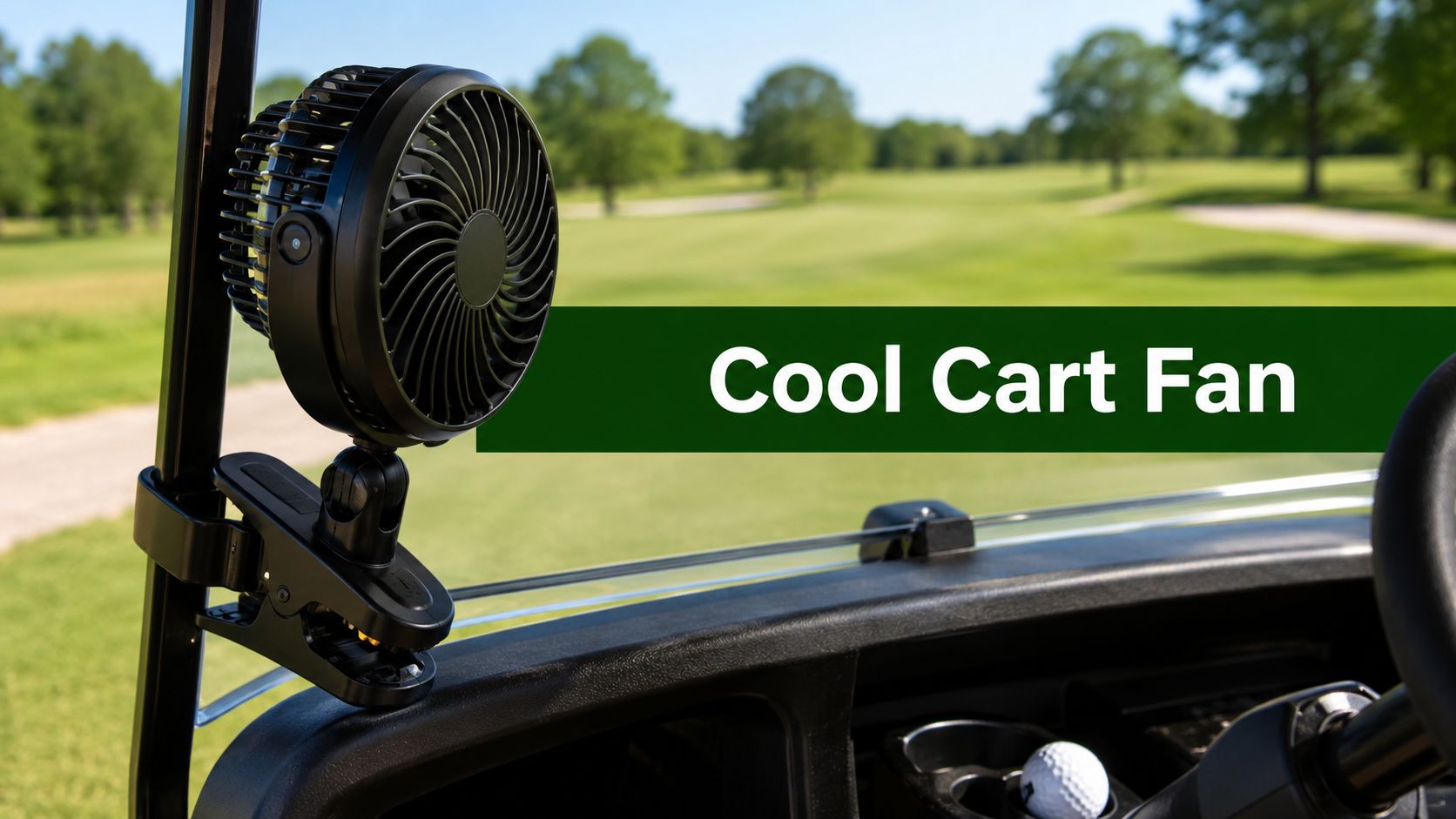
By the time you reach the back nine on a still, hot day, the scorecard often stops being the main battle. You start thinking about shade, cold water, and whether the seatback can somehow produce a breeze. Sweat runs into your eyes, your glove feels damp, and your focus starts leaking away one small decision at a time.
That's why a battery operated fan for golf cart has become more than a novelty. On the right day, it's the difference between feeling cooked by the turn and finishing the round with some energy left. But the product page specs only tell part of the story. On a golf course, the important question isn't just whether a fan spins. It's whether you feel better using it when the cart is open, the air is sticky, and the sun is pounding one side of your body for hours.
Stay Cool and Play Your Best Round
A lot of golfers buy a fan after one specific round. Usually it's the one where the cart felt like it was holding heat instead of helping you escape it. You drive to your ball, stop in the fairway, and the air goes dead. The breeze you got while moving disappears, and all that's left is humidity, glare, and heat bouncing off the path.

That's where a portable fan earns its place. Not because it turns your cart into air conditioning, but because it gives you a usable pocket of airflow exactly when golf is least comfortable. Waiting on a tee box. Sitting in a backed-up par 3. Pulling clubs while the sun sits right on your shoulder.
Existing reviews tend to focus on rechargeable batteries and mounting styles, but they often miss the bigger question of how much comfort a fan delivers in open-air, high-humidity conditions where airflow, sun exposure, and seat position matter more than specs alone, as noted in this real-world cooling discussion.
What matters more than the product page
A fan that looks strong indoors can disappoint on the course. Open carts bleed air. Sun exposure changes by seat. Some fans cool your face but leave your chest and arms roasting. Others are mounted too far away, so by the time the air reaches you, it barely matters.
Practical rule: If the fan doesn't create relief when the cart is stopped, it won't feel nearly as useful as you hoped.
That's also why golfers who compare riding setups and walking setups often think differently about gear. If you're still deciding how you want to get around the course, this electric bike golf cart buyer's guide is worth a look because it frames comfort, portability, and on-course practicality from a broader mobility angle.
Cooling gear works best as a system, not a single gadget. A fan helps most when you've also packed cold drinks and kept them cold. If you're building that full setup, a practical read on a golf cart cooler setup fills in the other half of staying comfortable through a long round.
Fan Types and Mounting Options
Mounting decides whether a fan becomes part of your routine or ends up in the garage. A strong motor doesn't help if the fan droops, slides, or blocks the wrong part of the cart. Golf carts vibrate, turn, bounce over path seams, and sit in the sun for hours. The mount takes all of that abuse.

Clip-on mounts
Clip-on fans are the easiest starting point because they work across a lot of surfaces. They can grab roof supports, dash lips, basket edges, and some push cart frames. For rental carts, that flexibility matters.
The downside is obvious the first time you hit rough pavement. Cheap clips look secure until vibration works them loose. A good clip needs a wide jaw, grippy pads, and enough tension that you can't casually knock it off while reaching for a rangefinder.
Clip-on is often the safest bet if you switch between different carts and don't want to think too hard about compatibility.
Flexible tripod mounts
These are the octopus-style mounts with bendable legs. They shine on push carts and awkward frame shapes where a standard clamp can't grab cleanly. If your cart has irregular tubing, accessory bars, or curved handles, this style can wrap around spots that other mounts can't use.
They're less ideal when you want a fast on, fast off setup in a riding cart. You usually spend more time positioning them, and if the legs are soft or flimsy, the fan can sag after a few holes.
On a push cart, adaptability matters more than elegance. A mount that wraps securely is more useful than one that looks cleaner but slips.
Magnetic and fixed mounts
Magnetic fans are convenient when your cart gives them a proper metal surface. They're quick, tidy, and easy to reposition. But golfers often assume every cart offers the right metal attachment point. That's not always true, and some surfaces that look promising don't give enough confidence once the cart starts moving.
Permanent mounts sit at the other extreme. They're stable and dedicated, but they make the most sense for owners using the same personal cart all the time. If you ride club carts, borrow carts, or want to move the fan to a patio chair or tent later, permanent mounting can feel limiting.
A quick comparison helps sort the options:
| Mount Type | Best For | Pros | Cons |
|---|---|---|---|
| Clip-on | Rental carts, mixed cart use, dashboards and rails | Flexible placement, easy to remove, widely compatible | Can loosen if clamp quality is poor |
| Magnetic | Carts with suitable metal surfaces | Fast to place, clean setup, easy to reposition | Useless on non-magnetic surfaces |
| Suction Cup | Smooth panels or windshields | No clamp pressure needed, easy to move | Can lose grip in heat, dust, or textured surfaces |
| Permanent Mount | Dedicated personal carts | Stable, tidy, always ready | Not portable, less versatile |
A short video can help you think through real placement points before buying:
What actually works on the course
For most golfers, the best mount isn't the strongest on paper. It's the one that fits your exact setup without fuss.
- If you use club or rental carts: A strong clip-on usually makes the most sense because you can adapt to whatever frame or dash you get.
- If you walk with a push cart: Flexible tripod styles deserve a close look because they handle odd tube shapes better.
- If you own a personal cart: Magnetic or fixed mounts can feel cleaner if your cart has the right surfaces and you use the same arrangement every round.
If you play in severe heat and are comparing broader cooling ideas beyond fans, even something like a premium misting air cooler can be useful as a contrast point. It reminds you that golf cart cooling is always about the environment you're trying to cool, not just the fan itself.
Decoding Power Sources and Runtime
A fan that feels great on the first three holes and quits on the back nine is just extra clutter in the cart. Power choice matters because golf heat builds over four hours, especially in humid conditions where moving air is doing the work, not lowering the temperature around you.

What the numbers mean in practice
Product pages love battery capacity because it is easy to print in big type. On the course, the better question is simpler. Will the fan stay useful for an entire round at the speed you will really use?
AIPSET's product details and charging notes on this rechargeable golf cart fan listing show the pattern you see across this category. Fans with larger lithium-ion packs and USB-C charging are easier to live with than older setups that take longer to top off or need a less common cable.
That convenience shows up before the round starts. A fan you can charge with the same cord as your phone is far more likely to be ready when your tee time comes around.
Runtime depends on how golfers use the fan
Listed runtime is usually based on low speed. That number has value, but it can mislead golfers who spend the hottest part of the day on high.
In real use, battery life drops fast as fan speed goes up. That matters more in an open cart than it would on a desk at home, because you will often bump the fan up when the cart is parked in direct sun and the breeze disappears. A fan that runs all weekend on low can still come up short if your normal habit is high speed from the second hole through the clubhouse turn.
Use your round to judge battery needs.
- Morning rounds in mild weather: Low or medium may be enough for most of the day.
- Hot, humid afternoon rounds: Expect to use medium or high much more often.
- Practice after the round or 36-hole days: Extra battery capacity starts to matter a lot more.
- Cart partner who wants airflow too: Shared use drains battery faster than solo use.
A weak fan with marathon runtime does not help much. A strong fan with short runtime is just as frustrating. The sweet spot is enough battery to run at the settings that keep you comfortable, not the settings that look best in a spec table.
Battery fan versus cart power
Rechargeable fans are usually the safer pick for golfers who ride different carts, use club carts, or do not want one more thing tied into the vehicle. They are simple. Charge them at home, clip them on, and go play.
Cart-powered fans can make sense if your setup is consistent and you already have charging sorted out. If you are still figuring that piece out, this guide to adding a USB port for golf cart is worth reading before you assume every cart can support your fan the same way.
As a comparison point, AGM batteries for mobility scooters show the difference between heavy-duty battery systems and the lightweight power packs used in portable fans. Golf cart fans are better judged by charging convenience, realistic runtime, and how little attention they need during a round.
Airflow and Noise A Golfer's Perspective
Airflow is where golf reality parts ways with indoor testing. A fan can seem impressive on a bench and still underperform in an open cart because the air has to fight distance, body position, sun angle, and the fact that the cart itself doesn't hold cool air.
Think in terms of a comfort cone
The best way to judge a fan isn't by technical jargon. Judge it by the cone of comfort it creates. Can it cool just your nose and forehead, or does it reach your neck, chest, and hands while you're sitting naturally?
That's why placement often beats advertised power. A moderate fan mounted close and aimed correctly can feel more effective than a stronger fan mounted too far away or too low. Golfers notice this most when the cart is stopped and the natural breeze disappears.
In humid weather, airflow also needs to reach skin that's hot, not just the front of your shirt. If the fan only tickles your face, relief is limited.
Noise matters more on a golf course
At home, a little motor hum is background noise. On a golf course, it's different. You hear swings, conversations, birds, and silence between shots. A whiny fan gets old quickly, especially if it's mounted near head level.
Some golfers tolerate more noise if the fan is mainly used while driving between shots. Others want something quiet enough to leave running at a tee box without annoying everyone in the cart. There isn't one right answer, but there is a bad one. A fan that sounds cheap often feels cheap over time.
What works in actual use
Here's the trade-off most golfers end up making:
- High speed: Better for dead-air moments, tougher on battery and often louder.
- Medium speed: Usually the sweet spot for comfort, battery life, and tolerable sound.
- Low speed: Best when the fan is placed very well and you want steady background airflow.
If you hear the fan more than you feel it, something is wrong. Either the fan is too weak, too far away, or pointed at the wrong place.
The golfers who are happiest with their setup usually don't chase maximum blast. They choose enough airflow to be noticeable without adding a constant mechanical buzz to the round.
Assessing Durability and Weatherproofing
Golf accessories live rough lives. They get tossed in trunks, knocked against bag wells, left in direct sun, and bounced around on cart paths. If a fan feels flimsy in your hand, it won't become sturdier after a season outside.
The parts that fail first
The mount usually gives up before the motor. Hinges loosen. Clips lose bite. Ball joints stop holding their position. Fan cages get bent after one awkward drop onto pavement or concrete.
That's why build quality matters more than cosmetic features. A sturdy housing, a protected fan cage, and a mount that still grips after repeated use are worth paying attention to. On the course, reliability is a comfort feature.
Weather resistance in plain English
Most golfers don't need a fan that survives a downpour. They need one that can handle sweat, a splash from a water bottle, damp morning air, and being left in heat without turning brittle or inconsistent.
This is also where power decisions come back into play. For many golfers, the most usable setup is the one that fits existing power infrastructure, and a battery-operated option isn't always automatically the most convenient. Understanding power draw and compatibility helps you avoid draining the cart mid-round, a point raised in this discussion of cart power tradeoffs and compatibility.
If your setup uses accessories with handheld controls, weather protection matters there too. The same logic applies whether you're managing a fan or another cart add-on, and this piece on waterproof remote controls is a useful reminder that outdoor electronics need practical protection, not just marketing language.
Buy for the accidental drop, the hot trunk, and the surprise sprinkle. Those are the real tests.
How to Choose the Right Fan for Your Game
A fan that feels fine in the driveway can disappear on the course. In an open golf cart, moving air, direct sun, and humidity all work against you. The right pick is the one you can still feel on the back nine, not the one with the most impressive spec sheet.

The push cart walker
If you walk, keep it light and easy to move. A fan that adds bulk to a push cart gets annoying fast, especially on hilly courses or during a long summer round. Compact size, simple charging, and a mount that works on narrow tubing matter more than raw power.
Aim matters too. A smaller fan pointed at your chest or face usually does more than a larger one blowing past you from an awkward angle.
The hot and humid regular
Golfers who ride in heat and humidity need airflow that stays noticeable when the cart is stopped at a tee box or waiting on a green. That usually means prioritizing fan position and adjustability over extra features. If the head does not pivot enough, or the mount forces the fan too far away, the cooling effect drops off in a hurry.
Battery strategy also matters here. High speed drains any fan faster, so usable speed settings are more important than a big battery number by itself. On sticky afternoons, a fan with a medium setting that still feels strong is often the better buy because that is the setting you will use for four hours.
The family or utility cart owner
If the cart gets used by different people, a portable setup usually makes more sense than a dedicated one. The fan should move easily from the front seat to the back, then off the cart and onto a patio chair or sideline bench without much fuss.
For that kind of use, I would look for:
- Easy attachment: It should fit more than one mounting spot without constant adjustment.
- Simple charging: USB-C is easier to live with than a charger you can misplace.
- Useful airflow: Strong enough to feel at normal seating distance.
- A housing that can take some abuse: Shared gear gets bumped, dropped, and tossed in storage bins.
A simple buying filter
If a friend asked me how to choose, I would sort it like this:
- Can you mount it where the airflow reaches you?
- Can you feel it when the cart is parked in heat?
- Will the battery last at the speed you will really use?
- Will it hold up to regular golf-cart abuse?
- Can you live with the noise for a full round?
That order reflects what directly affects comfort during play. A huge battery does not help if the fan sits too far away. Low noise does not matter much if the airflow gets lost in an open cart. Buy for real relief over four hours, not for the best-looking spec list.
Frequently Asked Questions
Can I run a golf cart fan from a phone power bank
Sometimes, yes, if the fan supports USB charging while operating. The practical issue is cable clutter and placement. For most golfers, a self-powered fan is cleaner and easier during a round.
Are bigger battery fans always better
Not automatically. Higher capacity can mean much longer runtime, but gains aren't always linear because motor efficiency and extra features also use energy. For example, a 24,000 mAh clip-on fan is advertised for up to 150 hours of work time, which shows how larger batteries can stretch runtime when the fan runs at low demand, as seen on this 24,000 mAh fan listing.
How should I clean and store one
Use a dry or lightly damp cloth on the housing. Keep debris out of the grille, and don't store the fan loose where the blades or cage can get crushed. In the off-season, charge it periodically and keep it out of extreme heat.
Is an expensive fan worth it
Sometimes. The premium is usually justified by a better mount, better battery behavior, and better construction, not by flashy extras. If you play often in real heat, that upgrade can be worth it. If you only need occasional relief, a simpler model may do the job just fine.
What's the most common buying mistake
Buying based on battery size alone. A fan has to fit your cart, aim properly, stay put, and create noticeable comfort when the cart is stopped. If it misses those basics, the rest doesn't matter.
If you prefer to walk but still want to save energy over a full round, Caddie Wheel is worth a look. It adds motorized push-cart assist to standard golf push carts, which can make hot-weather walking a lot more manageable when you'd rather conserve your legs for swings and putts than spend the day pushing uphill.
Partager:
Golf Push Cart Basket: The Ultimate Buyer's Guide
Caddie Wheel Quad Remote Control: Master Your Game