
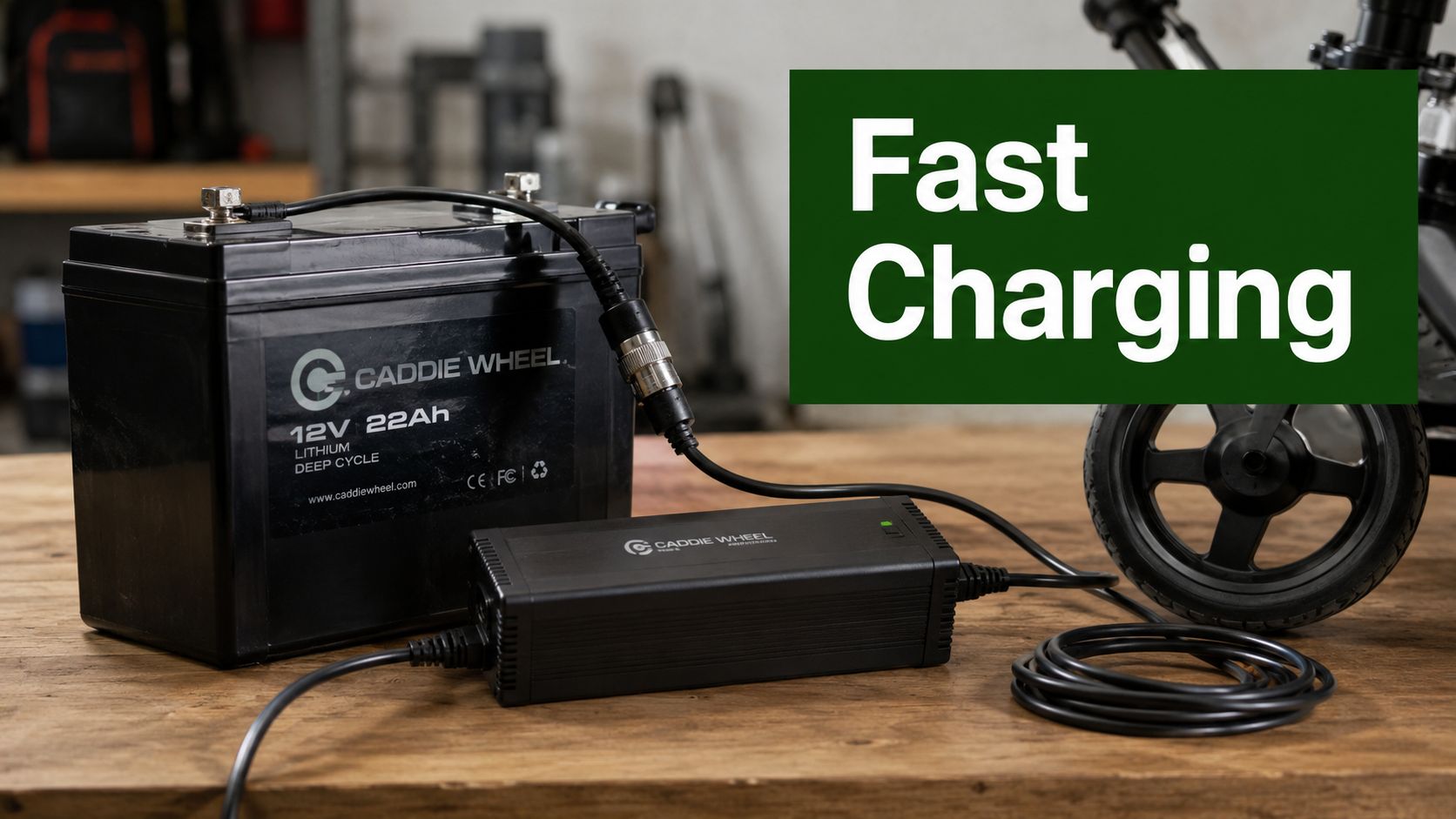
You're halfway through a round when the battery indicator on your electric golf push cart starts blinking. The cart still moves, but it slows on an uphill lie, and now every fairway feels like a charging calculation. You're wondering whether the portable charger at home can recover enough power before tomorrow's tee time, or whether a short plug-in will leave you stranded on the back nine.
That concern is different from electric vehicle range anxiety. A golf push-cart battery is smaller, your charging source is usually a household outlet, and the round has a defined length. You're not planning a highway trip between charging stations. You're trying to finish today's holes and prepare calmly for the next ones.
Understanding charger fast charging turns that blinking light into a routine. You'll learn what watts and amps mean, where a portable golf-cart charger fits beside EV equipment, how charging affects lithium-ion battery health, and which habits make a top-up predictable rather than stressful.
When the Battery Light Starts Blinking
The first sign usually appears at an inconvenient moment. You've made the turn, the group ahead has cleared the fairway, and your cart hesitates as you guide it toward the next tee. The battery light flashes. You may still have plenty of holes left, but the cart's changing pace makes you second-guess every hill.
That moment is a useful warning, not an automatic emergency. A blinking indicator tells you to manage the remaining charge, reduce unnecessary stops, and think about where the next full recharge will happen. If the cart is carrying a battery designed for a long walking round, the right response is usually a measured decision rather than repeatedly switching the motor on and off.
The key question is not, “How fast is this charger?” Ask instead, “How much usable energy can this charger restore during the time I have?” A charger that looks modest beside an automotive DC fast charger can be very quick for a compact golf-cart battery. Charging speed is relative to the size of the battery and the amount of power the battery can safely accept.
A different kind of range anxiety
An EV driver may need to locate a working public station, confirm connector compatibility, check pricing, and allow for a changing charging curve. A walking golfer usually has a more controlled setup. The battery comes home with the cart, the charger travels easily, and a standard indoor outlet can often provide the next opportunity to recharge.
That simplicity matters, but it doesn't eliminate uncertainty. You still need to know whether a brief evening connection is enough, whether a full overnight cycle is preferable, and whether heat or an unsuitable replacement charger could shorten battery life.
Practical rule: Treat the battery indicator as a planning signal. A low reading after play is a reminder to plug in, not proof that the charger needs extreme power.
The rest of the process becomes easier once you understand the basic electrical terms. You'll be able to read a charger label, compare outputs sensibly, and choose a charging window that supports the next round without rushing the battery.
What Charger Fast Charging Actually Means
Start with four terms: watts, amps, voltage, and charge rate. They describe different parts of the same process, much like different features of a garden hose.
The garden-hose analogy
Voltage is water pressure. It provides the push that moves electrical energy toward the battery. Amps are similar to hose diameter, because they describe how much electrical current is moving through the system. A larger hose can carry more water, just as a higher current can carry more charge when the equipment and battery support it.
Watts describe the total power reaching the battery. In practical terms, watts combine voltage and amps. More available watts can refill the battery faster, provided the charger, cable, battery, and control electronics all agree that the higher flow is safe.
Charge rate is the result you experience. It answers the golfer's question, “How quickly does the battery gain usable energy?” The hose may have strong pressure and a wide opening, but the bucket still controls how quickly it can accept water. A battery works the same way. The charger can offer power, but the battery management system controls how much the cells accept at a given moment.

Peak speed isn't the whole story
A charger label may advertise its maximum output, but the battery won't necessarily receive that figure throughout the entire session. Lithium-ion systems commonly reduce charging power as the battery approaches full. This taper protects the cells and prevents the final portion of the charge from creating unnecessary stress.
That creates two useful ideas:
- Peak charging speed: The highest power the setup may deliver during part of the cycle.
- Sustained charging speed: The power maintained across a larger portion of the recharge.
A battery at a low state of charge may accept power more readily than a battery already close to full. Temperature also matters. The battery management system may reduce current if the cells are too warm or too cold.
Why small packs feel the difference
A compact golf-cart battery doesn't need automotive-scale power to benefit from fast charging. If the battery holds a relatively small amount of energy, a suitable portable charger can restore a meaningful portion during an evening, between rounds, or while you prepare equipment.
The practical takeaway is simple: fast charging means more useful watts delivered within the battery's safe acceptance limits. It doesn't mean forcing maximum current into the cells regardless of temperature, chemistry, or charge level.
Where the Caddie Wheel Charger Sits on the Spectrum
A golfer comparing charger labels can quickly end up comparing the wrong machines. Electric vehicle charging provides a useful reference point, but those figures describe public automotive infrastructure, not a golf push cart. The International Energy Agency's explanation of electric vehicle charging places fast chargers above 22 kW and below 150 kW, with ultra-fast chargers at 150 kW or above. In 2024, the global stock of fast chargers reached 2 million, while ultra-fast chargers grew by more than 50% and represented nearly 10% of all fast chargers.
A basic 1 kW wall box offers a reference for slower charging. Automotive equipment may provide 50 kW, 150 kW, or 350 kW. Those numbers sound dramatic beside a golf charger, but the battery pack changes the meaning. A car stores far more energy, so it needs much higher power to achieve a similar refill window.
The Right Scale for a Push-Cart Battery
A portable golf-cart charger can deliver only a small fraction of an EV highway station's output and still be fast for one push-cart battery. The smaller battery is a smaller energy reservoir, so the charger does not need automotive-scale power to restore a useful amount of charge. The practical question is, “How quickly can this device refill the battery it was designed to serve?”
Caddie Wheel's portable charger is built for that narrower job. It provides a practical recharge path for the system's high-capacity battery without requiring a garage, clubhouse, or hotel room to function like an EV charging depot. The Caddie Wheel smart charger guide explains the charger's role in the wider charging setup. Compared with a low-output trickle charger, the bundled charger is intended to restore the same battery without such a long connection.
| Charger Category | Typical Output | Use Case |
|---|---|---|
| Basic wall box | 1 kW | Slow, controlled home charging |
| Portable golf-cart charger | Product-specific | Recharging a compact golf push-cart battery |
| EV fast charger | 50 kW | Public top-ups for passenger EVs |
| EV ultra-fast charger | 150 kW or above | High-power highway and public charging |
| Heavy-vehicle charging | Up to 750 kW | Electric trucks using Megawatt Charging System equipment |
Heavy transport operates at a still larger scale. The Megawatt Charging System is specified for up to 3,000 amperes and can deliver up to 750 kW. Scania says its MCS solution can provide an 80% battery charge in less than 30 minutes, which suits electric trucks but has little to do with a golfer walking between holes.
For a push cart, the useful sweet spot is a charger that fits the available schedule and the battery's size. Fast charging means practical recovery for your rounds, not enough power to imitate a highway station.
Charge Time and 36 Holes of Range
The useful Caddie Wheel question isn't whether the charger sounds fast. It's whether the battery can support the way you play. The system is described as supporting up to 36 holes per charge, which gives you a practical planning framework for a single round, consecutive rounds, or a busy tournament week.
Start with the simplest scenario. If you play one round and return home with charge remaining, connect the portable charger after the cart cools and allow it to restore the battery before the next outing. A partial evening top-up may be enough when the battery wasn't heavily depleted. If you've used the cart across two rounds, plan for a complete recharge window rather than relying on a short connection.
Think in recovery windows
| Round Played | Battery Left After Round | Time to Full on Portable Charger |
|---|---|---|
| One round | Partial charge remains | Shorter top-up window |
| Two rounds | Low charge remains | Longer recharge, potentially overnight |
| Practice or short outing | More charge remains | Brief connection may be sufficient |
The exact time depends on the battery's starting state, its capacity, the charger's output, and the charging system's taper near full. Caddie Wheel's battery charging time guidance is the appropriate product reference for the actual recharge window, because a generic calculation can mislead if it ignores the charger's control behavior.
A simple energy calculation explains the logic. Battery capacity is expressed in watt-hours, while charger output is expressed in watts. Dividing the energy that must be restored by the charger's output gives an idealized time, but real charging takes longer because the system manages heat and slows near full. That is why an “empty to full” estimate should be treated as a planning range rather than a stopwatch promise.
Three common playing patterns
For a single weekend round, plugging in after the previous outing gives the battery time to recover without pressure. For a twosome weekend with two rounds close together, charge as soon as the first round ends and avoid waiting until the morning of the second round. During tournament week, make the charger part of the equipment reset alongside cleaning grips, checking wheels, and preparing balls.
The mental model is easy to remember: one full charge supports the stated 36-hole range, and one round played should be followed by enough charging time to recover the next round. A short evening top-up can support the next morning's front nine when the battery still has a healthy reserve, while a heavily used battery deserves a full recharge cycle.
Battery Health Without the Guesswork
Faster charging isn't automatically harmful. The issue is how much heat and electrochemical stress the battery experiences while it accepts current.
Lithium-ion cells can age faster when charging pushes lithium ions too quickly for the anode to absorb cleanly. That can increase the risk of lithium plating, a condition that permanently reduces usable capacity. In severe cases, plating can contribute to dendrites that damage internal battery structures. The underlying heat and plating tradeoff is explained in this battery overview.
The battery management system reduces that risk by controlling current and responding to temperature. It may throttle the charge rather than allowing the charger's maximum output to continue unchecked. Moderate fast charging within the battery's designed limits can therefore be convenient without creating the same stress associated with extreme charging conditions.

The EV comparison has a useful warning
Large fleet analyses provide a clear caution about making very high-power charging the default. One analysis found roughly 1.5% average annual degradation when fast charging represented under 12% of sessions, compared with about 2.5% when it exceeded 12%. Outcomes were worse when charging sessions at 100 kW or more represented over 40% of charging. These figures come from an EV context, but the principle applies broadly: frequent extreme charging, high state of charge, and hot conditions can combine to increase stress. The fleet degradation analysis is discussed here.
A golf push-cart battery operates at a much smaller scale, and its supplied charger is intended for that battery rather than for an automotive pack. You still shouldn't treat a compact battery as indestructible.
- Avoid deep depletion: Plug in after play instead of repeatedly running the battery until the cart can barely move.
- Control heat: Don't leave the cart in a hot trunk while it charges, and don't place the charger brick where heat can collect.
- Store thoughtfully: During the off-season, follow the battery maker's storage guidance and avoid leaving the pack in an extreme state for a prolonged period.
- Use the supplied equipment: A charger with the wrong voltage or chemistry profile can create more risk than a correctly matched fast charger.
Battery rule: Use fast charging when the next round requires it. Choose the gentler overnight cycle when you have plenty of time, especially after a hot day or heavy use.
When a battery eventually reaches the end of its useful service life, responsible disposal matters. Golfers replacing a lithium pack can research eco-friendly battery recycling services instead of placing it in ordinary household waste.
Compatibility and Everyday Charging Habits
A fast charger only helps when the complete setup matches. Before plugging in, confirm the connector, voltage, battery chemistry, outlet, and charging environment. A high amp rating by itself doesn't make a charger suitable.
Run this compatibility checklist
- Match the battery port. Confirm that the portable charger's connector fits the Caddie Wheel battery port securely. It should seat fully without force, looseness, or exposed contacts.
- Check the cable reach. Make sure the cable is long enough to connect the battery while the charger brick rests on a stable surface. Don't suspend the brick from the cart or stretch the cable across a walkway.
- Use a standard household outlet. The portable setup is intended for ordinary household charging, so a garage, hotel room, or clubhouse can work when the outlet is safe and accessible. You shouldn't need to improvise with an adapter that changes the electrical specification.
- Read the power label. Verify that the charger's voltage and battery-chemistry requirements match the pack. A third-party brick with the wrong output can be unsafe even if its plug appears identical.

Set up the charging area properly
Place the battery and charger on a hard, non-flammable surface with air around the charger brick. Keep it out of direct sun, away from damp areas, and never sealed inside a bag while charging. Don't leave the cable tightly coiled under the cart, because trapped heat and restricted airflow make a poor combination.
A quick plug-in after nine holes can be useful when the cart will be needed again soon. A full recharge is the better choice before a tournament week, a weekend with consecutive rounds, or any outing where a low battery would create unnecessary pressure. Partial-state charging is generally more practical than repeatedly forcing deep discharge and recovery.
Common mistakes to avoid
The most common error is choosing a replacement charger by connector shape alone. Two chargers can look compatible while using different voltage or charging profiles. Another mistake is charging immediately in a hot vehicle, particularly after the cart has spent hours in direct sun.
Finally, don't confuse the charger's maximum rating with the battery's actual acceptance rate. The battery management system may reduce power during part of the session, and that's normal protective behavior rather than a defect.
A Simple Pre-Round Charging Routine
A dependable routine beats a frantic burst of charging on the morning of a tee time. Use the battery indicator, the previous round's distance, and the next day's schedule to decide how much recovery time the pack needs.
The night-before sequence
After the last round: Check the battery indicator before putting the cart away. If the reading is low, don't postpone charging until departure morning.
At the charging point: Move the battery and portable charger indoors to a cool, dry location. Use a suitable household outlet, place the charger on a hard surface, and leave the cable clear of the cart's wheels and frame.
Before bed: Connect the battery and charger correctly. If the system includes automatic charge control or cutoff behavior, allow it to manage the final stage rather than repeatedly unplugging and reconnecting the pack.
Before leaving: Check the indicator or charger LED, then unplug the wall connection and disconnect the battery before packing the cart. A quick visual check catches an unseated connector or an outlet that was switched off.

The routine works because it separates charging decisions from tee-time pressure. You're not trying to extract the highest possible power in the shortest possible interval. You're giving a correctly matched charger enough time to restore the battery while the system controls current as the pack fills.
For the full product-specific connection sequence, use Caddie Wheel's guide to using the portable charger. Keep one decision rule in your golf bag: top up if the indicator shows two bars or fewer, then trust the charger to handle the rest automatically. Consistent overnight charging supports the stated 36-hole range without turning every round into a battery-management exercise.
Caddie Wheel offers lightweight electric power assist for standard three- and four-wheel golf push carts, with a snap-in design, variable-speed remote control, high-capacity battery, portable charger, and a 12-month warranty. Visit Caddie Wheel to choose an electric assist setup that makes charging and walking your next round simpler.
Partager:
Umbrella Holders Golf
Caddie Wheel Remote Control Not Working: How to Fix It