
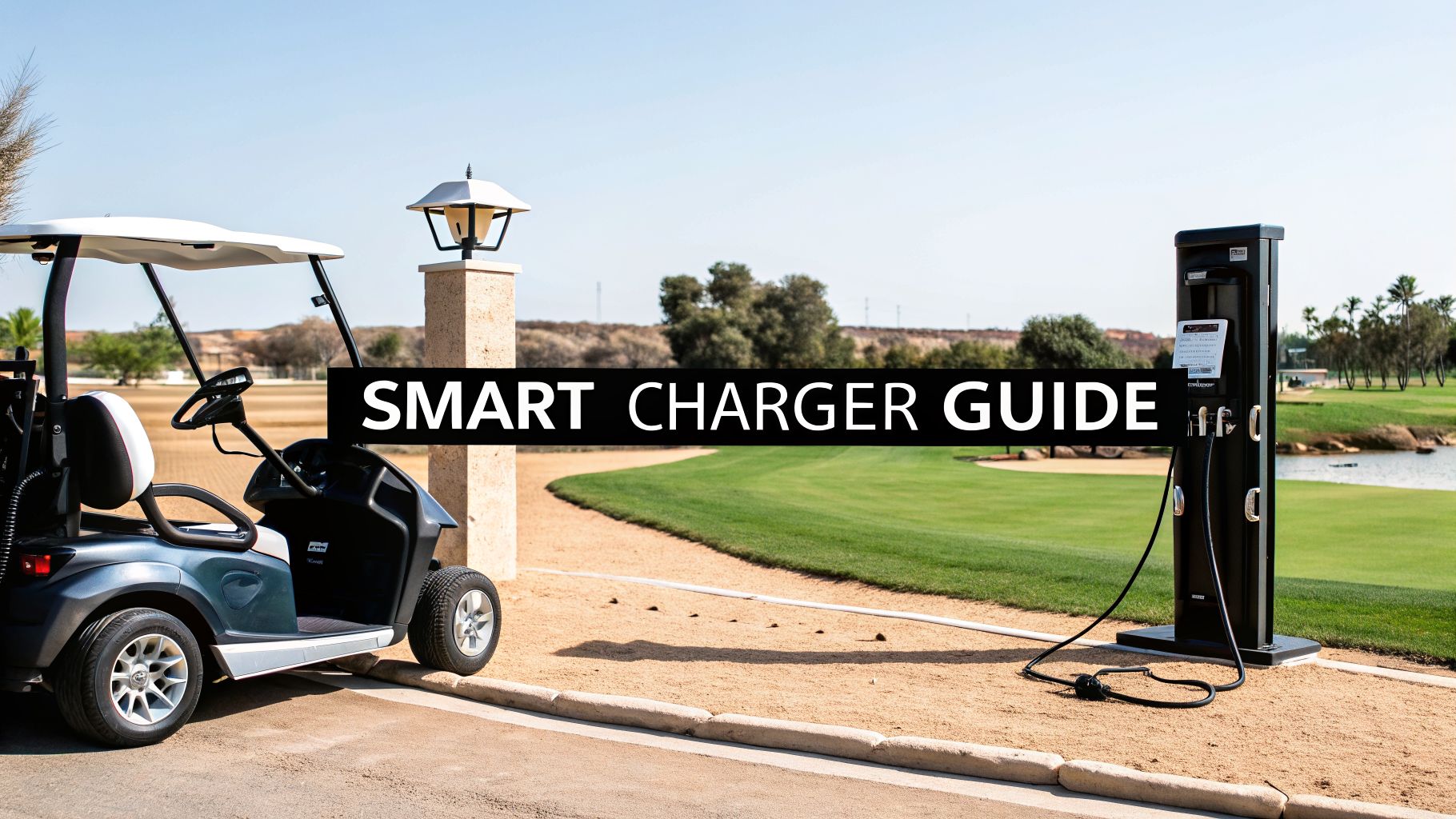
A golf cart smart charger is an intelligent device that communicates with your cart's battery to deliver a perfect charge every time. Unlike an old-school charger that just dumps constant power, a smart charger adjusts its voltage and current on the fly. This prevents damage, dramatically extends your battery’s lifespan, and gets you back on the course faster.
The Smarter Way to Power Your Round

Think of a traditional charger like a kitchen faucet stuck on full blast—it just keeps pouring power, whether the battery needs it or not. A smart charger, on the other hand, is more like a personal chef for your battery. It carefully monitors the battery's health, "listens" to its needs, and serves up a perfectly tailored charge. This intelligent approach is a true game-changer for any golf cart owner.
This shift toward smarter tech is reshaping the industry. The golf cart battery charger market, valued at $450 million in 2024, is expected to climb to a whopping $750 million by 2033. This boom is directly fueled by thousands of U.S. golf courses switching to electric fleets, where operators need efficient charging to keep carts on the move and reduce downtime.
To get a better sense of how these chargers fit into the bigger picture, it helps to understand the evolution of modern charging. Many of the same principles of efficiency and safety are shared with other modern electric vehicle technologies, like EV chargers.
Smart Charger vs. Traditional Charger At a Glance
So, what really sets a smart charger apart from the dusty old charger that came with your cart? Let's break down the key differences. This table shows you exactly why making the switch is such a smart move for your battery's health and your wallet.
| Feature | Smart Charger | Traditional Charger |
|---|---|---|
| Charging Method | Multi-stage, adaptive algorithm that adjusts to battery needs. | Constant, single-stage power delivery ("trickle" or "bulk"). |
| Battery Communication | Actively "listens" to the battery's voltage and state of charge. | No communication; simply delivers a fixed current. |
| Overcharging Risk | Virtually zero. Automatically stops when the battery is full. | High risk. Can easily overcharge and "cook" the battery. |
| Battery Lifespan | Maximizes lifespan by preventing damage and sulfation. | Can significantly shorten lifespan due to overcharging. |
| Efficiency | Charges faster and uses less electricity. | Slower and less energy-efficient. |
| Best For | All battery types, especially modern lithium-ion. | Older, less sensitive lead-acid batteries (with caution). |
As you can see, the technology inside a smart charger is designed not just to power your battery, but to protect it. It’s an investment that pays for itself by keeping your most expensive component in peak condition for years.
Why Smart Charging Matters
The real value of a smart charger comes down to one thing: protecting your investment. Your cart’s battery is its most expensive and vital component, and overcharging is one of the quickest ways to ruin it, leading to poor performance and a short lifespan. A smart charger completely eliminates this risk with its multi-stage charging process and automatic shut-off feature.
This is especially important for today's advanced power systems, including:
- Lithium Batteries: These modern powerhouses demand precise charging to stay healthy and last longer. You can learn more in our guide on the ideal lithium battery charger for a golf cart.
- Portable Power: For golfers using an electric caddie like the Caddie Wheel, a smart charger ensures the portable battery is topped off quickly and safely, so you’re always ready for up to 36 holes.
- Lead-Acid Batteries: Even old-school batteries get a new lease on life. A smart charger helps prevent sulfation—a common killer of lead-acid batteries—and keeps them running optimally.
A smart charger isn’t just a fancy accessory; it's a critical tool for getting the most out of your golf cart. By preventing overcharging and promoting battery health, it saves you money on electricity and helps you avoid the headache of a premature—and expensive—battery replacement.
How Smart Chargers Optimize Battery Performance

A smart charger does more than just pump electricity into your golf cart’s battery—it manages the entire process with precision. Think of it like a bartender pouring a perfect pint. An old-school charger is like someone who just yanks the tap open, letting foam and beer spill everywhere. A smart charger, on the other hand, fills the glass quickly at first, then slows down to top it off perfectly without wasting a drop.
This intelligent approach is designed to maximize your battery's health and extend its lifespan. It starts by analyzing your battery's current state of charge and then kicks off a specific sequence to bring it back to full power safely and efficiently.
The Three Stages of a Smart Charge
The secret sauce that makes a golf cart smart charger so effective is its multi-stage charging algorithm. Each stage has a specific job, and they all work together to give your battery a full, healthy charge every single time.
-
Bulk Stage: This is the power-hour. The charger sends the maximum current to the battery to do the heavy lifting. It’s like filling that pint glass most of the way up as fast as you can. This stage quickly gets a depleted battery up to about 80% capacity.
-
Absorption Stage: Once the battery hits that 80% mark, the charger eases off the gas. It dials back the current while holding the voltage steady, letting the battery "absorb" the remaining charge without stress. This is the part where the bartender slows the pour to settle the head and fill the glass right to the brim.
-
Float Stage: After the battery is fully charged, the job isn't quite done. The charger switches into a low-power maintenance mode, providing just a tiny bit of energy to counteract the battery’s natural self-discharge. This "float" charge keeps it topped off at 100% without any risk of overcharging, ensuring your cart is always ready when you are.
This careful, step-by-step process delivers real-world benefits. For today's lithium batteries, it means a complete, safe charge in just 2-4 hours—leaving you plenty of time to get ready for another 36 holes.
It's crucial to understand the difference between a "trickle charger" and a smart "battery tender" or maintainer. A basic trickle charger keeps sending a constant current, which will eventually boil the electrolyte and kill your battery. A smart charger, however, automatically stops and just maintains.
Preventing Battery Killers
Beyond just charging, a smart charger acts as a bodyguard for your battery. It's constantly communicating with the battery's built-in "brain"—the Battery Management System (BMS)—to monitor temperature and voltage in real-time.
This digital handshake helps prevent the two most common battery killers:
- Overcharging: Thanks to its automatic shut-off and float mode, you can’t "cook" your battery by leaving it plugged in for too long.
- Overheating: If the battery starts getting too hot, the charger will adjust its output or shut down completely, preventing the kind of internal damage that permanently shortens its life.
By following these smart protocols, you not only get a faster, more efficient charge but also protect your investment for years to come. For more on best practices, our guide on charging golf carts dives into even more helpful tips.
Key Features to Look For in a Smart Charger
Picking the right golf cart smart charger isn't as simple as grabbing the first one you see on the shelf. It’s about finding the perfect match for your battery to protect your investment and make sure your cart is always ready for the next round. Getting this right is non-negotiable.
Think of it like this: you wouldn't put regular gas in a diesel engine. The same principle applies here. Your charger must be precisely matched to your battery’s chemistry and voltage, or you risk poor performance and even serious damage.
- Battery Chemistry: A charger built for a traditional lead-acid battery uses a totally different charging process than one made for a modern lithium-ion (LiFePO4) battery. Always double-check that your charger explicitly supports your battery type.
- Voltage: Your charger’s voltage has to match your cart’s system, which is almost always 36V or 48V. Using the wrong voltage won't just fail to charge your cart—it could fry your entire electrical system.
When you're shopping, remember that the charger and battery are a team. The charger’s profile needs to be fine-tuned to the battery's specific needs for voltage, chemistry, and capacity to deliver a safe, efficient charge every single time.
Essential Safety Protections
A good smart charger is more than just a power source; it’s a bodyguard for your expensive battery pack. It should come packed with a full suite of built-in safety features that stop common electrical problems before they start. These aren't just nice-to-haves—they are critical protections that can save you from costly repairs.
Be on the lookout for these key safety features:
- Short-Circuit Protection: This prevents a disaster if the charger's clamps happen to touch each other.
- Reverse-Polarity Protection: A real lifesaver. It protects both the battery and the charger if you accidentally hook up the positive and negative clamps to the wrong terminals.
- Overheat Protection: This feature keeps an eye on the charger’s internal temperature, automatically reducing power or shutting down completely if it gets too hot.
This shift toward smarter, safer accessories is a huge trend. In fact, the market for golf cart accessories, including these advanced chargers, is expected to jump by nearly 49% to $884.4 million by 2035. You can read more about this industry trend and the move toward electrification in a recent analysis about the future of the golf cart market on FortuneBusinessInsights.com.
Modern Conveniences and Connectivity
Today’s top smart chargers deliver more than just a safe charge; they offer incredible peace of mind through modern tech. For anyone who loves having information at their fingertips, features like Bluetooth connectivity are becoming essential. This lets you monitor the entire charging process right from your phone.
A connected app can show you real-time data like the current charging stage, voltage levels, and how much time is left. This gives you total control and lets you know the exact moment your cart—or even a portable unit like the Caddie Wheel—is topped off and ready for action. To dive deeper into finding the perfect model for you, check out our guide on the best golf cart battery charger.
Confirming Charger Compatibility for Your Cart
When it comes to picking a new golf cart smart charger, everything boils down to one crucial question: will it actually work with your cart? Getting this right isn't just a suggestion—it's essential. Using the wrong charger can lead to sluggish performance, permanent battery damage, or even a complete system meltdown. Think of it like a key and a lock; getting it "close enough" just won't cut it.
Your first step is to figure out your cart's basic electrical needs. This means finding two key pieces of information: the battery voltage and the battery chemistry. Most personal golf carts run on either a 36V or 48V system. You can usually find this printed right on the battery labels or tucked away in your cart's user manual.
Just as important is knowing your battery chemistry. A charger built for traditional lead-acid batteries delivers its power in a completely different way than one designed for modern lithium-ion (LiFePO4) batteries. Mismatching the charging algorithm is a surefire way to shorten your battery's lifespan.
Matching Charger to Battery Type
Once you know your voltage and chemistry, you can start shopping with confidence. The good news is that most quality chargers clearly state which systems they’re built for, making it a simple matching game.
- Lead-Acid Batteries: These old-school workhorses need a charger with a multi-stage algorithm that includes an equalization phase to fight off sulfation and keep them healthy.
- Lithium-Ion (LiFePO4) Batteries: These modern powerhouses require a charger with a very specific lithium profile that can talk to the Battery Management System (BMS) for a fast, safe, and balanced charge.
This simple flowchart breaks down the selection process. Start with your battery type, confirm the voltage, and finish by making sure the charger has the right safety features.

As you can see, it’s a logical path that helps ensure you don't miss a critical compatibility step along the way.
If you’re running into issues even with what seems like the right charger, a few common culprits might be at play. This quick troubleshooting table can help you diagnose the problem.
Quick Compatibility Troubleshooting Guide
| Symptom | Potential Cause | Solution |
|---|---|---|
| Charger won't turn on | Battery voltage is too low for the charger to detect. | Use a smart charger with a "wake-up" feature or have a professional service the battery pack. |
| Charger turns on but doesn't charge | Incorrect plug/receptacle for your cart model. | Verify you have the correct plug type (e.g., Crowfoot, Powerwise, TXT, etc.) and use an adapter if necessary. |
| Battery gets hot during charging | Incompatible charging algorithm (e.g., lead-acid charger on a lithium battery). | Immediately disconnect the charger. Replace it with one that matches your battery's specific chemistry. |
| Charging stops before it's full | The charger's safety features are kicking in, or the cart's onboard computer (OBC) is interfering. | Check for a poor connection. For carts with an OBC, you may need a charger designed to work with it or bypass it. |
Remember to always double-check your connections and consult your user manuals if you're ever in doubt.
Compatibility for Portable Power and Aftermarket Systems
The same smart charging rules apply just as much to portable power solutions. For a motorized push cart conversion like the Caddie Wheel, having a compatible portable smart charger is key. It ensures its high-capacity lithium battery gets a fast, safe recharge, getting you ready for up to 36 holes of walking the course.
This technology is becoming the new standard. The industry is moving so fast that lithium batteries are expected to be in over 80% of new carts by 2026. These systems offer incredible benefits, like up to 60 miles of range and lightning-fast 2-4 hour charges. You can read more about these and other golf cart trends driving the industry forward on GolfCartResource.com.
Quick Tip: If you plug in your charger and get nothing—no lights, no hum, no action—your battery pack's voltage might have dropped too low for the charger to even recognize it. This is a classic problem for carts that have been sitting unused for a long time. Many modern smart chargers have a "wake up" or "recovery" mode specifically designed to solve this.
Smart Charger Installation and Maintenance

A golf cart smart charger is built for “set it and forget it” convenience, but a little bit of know-how during installation and some routine care will make sure it performs safely and reliably for years. The most critical step? Getting the connection sequence right.
Plugging things in seems simple, but getting the order wrong can create a startling spark. Over time, those little arcs can damage the charger’s plug and your cart’s receptacle. Nobody wants that.
For a safe, spark-free connection every single time, just follow this simple order:
- Plug into the cart first. Make sure the charger's plug is seated firmly and completely in your golf cart's charging port. A loose fit here is a recipe for heat buildup and potential damage.
- Plug into the wall last. Only after you’ve made a solid connection to the cart should you plug the charger’s AC cord into the wall outlet. This simple sequence keeps the electrical arc away from your cart's sensitive port.
While specific to carts, the core principles of a safe electrical connection are universal. You can see similar safety logic applied in guides for an installation EV charger, where proper procedure is just as crucial.
Best Practices for Everyday Use
Beyond that initial plug-in, a few good habits will go a long way in protecting your investment. Smart chargers are tough, but they aren’t indestructible. It really comes down to placement and paying attention to its status lights.
Always charge your cart in a well-ventilated area. The charging process naturally generates some heat, and good airflow is key to helping it dissipate. This prevents the charger from overheating and is healthier for your battery, too. A garage with the door cracked open or a covered patio are perfect spots.
Also, get to know your charger’s LED indicator lights. They’re your charger’s way of talking to you. A solid green light usually means you’re fully charged, while a blinking light might signal a fault or a specific charging stage. Take a minute to check your user manual—it will tell you exactly what each color and pattern means.
Quick Tip: Never use a cheap, basic "trickle charger" as a long-term battery maintainer. Unlike a smart charger, these simple devices don't shut off automatically and can literally boil the electrolyte fluid, causing permanent battery damage. A true smart charger switches to a "float" or "maintenance" mode once the battery is full, keeping it topped off safely.
Simple Maintenance Habits
Think of this as a quick pre-round checkup for your charger. A few minutes of attention every now and then can dramatically extend its life and prevent problems down the road.
- Inspect the Cables: Give the DC cord (to the cart) and the AC cord (to the wall) a quick look-over. You’re checking for any signs of fraying, cracking, or exposed wires. Damaged cables are a serious safety hazard and need to be replaced right away.
- Keep it Clean: Dust and debris can clog up the ventilation slots on the charger’s casing, trapping heat. A quick wipe-down with a dry cloth is all it takes to keep things clear and cool.
- Check the Connections: Before you plug in, glance at the charger plug and your cart’s receptacle. Make sure they’re free of dirt, gunk, or corrosion. A clean connection is an efficient connection.
Frequently Asked Questions About Smart Chargers
If you're thinking about upgrading your charging setup, you probably have a few questions. It's a common topic among cart owners, and it's smart to get all the details before you make a move. We’ve gathered the most frequent questions we hear and put together some clear, straight answers to give you the confidence you need.
Is a Smart Charger Really Worth the Higher Price?
Let's get the big one out of the way: yes, smart chargers cost more upfront than your basic, traditional charger. But looking at it as just another expense is the wrong way to think about it. A smart charger is an investment in the single most expensive part of your cart—the batteries—and it pays for itself over time.
The number one killer of expensive golf cart batteries is improper charging. A traditional "dumb" charger just dumps power into the battery, often overcharging and "cooking" it, which dramatically shortens its life.
A smart charger is your battery's best friend. It protects your battery pack from overcharging and keeps it in peak condition with its multi-stage algorithms. This simple upgrade can help your batteries last for years longer, saving you from a premature and very expensive replacement.
The savings don't stop there. When you run the numbers, it becomes pretty clear:
- Extended Battery Life: A new set of golf cart batteries can run you anywhere from $800 to over $2,000. If a smart charger helps them last even one or two extra years, it has easily paid for itself.
- Lower Energy Bills: Smart chargers are just plain more efficient. They charge your batteries faster and then switch to a low-power maintenance mode. A dumb charger, on the other hand, will just keep humming along, wasting electricity.
So, while you might pay a little more initially, the long-term savings on battery replacements and your power bill make it a financially savvy choice.
Can I Use One Smart Charger for Different Batteries?
This is a really important question, and the answer is a hard no—unless the charger is specifically built with multiple charging profiles. You absolutely cannot use a charger designed for a lead-acid battery on a lithium battery, or the other way around. Their charging needs are completely different.
Think of it like this: you wouldn't feed a cat dog food just because they're both pets. Their dietary needs are worlds apart. It's the same with batteries.
A golf cart smart charger for lead-acid batteries uses a specific process, including an equalization phase that prevents sulfation. If you used that on a lithium battery, you'd cause serious damage to its cells. A lithium charger is designed to work with a Battery Management System (BMS) for a quick, balanced charge and doesn't have the features a lead-acid battery needs to stay healthy.
Always match the charger to your battery's chemistry—Lead-Acid or Lithium (LiFePO4)—and its correct voltage (36V or 48V).
How Can I Tell If My Current Charger Is a Smart Model?
It’s not always obvious whether your charger is a modern smart model or an older, basic one, especially if you inherited it with the cart. Thankfully, there are a few tell-tale signs you can look for.
First, just take a good look at the charger itself. Many smart chargers will have words like "Automatic," "Multi-Stage Charging," or "Float Mode" printed right on the casing. Also, check the indicator lights. A basic charger might just have one light for "On," while a smart charger usually has multiple LEDs to show different stages like "Charging," "Charged," or "Fault."
The best clue, though, is its behavior. A golf cart smart charger will finish its job and then automatically shut off or drop into a very low-power "maintenance" or "float" mode. If your charger stays warm and keeps humming away long after the batteries should be full, you're likely dealing with an old-school model that could be slowly harming your batteries.
Ready to stop worrying about your battery's health and start enjoying longer, more reliable performance? The Caddie Wheel is designed to work seamlessly with modern smart charging technology, ensuring its high-capacity battery is always ready for your next 36 holes. Upgrade your game with effortless power and peace of mind by visiting https://caddiewheel.com today.
Share:
Your Guide to the Perfect Golf Cart Winter Cover
Your Guide to the 2026 Golf Pull Cart Sale