
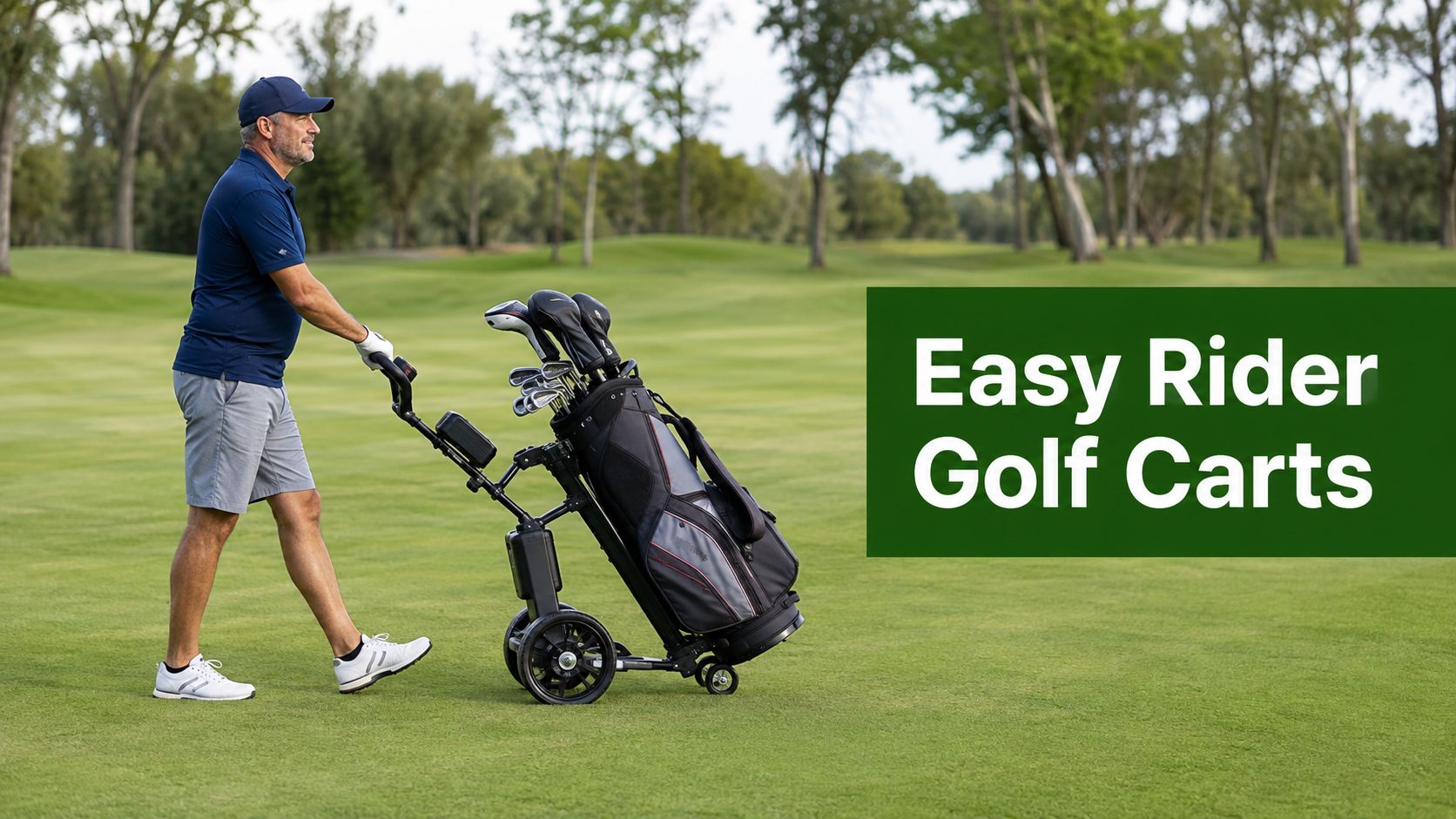
You've probably stood in the pro shop or scrolled a product page, wondering why the words easy rider golf carts seem to mean two different things. One person is talking about a course cart you can sit in and drive, another is talking about a powered add-on that helps a walking golfer move a push cart with far less effort. If you're trying to buy the right thing, that confusion is where buyer's remorse starts.

What Easy Rider Golf Carts Actually Are
A golfer usually runs into this phrase after a frustrating search. Maybe you need less strain on your knees, maybe you're helping an older parent keep walking the course, or maybe you just want to stop pushing a loaded bag up every hill. In that moment, “easy rider” sounds simple, but the market uses it in two very different ways.
Two products hide under one phrase
The first meaning is a course-owned adaptive single-rider cart. That's the sit-down style you'll often see in accessibility programs, where the cart is part of the facility's fleet and the golfer uses it to travel the course with less walking. The second meaning is a personal electric assist system for a standard push cart, which adds motorized help to the cart you already own. For readers comparing options, the difference is huge, because one solves access on the course and the other solves push effort.
The cleanest way to think about it is this. A course-owned adaptive cart is a vehicle you borrow from the facility. A personal electric assist setup is a conversion-style tool that travels with your push cart and makes it easier to move, steer, and climb. If your main problem is availability at the club, the first category matters. If your main problem is fatigue while walking, the second category usually fits better. For a plain-language breakdown of the push-cart side, what a push cart is is a helpful starting point.
Practical rule: If you want to walk with your own gear, you're usually shopping for assist. If you need seated mobility on demand, you're looking at an adaptive cart.
Why the distinction matters before you compare prices
People often compare the wrong products. They'll look at a seated single-rider cart, then judge it against a motorized wheel that bolts onto a push cart, even though those tools solve different problems. That's like comparing a riding mower to a self-propelled walk-behind mower. Both reduce effort, but the user experience isn't the same.

The Evolution from Accessibility Aid to Mainstream Convenience
The roots of golf mobility go back to the 1930s, when the first known electric golf cart was custom-made in 1932 and used mainly by people with disabilities who couldn't walk far. By the mid-1950s, golf carts had gained wide acceptance among U.S. golfers, which tells you something important about the category. Golf didn't adopt motorized help as a gimmick, it adopted it because golfers wanted to keep playing with less physical strain. That history is documented in the long-running golf-cart timeline, including the early electric and gas milestones and the entry of major manufacturers like E-Z-GO in 1954, Cushman in 1955, and Club Car in 1958 (golf cart history and milestones).
The broader market story makes the same point. Traditional golf carts were first introduced in the 1930s and took about 30 years to become commonplace, while the first commercially successful electric golf cart is widely attributed to Merle Williams' Marketeer Company in 1951 (single-rider history overview). That long runway matters because it shows the category didn't emerge from a trend cycle. It evolved through repeated use, practical feedback, and course-level acceptance.
From golf-course transport to walking support
The modern walking golfer sits inside that same lineage. Today's electric assist systems carry the same core promise that early cart makers were chasing, less walking effort and better access across different age and mobility levels. They just do it in a smaller, lighter format, usually by helping the golfer keep the push-cart model instead of replacing it.
For readers who also think about access beyond golf, adaptive mobility often works best when the equipment matches the actual setting. A useful parallel is the way people choose specialized transport for travel or daily life, such as adapted car rental Portugal, where the right setup depends on the rider's needs, not on a generic label. The same logic applies here. You don't start by asking for an “easy rider” cart, you start by deciding whether you need a seated course vehicle or a powered walking aid.
The best mobility products don't just move you, they preserve the kind of round you want to have.
A broader accessibility lens also helps. The conversation around adaptive sports equipment isn't only about sport, it's about giving people a way to keep participating without being forced into a worse experience. Golf has been moving in that direction for decades.
Course-Owned Adaptive Carts Versus Personal Electric Assist
A course-owned adaptive cart and a personal electric assist system can both make golf easier, but they behave differently in real life. One is about availability and accommodation, the other is about ownership and independence. That's the decision tree most golfers need.
Side-by-side comparison
| Feature | Course-Owned Adaptive Cart | Personal Electric Assist |
|---|---|---|
| Who provides it | The golf course or facility | The golfer |
| Best for | Players who need seated mobility support on the course | Walking golfers who want less pushing and more control |
| Availability | Depends on whether the course has one ready when you tee off | Available whenever you bring your own push cart setup |
| Fit with your routine | You plan around the course's inventory and policies | You use your own gear on your own schedule |
| Ideal use case | Significant mobility challenges, ADA-oriented access needs | Fitness-minded walkers, budget-conscious upgraders, regular push-cart users |
Cost, access, and convenience
The course-owned route can be a great solution when it's available. Some facilities treat single-rider carts as part of the course inventory, and that helps golfers who can't comfortably walk the course. But the catch is obvious. You're dependent on the club's fleet, its reservation habits, and its local policy.
Personal assist works differently. You keep your existing push cart and add motorized help, which means no waiting for a course to have the right vehicle on-site. That matters for golfers who play different courses, travel often, or don't want to build their round around someone else's equipment. It also matters if you'd rather walk with your own bag shape, your own setup, and your own routine.
The market can still be confusing because some products blur the language. Caddie Wheel, for example, is a battery-operated push cart conversion kit that attaches to a standard golf push cart and turns it into a remote-controlled cart. That's not the same thing as a course-owned adaptive vehicle, and it solves a different problem.
Who each option fits
- Choose course-owned adaptive carts if walking itself is the barrier and you need a seated solution from the facility.
- Choose personal electric assist if you already like walking, but want help on hills, late-round fatigue, or long carry days.
- Choose neither yet if you're still unsure which problem you're solving. Start with the use case, not the gear.
For golfers who want a deeper look at the broader category, a practical adaptive golf equipment guide helps separate access needs from convenience upgrades.
Installing and Maintaining Your Electric Push-Cart Assist
A personal assist system only feels easy if the setup is clean. The good news is that most golfers don't need a workshop, they need a level floor, a little patience, and a careful first assembly. The bad news is that skipping the compatibility check can waste time before you ever get to the first tee.
Start with fit, not force
Your first job is to confirm that the assist system matches your push cart's frame and wheel setup. Three-wheel and four-wheel carts can both work, but not every motorized add-on fits every design the same way. Look at the attachment points, the clearance around the rear wheel area, and the way your bag sits once the cart is loaded.
Then read the manual before you touch the hardware. That sounds obvious, but many avoidable mistakes happen at this stage. If the kit uses a snap-in bracket, torque-sensitive fasteners, or a battery mount that needs to sit level, the instructions matter more than guesswork.
Installation and daily care
A simple install usually follows the same rhythm.
- Check compatibility first. Make sure the assist unit matches your push cart model and your bag size.
- Mount everything securely. The motor, battery, and controls should feel solid before you roll out.
- Charge the battery fully before first use. Partial first charges can leave you guessing about range.
- Clean after the round. Dirt, grass clippings, and moisture build up around moving parts.
- Store the battery in a cool, dry place. Long idle periods are easier on the battery when it's not sitting in extreme conditions.
- Inspect electrical connections regularly. If anything feels loose, fix it before the next round.
A useful maintenance mindset is simple. Treat the battery like the heart of the system and the connector points like wear items. That's the same logic golfers already use with rangefinders, carts, and other gear that needs reliable power to work on demand.
If you want a deeper DIY reference, how to convert a push cart to electric is a practical companion to the install process.
Why Walking Golfers Choose Electric Assist
Most walking golfers don't want to stop walking, they want to stop fighting the cart. That's a big difference. Electric assist preserves the part of golf they like, the walk, the rhythm, the pace between shots, while reducing the part that wears them down.
A powered push-cart setup can help golfers save energy for the swing instead of spending it on the hill between the tee and the fairway. That matters late in the round, when tired legs turn into rushed decisions and sloppy tempo. If the cart handles the work, the golfer can focus on club selection, reading the wind, and making better swings with less physical noise in the background.
What it changes on the course
Electric assist also changes who can comfortably stay in the walking group. A player with joint issues may not want a seated cart all the time, but they still want to keep pace without pushing through pain. A fitness-minded golfer may want the exercise and the fresh air, but not the shoulder strain that comes from fighting a loaded cart uphill.
That's why the appeal is broader than convenience. It's about preserving walking golf as a realistic option. You still cover the course on foot, but you're not forced to spend your energy where it does the least good.
If a cart leaves you fresh enough to swing well on the last few holes, it's doing its job.
The social side matters too. Walking golfers often care about pace, etiquette, and not feeling like they're holding anyone up. Electric assist can help there because it lets players keep moving without turning every incline into a small workout. The result is a round that feels more balanced, especially for regulars who want to keep walking as they age.
For some golfers, the right answer is a full course-owned mobility solution. For others, it's a lighter system that keeps the walking routine intact. That's where a product like Caddie Wheel fits, as one option that attaches to an existing push cart rather than replacing it.
Battery Range and Terrain Performance Expectations
Battery performance sounds simple until you play a course with hills. Then the numbers start to matter. Range depends on battery capacity, vehicle mass, and terrain, not just marketing language on the box.
The Xtrider technical sheet gives a clear example. On flat ground, it reports 37 km / 23 mi on a 10 Ah battery and 53 km / 33 mi on a 14 Ah battery at a 110 kg load (technical specification). On hilly lawn, those figures drop to 19 km / 12 mi and 26 km / 16 mi at the same load, which shows how much elevation changes usable distance even when the drivetrain stays the same. The same sheet lists a 60 V lithium-ion removable battery and a 36 A controller, which fits a system built for climbing torque rather than just cruising.
What that means in plain language
If your home course is flat, range is easier to predict. If your course has repeated climbs, expect less battery economy and plan your charge around that reality. The test data also shows why weight matters. A heavier setup usually needs more energy to accelerate, hold speed, and climb.
The Xtrider leaflet also lists a 15° (27%) maximum climbing angle at 110 kg load, plus travel speeds of 13 kph (8 mph) on flat road and 6.5 kph (4 mph) in walking mode (product leaflet). Those specs help you judge whether a system is built for your course shape, not just your driveway test.
Practical rule: If your usual round includes repeated climbs, don't size the battery off flat-course expectations alone.
The broader takeaway is easy to miss. Range claims only help if they match your terrain, your bag weight, and your round length. That's why seasoned golfers look beyond the headline number and ask how a cart behaves once it's loaded and pointed uphill.

Turf Impact and Course Policy Realities
The worry I hear most is simple. “Will this chew up the course?” The honest answer is that it depends on the cart type, the turf conditions, and the local policy. Course rules still matter, but the evidence isn't as one-sided as people assume.
The common 90-degree rule lets carts leave the path at a right angle to reach a ball, then return to the path after the shot. Courses use it to balance access and turf protection, and the exact rule can vary by facility and region (90-degree rule overview). That's why the first question should be the pro shop's policy, not a guess based on what another club does.
The more interesting piece is turf impact. The USGA's 2024 field-study results found no loss of green smoothness or trueness after SoloRider traffic in those tests, and little to no impact when multiple seated carts crossed the same green that day. That doesn't mean every setup is harmless in every condition, but it does challenge the assumption that single-rider carts automatically damage surfaces.
For golfers traveling or booking around accessibility, local policy still beats assumptions. If you're planning a trip and trying to compare course access near a destination like Central Florida, a practical guide to planning a golf getaway near Orlando can help you think about course selection before you arrive.
Ask the course how it handles wet fairways, cart-path-only days, and adaptive cart access before you book.
The responsible play is straightforward. Check the rule, respect the route, and avoid sensitive turf when conditions are soft. That keeps access conversations practical instead of emotional.
If you want a walking setup that's easier on your legs without replacing the way you already play, Caddie Wheel gives you a way to add powered assist to a standard push cart. Visit Caddie Wheel to see how a conversion-style electric assist fits the kind of round you want to walk, then compare it against course-owned adaptive options with a clearer idea of what problem you're solving.
Partager:
Golf Fitness Equipment Guide for Better Performance
Top Tips for Long Distance Walking: Gear, Pacing & Safety