
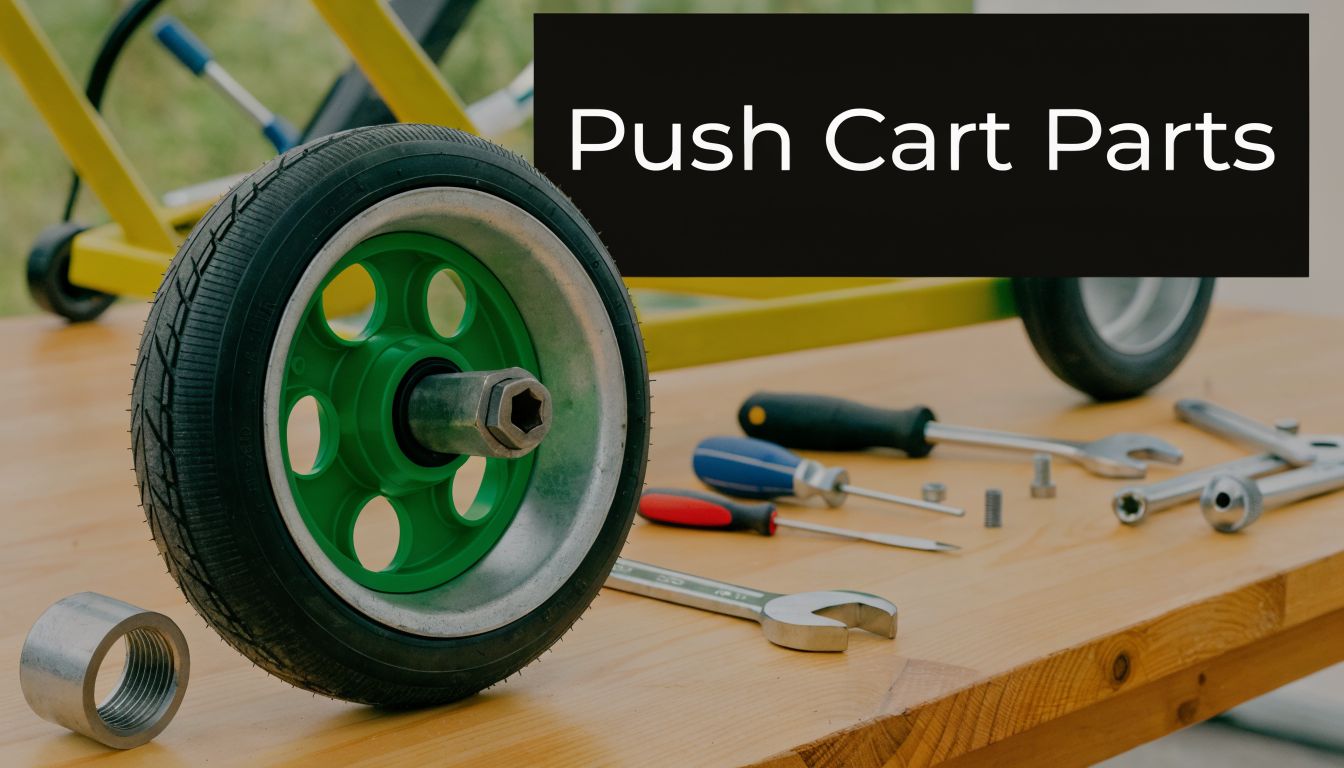
You’re halfway through a round, the fairway is firm, the weather is perfect, and then your push cart starts acting up. A rear wheel drags. The brake won’t hold on a slope. The handle gets sloppy and the whole cart starts feeling older than it is. That’s usually the moment golfers start wondering if they need a new cart.
Most of the time, they don’t.
Sun Mountain carts have earned that loyal following because they’re built to stay in service. The company has been a market leader for over 40 years, and parts are available through more than 7,000 retailers across the U.S. and Canada, which makes support far better than what you get with many smaller cart brands, according to Sun Mountain’s FAQ. In plain terms, that means a broken bracket or worn wheel usually isn’t the end of the cart.
That’s why sun mountain push carts parts matter so much. If you know your model, identify the failed component correctly, and buy the right replacement the first time, you can keep a good cart working for years instead of dumping it over one bad season. I’ve seen plenty of carts written off for problems that took a wrench, a little cleaning, and the right part to fix.
Your Essential Guide to Sun Mountain Push Cart Parts
A lot of golfers end up here after the same kind of round. The cart was fine when it came out of the trunk. By the turn, one wheel had developed a wobble, the bag was leaning to one side, or the parking brake started slipping. None of those failures feels small when you’re pushing uphill with a full bag.
The useful thing about Sun Mountain is that the brand has long treated carts as serviceable gear, not disposable gear. That matters. A push cart takes abuse from curbs, cart paths, wet rough, trunk loading, and poor storage. If the design doesn’t allow straightforward replacement of common wear parts, ownership gets expensive fast.
What usually fails first
The parts that take the most punishment are predictable:
- Wheels and tires because they collect grit, grass, and side-load stress.
- Brake assemblies because they get engaged on slopes and sometimes stored under tension.
- Bag brackets and bungees because golfers overstuff bags or cinch them down unevenly.
- Folding latches and handle pivots because they’re opened and closed every round.
That’s an essential mindset shift. You’re not dealing with a mysterious machine. You’re dealing with a cart that has a handful of wear points.
Practical rule: If the frame is sound, the cart is usually worth repairing.
That’s especially true with Sun Mountain. The replacement ecosystem is broad, and the company’s long history means there are still a lot of repairable carts in circulation. The mistake most owners make isn’t waiting too long to repair. It’s buying parts before they’ve diagnosed the failure.
Why this guide goes further
Most parts pages tell you what exists. They don’t tell you what breaks, what’s worth fixing yourself, what should stay OEM, and when an upgrade makes more sense than another repair cycle.
That’s where experienced ownership matters. A sticky folding joint isn’t always a broken latch. A cart that pulls sideways isn’t always a bad wheel. And a golfer fighting hills every weekend may be better served by improving the cart rather than replacing the same stressed parts over and over.
Identifying Your Sun Mountain Model and Required Parts
Before you buy anything, identify the cart correctly. Sun Mountain has made several families of push carts, and parts compatibility can get narrow fast. A bracket that fits one line may not fit another, even if the carts look similar in a quick photo.
The safest approach is simple. Start with the wheel layout, then the handle shape, then the fold style, then the bracket design where the bag sits.

Start with the cart family
Three-wheel and four-wheel carts tell you a lot right away.
- Speed Cart line usually points you toward the classic three-wheel Sun Mountain format.
- PX4 and Pathfinder-type layouts move you into the more stable four-wheel side of the lineup.
- Micro-Cart designs tend to prioritize compact folded size.
If you’re comparing older or compact models, size helps. The Speed Cart GT weighs 17.25 lbs and folds to 37″ x 16″ x 13″, while the Micro-Cart GT weighs 16.6 lbs and folds to 27″ x 16″ x 13″, based on the Speed Cart GT review at The Sand Trap. Those numbers are useful when a used cart has lost its label or the seller doesn’t know exactly what it is.
For a broader overview of model differences, this guide to Sun Mountain push cart models is a helpful visual reference.
Use physical clues, not guesswork
A few model-specific traits narrow things down fast.
Speed Cart V1R and related three-wheel carts
The V1R family is known for an efficient folding setup and bag bracket arrangement that’s meant to be adjusted without drama. If your cart has that classic three-wheel profile and a more traditional front-fork look, you’re likely in Speed Cart territory.
Common replacement needs include:
- Front fork assembly
- Rear wheel components
- Bag brackets
- Brake parts
- Handle-related hardware
GT and Micro-Cart style carts
These matter because they can look close in photos but store very differently. If your folded cart takes up less trunk space than older Speed Cart models, you may be dealing with a more compact line rather than a standard GT-style frame.
Parts buyers get tripped up here with:
- wheel assumptions,
- latch assumptions,
- and lower bracket assumptions.
That last one causes plenty of returns.
If two Sun Mountain carts fold differently, don’t assume they share the same latch hardware.
PX4 and other four-wheel carts
A four-wheel Sun Mountain cart usually signals a stability-first setup. These carts often use different lower support geometry, different front-end layouts, and different accessory mounting details than the three-wheel carts.
Common service items include:
| Part area | What to inspect first | What usually tells you it’s bad |
|---|---|---|
| Front wheel area | axle movement and spin | drag, chatter, side play |
| Bag brackets | cracks, looseness, fit | bag twist or slipping |
| Brake system | lever feel and hold | weak parking hold |
| Folding joints | debris and latch wear | hard fold or incomplete lock |
Check the exact part zone before ordering
Once you know the model family, identify the failed area by function, not by frustration.
Ask these questions:
- Does the cart still roll straight? If not, look at wheel alignment, axle seating, and fork condition.
- Does it fold and lock normally? If not, inspect joints and latch wear before blaming the frame.
- Does the bag sit square? If not, the bracket set may be the issue, not the wheels.
- Does the brake stop and hold? If not, inspect cable routing, lever action, and the contact point at the wheel.
That’s how you get from “my cart feels off” to “I need the lower bag bracket” or “I need the front wheel assembly.”
Diagnosing Common Sun Mountain Cart Failures
Most cart problems announce themselves early. The trick is not misreading the symptom. A squeak isn’t always a wheel bearing issue. A crooked bag isn’t always a bad bracket. Dirt, bent hardware, and loose fasteners create a lot of false alarms.
I like to sort failures into three buckets. Rolling problems, braking problems, and folding/frame problems. That keeps you from replacing a part that isn’t the cause.
Wheel and tire problems
If the cart pulls to one side, starts feeling heavy, or wobbles over smooth ground, start low.
Common causes include:
- debris wrapped around an axle,
- a wheel not seated correctly,
- damage in the front fork area,
- or uneven wear between left and right sides.
A cart that feels “slow” often just has resistance somewhere in the rolling system. Pull the wheel, clean the axle, spin the wheel by hand, and compare all sides. If one wheel doesn’t spin as freely as the others, that’s your starting point.
Brake and parking issues
A brake problem usually shows up as one of two things. The lever feels loose, or the cart won’t stay put on an incline.
That can come from cable stretch, grime at the engagement point, or wear in the brake assembly itself. Before ordering a brake part, check whether the cable is routed cleanly and whether the moving pieces are obstructed.
A lot of “bad brakes” are just neglected brakes.
If the brake engages but won’t hold, inspect for contamination and slop first. If it doesn’t engage at all, move upstream to the lever and cable path.
Folding and frame complaints
A stiff fold usually isn’t a ruined cart. It’s commonly dried mud, trapped grit, corrosion at a joint, or worn latch hardware.
If the cart feels unstable when open, inspect:
- handle pivots
- latch engagement
- bag support hardware
- frame connection points
What golfers call “frame wobble” is often play in a replaceable part.
Common Sun Mountain Failure Points and Parts Needed
| Symptom | Likely Cause | Required Part | DIY Difficulty (1-5) |
|---|---|---|---|
| Cart pulls to one side | Wheel not seated correctly, debris on axle, fork issue | Wheel assembly or fork assembly | 2 |
| Rear end wobbles | Loose or worn rear wheel component | Rear wheel component | 2 |
| Brake won’t hold | Worn or dirty brake mechanism, cable issue | Brake kit or brake-related hardware | 3 |
| Brake lever feels loose | Cable routing or cable wear | Brake cable or lever-related hardware | 3 |
| Cart won’t fold smoothly | Dirty joint, worn latch, binding hardware | Folding latch or pivot hardware | 2 |
| Bag twists during round | Worn or loose upper or lower bracket | Upper bag bracket or lower bracket | 2 |
| Handle feels sloppy | Pivot wear or loose fasteners | Handle pivot kit | 3 |
What not to do
Don’t order three parts at once because you’re annoyed and want to “cover it.” That’s how golfers end up with a box of wrong components.
Do the basic checks first:
- clean it,
- tighten obvious hardware,
- compare left and right wheel behavior,
- and inspect the exact failure point under load.
That process saves money and usually shortens repair time.
Sourcing and Purchasing Your Replacement Parts
Where you buy the part matters almost as much as which part you buy. With Sun Mountain carts, I’d split sourcing into three lanes. OEM first, reputable retailer second, used or custom solutions third.
That order keeps you out of most trouble.
When OEM makes the most sense
If you’re replacing a model-specific structural part, buy as close to original spec as you can. That includes:
- lower bag brackets,
- fork assemblies,
- latch hardware,
- and parts that affect fold geometry.
These pieces need fit more than they need a low price. A cheap wheel is annoying if it fails. A cheap bracket can make the whole cart unstable.
There’s also a real supply issue at times. Retailers have shown stock alerts such as “only 206 left” for specific brackets, which is a reminder to verify availability before you assume the part will be easy to get from one source, as noted by InTheHoleGolf’s Sun Mountain parts listings.
Retailers, pro shops, and aftermarket trade-offs
Authorized retailers are useful when Sun Mountain is out of stock or when you need a common service part quickly. Local shops can also help if they know the cart line well and can compare your old part in hand.
Aftermarket is where you need discipline. Some third-party components are fine for low-risk items like simple accessories. I’m much less relaxed about critical fit parts unless the seller can clearly document compatibility.
A smart fallback for hard-to-find plastic pieces or discontinued small components is to look at how on-demand production replacement parts are being used in other industries. That doesn’t make every printed golf-cart part a good idea, but it’s a useful framework for thinking about obsolete, low-load pieces that are no longer easy to source.
For golfers comparing broader repair options across rolling equipment, this overview of golf cart parts and replacement categories helps with the buy-versus-repair decision.
My buying checklist
Before placing the order, confirm these points:
- Exact model match. Not “looks similar.” Exact.
- Part position. Left, right, front, rear, upper, lower.
- Cart generation. Older and newer Sun Mountain carts can differ in subtle ways.
- Return policy. Useful if fitment turns out to be narrower than expected.
- Photos of your old part. Keep them on your phone before buying.
Buy the part after you remove the old one if there’s any doubt. Five extra minutes in the garage beats a return shipment.
What works and what doesn’t
What works:
- OEM for structural parts.
- Reputable retailers for common maintenance pieces.
- Used donor carts for discontinued hardware if the frame family matches.
What doesn’t:
- buying from a listing that doesn’t name the exact model,
- assuming all Sun Mountain brackets interchange,
- and chasing the lowest price on a critical component.
Your DIY Guide to Maintenance and Common Repairs
Preventive maintenance is what separates the cart that lasts from the cart that becomes a nuisance. Sun Mountain’s modular layout helps a lot here. Models like the Speed Cart V1R use a two-step folding design with easily adjustable upper and lower bag brackets, and that repair-friendly approach has been part of the cart’s design since 1999, according to the Speed Cart V1R product details at Golf4Her.

The maintenance habits that prevent most repairs
You don’t need a workshop. You need a routine.
- Clean the wheel axles after muddy or sandy rounds. Grit builds resistance and makes good wheels feel bad.
- Wipe the folding joints before storing the cart. Packed debris is one of the main reasons latches start feeling rough.
- Check bracket tightness if your bag starts leaning. Small looseness becomes a bigger fit problem fast.
- Test the brake before each round on a slope or driveway, not on the first hill on the course.
- Store the cart dry. Wet storage shortens the life of moving parts and hardware over time.
These are simple checks, but they catch most problems early.
Repair one with wheel removal and inspection
This is the first job I’d tell any owner to learn. It solves a surprising number of complaints.
You’ll need:
- a clean rag,
- a basic wrench or the appropriate tool for your cart’s wheel hardware,
- and a flat surface.
Steps:
- Remove the wheel carefully and keep the hardware in order.
- Clean the axle and the inside contact area of the wheel.
- Look for wrapped grass, hardened dirt, or visible wear.
- Spin the wheel by hand before reinstalling.
- Refit it firmly and compare it with the opposite side.
If the cart had drag or wobble, test it unloaded first. If the symptom remains on one side, that’s when I start suspecting the wheel itself or the adjoining hardware.
Shop-floor advice: Always compare the problem side to the good side. Your eye catches differences faster than your memory does.
Repair two with bracket adjustment or replacement
A twisted bag is one of the most annoying on-course problems because it makes the cart feel wrong every time you turn or stop. In many cases, the issue is bracket wear, looseness, or misalignment.
Start here:
- unload the bag,
- inspect both upper and lower contact points,
- tighten what’s loose,
- and look for cracks or distortion.
If the bracket is adjustable, set it so the bag sits square without forcing it. If the piece is damaged, replace only that component rather than trying to compensate with over-tightened bungees.
A practical video reference helps when you want to see the hardware in motion:
Repair three with brake troubleshooting
Brake work sounds more intimidating than it is. Most owners can at least inspect and clean the system themselves.
Use this order:
- engage the brake and watch what moves,
- inspect for grime or obstruction,
- check the cable path for kinks or slack,
- then decide whether adjustment or replacement is needed.
If the brake hardware is visibly worn or the engagement remains inconsistent after cleaning, that’s the point to install the new part. Don’t keep compensating for a failing brake with parking angle and luck.
The tools worth keeping nearby
A small cart-repair kit goes a long way:
| Tool | Why it earns a spot |
|---|---|
| Allen wrenches | Common on brackets and wheel adjustments |
| Screwdrivers | Useful for accessory and small hardware work |
| Small wrench set | Helps with wheel and brake fasteners |
| Cleaning rag | Needed every time, not occasionally |
| Light lubricant safe for moving joints | Helps maintain folding action |
None of this is complicated. That’s the good news. A Sun Mountain cart usually rewards basic care.
Upgrade Your Cart with an Electric Power Assist
Some repairs solve a failure. Others solve a pattern.
If your cart is mechanically sound but you play hilly courses, deal with fatigue late in the round, or want to walk more often without fighting the push, an electric power assist changes the ownership equation. This leads many golfers to stop thinking in terms of replacement parts and start thinking in terms of better use.

Why the PX4 is a strong platform
A stable four-wheel cart is a natural candidate for motorized assistance. Sun Mountain notes that upgrading a PX4 with a motorized wheel is a strong fit because the cart’s low center of gravity supports the setup well, and the assist can handle 20% grade inclines while conserving up to 50% of the user’s energy, according to the PX4 product page.
That matters in real use. A cart that stays planted under power is easier to trust on side slopes, walkways, and uneven transitions.
When the upgrade makes more sense than more repairs
An electric assist is worth serious consideration when:
- You’re replacing wear parts often because of steep terrain. Hills put extra stress on wheels, brakes, and your patience.
- You still like the cart’s frame and storage setup. There’s no point abandoning a cart you already know works for your bag and routine.
- You want to keep walking without the push fatigue. That’s common with older golfers, recovering golfers, and anyone playing long, rolling courses.
The wider market is clearly paying attention to evolving battery-assisted designs and control systems. If you want a broader sense of where that category is heading, this look at new electric caddy performance gives useful context.
One practical route for Sun Mountain owners
One option is the push-cart-to-electric conversion approach. That route is relevant for golfers who already own a compatible cart and want power assist without replacing the whole setup. In practical terms, that means attaching a motorized wheel to an existing cart rather than buying a separate full electric trolley.
What works well with this kind of upgrade:
- keeping your familiar cart,
- reducing manual strain on climbs,
- and extending the usefulness of a frame you already trust.
What doesn’t:
- adding power to a cart with unresolved structural problems,
- ignoring bracket fitment,
- or expecting any assist to fix a damaged frame or badly worn rolling hardware.
Don’t motorize a sick cart. Repair the base cart first, then upgrade it.
That order keeps the cart predictable and safer to use.
Keep Your Cart Rolling for Years to Come
A Sun Mountain cart usually doesn’t ask for much. It asks for correct diagnosis, the right part, and a little regular attention. Give it those things and it will usually outlast the frustration that made you think about replacing it in the first place.
That’s the practical value of understanding sun mountain push carts parts. You stop reacting to breakdowns and start managing ownership. A dragging wheel becomes a service job. A crooked bag becomes a bracket check. A hard push on hilly courses becomes a decision about whether repair alone is enough or whether it’s time to change how the cart works for you.
The golfers who get the longest life out of these carts aren’t mechanics. They’re owners who pay attention. They clean the axle before grit hardens up. They fix the loose bracket before it cracks. They replace the failed part instead of forcing the cart through another season.
That’s how a good push cart stays in your rotation for years. Not because nothing ever wears out, but because the wear points are manageable if you handle them early.
Frequently Asked Questions About Sun Mountain Parts
Will non-OEM parts void my warranty
It depends on the part and the issue. As a practical rule, I’d stay with OEM for structural or model-specific parts such as lower brackets, fork assemblies, and latch hardware. For low-risk accessories, owners have more room to experiment. If warranty protection matters to you, keep records of what you installed and avoid modifications that change load paths or folding geometry.
How do I find parts for an older or discontinued Sun Mountain cart
Start by identifying the cart family from its wheel layout, fold style, and bracket shape. After that, compare the old part in hand, not just the cart photo online. Older carts are where used donor carts, specialty golf retailers, and niche parts sellers become especially useful. Patience helps more than guesswork.
What are the most useful tools to keep for Sun Mountain cart repairs
If you own one of these carts, keep a small kit together:
- Allen wrench set for bracket and adjustment points
- Screwdrivers for small hardware and accessory work
- Small wrench set for wheel and brake fasteners
- Cleaning rags for axle and joint cleanup
- Light lubricant for folding points and moving hardware
That kit handles most common service jobs.
Should I repair the cart or replace it
Repair it if the frame is still sound and the problem is isolated to a wheel, brake, bracket, latch, or pivot area. Replace only when the frame itself is compromised or the cart has multiple failures that make the repair chain impractical. Most of the time, golfers underestimate how repairable these carts are.
Can I add an electric assist to any Sun Mountain cart
Not every cart will be equally suitable, and fitment matters. The cart needs to be mechanically healthy first, and the bracketing has to match the model. Stable four-wheel carts are often strong candidates, but the key is confirming compatibility before you buy anything.
If your Sun Mountain cart still fits your game but doesn’t fit your course anymore, Caddie Wheel is worth a look. It’s a power-assist option for standard push carts, with a drop-on motorized wheel and snap-in bracket setup designed for compatible three- and four-wheel carts. For golfers who want to keep walking while cutting down the strain of hills and long rounds, it’s a practical upgrade path instead of starting over with a completely new cart.
Partager:
Power Wheel Gears: A Guide for Motorized Golf Caddies
Master Your EZ GO Golf Cart Motor