
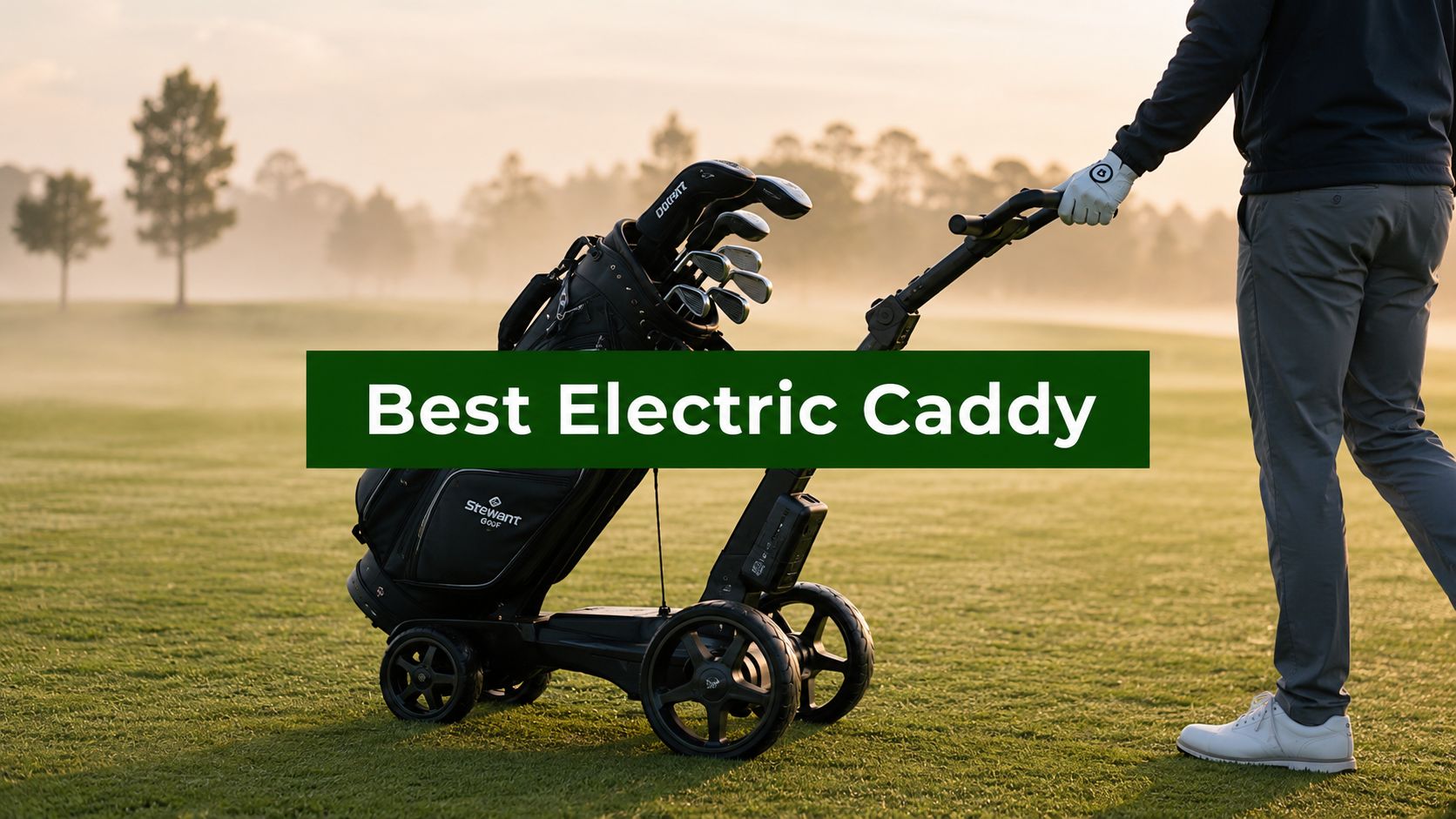
You're on the 14th fairway, your bag is loaded, the course keeps climbing, and your legs are already negotiating with the final four holes. A manual push cart still leaves you doing the hardest part, especially when the grass is damp, the bag is heavy, or the route drops sharply toward the green. The best electric golf push cart removes that strain without taking walking out of the game.
The smart purchase isn't automatically the most expensive remote caddy. It depends on whether you already own a push cart, how your home course treats brakes and traction, and whether you value compact storage over follow-me automation. This guide compares both product families, separates useful features from showroom decoration, and makes a clear recommendation for golfers who want powered assistance without buying more machine than they need.
Why Walking Golfers Are Switching to Electric Push Carts
A tired walker usually doesn't need convincing that pushing is work. The problem appears late in the round, when the golfer still wants the exercise and rhythm of walking but has less energy for the swing, the read, and the final stretch between shots. Electric assist lets the golfer keep moving under their own power while the motor handles the bag.
That distinction matters. You're not replacing walking with a motorized ride. You're reducing the repetitive load of pushing, particularly on climbs and long transitions between holes. A powered cart can preserve a steadier pace and leave more energy for the parts of golf that require concentration.
The category is expanding beyond niche equipment. The global electric golf push cart market is projected to grow from US$0.32 billion in 2024 to US$0.57 billion by 2034, an increase of about 78%, with a forecast 6% CAGR, according to Global Growth Insights' electric golf push cart market analysis. North America represents 34% of global share, followed by Europe at 29% and Asia-Pacific at 27%, while battery and smart-feature innovation accounts for more than 40% of consumer adoption worldwide, according to the same source.
The practical benefit: Electric assist protects your walking experience, not just your legs.
For seniors and mobility-limited golfers, controlled propulsion can make walking feel manageable again. Fitness-minded players get to keep the workout without turning every hill into a test of endurance. Frequent walkers also gain a more consistent round because they're less likely to slow down, stop repeatedly, or arrive at the ball already fatigued.
The important decision comes next. A fully integrated electric cart gives you a complete motor, battery, frame, and wheel package. A conversion system adds power to a push cart you already own. The right answer depends less on a generic “best” ranking and more on your storage space, course terrain, and willingness to replace equipment that already works. For a useful breakdown of the walking benefits, see the benefits of electric push carts for golfers.
What Counts as an Electric Golf Push Cart
An electric golf push cart falls into one of two product families.
Fully integrated electric carts combine the motor, battery, frame, wheels, and controls into one purpose-built unit. They're the cleanest option for shoppers starting from scratch and usually offer the broadest selection of remote, braking, tracking, and accessory features.
Conversion-style assist systems motorize a standard push cart you already own. The attachment supplies propulsion while your existing frame, bag supports, and folding setup remain in service. That can reduce replacement waste and keep the storage footprint familiar, but compatibility and installation deserve closer attention.

Compare these five specifications
- Battery range means how far the cart can travel before charging. Treat a claimed hole count as a practical target, not a promise that ignores hills, wet turf, bag weight, or repeated stopping.
- Motor torque describes the cart's ability to keep moving under load, especially uphill. A cart that feels fine on a flat fairway can struggle when traction disappears or the course tilts sideways.
- Total weight includes the frame, battery, motor, wheels, and accessories. Lower weight helps with lifting and storage, while extra mass can support stability and carrying capacity.
- Installation effort covers how much assembly, bracket fitting, and adjustment you'll handle before the first round. Integrated carts generally reduce setup work, while conversions can be attractive when the attachment fits your current cart cleanly.
- Warranty tells you how much protection the manufacturer provides for the cart, charger, battery, and related components. Read the component terms separately because coverage can differ.
Battery life deserves particular scrutiny. Independent market data places electric drive systems at about 70% of the push-pull golf cart market in 2026, reflecting the category's shift toward powered assistance, according to Fact.MR's push-pull golf cart market forecast. That same analysis identifies 18-to-36-hole usability as an important practical range for buyers comparing powered carts.
If you already own a comfortable three-wheel or four-wheel push cart, start with conversion systems. If you have no cart at all and want integrated braking, remote steering, or follow-me features from the outset, shop the complete units.
Side-by-Side Comparison of Today's Top Picks
The right choice depends on your starting point. Buy an integrated cart if you need a complete setup with built-in controls. Choose a conversion if you already own a comfortable push cart and want powered assistance without replacing the frame.
| Cart | Battery Range | Torque / Hill Climb | Total Weight | Install Effort | Warranty |
|---|---|---|---|---|---|
| MGI Zip Navigator | 36-hole claim | Dual-motor power and gyroscope tracking | Not consistently disclosed in the cited data | Integrated, minimal assembly | Verify current component terms |
| Motocaddy M7 GPS Remote | Long-round battery configuration | Downhill control and all-terrain stability features | Not consistently disclosed in the cited data | Integrated, minimal assembly | Verify current component terms |
| Bag Boy Volt | Up to 36 holes | Powered assistance with tracking-focused design | Lightweight positioning, exact figure not used here | Integrated, minimal assembly | Verify current component terms |
| Caddie Wheel conversion system | Up to 36 holes | Motorized assist for compatible carts | Adds motor and battery to existing cart | Bracket-based conversion | 12-month warranty |
| KEMIMOTO remote electric caddy | Battery range varies by configuration | Remote forward, reverse, and braking control | Not consistently disclosed in the cited data | Integrated, minimal assembly | Verify current component terms |
MGI Zip Navigator: Pick this for remote steering, stable tracking, and a full-cart purchase. Its 36-hole battery claim and gyroscope-based straight tracking suit undulating layouts. It makes less sense if you already own a push cart that folds well and fits your storage space.
Motocaddy M7 GPS Remote: This model suits golfers who prioritize downhill control over compact storage. Automatic downhill control and all-terrain wheel design help manage momentum on steep descents, where a cart without reliable restraint becomes difficult to handle.
Bag Boy Volt: The Volt fits golfers who want an integrated cart, practical battery capacity, and straightforward operation. It is a weaker match for relentlessly steep courses where advanced braking and heavy-load hill performance rank first.
Caddie Wheel conversion system: This option keeps your current push-cart frame and adds motorized assistance. The publisher describes compatibility with most three-wheel and four-wheel push carts, with a battery supporting up to 36 holes per charge. It is the clear fit for golfers who value easier storage and a simpler ownership change over premium automation.
KEMIMOTO remote electric caddy: Its control layout is easy to understand. KEMIMOTO's remote-control cart listing specifies forward, reverse, and braking functions, along with variable-speed control and an electronic brake that can hold the cart on an incline.
Compare the products by role, not by isolated feature counts. Integrated carts offer the cleaner first purchase and broader built-in functionality. Conversion systems make better sense when your existing cart already folds, stores, and carries your bag well.
Real-World Performance on Hills, Wet Fairways, and Long Days
A motor's value shows up when the course stops being convenient. Uphill power matters, but downhill control can matter more because an unrestrained cart becomes a moving problem once gravity takes over. Look for explicit braking behavior, not just vague references to “all-terrain performance.”
Remote systems can provide more than forward motion. A controller that supports forward, reverse, and braking gives you a way to reposition the cart, stop it on a slope, and avoid wrestling with the frame. The details of motor torque and how ratings translate to hill behavior are explained in this guide to motor torque ratings.

Hills test power and restraint
On a climb, torque keeps the wheels turning when the bag adds resistance. On a descent, electronic braking or downhill cruise control keeps speed predictable. Premium integrated models may include downhill cruise control, while other systems rely more heavily on the operator's remote input.
Sidehill lies create a different problem. A narrow wheelbase or poor tracking can make the cart drift downhill, forcing constant corrections. Gyroscope assistance, an anti-tip wheel, and a stable frame can reduce that workload, but they also add hardware and potentially more lifting weight.
Wet turf exposes tire design
Water resistance protects electronics, but it doesn't guarantee traction. Reviews in this category highlight features such as IPX5 waterproofing, downhill cruise control, and auto-follow systems, yet neutral evidence remains limited on which combination helps older golfers or mobility-limited players most.
Damp rough, muddy paths, and wet slopes can change how quickly a wheel breaks traction. Deep tread may help in soft turf, while a lighter setup may feel easier to correct on a sidehill. Check the manufacturer's water-resistance statement, then treat wet-course handling as a tire and terrain question rather than a waterproofing question alone.
The widely used battery benchmark is up to 36 holes, but that's not a universal runtime guarantee. One listing describes a 24V, 299W lithium system lasting up to 36 holes, while another cites a 220Wh battery with the same upper range, depending on terrain and load, as documented by Bag Boy's Volt product information.
For a 27-hole day, a healthy battery should give useful margin, but a heavy bag, constant hills, wet ground, and frequent acceleration can reduce practical range. Buy for your hardest normal day, not your flattest test round.
Matching the Right Cart to Your Walking Style
There isn't one best electric golf push cart for every golfer. The senior golfer who needs predictable stopping has a different brief from the fitness walker who wants the least added weight, and both differ from the owner of a perfectly good manual cart.
Seniors and mobility-limited golfers
Prioritize braking, stability, and control simplicity. A remote with forward, reverse, and braking functions can reduce the need to push or pull on slopes. Integrated carts with downhill control are strong candidates when the home course has sustained descents, while a conversion can work well when the existing frame is stable and easy to maneuver.
Avoid paying for follow-me automation if the golfer would rather make deliberate steering decisions. A straightforward remote often creates less confusion than a feature-heavy interface.
Fitness walkers
The goal is reduced strain, not zero effort. A lightweight conversion-style setup can preserve the familiar feel of the current cart while taking over the repetitive propulsion. Fitness-minded golfers should also think about how much equipment they lift between the car, storage area, and first tee.
An integrated cart with compact folding may be preferable if the existing manual cart is awkward or unstable. Keep the feature list focused on battery efficiency, handling, and storage instead of paying for a display or tracking mode you won't use.

Budget-conscious golfers
Conversion systems deserve more attention than most buying guides give them. If your current push cart has a sound frame, reliable bag straps, and a comfortable handle, replacing it all can be unnecessary.
A complete integrated cart makes more sense when your manual cart is already worn out or when you need purpose-built braking and terrain hardware. The budget choice isn't the lowest sticker price. It's the route that avoids paying twice for a frame, wheel set, and storage system you already have.
Hilly-course players
Choose terrain control before luxury automation. A cart that can climb but can't hold a descent safely is incomplete for a steep course. Integrated models often have the clearest hill-specific feature packages, while conversions suit golfers whose existing cart already tracks well and only needs powered assistance.
Your profile should narrow the field quickly. Seniors should start with braking and stability, fitness walkers with weight and simplicity, budget upgraders with conversion compatibility, and hilly-course players with torque and downhill control.
Pricing, Hidden Costs, and Warranty Math for 2026
The price ladder is easy to understand even when exact retail figures change. Entry-level conversion wheels usually ask you to reuse your existing frame. Mid-range integrated carts bundle the frame, motor, battery, and controls. Premium remote or follow-me flagships add automation, advanced stability, displays, and more elaborate control systems.
The mistake is comparing only the cart price. A complete package may require a spare battery for multi-round use, a travel bag for transport, a replacement or premium remote, accessory mounts, and extended warranty coverage. A conversion system can avoid several of those purchases if your current push cart already has the storage and accessories you like.
The category also has an unresolved comparison problem. Buying guides tend to focus on premium integrated models and remote features, while offering little detail on the total cost, weight, storage, and installation tradeoffs of retrofitting a standard cart, as noted in this comparison of electric golf push carts.
Use the warranty as a quality filter
Warranty language should identify the covered component and duration. One manufacturer states that its carts and chargers receive a 24-month warranty, with the lithium battery also covered for 24 months, according to QOD Golf USA's warranty information. Another battery listing also specifies a 2-year warranty, which shows why battery terms deserve separate attention from frame coverage.
A shorter warranty doesn't automatically make a product poor, but it increases the importance of replacement battery availability, service access, and clear charging instructions. A longer warranty is useful only if the exclusions and claim process are practical.
Build the budget around use
Infrequent walkers should resist premium automation unless it solves a specific problem. Frequent walkers, hilly-course players, and golfers managing physical strain can justify spending more when the extra money buys dependable braking, stable tracking, useful battery reserve, or easier handling.
Before buying, add the battery, transport, accessory, and warranty costs to the cart itself. For a deeper breakdown of ownership expenses, use this guide to the cost of electric golf carts.
Why the Caddie Wheel Stands Out for Most Walkers
Caddie Wheel is the conversion-style option for golfers who already like their push cart and only want to remove the pushing. Its drop-on motorized wheel and snap-in bracket are designed to reduce installation friction, so you're adding propulsion instead of replacing the entire frame.
The control setup is practical rather than theatrical. The variable-speed remote provides forward, reverse, and braking control, which covers the movements that matter on a fairway, around a green, or on an incline. That's a better fit for golfers who want active control than for shoppers specifically seeking autonomous follow-me behavior.
The battery supports up to 36 holes per charge, according to the publisher's product information. That makes the system suitable for long walking days when the battery is charged properly, though terrain, bag load, and operating conditions still affect real-world runtime.
Compatibility is the key check. Caddie Wheel is described as working with most three-wheel and four-wheel push carts, and the package includes the remote and holder. The manufacturer also lists a 12-month warranty, so buyers should confirm that their cart geometry fits before ordering and understand which components the warranty covers.
My buying rule: If your current push cart folds well, carries your bag securely, and feels stable, add power before you replace the whole cart.
That's why the conversion route makes sense for many walkers. It preserves a familiar storage footprint, avoids duplicating a frame and wheel system, and puts the budget into the parts that change the round, propulsion, battery capacity, and control. Golfers starting without a push cart, or those who need integrated downhill systems and built-in automation, should still compare complete electric units.
Common Questions Before You Buy
How long does a conversion installation take?
A conversion wheel requires bracket fitting and alignment, while an integrated cart arrives as a complete motorized unit with only basic setup. Don't judge installation by the first five minutes alone. Confirm that the attachment locks securely, tracks straight, and releases cleanly for storage.
Are electric push carts allowed during tournaments or on airline trips?
Course and tournament rules vary, so check the event or club policy before playing. Airline transport also depends on the battery type, packing method, and carrier rules. Contact the airline before arriving at the airport, especially when carrying a lithium battery separately from the cart.
What's the difference between three-wheel and four-wheel compatibility?
Three-wheel carts often turn easily and fold compactly, while four-wheel carts can provide a broader stance. The important question is whether the conversion bracket fits the frame and places the powered wheel correctly. Confirm compatibility with the manufacturer rather than assuming all push carts share the same geometry.
How do you extend battery life across seasons?
Charge and store the battery according to the manufacturer's instructions, keep it dry, and avoid leaving it unused in a fully depleted state. Clean grass and mud from the cart after wet rounds, then inspect the wheels and connections before the next outing.

If you already own a dependable push cart, start by checking conversion compatibility and deciding whether powered assistance solves your main problem. If you're buying from scratch, focus first on braking, battery range, terrain handling, and storage before paying for screens or autonomous features.
Caddie Wheel offers a motorized conversion system with a drop-on wheel, snap-in bracket, variable-speed remote, and battery support for up to 36 holes on compatible push carts. Visit Caddie Wheel to check the setup and turn your existing walking cart into a more manageable electric-assisted system.
Share:
Best Motorized Golf Push Cart Compared for Every Golfer 2026
Golf Bag on Wheels: The Complete Buyer's Guide for 2026