
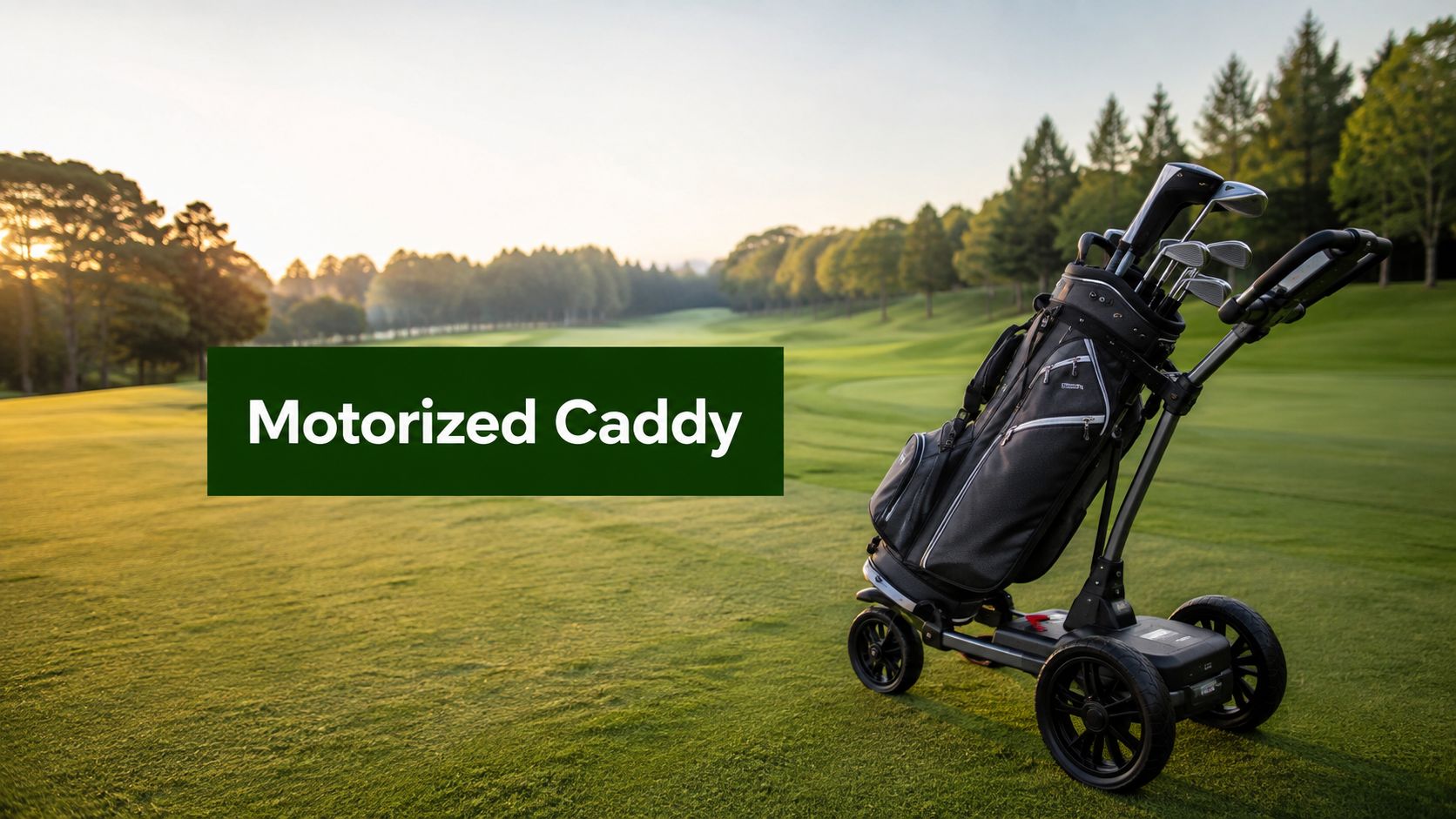
You're on the 16th tee, the course is climbing again, and your shoulders are fine only because the cart is carrying the bag. The problem has moved to your legs. Every uphill walk feels longer, every downhill section demands attention, and the swing you brought to the first tee has started to disappear.
That's where the best motorized golf push cart earns its place. It doesn't turn walking into riding. It keeps you on foot while taking away the repetitive load of pushing a fully loaded bag across uneven ground. The right system leaves you with more energy for the back nine, but the wrong one introduces new frustrations, including poor hill tracking, weak batteries, awkward folding, or a remote you can't trust.
The market is moving in that direction. One independent forecast values the global golf push and pull cart market at US$630.6 million in 2023, with a projection of US$817.0 million by 2030 at a 3.8% CAGR. The same forecast identifies electric carts as the fastest-expanding segment, projecting a 4.6% CAGR and a value of US$450.6 million by 2030 (GII Research market forecast). Those figures don't make every electric cart a smart purchase. They do show that powered walking has moved well beyond a novelty.
This guide focuses on the ownership questions product lists often skip. I'm looking at hill stability, downhill control, battery headroom, remote behavior, portability, and whether a drop-on power kit can preserve the health benefits of walking without preserving all the fatigue.
Introduction Why Motorized Push Carts Are Changing How Golfers Walk
A motorized push cart matters most late in the round, not in the parking lot. On a hilly back nine, your bag still needs to move, but your arms shouldn't be doing the work every time the fairway rises. A remote-controlled or power-assisted system lets you keep walking while reducing the effort required to manage the load.
That distinction matters because walking golf carries a much larger physical workload than riding. A standard 18-hole round generally involves about 5 to 6 miles of walking on a 6,000 to 7,000-yard course, while riders may cover only 1 to 2 miles across the same round (golf-walking comparison). The precise experience varies by course and playing style, but the practical conclusion is clear. Walking golfers need equipment that manages fatigue without removing the walk.
My starting rule: Buy motorization for the terrain and the length of your rounds, not for a feature list.
Demand also has a durable base. The R&A reports more than 100 million golfers across its markets, including 43.9 million juniors, and says 80% of young people engage through formats other than nine- or 18-hole rounds (The R&A participation overview). Flexible golf experiences continue to attract players, and motorized push carts fit golfers who want the course walk without the full physical cost of carrying or manually pushing.
My recommendations therefore separate four types of buyer. The hill walker needs torque, traction, directional stability, and controlled descents. The senior or joint-conscious golfer needs reduced strain and a manageable setup. The existing push-cart owner may get better value from a lightweight power-assist kit. The budget buyer should spend on propulsion and braking before GPS screens, app features, or luxury finishes.
A good cart should disappear into the round. It should track where you expect, stop when you expect, and have enough battery left that the final holes don't become a range calculation. That's the standard used throughout this comparison.
What a Motorized Golf Push Cart Is and How It Works
A motorized golf push cart is a walking trolley fitted with powered wheels, a rechargeable battery, and a control system. Depending on the design, you either buy the entire electric cart as one integrated unit or add a motorized wheel system to a push cart you already own.

Two architectures, two ownership experiences
An integrated electric cart combines its frame, motors, battery mount, wheels, handle controls, and accessories into one engineered package. That usually gives you cleaner cable routing and a consistent fit, but it also means replacing or storing the full cart. The added hardware can make lifting and transport more demanding than with a manual trolley.
A drop-on power kit takes a different route. A motorized wheel and bracket attach to a compatible three- or four-wheel push cart, turning that cart into a powered system. This approach makes sense if you already like your frame, want a lighter upgrade path, or need to avoid buying another complete cart.
The control method determines how involved you'll be during play. A variable-speed remote typically handles forward movement, reverse, turning, and braking. Remote control gives you direct authority over the cart's path, but it adds another device to charge, pair, carry, and protect from drops.
Battery basics and setup
Lithium-ion batteries dominate the category because they provide a compact power source for walking rounds. The important questions are less glamorous than a screen or app. Can you remove the battery easily? Does the charge indicator give you useful information? Can the system be pushed manually if power or control fails?
Compatibility deserves equal attention. Measure your push cart, confirm the bracket system, and check how the powered wheel changes the cart's balance. Installation should be straightforward, but a quick attachment isn't useful if the wheel sits poorly or the cart becomes unstable on a side slope.
If you track your walking volume and training response, a resource on metric-based muscle gain tracking can help you separate the exercise stimulus from the assistance your cart provides. That's useful for golfers who want less fatigue but still want to monitor how walking fits into their broader fitness routine.
Top Motorized Golf Push Carts Compared by Real World Criteria
After a hilly 36-hole day, the useful question is not which cart has the longest feature list. It is whether the cart tracks straight, brakes predictably, and leaves enough battery reserve that you can keep walking without managing it every few holes. I rank hill stability and control confidence above displays or entertainment features.

Core comparison
| Model Type | Drive System | Battery Endurance | Control and Stability | Best Fit |
|---|---|---|---|---|
| Integrated premium cart, such as Motocaddy M7 | Twin-motor architecture with strong powered assist | Verify long-round capacity against the manufacturer's current configuration | Remote operation, downhill control, and terrain-focused stability | Golfers who want one complete system for demanding courses |
| Drop-on power-assist kit, such as Caddie Wheel | Motorized wheel added to a compatible existing push cart | Choose enough reserve for your longest planned day | Variable-speed remote with forward, reverse, and braking | Existing push-cart owners seeking conversion without replacing the frame |
| Integrated or modular electric cart, such as Alphard systems | Dual powered wheels or hub-motor configuration, with kit-specific hardware | Match the configuration to your round length and terrain | Remote control, braking, and stabilization features vary by kit | Golfers who value compact handling and responsive remote control |
| Integrated handle-control cart | Motors and controls built into a complete trolley | Select for realistic course demands rather than the headline rating | Handle control is simple, while downhill management still matters | Players who do not want to carry a separate remote |
| Entry-level electric cart | Lower-output powered system with simpler controls | Suited to shorter or flatter use when confirmed by the maker | Basic steering and speed control, often with fewer stability features | Casual walkers on manageable terrain |
The architecture matters because it shapes ownership. A complete integrated cart gives you matched frame, battery, controls, and motors, but it can add bulk. A drop-on kit preserves a push cart you already know, provided its frame folds well, holds the bag securely, and remains balanced on side slopes.
Independent testing provides useful reference points. One tested kit used dual 130W brushless hub motors, reached a stated 5 mph top speed, offered a 50-yard remote-control range, and delivered 27 holes per charge (MyGolfSpy Alphard testing). That is a credible baseline for a long 18-hole round. I would want more reserve for repeated climbs, wet turf, or a second round.
Another reviewed model used dual 230W motors, a 36-hole battery, and an internal gyroscope that kept the cart tracking straight while automatically adjusting speed downhill (GOLF.com electric push-cart review). That package addresses the problems you feel on course, especially side slopes and descents. Raw top speed matters less than traction, braking, and a remote that responds without delay.
The important contrast: 130W per wheel can work well in a lighter kit. Steeper terrain demands more drive capacity, dependable traction, and braking that works together.
My shortlist by use case
Choose an integrated premium cart if you want the frame, battery, controls, and stability system designed as one package. Accept the added bulk for a more finished setup and fewer compatibility decisions.
Choose a drop-on kit if your current trolley already fits your height, folds cleanly, and secures your bag. You add propulsion without replacing a frame that already works, but you must confirm the wheel position and balance before relying on it on slopes.
Choose a basic handle-control model if remote ownership creates more charging and carrying friction than you want. Choose remote control if you plan to send the cart ahead, correct its line from a distance, or control a descent without keeping both hands on the handle.
Battery Life Motor Power and Control You Can Count On
Battery capacity determines whether an electric cart feels dependable or becomes another concern during the round. A manufacturer's hole rating provides a starting point, not a guarantee for every course. Hills, rough, heavy bags, wet turf, and frequent steering corrections all increase the demand on the battery and motors.

Battery headroom beats optimistic ratings
A tested electric push-cart kit managed 27 holes per charge. Expert roundups also identify 36-plus holes per charge as a useful all-day target. I consider 27 holes adequate for a standard 18-hole routine, while 36 holes gives better reserve for steep courses, consecutive rounds, or golfers who do not want to watch the battery indicator throughout the day.
Independent product coverage describes lithium-powered systems operating across 18 to 36 holes, depending on the model and conditions (Cart-Tek electric golf push carts). A remote-controlled caddy listing specifies a 10.4 amp-hour lithium-ion battery and performance of up to 36 holes depending on course conditions (Cart-Tek product listing). Read that qualification carefully. Temperature, slopes, turf, payload, and driving style affect usable range.
Use the supplied charger, keep the battery dry, and treat the maximum rating as an upper limit rather than a daily goal. For charging and storage habits, keep this golf cart battery maintenance guide with your equipment notes.
Motor output and hill behavior
Wattage is only one part of hill performance. Dual motors spread drive across both wheels, improve balance, and reduce the tendency for one side to pull the cart off line. Brushless hub motors keep the package compact by placing the drive hardware inside the wheel assembly.
Expert roundups commonly use 200W or more per wheel as a practical benchmark for stronger hill work. A lighter 130W-per-wheel kit can still perform well when its frame, tyres, load, and terrain match. Choose traction, a stable wheelbase, anti-tip support, and controlled downhill speed before chasing a higher wattage figure.
Control reliability is part of performance
Remote range matters less than predictable response. The handset should turn the cart smoothly, hold a straight line, slow the descent, and stop promptly when you release the control. Charge it before play, confirm pairing at the first tee, and learn the manual-push procedure before a fault leaves you on a slope.
A gyroscope can help maintain a straight path across a side slope. Automatic downhill adjustment can reduce runaway movement. These features matter when terrain changes quickly, because constant corrections take attention away from the next shot and make a long walking day more tiring. Choose the system that preserves a natural walking rhythm, not merely the one with the longest advertised range.
How Walking With Power Assist Affects Health Energy and Scores
Power assist changes the workload without turning a walking round into a riding round. You still cover the course on foot, move between shots, and handle slopes and changing terrain. The motor carries the bag, while your legs continue doing the walking.
The health gap between walking and riding can be substantial. One recent study recorded 17,007 steps and 880 kcal for walking a round, compared with 6,274 steps and 456 kcal when using a cart (peer-reviewed study in PMC). A motorized trolley therefore makes sense when pushing the load is the part that limits your walking, not when you want to remove walking from the round.
Fitness goals change the right answer
Choose manual pushing or carrying when maximum steps and energy expenditure are the goal. Choose power assist when you want to walk regularly, manage hills with less strain, and still have enough energy for the final holes. This walking golf health benefits guide offers useful context for weighing those priorities.
Clinical research also reports that walking golf can improve aerobic performance, reduce body weight and waist circumference, and increase HDL cholesterol over a 20-week period compared with sedentary controls (health research summary). Reducing the effort required to move your bag does not erase the value of walking.
For fitness-minded golfers: Use power assist to protect consistency. A walk you can repeat is more useful than an occasional round that leaves you unable to recover comfortably.
Joints and late-round concentration
Walking can expose joint limitations, especially on hilly courses. A separate study found that walking increased moderate-to-vigorous activity but also increased knee pain among golfers with osteoarthritis. If pushing a loaded trolley aggravates your knees, powered assistance can reduce upper-body effort and cart resistance while preserving the walking component. It will not remove the impact of walking uphill or downhill, so test the setup over a full round rather than judging it on a flat path.
A health comparison summarized by Colorado Golf reports better mental focus and lower scores among golfers who walked or used a push cart or electric trolley than among players using a motor cart, while all golf formats burned more calories than walking (Colorado Golf health summary). Treat that comparison as a reason to monitor your own energy, concentration, and scoring, not as a promise of lower scores.
Choosing the Best Motorized Golf Push Cart for Your Course and Budget
The right choice is situational. I wouldn't recommend the same setup to a flat-course golfer who plays occasional 18-hole rounds and a walker who tackles steep fairways twice in one day.
For hilly courses
Choose a system with strong drive capacity, reliable traction, and downhill control. A gyroscope or comparable tracking technology deserves priority if your fairways slope sideways, because constant correction becomes tiring and distracting. Dual motors and an anti-tip design are more valuable here than a large accessory console.
Hilly-course pick: Spend first on torque, side-slope tracking, and braking. Add GPS only after those needs are covered.
For seniors and reduced strain
Favor a frame you can lift, fold, and store without assistance. A remote can reduce the need to push, but it also introduces pairing and charging tasks, so choose a control layout you'll use confidently. A system that can be manually moved after a battery or remote problem gives you a practical fallback.
The walking-health trade-off matters here. If your knees tolerate walking but not pushing, power assist is a sensible middle ground. If walking itself causes significant pain, reducing cart effort won't solve the whole problem, so discuss your limits with a qualified clinician.
For existing push-cart owners
A drop-on kit is the most logical first option if your current cart has a secure bag platform, folds acceptably, and fits your vehicle. You preserve a frame you already know and add propulsion only where you need it.
Caddie Wheel is one example of this format. Its motorized wheel attaches to compatible three- and four-wheel push carts, uses a bracket installation, and provides variable-speed remote control with forward, reverse, and braking. The product's published operating range reaches up to 36 holes per charge, and the company describes the system as a lightweight power-assist conversion rather than a complete integrated cart. For a broader buying framework, use this electric golf push cart buying guide.
For budget-conscious buyers
Don't pay for features you won't use. A basic powered conversion can make more sense than a premium integrated cart if you already own a good trolley and mostly need help on hills or during long rounds.
The compromise is straightforward. You may get less integrated cable management, fewer built-in accessories, and a more hands-on installation process. In return, you can avoid replacing the entire push-cart frame.
Compatibility Setup and Buying Checklist Before You Buy
Start with compatibility, not motor output. Confirm that the kit fits your three- or four-wheel push cart, check the bracket position, and make sure the added wheel won't interfere with folding or bag support.
Use this short checklist before ordering:
- Measure the frame: Confirm the cart's wheel layout, bracket space, and folded configuration.
- Inspect the bag platform: A powered wheel can't compensate for a loose or poorly balanced bag.
- Confirm the battery plan: Check the stated hole range, charging method, storage requirements, and whether the battery is removable.
- Test the remote: Pair it before the first round, learn forward, reverse, turning, braking, and stopping behavior.
- Plan for failure: Find out whether the drive system disengages so you can finish manually if control or battery power fails.
- Check support terms: Read the warranty, replacement-part policy, and service process before paying.
- Practice on varied ground: Test the cart on a flat area first, then introduce slopes and uneven turf before using remote operation near hazards.
The best setup is the one you can operate without thinking about it. Charge the battery before each round, keep the remote accessible, clear grass from the wheel and bracket after play, and store the electronics in a dry environment.
If your existing push cart fits a lightweight conversion approach, Caddie Wheel offers a motorized wheel, bracket-based attachment, variable-speed remote control, and battery capacity rated for up to 36 holes. Visit Caddie Wheel to check compatibility and see whether adding power to the cart you already own is a better fit than replacing the entire setup.
Share:
Roll Cart Bags: A Complete Guide for Golfers
Best Electric Golf Push Cart: 2026 Buyer's Guide