
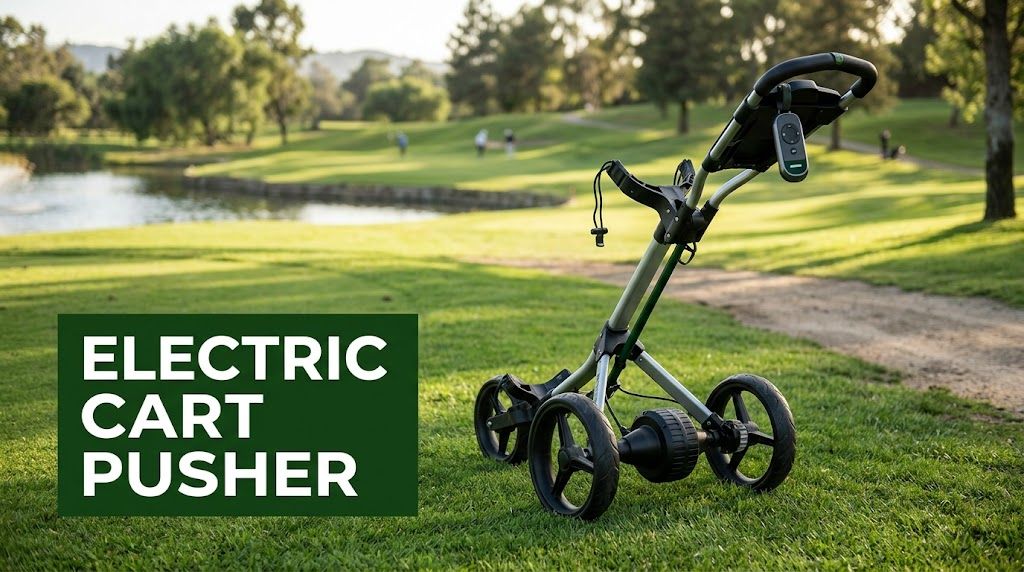
You know the feeling. You start the round happy to walk, happy to leave the riding cart behind, and by the back nine you're spending more energy shoving your push cart up hills than thinking about club selection.
That's where the car pusher electric idea starts to make sense for golfers. Not as some industrial machine, but as a compact motorized add-on that gives your existing push cart power assist. It's the middle lane between pushing everything yourself and buying a whole new electric caddy.
For a lot of golfers, that middle lane is the smart one. You already own a cart you like. You know how it folds, how it tracks, and where your bag sits. Adding electric assist lets you keep that familiarity while taking strain out of the walk.
That's also why this category is getting more attention. The broader electric pusher market is projected to grow from US$276 million in 2025 to US$405 million by 2032, according to this electric pusher market forecast. In golf terms, that matters because battery-powered assist is moving from niche gadget to practical walking tool.
Walk the Course Effortlessly with an Electric Pusher
Walking is still one of the best parts of golf. You see the course better, you stay looser between shots, and the round feels less rushed. The problem isn't walking. The problem is the steady grind of pushing a loaded cart for hole after hole, especially when the course has long climbs, soft turf, or awkward side slopes.
An electric pusher changes that without changing your whole setup. Instead of replacing your push cart, you add a powered wheel unit that helps move it along. You still walk. You still steer. You just stop wasting energy on the least interesting part of the round.

Why this upgrade feels different
A full electric caddy can be great, but it asks you to start over. New frame. New folding system. New storage shape in the trunk. A pusher conversion kit feels more like upgrading a favorite club with a better shaft. Same basic tool, improved performance.
That matters if you're in one of these camps:
- You like your current push cart: It already fits your bag and your routine.
- You want less strain, not more complexity: Power assist helps, but you don't want a machine that feels fussy.
- You walk for health: You still get the movement without the constant shove.
- You play hilly courses: That's where fatigue sneaks up on you fastest.
Practical rule: If you enjoy walking but dislike pushing, you're probably the exact golfer this category is built for.
Why golfers are paying attention now
Battery help is showing up in more kinds of equipment because it solves a simple problem. People want assistance without bulk, fumes, or a steep learning curve. That trend isn't limited to warehouses or vehicle handling. It's spreading into personal gear that cuts effort while keeping control in your hands.
For golfers, the benefit is immediate. You finish the round with more left in the tank. Your hands and shoulders stay fresher. Your focus stays on the shot, not on dragging your bag to it.
And that's the main appeal. A car pusher electric setup doesn't try to turn golf into a remote-controlled experience. It just removes the part of walking golf that wears you down for no good reason.
Understanding Electric Pusher Technology
It's like an e-bike conversion kit for your golf cart. You're not buying a totally different machine. You're adding a motorized assist system to the push cart you already own.
That simple analogy clears up most confusion. A conversion kit is not the same as an all-in-one electric caddy. The cart remains the cart. The add-on supplies the push.
The four parts that matter
Most golfers only need to understand four pieces.
The motorized wheel does the work. It contacts the ground, drives the cart forward, and usually handles reverse and braking behavior too.
The battery feeds the system. In golf products, the battery is sized around walking convenience, not industrial force. What matters to you is whether it supports your typical round and whether charging fits your routine.
The remote controls the pace. Good remotes keep things simple. Forward, reverse, speed adjustment, and stopping should all feel obvious within a few minutes.
The mounting bracket is the unsung hero. This is the part that connects the powered unit to your cart frame. If the bracket is well designed, the whole product feels neat and secure. If it isn't, everything else feels like a workaround.
Why it moves slowly on purpose
This is the part people sometimes misunderstand. Faster isn't better here.
The core of an electric pusher is a low-speed, high-torque drivetrain. Industrial models use a similar setup, often with a 36V battery system and variable-speed control to move at a controlled 0 to 3 mph, as described in this CarCaddy technical overview. That same design idea fits golf because traction and control matter more than speed.
On a course, that means the unit isn't trying to race ahead. It's trying to hold steady, keep grip on uneven ground, and avoid jerky movement.
Slow and steady is the whole point. A golf pusher should feel calm on hills, not quick on flat pavement.
What that means on the course
Low-speed torque gives you three practical benefits:
- Better hill handling because the motor is built to pull, not sprint.
- Smoother starts so the cart doesn't lurch when you engage it.
- More control near greens, paths, and slopes where precision matters.
You still guide the cart by hand. The motor just takes over the tiring part. Once you understand that, the tech stops feeling mysterious. It's a small drive system designed to make walking easier, not a robot replacing the golfer.
Key Factors for Choosing Your Electric Pusher
Choosing the right car pusher electric kit gets easier once you stop viewing it as a gadget purchase and start viewing it as a cart upgrade. You already know how your push cart behaves on your home course. The question is simple. Which add-on will make that familiar cart easier to walk with, easier to control, and easy to live with week after week?

Will it fit my cart
Start with fit, because a conversion kit only works well if it suits the cart you already own.
Golfers often hear "universal" and assume any push cart is fair game. In practice, that usually means the kit fits many common frames, with a few exceptions. Rear frame shape, brake position, wheel spacing, and folding design all affect whether the bracket sits square and stays out of the way.
Check these points before you order:
- Frame shape: Round, square, and angled tubing can change how the mount clamps on.
- Fold pattern: Some carts fold into the same space where the motor bracket needs to sit.
- Brake placement: Rear brake parts can block the mounting area.
- Bag clearance: The powered unit should not crowd the base of your golf bag.
If you want a good visual reference for what compatibility checks look like in real life, this guide to converting a push cart to electric shows the mounting area golfers usually need to inspect.
Will the battery cover my usual round
Battery life makes more sense when you match it to your routine, not just the label on the charger.
A flat course with firm ground asks less from the motor than a hilly course with long walks between holes. A light carry setup is easier on the system than a loaded cart with extra layers, drinks, and a full accessory pouch. Cold mornings can also make any battery feel a bit less eager.
A practical way to judge battery needs is to ask how you play:
- Mostly 18-hole rounds on flatter courses: Moderate battery capacity is often enough.
- Regular hilly rounds: You want more reserve.
- Frequent 27 or 36-hole days: Endurance and recharge time matter more.
- Year-round golf in cooler weather: Leave yourself extra margin.
Buy for the toughest round you play regularly. That is the round that exposes whether the kit fits your game.
Is it easy to transport and store
A good conversion kit should save effort on the course without creating a new chore in the parking lot.
This matters more with upgrade kits than with full electric caddies, because one of the big advantages is flexibility. You are adding power to a push cart you already know how to fold, load, and store. If the powered section comes off quickly and the bracket can stay attached, the whole setup feels more practical.
Look closely at:
- Added weight: Make sure you're comfortable lifting the motor unit in and out of the trunk.
- Storage shape: Compact parts are easier to fit around shoes, umbrellas, and rain gear.
- Handles and grip points: Small details matter when you're packing up after a long round.
- Quick removal: Fast detach often matters more than first-time installation speed.
How easy is the control system to use
Control should feel calm and predictable, especially late in the round when you're tired.
Some golfers want a basic remote with forward, stop, and reverse. Others prefer finer speed steps and stronger control on slopes. There is no single right answer here. The better choice is the one that lets you guide the cart without overthinking it.
Here's a simple way to sort your options:
| Question | What to look for |
|---|---|
| Do you want the shortest learning curve? | A remote with clear forward, stop, and reverse buttons |
| Do you play on hills often? | Predictable braking and precise speed control |
| Do different people use the same cart? | Controls that feel obvious right away |
| Do you dislike extra clutter? | A secure remote holder and simple pairing |
One example in this category is Caddie Wheel, a power-assist attachment made for standard push carts, with a drop-on design, snap-in bracket, and remote control. That kind of setup appeals to golfers who like their current cart and want to upgrade it instead of replacing the whole thing.
Does the upgrade make financial sense
Conversion kits particularly stand out.
If you already own a push cart you like, adding power can be the smarter spend. You keep the frame, handle, storage layout, and folding system you already trust. You pay for the part that changes the walking experience most, the drive assist, instead of buying an entirely new electric caddy from scratch.
That makes the decision less about chasing features and more about improving the rounds you already play. The right kit fits your cart, lasts through your usual day, stores without fuss, and feels natural to control. When those pieces line up, an electric pusher upgrade can feel like adding a good pull cart wheelset to a bag you already love. Familiar, useful, and worth it every time you walk.
Attaching Your Electric Pusher in Minutes
Most golfers expect installation to be the hard part. Usually, it isn't. If the kit is designed well, setup feels more like adding a seat post accessory to a bike than assembling a machine.

Phase one starts with the bracket
The bracket is the foundation. You attach it to the rear frame of the push cart where the unit is meant to sit square and stable. This part matters because the motor can only track properly if the bracket is aligned properly.
In most cases, you're not doing complicated workshop labor. You're positioning, tightening, and checking that nothing rubs the wheels, brake, or folding joints. The smartest move is to install the bracket before your bag is loaded, when you can clearly see the frame and work without awkward angles.
If you want a visual walkthrough before trying it yourself, this guide on how to convert a push cart to electric gives a good sense of how these kits typically go on.
Then the powered wheel drops into place
Once the bracket is mounted, the powered section usually becomes the easy part. The wheel assembly connects to that bracket and locks in. Good product design is evident in this connection. You want a firm fit without wrestling the unit.
Before you head to the course, do a quick dry run in the driveway or garage:
- Check alignment: The wheel should sit straight and centered.
- Test clearance: Fold and unfold the cart if the design allows it.
- Shake lightly: You're looking for security, not looseness.
- Try manual rolling: The cart should still feel manageable when not powered.
A five-minute test at home beats a frustrating first tee surprise.
A short demo often makes the process click faster than text alone:
Pairing the remote is usually the last small task
Remote pairing tends to be simple, but it's still worth doing calmly the first time. Turn the system on, follow the pairing instructions, and test forward, reverse, and stop before you add your golf bag. That last part matters more than people think. A loaded bag changes balance, and it's easier to learn the controls without the extra weight.
For your first round, keep the pace modest. Let the cart move just ahead of your natural walking speed, not faster. After a few fairways, most golfers settle into a rhythm where guiding the cart feels automatic.
The last check is the most important one. Make sure all hardware is snug after the first use. New installs sometimes need a small retightening once everything has been out on actual turf.
Pusher Upgrade vs Full Electric Caddy
This is the decisive choice. Do you upgrade the push cart you already own, or do you buy a complete electric caddy from scratch?
For plenty of golfers, the answer comes down to how attached they are to their current cart and how much change they want. A pusher add-on is usually about practical improvement. A full electric caddy is often about getting an integrated system with a broader feature set.
The biggest difference is philosophy
A pusher upgrade says, "I like my cart. I just want help pushing it."
A full electric caddy says, "I want a different platform designed around electric use from the beginning."
That difference affects cost, storage, learning curve, and daily convenience more than generally anticipated. In the industrial world, electric pushers can be built for raw force, with some models capable of moving 22,000 lbs, while golf-focused pushers aim for a balance of hill power, portability, and all-day usability for a single golfer, as noted on this automotive power pusher product page. Golf gear isn't chasing maximum force. It's chasing useful assist without bulk.

Side by side comparison
| Factor | Electric Pusher Add-On | All-in-One Electric Caddy |
|---|---|---|
| Cost | Usually the lower-commitment way to add power to golf walks | Usually a bigger upfront purchase because you're buying a full system |
| Existing cart use | Keeps the push cart you already know and like | Replaces your current cart |
| Portability | Motor unit may detach for transport and storage | One larger dedicated unit to fold and load |
| Flexibility | You can remove the assist and use the cart manually if you want | Built primarily to be used as an electric caddy |
| Features | Focuses on power assist, remote control, and straightforward function | May offer more integrated features depending on model |
| Learning curve | Often simpler if you're already familiar with your cart | May take longer because the whole setup is new |
When the add-on makes more sense
A conversion kit is usually the smarter choice if your current push cart already checks the big boxes. It folds well. It fits your trunk. It tracks straight. You like it. In that case, replacing the whole thing can feel wasteful.
The add-on route also helps golfers who want options. On some days you may want electric assist. On others, you may want to go fully manual. That flexibility is useful if you travel, swap carts with a partner, or play a mix of flat and hilly courses.
Some golfers also prefer the smaller storage footprint that can come from separating the motorized component from the base cart. If garage or trunk space is tight, modular gear often wins.
When the full caddy makes more sense
There are golfers who should skip the conversion idea and go straight to a dedicated electric caddy. If you dislike your current cart, don't force yourself to build around it. If you want a full package designed from the ground up as one unit, that's a fair reason to go integrated.
A full electric caddy can also appeal to golfers who want the cleanest all-in-one look and don't mind a larger single purchase. That buyer is choosing simplicity of system over modular flexibility.
If your current push cart already does everything well except move itself, an add-on is usually the more sensible move.
For golfers weighing that decision in more detail, this guide to an electric push cart attachment is useful because it focuses on the upgrade path rather than assuming you need a whole new cart.
Keeping Your Electric Pusher in Top Shape
An electric pusher doesn't ask for much, but it does reward basic care. A few good habits will keep it reliable and make your rounds smoother.
Start with the battery
Battery care is mostly about consistency. Charge it the way the maker recommends, avoid letting it sit neglected for long stretches, and don't treat every round like you need to drain it completely before plugging it in again.
If you want a practical refresher on that part, this guide to golf cart battery maintenance covers the basics in plain language.
Keep the wheel area clean
Grass, mud, sand, and damp debris collect faster than people think. After a wet round, wipe down the wheel, check the tire contact area, and clear anything packed around the housing. You don't need a deep workshop routine. You just don't want buildup turning into drag or noise.
A simple post-round check works well:
- Wipe the wheel: Remove grass and mud before it dries on.
- Inspect the bracket: Make sure nothing has shifted or loosened.
- Check moving areas: Look for grit near connection points.
Know one or two simple fixes
Most minor issues aren't dramatic. A remote may lose connection. A bracket may need tightening. A control may feel odd because the unit wasn't fully seated after transport.
Keep troubleshooting boring. Check charge, connections, and mounting before assuming anything is broken.
That simple mindset solves a lot. If the unit is clean, charged, and properly attached, you're already most of the way to dependable performance.
Your Electric Pusher Questions Answered
Can I use one on any golf course
Usually yes, but course rules still matter. Some clubs are relaxed about walking tech, while others may have local preferences on where carts can go, how they cross sensitive turf, or how closely they should be supervised near greens and tee boxes.
The safe move is simple. Use it respectfully, keep it under control, and ask the shop if the club has any specific policies on powered walking equipment.
How does it handle very steep hills
Hills are exactly where this kind of product earns its keep, but there are still limits. The useful principle is high torque at low speed. Heavy-duty electric pushers are engineered to move loads of up to 22,000 lbs on a 5% grade, according to this PowerPusher specification page. Golf pushers use the same idea in a much lighter, course-friendly form.
That doesn't mean you should stop paying attention on extreme slopes. On very steep terrain, traction, surface condition, and braking control all matter. Wet grass and sidehill lies can challenge any wheel-driven system, so guide the cart actively and keep speeds modest.
Is it difficult to steer with the motor attached
Not usually. You're still steering the cart, just with far less pushing effort. Most golfers adjust quickly because the motor is assisting forward motion, not taking over the whole experience.
The first few holes are the learning period. After that, it tends to feel natural. The trick is to let the cart move at your walking pace instead of trying to make it lead you too aggressively.
If you enjoy walking but want the round to feel easier on your legs, shoulders, and back, a motorized add-on is a practical place to start. It keeps the walk in the game while taking the grind out of it.
If you want to explore a power-assist option for the push cart you already own, take a look at Caddie Wheel. It's built around the upgrade approach many walking golfers prefer, with a motorized attachment that works with standard push carts instead of asking you to replace your whole setup.
Share:
Refurbished Golf Buggies: Ultimate Buyer's Guide
Electric Golf Cart Off Road Guide