
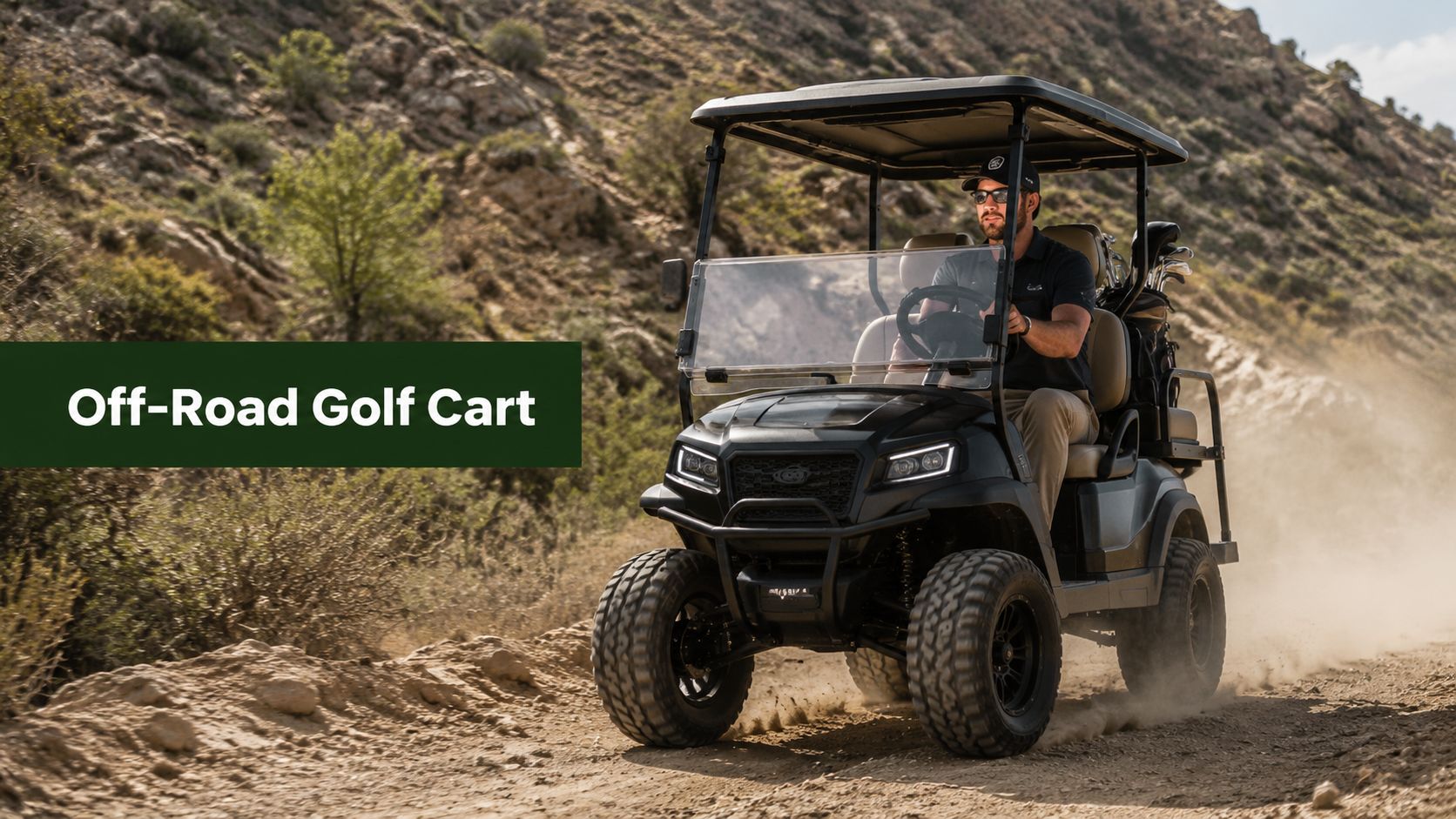
A lot of people start searching for an electric golf cart off road setup after the same moment. The rear tires spin on wet grass. The cart noses into a rut. Or it gets halfway up a hill and feels done.
That's when the difference between a normal golf cart and an off-road-capable machine stops being theoretical. It becomes very expensive, very obvious, and sometimes very inconvenient if you're a golfer, property owner, camper, or trail user who expected “lifted” to mean capable.
When the Fairway Ends and the Trail Begins
A standard cart can feel perfectly adequate until the ground changes. On a flat course path, almost any electric cart seems fine. Move onto a steep service trail, a muddy crossing between holes, or a rough property road after rain, and the weak points show up fast.
The first failure usually isn't dramatic. It's loss of momentum. The cart slows earlier than expected, the tires hunt for grip, and the underbody starts getting too close to the ground. If you carry gear, passengers, or tools, that problem gets worse.

Off road means different things to different buyers
For one golfer, “off road” means a hilly course with cart-path transitions, damp turf, and rougher access lanes. For a property owner, it might mean hauling tools over gravel, grass, and shallow washouts. For someone using a cart around a hunting property or campsite, it can mean roots, loose dirt, and uneven grades.
Those are not the same job.
A lot of carts are sold with aggressive tires, a brush guard, and a more rugged look. That visual package can help, but looks don't fix weak torque delivery or a chassis that wasn't built for repeated bumps and load transfer. That's why cosmetic upgrades often disappoint people who expected trail performance.
A cart that works on a rugged course isn't automatically a trail cart. A cart that survives a trail isn't automatically comfortable or legal anywhere else.
There's also a practical side that buyers often overlook. If you're using a cart on mixed terrain, the body and finish take more abuse than most golf-course-only carts ever see. That's where things like better panel protection and durable automotive graphics can make sense for identification, safety labeling, or fleet use on private land.
The real question to ask first
Before looking at brands or accessories, define your terrain:
- Mostly course use: Rolling fairways, occasional wet grass, maintained paths
- Mixed utility use: Gravel lanes, grassy slopes, maintenance roads, gear hauling
- True trail use: Ruts, soft ground, steep climbs, uneven surfaces, repeated impacts
That one decision filters everything else. It tells you whether you need a mild all-terrain setup, a heavily modified machine, or a purpose-built off-road cart.
What Makes an Electric Golf Cart Truly Off-Road
An off-road cart isn't just a golf cart with bigger tires. It's a package built around traction, torque, clearance, suspension control, and structural durability. If one of those is missing, the cart may still look the part, but it won't perform consistently once the ground gets rough.
Capability starts with the whole system
The easiest mistake is judging a cart by one visible feature. Buyers fixate on tire size because it's obvious. Tires matter, but they only work when the motor can keep them turning under load, the suspension keeps them planted, and the frame handles the stress without flexing in the wrong places.
A true off-road setup usually shows itself in how the cart behaves when conditions get worse:
- It keeps moving uphill instead of fading halfway through the climb
- It stays composed over uneven ground instead of bouncing and unloading a wheel
- It clears obstacles without scraping critical components
- It tolerates cargo or towing without feeling overmatched
That last point matters more than many buyers think. A cart that feels lively with one person on packed ground can become sluggish and unstable when loaded with coolers, tools, bags, or a second passenger.
What counts as real off-road hardware
The parts that matter tend to be less flashy than the accessories in a showroom:
- Suspension travel and quality: Better wheel movement helps the tires stay in contact with uneven terrain.
- Ground clearance: Enough space under the cart prevents constant scraping and hang-ups.
- Strong frame and mounting points: Rough terrain transfers shock into the chassis repeatedly.
- Appropriate gearing and controller tuning: Off-road use rewards torque, not just top speed.
- Tire construction and tread choice: The right tire depends on whether you're on grass, gravel, dirt, or sand.
Practical rule: If a cart's upgrades are mostly visual, expect visual results.
What doesn't automatically help
Some add-ons have value, but they don't create off-road performance by themselves:
- Fender flares don't add traction.
- Roof lights don't improve climbing.
- Decorative bumpers don't strengthen the drivetrain.
- Oversized wheels can hurt performance if they overload a weak motor or reduce effective torque at the ground.
Many buyers experience a common difficulty: they buy a cart that looks rugged, then spend the next season solving one limitation at a time. Real off-road performance is designed in as a system, not added later one cosmetic part at a time.
Essential Features for All-Terrain Performance
The fastest way to evaluate an electric golf cart off road is to ignore the styling and read the hardware. Start with the parts that decide whether the cart can move, climb, carry, and survive.

Motor and climbing ability
A practical off-road cart needs far more than baseline golf-course power. Alke's electric golf buggy shows the gap clearly, with 14 kW maximum motor power and a 35% negotiable slope, versus a conventional golf-buggy baseline of 2 to 4 kW and 20% slope. That gap is what off-road readiness looks like in engineering terms, not marketing language.
More power alone isn't the whole story, but it matters because steep ground and soft surfaces demand sustained torque. If the motor can't hold wheel speed while climbing, the cart slows, traction falls off, and heat builds in the system.
Battery output matters as much as battery size
Range gets most of the attention, but discharge capability often matters more on rough ground. A cited lithium example for off-road golf-cart use delivers 5.37 kWh capacity, 10.24 kW output, 200 A continuous discharge, and up to 400 A peak for 35 seconds, with a claimed up-to-50-mile range on golf-course use according to Tara Electric Vehicles. The same source also notes that a typical electric golf cart on flat terrain delivers about 25 to 40 miles per charge, and that off-road driving reduces range because rough terrain increases resistance and power draw.
That's the practical lesson. Battery capacity tells you how much energy you have. Discharge capability tells you whether the cart can utilize that energy when the hill gets steep or the mud gets deep.
If the pack and controller can't support current demand, the cart feels weak long before the battery is empty.
Tires, suspension, and wheels
Tires need to match the surface. Aggressive tread helps in mud and loose dirt, but can ride harshly and feel unnecessary on maintained turf. Suspension has the same trade-off. Soft enough to absorb bumps is good. Too soft under load can make the cart feel vague or unstable.
Wheel choice belongs in the same conversation. If you're sorting through fitment and sizing options, this guide to golf cart wheels helps frame the practical differences.
- For grass and mixed course terrain: prioritize moderate tread and controlled ride quality.
- For loose dirt and rough property roads: step up sidewall strength and tread depth.
- For heavier loads: pay attention to tire construction, not just appearance.
Chassis and underbody protection
Off-road stress goes straight into the frame. That's why purpose-built carts usually feel more settled on rough ground. The chassis, mounting points, and underbody protection are designed to absorb repeated shock without loosening parts or grinding vulnerable components into obstacles.
A cart can have enough motor and still disappoint if the rest of the structure wasn't built for uneven terrain.
Modifying vs Buying a Purpose-Built Cart
This is usually the fork in the road. You either start with a stock cart and upgrade it, or you buy something built from the factory for rough ground. Both paths can work. The right answer depends on how hard you'll use the cart and how much compromise you can tolerate.
When modification makes sense
A modified stock cart fits buyers who already own a decent platform and only need moderate terrain capability. If your use is mostly a hilly course, light property work, or improved access across gravel and grass, targeted upgrades can get you where you need to go.
That often means tires, suspension, clearance, and possibly powertrain tuning. For golfers considering smaller-scale electric assistance options rather than a full vehicle build, an electric golf push cart conversion kit can also be a more sensible category to explore.
When a factory off-road cart is the safer bet
Purpose-built off-road carts cost more up front, but they usually solve the integration problems that show up in home-grown builds. The frame, motor, controller, suspension geometry, and load expectations are designed together.
That matters if you expect repeated trail use, heavy hauling, towing, or steep terrain. It also matters if you don't want to spend weekends chasing rattles, clearance issues, or electrical limits after every upgrade.
| Factor | Modifying a Stock Cart | Buying a Purpose-Built Cart |
|---|---|---|
| Upfront cost | Usually lower if you already own the cart | Usually higher at purchase |
| Performance ceiling | Limited by the original platform | Higher because the system is engineered as a whole |
| Reliability | Depends on parts choice and installation quality | More consistent when used as intended |
| Installation complexity | Can become time-consuming fast | Minimal buyer-side setup |
| Warranty clarity | Mixed once multiple aftermarket parts are involved | Usually simpler |
| Best fit | Mild to moderate all-terrain use | Frequent rough-ground use, hauling, steep terrain |
Buy the cart for the ground you actually drive, not the ground you hope to try once a year.
What usually goes wrong with modified builds
The common failure isn't one broken part. It's mismatch. Oversized tires with a weak motor. A lift without enough suspension control. More battery weight without the frame support to carry it well. The cart becomes a collection of upgrades instead of a balanced machine.
If you enjoy wrenching and know the platform, modifying can work well. If you need dependable performance under load, factory engineering usually wins.
Navigating Rules for Off-Road and Street Use
A lot of buyer confusion starts here. People use the terms interchangeably, but an off-road cart and a street-legal low-speed vehicle are not the same thing.
Gem's street-legal cart guidance makes the distinction clear. LSVs require specific safety features for on-road driving under specific rules, while off-road builds focus on trail capability. The legal and safety consequences vary by jurisdiction, so a cart that's perfect on private land may not be lawful on neighborhood streets.

Off-road capable doesn't mean road legal
Problems often arise. People buy a lifted cart with lights and mirrors, assume it can be used anywhere, and learn later that local rules expect more than a few accessories. Street use can involve equipment requirements, registration standards, and restrictions that don't apply on private property.
Off-road builds also make choices that may not be ideal for public pavement. Tire selection, ride height, suspension tuning, and braking feel can all favor trail use over road manners.
Questions to answer before you buy
Ask these before spending money:
- Where will the cart live most of the time? Private property, golf course, campground, beach road, neighborhood street
- Who controls access? You, a course, a homeowners association, a park, or local authorities
- What use matters more? Trail ability or legal on-road access
- Are you crossing public roads or driving along them? That difference can change the compliance conversation
Check the rulebook before you check out. The wrong cart can be mechanically capable and legally useless.
A practical dividing line
If your use is mostly private land, rough paths, utility work, or recreational trail movement, prioritize off-road hardware first. If your use includes regular public-road travel, start with the legal category and then see how much terrain capability you can add without creating new problems.
Trying to build one cart that excels equally at both jobs usually leads to compromise. Some buyers can live with that. Others are better served by deciding which job matters most.
Matching the Cart to Your Terrain and Budget
The smart purchase starts with use case, not brochure language. “Off road” covers a wide range, and most buyers don't need the same machine.
Four common buyer profiles
The rugged-course golfer needs traction on hills, stability on uneven edges, and enough power to avoid bogging down in damp areas. This buyer usually benefits from a mild all-terrain setup instead of a full trail machine.
The property owner needs a cart that can carry tools, move across grass and gravel, and handle repeated daily use without drama. Reliability matters more here than style.
The recreational trail user needs real clearance, real suspension, and the discipline to accept lower comfort on smooth surfaces in exchange for rough-ground ability.
The beach or soft-ground user faces a different problem. Sand creates drag and exposes weak torque delivery quickly. Tire choice and current delivery matter more than cosmetic upgrades.
How to decide without overbuying
The easiest way to stay on budget is to match the machine to the hardest terrain you see regularly, not occasionally. A cart that spends most of its life on maintained ground shouldn't be built like a utility buggy unless there's a clear reason.
For many golfers and mixed-use owners, the practical middle ground looks like this:
- Course plus rough edges: mild lift, sensible tires, better suspension
- Property work: stronger chassis, better torque delivery, cargo-focused setup
- Frequent trail use: purpose-built off-road cart
- Walking golf on hilly courses: consider whether a full-size vehicle is overkill and whether an all-terrain cart in the push-cart category solves the actual problem with less bulk
What buyers often overlook
Battery sizing is one of the least understood parts of the decision. A lot of sellers advertise pack capacity, but buyers really need terrain-adjusted expectations. Available guidance says off-road use increases energy demand on hills, mud, rough ground, and under load, but it often doesn't quantify what that loss looks like by terrain type or cart weight, as noted by Arch Golf Cars.
That gap matters. If your route includes soft ground, repeated climbs, or cargo, plan conservatively. A cart that looks fine on headline specs can still disappoint in real terrain.
A Smarter Choice for the Walking Golfer
A lot of golfers searching for an electric golf cart off road don't need a vehicle for trails, towing, or utility work. They need help on long, hilly, tiring courses where pushing a loaded cart starts to wear them down by the back nine.
That's a different problem, and it calls for a different tool.

When a full-size cart is too much
If you walk your rounds, a full off-road cart brings baggage with it. Storage space. Transport concerns. Course rules. Maintenance. And the simple reality that you may not want a vehicle when what you really want is less strain getting up steep fairways.
That's where an electric assist approach makes more sense. Instead of replacing the walking experience, it supports it.
Caddie Wheel fits that niche. It adds electric power assist to a standard golf push cart through a drop-on motorized wheel and snap-in bracket, with remote control for forward, reverse, and braking. For golfers who want help on challenging terrain without moving into full vehicle ownership, that's a more targeted solution.
Why this fits many golfers better
Walking still gives you the pace and rhythm many players prefer. You stay closer to your shot. You avoid the stop-start feel of cart driving. But you take away the part that often makes walking harder than it needs to be, which is pushing weight uphill over a long round.
That's especially relevant for golfers who:
- Play hilly courses often: the climb is the issue, not transportation across trails
- Want less physical strain: especially in heat or late in the round
- Already own a push cart: and don't want to start over with a completely different setup
- Need simplicity: less storage, less complexity, fewer use restrictions
A quick look at the setup in action makes the category easier to understand:
The smartest gear choice isn't always the most capable machine. It's the one that solves the problem you actually have.
For many readers, that's the final takeaway. If your world includes rough property trails and hauling, look at true off-road carts with a clear eye. If your world is mostly golf and fatigue is the main concern on rolling terrain, a compact electric assist setup is often the cleaner answer.
If you want to keep walking but take the strain out of steep and sprawling courses, Caddie Wheel is worth a look. It gives standard push carts powered assistance without the storage, transport, and legal complications that come with a full-size vehicle.
Share:
Car Pusher Electric: The Ultimate Golf Cart Upgrade Guide
Battery Charging Problems: A Caddie Wheel Guide