
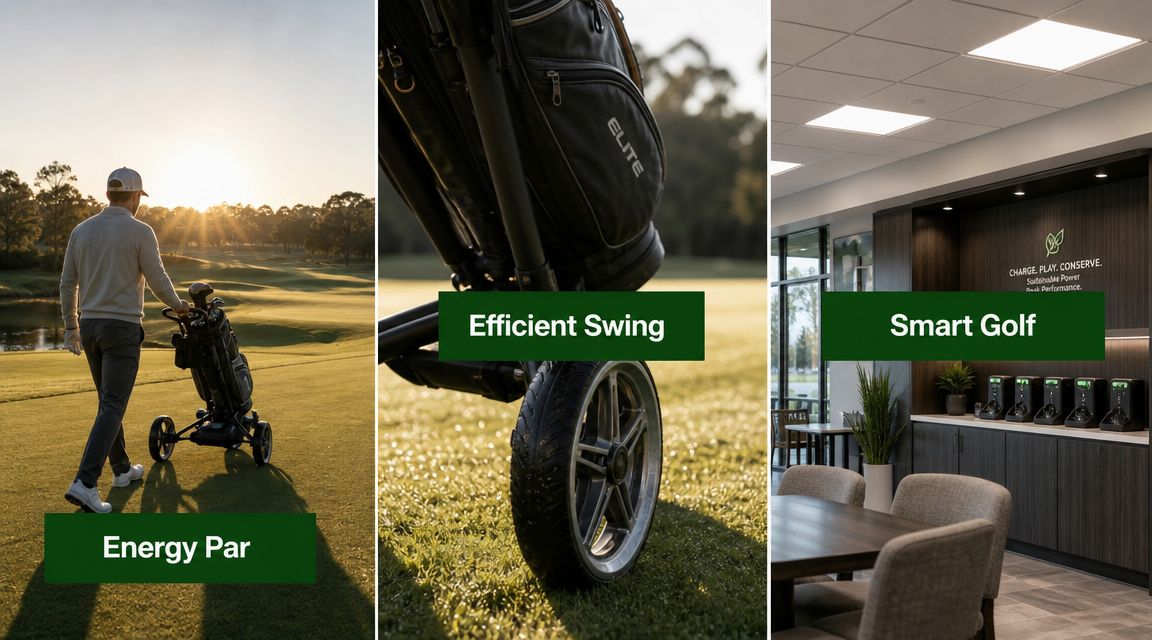
Play smarter, not harder. By the 14th tee, most walking golfers know whether they've managed their energy well or wasted it early. The swing gets shorter, the decision-making gets foggier, and even a good number off the face doesn't feel quite as solid when your legs and shoulders are already cooked.
That's why energy efficiency best practices matter in golf. Not just in a battery pack or a clubhouse utility bill, but in how you move through a round, how your gear supports you, and how much effort you burn on tasks that don't help you score. A smart setup saves more than power. It preserves focus, pace, and enough physical freshness to make a committed swing late in the day.
The same mindset shows up at bigger scales too. The U.S. EPA's guidance on efficiency programs emphasizes measurable baselines, tracked performance over time, explicit goals, and accountability, and it notes that energy efficiency could supply more than 20% of total U.S. electricity-demand savings by 2025 in projection terms in the EPA best-practices chapter. On the course, that translates well. If you don't track where your energy is going, you'll end up guessing.
If you like this kind of practical efficiency thinking beyond golf, the same mindset shows up in power management for van life too.
1. Upgrade Your Push Cart with an Electric Assist

A plain push cart works until the course gets long, the bag gets heavy, or the back nine starts climbing. That's where electric assist earns its keep. You still walk, still stay engaged with the round, and still control the cart. You just stop wasting good energy on pure hauling.
For a lot of golfers, this is the cleanest upgrade because it changes the biggest drain first. You're not trying to shave effort with tiny tweaks while still shoving a loaded cart up every slope. You're taking the heaviest repeated task and giving it motor help.
Why this usually beats a full equipment overhaul
A retrofit or drop-on system often makes more sense than replacing everything you already own. If your current push cart rolls well and fits your routine, adding assist can be the practical middle path between full manual walking and a separate motorized unit. That's one reason solutions like an electric golf push cart conversion kit appeal to golfers who want less strain without rebuilding their whole setup.
What doesn't work is using assist badly. Some players leave full power on all day, even on flat fairways, then wonder why the battery drains faster and the cart feels jerky. Smooth variable-speed use is better. Save more assist for climbs, wet ground, and long transitions between holes.
Practical rule: Use assist to remove effort you don't need, not movement you still benefit from.
A good real-world setup looks simple:
- Charge fully before the round: Start with a full battery so you're not rationing power by the sixth hole.
- Use low assistance on flat holes: Let the cart roll and guide it rather than driving it hard.
- Call on extra help uphill: That's where electric assist gives you the biggest return in reduced fatigue.
- Keep the wheel assembly clean: Grass buildup and dirt create drag and force the motor to work harder.
2. Choose a Motor with Efficient Power Management
You feel motor quality most on the back nine. A well-managed system keeps the cart steady on climbs, settled on side slopes, and calm on long walks between holes. That matters because energy efficiency on the course is not only about battery runtime. It is also about saving your legs and attention for swings that count.
Raw motor strength is only part of the story. The controller matters just as much. Good power management meters torque based on load, terrain, and speed input, so the cart moves with you instead of lurching ahead and forcing constant correction. On a golf course, that usually leads to two gains at once. Lower power waste and less physical and mental drain.
An efficient setup also makes a practical difference in club selection and pace. If the cart tracks predictably, you arrive at the ball less rushed, less tense, and with more focus left for yardage, lie, and shot shape.
What to look for in real use
Specs can help, but the course tells the truth. Efficient power management feels smooth under load, holds speed without sudden surges, and responds cleanly when you ask for small adjustments. The motor should not hunt for power on mild grades or jerk every time the ground changes.
Heat is another giveaway. A motor that runs hot during ordinary use is often wasting energy instead of converting it into useful movement. Excess heat also puts more strain on the battery and can shorten useful runtime over a full round.
A smart controller usually beats a bigger motor with sloppy delivery.
If you want to get more from the full system, not just the motor, this guide on how to optimize your golf cart charge pairs well with motor selection because efficient power use starts with both delivery and storage.
Use these checks when comparing options or dialing in your current setup:
- Prioritize controlled torque over peak punch: Strong low-speed pulling power is more useful than aggressive acceleration on a course.
- Choose smooth speed response: Small input changes should produce small speed changes, especially on greenside paths and narrow approaches.
- Watch for unnecessary heat: Warm is normal. Noticeably hot after routine use usually points to drag, poor tuning, or inefficient power delivery.
- Match the motor behavior to your home course: Rolling, windy layouts reward stable control. Flatter courses often benefit more from restrained output and consistent pacing.
- Avoid running at maximum assist by default: Constant full power wastes energy and makes the cart harder to guide cleanly.
On a windy, uneven course, efficient power management does more than preserve charge. It reduces the little corrections that add up over 18 holes. Less wrestling with the cart means less fatigue in your hands, shoulders, and legs, which is exactly the kind of energy saving that can still help on the final few swings.
3. Optimize Your Battery and Charging Routine

Battery efficiency starts long before the first tee. Most battery trouble comes from habits, not defects. Leaving a pack in extreme heat, storing it discharged, or topping it up carelessly round after round will eventually show up in reduced runtime and weaker performance when you need it.
That matters because battery anxiety changes how people play. Once a golfer thinks the assist might not last, they start micromanaging it, using it at the wrong times, or abandoning it too early.
Build a routine you can repeat
The best charging routine is boring. Charge the battery fully before extended play, store it in a cool, dry place, and keep the contacts clean so power transfer stays consistent. If you want a product-specific rundown, this guide on how to optimize your golf cart charge covers the practical side well.
IBM's efficiency program is a useful reminder that disciplined tracking beats guesswork. IBM reported a 3.5% annual energy-conservation target and said it exceeded that in 2008 with 6.1% savings, along with $32.3 million in savings and $16.4 million in cost avoidance, supported by a global reporting and accountability system across 650 facilities in this IBM energy-efficiency case study. You obviously aren't running 650 facilities on the back nine, but the principle is the same. The golfers who get dependable battery performance are the ones who use a repeatable routine.
Don't wait for the battery to “seem weak.” Track how it behaves over time and replace guesswork with a pattern.
Try this simple approach:
- Recharge before the pack gets depleted: That's usually easier on the system than repeated full drains.
- Use fast charging when you need it, not every time: Convenience is great, but slower charging is often gentler for routine use.
- Store in moderate temperatures: A trunk in summer or a freezing garage in winter is a bad long-term plan.
- Check connectors regularly: Dirty or corroded contacts create resistance and waste power.
4. Focus on Lightweight Gear and Cart Setup

Golfers love adding things to the bag. Extra outerwear, duplicate accessories, too many balls, tools for every possible weather shift. Then they wonder why the cart feels sluggish and the walk feels harder than it should.
Weight is the quiet energy thief. Every added pound asks more from you on manual pushes and more from the motor on assisted ones. That's why one of the best energy efficiency best practices for golf is also one of the least flashy. Carry less.
Trim the load without hurting your round
Start with the bag itself. If you're using a heavy cart bag packed like a travel case, you're creating drag that no efficient setup fully erases. A lighter bag and a cleaner loadout usually improve both battery endurance and physical comfort.
This doesn't mean chasing the lightest possible part at any cost. Some ultralight components give up durability, especially if you play rough terrain, load the cart carelessly, or travel often. The better trade-off is durable-light, not fragile-light.
A practical reset usually includes:
- Remove duplicate accessories: Two towels, extra water bottles, old scorecards, and spare layers add up fast.
- Choose lighter materials where it makes sense: Aluminum and smart composite parts can reduce total load without feeling flimsy.
- Balance the bag properly: Poor weight distribution makes the cart pull awkwardly and can stress the frame.
- Inspect lightweight components often: Reduced mass is useful only if the part still holds up safely.
A simple course example proves the point. On a flat practice loop, a tidy bag feels like convenience. On a hilly championship layout in summer, it feels like stamina insurance.
5. Use Adaptive Power for Different Terrains
The course doesn't ask for the same effort on every hole, so your cart shouldn't deliver the same assist everywhere either. Flat opening holes, sidehill lies, steep approaches, and long paved connectors all put different demands on the system. Adaptive power matters because steady full output is usually just waste.
This is one of the clearest places where golfers can act more like smart operators. Efficient systems respond to terrain and load in real time. Even if your equipment doesn't automate that perfectly, you can still drive it that way with your own habits.
Match the setting to the hole in front of you
If the hole is level and open, use less power and let momentum do some work. If you're climbing, carrying extra water, or moving through soft ground, step assistance up before the strain arrives. That small timing change keeps movement smoother and reduces those abrupt, battery-hungry bursts.
Researchers who study efficiency adoption often point to information barriers as a major reason people don't use efficient solutions well. A University of Chicago working paper says information is “continually cited” as the most influential market barrier for efficiency uptake and notes that efficient technologies are often “neither widely available nor understood by the public” in that synthesis of prior research. Golf sees the same thing. Many players own capable gear but never learn how to use its settings intelligently.
The wrong power mode on the wrong hole is like taking one club for every shot. It can work, but it's rarely efficient.
Use a terrain-based pattern:
- Flat stretches: Lowest practical assist.
- Rolling terrain: Moderate assist with smooth adjustments.
- Steep climbs: Higher assist before the cart starts to bog down.
- Tight, technical areas: Controlled speed beats raw power.
The payoff isn't only battery life. The round feels calmer. Less wrestling, less stop-start effort, less late-round fatigue in your hands and shoulders.
6. Leverage Regenerative Braking on Hilly Courses
Golfers on hilly courses often overlook the easiest recovery zone on the property. It's the downhill walk between shots. If your setup supports regenerative braking, those descents can do more than control speed. They can help feed energy back into the system instead of wasting it as heat.
That doesn't turn every slope into free power. The primary benefit is more modest and more useful. You get better downhill control, less wear from abrupt stopping, and some energy recovery when the terrain cooperates.
Where regen actually helps
Regenerative braking pays off most when the course has repeated elevation changes and you use the braking function deliberately. Long, steady descents are more useful than tiny dips. Sharp panic stops aren't the point. Smooth braking is.
If you want the mechanical side explained clearly, this breakdown of how regenerative braking works and its benefits is a good starting point.
What doesn't work is assuming regeneration will rescue sloppy energy use elsewhere. It won't. If you overdrive the cart uphill, blast full assist on flat sections, and carry too much weight, regen won't erase those choices.
A better approach looks like this:
- Brake progressively on descents: Smooth control helps the system recover energy more effectively.
- Use downhill stretches strategically: Let the cart settle into a controlled roll rather than constantly pulsing power.
- Pair regen with safe speed management: The first job is control, not chasing tiny recovery gains.
- Maintain the braking system: Regen is only useful when the whole braking setup is working properly.
On a hilly track, this can make the cart feel more composed all day. That alone is worth a lot because stable pacing keeps you fresher and mentally quieter.
7. Master Your Remote for Efficient Control
A remote looks like a convenience feature until you use it badly. Then it becomes an energy leak. Jerky inputs, repeated speed jumps, and constant correction force the motor to respond harder than necessary. Smooth control saves power and makes the cart easier to manage in traffic, around greens, and on uneven ground.
The best remote users don't make the cart do dramatic things. They make it do small, timely things.
Smooth inputs beat constant corrections
If you stab the controls every few seconds, the cart never settles into an efficient rhythm. A short learning session before a real round is worth it. Practice starts, stops, gentle speed changes, reverse, and braking in an open area. Once those movements feel automatic, you'll spend less energy managing the machine.
Good remote discipline also saves your own attention. During a round, attention is finite. You want it on lie, wind, target, and routine, not on whether the cart is drifting because you're overcontrolling it.
A few habits help immediately:
- Keep the remote accessible: If you're digging through pockets, you'll react late and make rougher inputs.
- Use gradual speed changes: Most carts track better when you ramp speed rather than jump to a setting.
- Check battery status before the second loop: That's especially useful if you're playing extra holes.
- Keep a backup remote handy: Redundancy isn't just for big systems. It's practical on the course too.
Remote mastery sounds minor, but it's one of those details that sharpens everything. The cart moves when you want, stops when you want, and disappears into the background where it belongs.
8. Follow a Preventive Maintenance Schedule
Efficiency drops slowly before it fails loudly. A wheel starts tracking slightly off. A connector loosens. Dirt blocks airflow around a motor housing. Bearings pick up resistance. None of those issues looks dramatic at first, but together they force the system to work harder and drain energy faster.
Preventive maintenance is the least glamorous item on this list and one of the most valuable. It keeps small problems from becoming battery problems, motor problems, or round-ruining problems.
Check the parts that create hidden drag
Most golfers are good at noticing visible damage. They're less consistent about spotting performance drag. That's where a schedule helps. Don't inspect only when something feels wrong. Inspect because it's time.
Economists writing about the energy-efficiency gap point to hidden costs, hassle, split incentives, asymmetric information, and behavioral biases as reasons people delay good efficiency decisions in this Resources for the Future article. That same friction shows up in golf gear care. Maintenance gets skipped because it feels small, inconvenient, and easy to postpone. Then the system performs worse than it should.
Small maintenance jobs are easier than carrying the cost of neglected equipment for an entire season.
A preventive schedule can stay simple:
- Monthly cleaning: Clear dirt and grass from wheel assemblies and ventilation areas.
- Quarterly connection check: Look for corrosion, looseness, or wear around battery contacts and wiring.
- Seasonal alignment review: Make sure wheels roll straight and bearings feel smooth.
- Off-season storage prep: Store equipment in a temperature-controlled area and don't leave the battery neglected for months.
The benefit is steady performance. The cart feels the same in month six as it did in month one, and that consistency matters more than people think.
9. Ensure Seamless Integration with Your Existing Cart
A power-assist system can be efficient on paper and frustrating in real life if it doesn't fit the cart you already trust. Bad integration creates wobble, awkward handling, installation headaches, and extra wear. That's the opposite of efficiency.
The best retrofit setups feel native once they're mounted. The cart still folds, rolls, and loads in a way that makes sense. You shouldn't have to redesign your routine just to add power.
Compatibility is an efficiency issue
A poor fit doesn't just annoy you. It can cost energy. Misalignment increases drag. Weak mounting can shift weight in ways that make the cart harder to steer. If the system adds complexity every time you install or remove it, many golfers end up using it inconsistently, which defeats the point.
That's why compatibility checks come first. Confirm your cart style, wheel layout, frame condition, and bracket fit before buying. If you swap between multiple carts, keep adapters organized and photograph the installation so you can repeat it without trial and error.
A solid integration process usually includes:
- Verify the exact cart model: “Looks close enough” is a bad purchasing strategy.
- Inspect the frame before adding assist: An older cart with play in the frame won't improve with added power.
- Follow bracket alignment carefully: Small mounting errors often create tracking issues later.
- Test manual rolling first: Before the powered round, confirm the cart still behaves well on its own.
Golfers often focus on battery capacity and motor feel, but integration decides whether the whole system becomes part of your routine or ends up staying in the garage.
10. Use Graduated Assistance and Eco Modes
You feel the cost of bad power pacing on holes 15 through 18. The battery may still have charge, but your legs are heavier, your tempo slips, and small uphill walks start to affect club selection and focus. Graduated assistance helps prevent that.
A fixed assist setting is rarely the most efficient choice for a full round. Courses change. So do wind, turf resistance, temperature, and your own energy level. Eco mode and stepped assist settings let you match output to the actual demand instead of running the cart harder than the hole requires.
Play for late-round stamina
Eco mode works best when the course gives you easy ground. Flat paths, mild transitions, and firm fairways usually do not need much help. Save stronger assist for long climbs, soft turf, or stretches where pushing would raise your heart rate before the next shot.
That same approach matters beyond battery management. The primary benefit is energy management for the golfer. If the cart does just enough work early, you keep more in reserve for the closing stretch. That often means steadier swings, better decisions, and less fatigue over the final few holes.
A simple pattern works well on most rounds:
- Use eco mode on flat sections: Let the cart roll with minimal assist where resistance is low.
- Move to a mid setting on mixed terrain: Keep the pace comfortable without drawing unnecessary power.
- Use high assist selectively: Steep climbs, wet ground, and heavier loads justify the extra output.
- Adjust as the round develops: Heat, wind, and tired legs can change the right setting by the back nine.
Golfers who get the most from electric assist usually treat power like club selection. They do not reach for the biggest option every time. They choose the setting that fits the shot, the slope, and the stage of the round.
That is how efficiency shows up where it matters. More battery left. More legs left. Better golf late in the day.
10-Point Energy Efficiency Best Practices Comparison
A good comparison table should help you choose where to spend money, where to spend setup time, and where you get the biggest return in fresher legs late in the round. The strongest options do both jobs well. They reduce battery draw and reduce the work your body does over 18 holes.
| Item | Implementation Complexity 🔄 | Resource Requirements ⚡ | Expected Outcomes 📊 | Ideal Use Cases 💡 | Key Advantages ⭐ |
|---|---|---|---|---|---|
| 1. Upgrade Your Push Cart with an Electric Assist | Low, tool-free drop-on install | Motor kit, battery, charger; moderate cost | Less fatigue; easier walking over full rounds | Walkers, seniors, multi-round trips | Easy retrofit; portable and cost-effective ⭐ |
| 2. Choose a Motor with Efficient Power Management | Medium to High, advanced controllers | Brushless motor, intelligent controller; higher cost | Longer runtime; lower heat; smoother power delivery | Setups prioritizing range and thermal control | Improves battery life and drivability ⭐ |
| 3. Optimize Your Battery and Charging Routine | Medium, BMS and charging discipline | High-capacity Li-ion, fast charger, BMS | More consistent round-to-round performance; faster top-ups; longer battery life | Frequent players and golf travel | Better reliability with safer charging habits ⭐ |
| 4. Focus on Lightweight Gear and Cart Setup | Medium, material selection and testing | Aluminum or carbon parts; possible higher cost | Lower energy use; easier handling; less strain on slopes | Players who value portability and control | Reduces drag on both motor and golfer ⭐ |
| 5. Use Adaptive Power for Different Terrains | High, sensors and predictive control | Terrain and load sensors, advanced firmware; higher cost | Smarter assist with better efficiency across mixed ground | Varied-terrain or efficiency-focused courses | Matches output to real course demands ⭐ |
| 6. Use Regenerative Braking on Hilly Courses | High, bi-directional control and safety tuning | Bi-directional motor, regen controller, quality brakes | Recovers some energy on descents; reduces brake load | Hilly courses with frequent downhill sections | Adds efficiency where gravity can help ⭐ |
| 7. Master Your Remote for Efficient Control | Low, ergonomic UI design | Wireless remote, receiver, small display; low cost | Fewer wasted inputs; better speed control; better battery awareness | All golfers, especially players who want simpler control | Reduces stop-start waste and control errors ⭐ |
| 8. Follow a Preventive Maintenance Schedule | Low to Medium, scheduled inspections | Time, basic tools, occasional professional service | Fewer failures; steadier efficiency over time | Regular users, rental fleets, long-term owners | Protects performance and avoids preventable losses ⭐ |
| 9. Ensure Proper Integration with Your Existing Cart | Low, retrofit compatibility checks | Drop-on kit, universal brackets or adapters; minimal tools | Upgrade without replacing the cart; preserves manual use | Budget-conscious owners with an existing cart | Straightforward retrofit with broad compatibility ⭐ |
| 10. Use Graduated Assistance and Eco Modes | Medium, mode management and UI | Firmware, presets, speed governors; modest cost | Better range when settings match the hole and load | Fitness-focused golfers balancing exertion | Flexible power control that supports smarter pacing ⭐ |
Your Most Efficient Round Awaits
Energy efficiency best practices in golf aren't just about extending battery runtime. They're about protecting the part of your game that matters most when the round gets deep. Your body, your focus, and your ability to make one more committed swing. If you waste energy on hauling, overpowered cart settings, poor maintenance, or a bloated setup, you pay for it later with tighter muscles, sloppier decisions, and less enjoyment.
The encouraging part is that most of the fixes are practical. Trim the bag. Charge with a repeatable routine. Learn your remote instead of jabbing at it. Use assist where it matters most. Treat hills differently than flats. Keep the system clean and aligned. None of that is flashy, but it works.
The larger lesson is the same one efficient operators use in other settings. Measure what matters, build a routine, and improve the system instead of guessing. On the course, your baseline might be simple. How fresh do you feel on the closing holes? How often are you still fully committed over the ball on 16, 17, and 18? How much of your walk feels healthy and active, versus draining and repetitive? Those are useful markers because they connect energy use to actual golf.
There are trade-offs, of course. More assist means more reliance on battery management. Lighter gear can sacrifice durability if you go too far. Advanced features only help if you learn them. And retrofits only pay off when they integrate cleanly with the cart you already have. But those are manageable trade-offs, especially compared with grinding through every round the hard way.
For golfers who want walking golf with less strain, a product like Caddie Wheel can fit into this approach because it adds electric power assist to standard push carts rather than forcing a complete reset of your setup. Used well, that kind of system supports preserving energy for better golf, not just easier transport.
A more efficient round usually feels better before it scores better. Then the better scores start showing up too. You finish stronger. You think more clearly. And walking the course starts feeling like an advantage again, not a tax.
If you want a simpler way to conserve energy while still walking the course, take a look at Caddie Wheel. It's built to add electric power assist to many standard push carts, which can help reduce strain, smooth out hilly rounds, and leave more of your energy for the shots that count.
Share:
Golf Cart Mule: Your Guide to Motorized Course Helpers
Motor Torque Ratings: Golf Push Cart Power Guide