
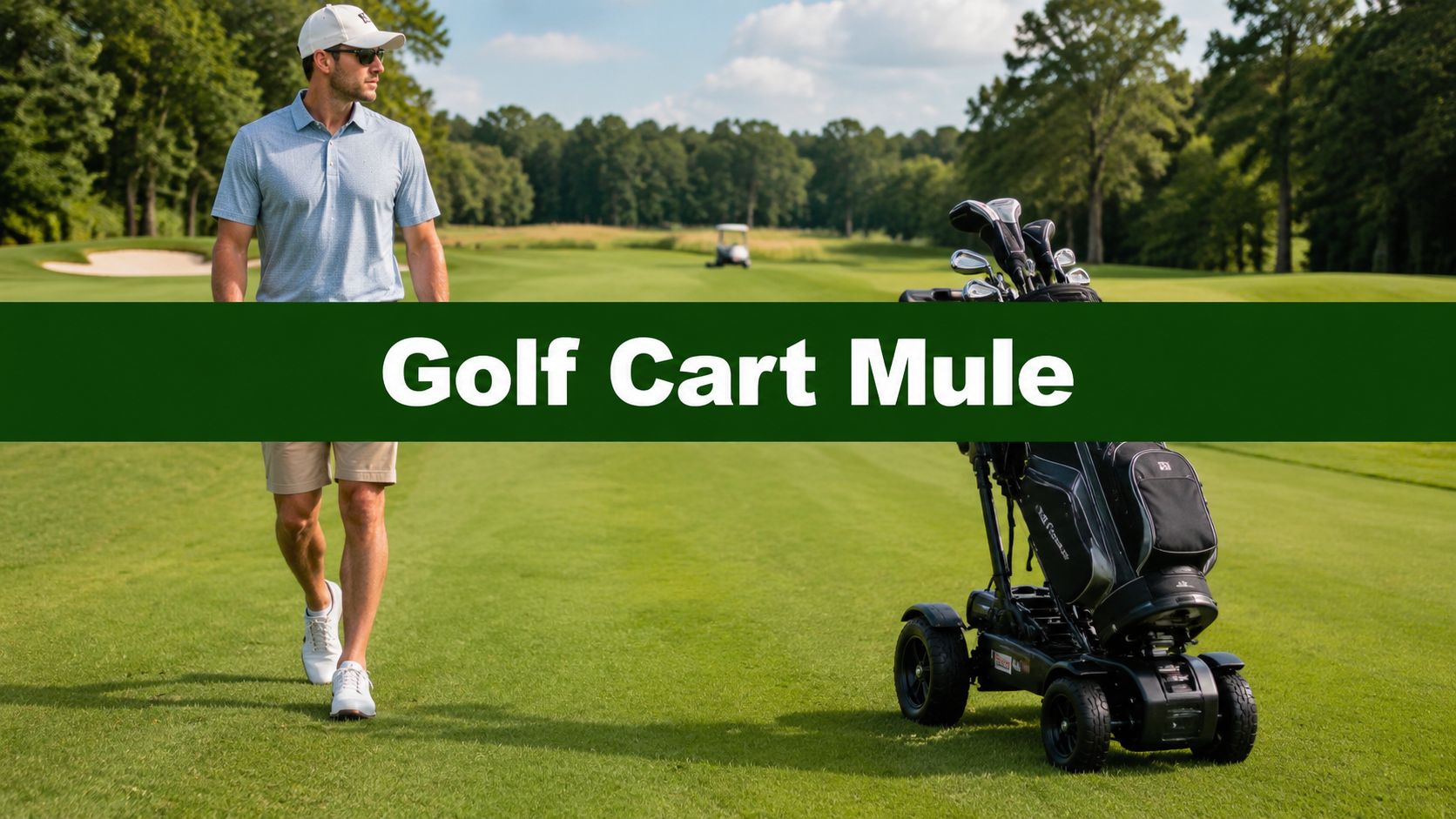
By the time many golfers reach the back nine, the scorecard isn't the only thing getting heavy. Your shoulders tighten. Your hands stop feeling loose. A course that felt pleasant on the first few holes starts to feel longer, hillier, and less forgiving. You still want the benefits of walking, but you'd rather save your legs and lower back for the swing.
That's where the idea of a golf cart mule starts to make sense.
I'm not using that phrase as a single product name. I'm using it the way golfers often think about gear in real life. A mule is the thing that carries the load so you don't have to. On a golf course, that can mean a utility vehicle, a riding cart, a motorized push cart, or a power-assist wheel that turns your current push cart into something much easier to manage.
For a lot of players, this gets confusing fast. Some people search “golf cart mule” and mean a rugged Kawasaki MULE. Others mean “What can help me walk without pushing so hard?” Those are very different questions, but they sit in the same family of course transportation. If you've been dealing with stiff knees, sore hands, or a tired lower back, it also helps to look beyond golf gear alone. This practical guide on relieving joint pain gives useful everyday ideas for managing discomfort between rounds.
Walking still has a lot going for it, and if you want a reminder why many players stick with it, this look at the benefits of walking the golf course is worth a read.
Enjoying the Walk Without the Work
A good round feels different when your energy goes into club selection, tempo, and short-game touch instead of shoving a loaded cart up every incline. Most golfers don't want less golf. They want less strain.
That's why the golf cart mule idea is so useful. It gives you a simple way to think about the whole category. Ask one question first: What do I want help with? Carrying the bag? Pushing the cart? Climbing hills? Getting around a large property? The answer points you toward the right kind of workhorse.
Golf is more enjoyable when the gear supports the walk instead of dominating it.
Some golfers need a full vehicle because they manage land, move supplies, or play on very large properties. Some just want their existing push cart to stop feeling like dead weight on the sixth uphill hole. Those are different jobs, and they deserve different tools.
Where most players get stuck
The confusion usually comes from lumping all motorized golf transport together. In practice, there are levels:
- Heavy-duty transport: Utility vehicles built for hauling, maintenance, and rougher terrain.
- Personal riding transport: Standard golf carts that carry you and your clubs.
- Walking support: Electric push carts and power-assist systems that carry the bag while you still walk.
If you sort the options by job instead of by marketing label, the buying decision gets a lot easier.
Defining the Golf Cart Mule
When golfers say golf cart mule, they usually mean one of two things. The first is literal. They mean a Kawasaki MULE or a similar utility vehicle. The second is broader and more useful for everyday golfers. They mean any powered helper that takes the burden of carrying or pushing clubs off the player.

The literal MULE
A real Kawasaki MULE sits closer to the groundskeeping and utility side of the spectrum than to the average golfer's walking setup. Kawasaki says a MULE built for golf-course and turf use is designed around low ground disturbance, with turf-type tires and a dual-mode differential that can be disengaged to reduce surface damage or locked for traction when conditions demand it, as described on the Kawasaki MULE platform page.
That matters because turf doesn't care whether a vehicle looks appropriate. Turf cares how the tires load, turn, scrub, and recover. An open differential helps reduce scrubbing when turning on sensitive grass. A locked differential helps when a vehicle needs grip on wet or uneven ground.
Why that still isn't the same as a golfer's walking aid
A utility vehicle is a work machine first. It may be golf-course compatible in certain roles, but it isn't built for the ordinary player who wants to enjoy a walking round with less effort. If your real problem is, “I'm tired of pushing my clubs,” then jumping straight to a utility vehicle is like buying a pickup truck because you don't want to carry groceries by hand.
Working definition: In this article, a golf cart mule means any motorized helper that carries golf gear or reduces pushing effort so the golfer can conserve energy and enjoy the round.
That broader definition is the one most golfers actually need.
A practical way to think about the term
Use this filter when you hear or search “golf cart mule”:
| Meaning | What it usually refers to | Best fit |
|---|---|---|
| Literal mule | Utility vehicles such as a Kawasaki MULE | Course operations, property work, hauling gear |
| Figurative mule | Riding carts, electric push carts, or power-assist wheels | Golfers who want less strain during play |
This is the key distinction. One category is built to work the property. The other is built to help the player.
Once you separate those roles, the rest of the shopping process stops feeling muddy.
The Three Categories of Golf Mules
The category didn't appear overnight. The earliest documented golf-cart-like vehicle dates to 1932, when Lyman Beecher of Clearwater, Florida built a rickshaw-style cart to help him keep playing despite arthritis. Histories also note similar cart-like vehicles by the mid-1930s, mainly for golfers with mobility limitations. Commercial adoption accelerated in the 1950s, with Marketeer producing carts in late 1951, EZ-GO in 1954, and Club Car in 1958, part of the shift from niche mobility aid to mainstream course transport, as outlined in this history of the golf cart.

That history helps because today's choices are easier to understand when you see them as branches of the same problem: golfers wanted a way to keep moving around the course without carrying everything themselves.
Category one: Riding carts and utility vehicles
This is the biggest, heaviest end of the golf cart mule spectrum. It includes standard riding golf carts and utility-style machines. For the player, the benefit is obvious. You sit down and let the vehicle do the moving.
For daily golf, a standard riding cart is the familiar version. For course staff, resorts, or large private properties, utility vehicles step in when more hauling, traction, or durability is needed.
Category two: Integrated electric push carts
This is the middle lane. You still walk, but the cart has its own motor built in. Some are controlled by a handle. Some use remote control. Either way, the idea is simple: your clubs move under power while you keep the walking part of the game.
For many golfers, this is the first serious alternative to a riding cart because it preserves the rhythm of walking without turning every slope into a chore.
Category three: Add-on power assist wheels
This is the lightest and most flexible version of the golf cart mule idea. Instead of replacing your whole cart, you add powered assistance to the push cart you already own.
That's a very different mindset from buying a full machine. You're not changing your entire golf setup. You're solving one problem: pushing effort.
The category has matured from “How do I get around the course?” to “How much help do I actually need?”
That's the evolution. Golf transport started as access. It became convenience. Now it's also about choosing the right level of assistance.
Comparing Your Options Ride Push or Assist
Once you stop treating every powered golf helper as the same thing, the tradeoffs become easier to judge. The right golf cart mule depends less on hype and more on what kind of round you want to have.
A useful reminder here is that golf carts are no longer limited to golf. Nationwide Golf Car says these vehicles are now used across campuses, neighborhoods, agriculture, maintenance, and emergency response, and it cites an IBISWorld projection that the U.S. golf cart dealer sector will reach $636 million in 2025, which shows how broad the category has become in this look at golf cart use beyond the course. That wider use is exactly why many buyers now ask a more practical question: when does a golf cart make more sense than a UTV-style mule?

If your priority is lowest physical effort
A riding cart wins. You're removing the walking demand almost completely. That can be the right choice for players recovering from injury, dealing with significant fatigue, or playing in conditions where preserving energy matters more than walking.
The tradeoff is that you give up the walking rhythm many golfers enjoy. You also become more dependent on course rules, cart-path routing, and vehicle availability.
If your priority is walking with less strain
Electric push carts sit in a sweet spot. You still move through the course on foot, but the clubs aren't fighting you. This works well for golfers who want exercise without the repeated push-pull effort that wears down shoulders, wrists, and lower back.
If you're weighing that route, this guide to a power push cart for golf helps explain what to look for in practical terms.
If your priority is using what you already own
Power-assist wheels make the most sense when you like your current push cart and don't want to replace it. That's often the sharpest answer for golfers who want help, but not a whole new machine.
It's a little like adding power steering to a familiar car. The feel stays recognizable. The effort drops.
Side-by-side in plain English
- Riding cart or UTV: Best when you want transport more than a walking round.
- Electric push cart: Best when you want a dedicated motorized walking cart.
- Power assist wheel: Best when you want to upgrade your current cart with minimal bulk.
Practical rule: Buy the least machine that solves your real problem.
A lot of golfers overshoot here. They think more motor always means a better answer. Usually it just means more storage, more charging, more weight, and more things to manage.
When a UTV-style mule actually makes sense
For ordinary play, it usually doesn't. A UTV-style machine makes more sense if your golf use overlaps with property maintenance, grounds work, hauling, or moving supplies over rough terrain. That's a different mission from “I want to enjoy walking 18 without getting worn out.”
That distinction saves people from buying utility when what they really need is assist.
The Smart Upgrade A Closer Look at Power Assist Wheels
For many walking golfers, power assist is the most sensible end of the golf cart mule category. It solves the specific problem most players feel on the course: pushing fatigue.

A common unresolved buying question is what setup works best for reduced pushing effort without buying a full vehicle, especially for budget-conscious or mobility-limited golfers who want lightweight assist rather than something larger, as noted in this discussion of golf carts as lifestyle vehicles. That's exactly where power-assist wheels enter the conversation.
Why this category feels different
A full riding cart changes your whole round. An integrated electric push cart changes your whole bag-moving system. A power-assist wheel changes one part only: the work required to move your current cart.
That smaller change is often the smarter change.
If you've already got a push cart you trust, keeping it can be more comfortable than learning a new frame, folding system, and storage routine. You're just adding motorized help where it counts.
What golfers usually like about power assist
- Familiar setup: Your existing cart still carries your bag the same way.
- Less bulk: You're not storing a full vehicle or replacing your whole push cart.
- Walking retained: You still get the pace and feel of a walking round.
- Simpler purpose: The product does one job well. It helps your cart move.
For golfers comparing compact solutions, this overview of electric golf walking carts gives helpful context on where assist systems fit.
What installation and use usually look like
Most golfers worry about two things. First, “Will it fit my cart?” Second, “Will it be annoying to use?” Those are fair concerns.
In this category, the better designs aim to make attachment straightforward and operation intuitive. You're usually looking for compatibility with common three-wheel and four-wheel push carts, simple bracket mounting, battery charging at home, and controls that don't distract from the round.
One example is Caddie Wheel, which is a motorized wheel system that attaches to standard push carts with a snap-in bracket and uses a remote for forward, reverse, and braking control. In plain terms, it turns a regular push cart into a self-propelled setup without requiring a full replacement cart.
A quick product walkthrough is useful here:
The real-world tradeoffs
Power assist isn't magic. You still need to charge a battery. You still need to learn the controls. You still need a push cart that works well structurally. But compared with full-size transport, the day-to-day burden is usually lower.
Here's where this category shines most:
| Golfer situation | Why power assist fits |
|---|---|
| You enjoy walking | It keeps the walk in the round |
| Your course has hills | It cuts the constant uphill shove |
| You already own a push cart | It upgrades gear you already use |
| You want simpler storage | It avoids the footprint of a larger machine |
You don't always need a new cart. Sometimes you need a better wheel.
A few practical habits help
- Charge after the round: Don't wait until the next tee time to discover the battery is low.
- Check wheel attachment: A quick pre-round check prevents mid-round annoyance.
- Practice before game day: A few minutes in the driveway or parking lot makes remote control feel natural.
- Match assist to terrain: Steeper courses benefit more from powered help than flat, short tracks.
For the average walking golfer, this category often feels like the least disruptive upgrade with the most immediate payoff.
Choosing the Right Golf Mule for Your Game
The right golf cart mule depends on the kind of golfer you are, not on which category sounds most powerful.
If you're the fitness walker, you probably want to keep walking but reduce the drag of a loaded cart. An electric push cart or power-assist wheel fits that profile well.
If you're the budget-conscious upgrader, power assist is usually the cleaner move. You keep the push cart you already know and add help where the strain shows up most.
If you're the hill-tackler, look closely at how much effort your course demands. Long climbs and uneven routing often justify some form of motorized walking support even if you don't want a riding cart.
If you're the course superintendent or property manager, a true utility mule belongs in the conversation. Machines in the Kawasaki Mule Pro-FXT class are much heavier and more powerful than golf carts, with a listed 2,000 lb towing capacity in the Metro Golf Cars overview of the Mule Pro-FX and FXT. That makes them suitable for hauling and rough terrain, but it also means more risk of soil compaction on fairways and a bigger footprint than a golfer usually needs.
The simple test is this. If you need to work the course, think utility. If you need to ride the course, think cart. If you want to walk the course without pushing fatigue, think electric push or power assist.
The best choice is the one that lets you finish the round with enough energy left to enjoy it.
If you like walking but don't like fighting your push cart, Caddie Wheel is worth a look. It's a power-assist option for standard push carts, built for golfers who want less strain without moving to a full vehicle.
Share:
Adaptive Sports Equipment: A Complete 2026 Guide
10 Energy Efficiency Best Practices for Golf in 2026