
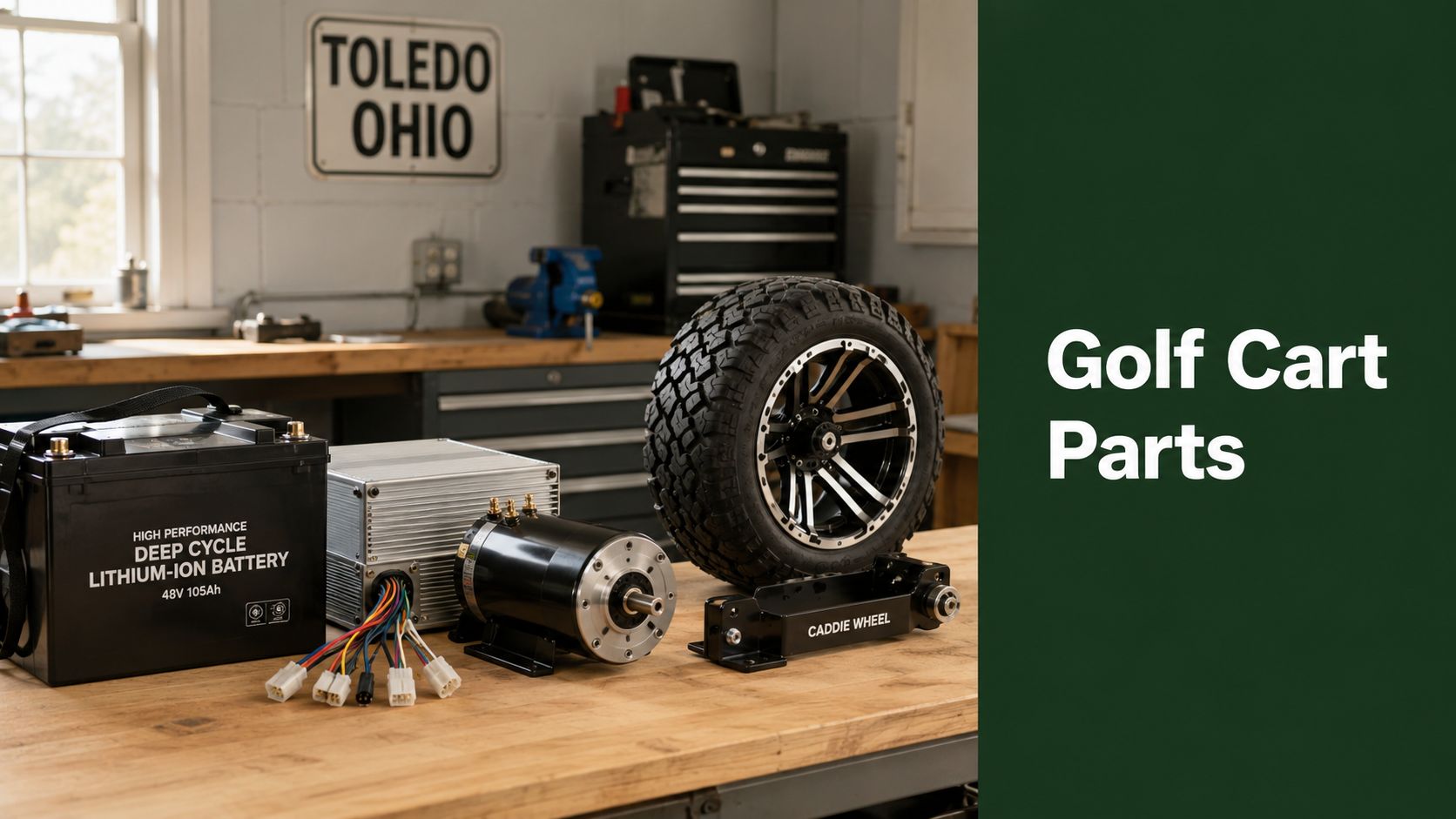
A lot of Toledo golfers are in the same spot right now. The cart starts acting up in the garage, the charger light doesn't look right, or you're tired of pushing a loaded push cart up the back side of a hilly fairway and wondering if there's a smarter setup.
The hard part usually isn't deciding to fix or upgrade something. It's figuring out which part failed, where to buy it locally, and whether the shops around here even deal with the kind of cart you use. That gets even messier if you're not talking about a ride-on Club Car or E-Z-GO, but a walking push cart that needs electric assist instead of a full vehicle repair.
Your Guide to Golf Cart Parts in Toledo
If you're searching for golf cart parts in Toledo, Ohio, you're probably already annoyed. Maybe your old cart clicks but won't move. Maybe the charger says one thing and the cart does another. Maybe you've got a perfectly good push cart and just want help on longer rounds without replacing the whole setup.
That confusion makes sense. Golf carts seem simple until you start chasing parts. One problem can point to the battery pack, controller, solenoid, charger, motor, wiring, or just a bad connection. Add model differences, voltage differences, and dealer preferences, and a “quick fix” turns into a Saturday you didn't want to lose.
The bigger market hasn't made this simpler. The United States Golf Cart Manufacturing industry, which includes parts production, is a $1.3 billion market in 2026, growing at a 9.4% annual rate since 2021, according to IBISWorld's golf cart manufacturing industry report. More parts are available than ever. That also means more versions, more compatibility traps, and more aftermarket choices that look right until they don't fit.
What works in Toledo is starting with the right lane. Ride-on cart owners need a different buying strategy than walkers upgrading a push cart. Local shops tend to understand one category well and ignore the other. If you want a broader overview before calling around, this golf cart parts overview is a useful starting point for sorting the basics before you spend money.
Local reality: The fastest way to waste money is buying a part before you've confirmed the cart's exact model, power system, and intended use.
The good news is that Toledo does have workable options. You just need to know which shops are useful for repairs, which ones are better for parts counters, and where the local market still leaves walking golfers on their own.
Navigating the Parts Maze Common Golf Cart Components
Most golfers get better results once they stop thinking of a cart as one machine and start thinking of it as a few connected systems. That makes diagnosing a problem much easier and helps you talk to a shop without guessing.

Powertrain parts
The powertrain is what gets the cart moving. On an electric cart, that usually means the motor, battery pack, controller, and drivetrain all working together. If the cart hesitates, surges, loses power on hills, or suddenly stops under load, you're often somewhere in this group.
The motor provides propulsion. The controller meters power to that motor. The drivetrain transfers that motion to the wheels. If one part in that chain is weak, the whole cart feels weak.
A lot of golfers call every movement issue a “battery problem.” Sometimes that's right. Often it isn't.
Electrical system parts
The electrical side is the cart's nervous system. It tells components what to do, when to do it, and how much power they should get. This includes chargers, solenoids, wiring harnesses, lights, reducers, switches, and gauges.
This is also where people make the costliest mistakes. Electrical components are strictly voltage-specific at 36V, 48V, or 72V, and mismatching battery chemistry or voltage on a controller or solenoid can cause immediate drivetrain failure or even a fire, as explained in this golf cart electrical parts guide.
If you don't know your cart's voltage and battery chemistry before ordering electrical parts, stop there and verify it first.
That means you shouldn't order a charger, solenoid, reducer, or controller based on appearance alone. Plug style matters. Battery chemistry matters. Voltage matters. Even small assumptions can ruin a new part quickly.
If you want a simple explanation of how these systems work together, this guide to how a golf cart works is useful before you start troubleshooting.
Chassis, tires, and body parts
These are the parts golfers usually notice first because they're visible. Tires, wheels, axles, shocks, springs, seats, windshields, and steering components all live here. They don't create power, but they shape how the cart rides, steers, and holds up over time.
Here's a quick way to sort the common categories:
| System | Typical parts | Common symptom |
|---|---|---|
| Powertrain | Motor, battery pack, controller, drivetrain | Weak pull, no movement, jerky acceleration |
| Electrical | Solenoid, charger, wiring, switches, lights | Clicking, charging issues, accessory failure |
| Chassis | Frame, axles, shocks, springs | Rough ride, sagging, poor handling |
| Body and accessories | Seats, windshield, steering wheel, trim | Comfort, usability, cosmetic wear |
The practical move is simple. Match the symptom to the system before you shop. That single step saves more money than chasing discounts.
OEM vs Aftermarket Parts A Practical Comparison
Once you know what failed, the next decision is whether to buy OEM or aftermarket. This isn't a purity test. It's a trade-off between fit, risk, cost, and how long you plan to keep the cart.

When OEM makes more sense
OEM parts are the safe choice when the part is hard to substitute or expensive to get wrong. Controllers, factory-fit body pieces, model-specific steering parts, and certain charger systems fall into that category. If your cart is newer, still under some kind of dealer support, or used heavily, OEM buys peace of mind.
The biggest advantage is predictable fit. You're not guessing whether a mounting hole lines up or whether a connector needs to be changed. That matters when labor is involved, because a cheaper part stops being cheaper fast if a shop has to modify around it.
When aftermarket is the smart buy
Aftermarket parts are often the better move for wear items, cosmetic upgrades, and carts that are already older. Tires, seats, light kits, some brake parts, and many accessory pieces are common examples. A lot of golfers in Toledo keep older carts alive this way because paying full dealer pricing on every repair doesn't always make sense.
That said, aftermarket quality varies a lot. Two parts can look almost identical online and perform very differently once installed. The fix is to shop by compatibility details, not by thumbnail photo.
Buying rule: Use OEM when fitment errors would be expensive. Use aftermarket when the part is straightforward, replaceable, and well matched to your model.
Here's the side-by-side reality:
| Factor | OEM | Aftermarket |
|---|---|---|
| Fit | Usually exact | Can vary by brand |
| Price | Usually higher | Usually lower |
| Availability | Often dealer-based | Often broader online and regional |
| Warranty confidence | Often clearer | Depends on seller and maker |
| Best use | Critical systems, newer carts | Wear parts, upgrades, older carts |
A good practical example is a controller on a name-brand ride-on cart. If the cart sees regular use and you need reliability, OEM is often worth it. For a worn seat cushion, a replacement windshield, or standard tires, aftermarket is usually fine if the dimensions and mounting points match.
For golfers comparing the broader U.S. market before buying, this look at golf cart parts across the USA helps show why so many Toledo buyers mix dealer parts with third-party replacements.
What doesn't work is mixing a bargain-bin electrical part with uncertain specs and hoping it's “close enough.” That kind of savings tends to disappear the minute something burns up or fails under load.
Where to Find Golf Cart Parts in the Toledo Area
Toledo buyers usually end up in one of three lanes. They go to a dedicated golf cart shop, an independent repair business, or a broader powersports store that handles golf carts alongside other vehicles. Each one can work. They just solve different problems.

Dedicated local golf cart shops
If you want the most direct local option, Golf Cart Warehouse at 6051 Telegraph Road, Toledo, OH is a practical place to know. It operates as a by-appointment-only custom golf cart facility and offers local technical support and component installation, according to the Golf Cart Warehouse website.
That setup works well for golfers who don't want to guess on fitment or wiring. It's less ideal if you expect to wander in and browse shelves the way you would at a general parts store. Call first, have your model details ready, and treat it like a service conversation rather than a casual retail stop.
Powersports shops that also handle golf carts
A lot of Toledo golfers forget about this category, but it matters. Point Place Powersports & Marine, located at 4644 N Summit St in Toledo, explicitly offers sales and repairs for golf carts alongside ATVs and boats, as noted on this Point Place Powersports & Marine listing.
That tells you something important about the local market. Multi-vehicle shops often act as de facto parts counters for golf cart owners. They may not carry every model-specific item on site, but they're often useful for common service parts, repairs, and practical problem-solving.
These shops are good when:
- You need broad mechanical help: They're used to troubleshooting machines, not just selling boxed parts.
- Your cart overlaps with utility use: If it's used like a small transport vehicle around property, these shops often understand that wear pattern well.
- You want installation help: They're more likely to think in terms of repairs, not just ordering.
Regional and cross-border repair options
The Toledo market also leans on nearby businesses outside city limits. The Better Business Bureau lists multiple golf cart repair businesses in the broader Toledo region, including operators in Angola, Indiana and Elkhart, Indiana, which points to a real cross-border service network for local golfers, as shown in the BBB golf cart repair category for the Toledo area.
That matters if you're chasing a harder-to-find part or trying to get a cart serviced during a busy stretch. Some Toledo owners do better by widening the search radius instead of waiting on one local shop to locate a part.
Which supplier fits which buyer
Here's the practical breakdown:
- Dedicated golf cart facility: Best for model-specific repairs, custom work, and buyers who want technical help.
- Powersports store: Best for service-minded troubleshooting and general mechanical support.
- Regional repair shop: Best when local inventory is thin or turnaround matters more than distance.
Don't start by asking, “Who has the part?” Start by asking, “Who deals with my type of problem every week?”
That one question usually points you to the right supplier faster than searching store names.
Finding Push Cart Upgrades The Dealers Ignore
An imbalance is evident in the local market. Toledo has places that can help with ride-on carts, but walking golfers run into a different problem. They search for parts and mostly find inventory built around Club Car, E-Z-GO, and similar ride-on setups.

According to Century Equipment's golf cart inventory context, local search results for golf cart parts Toledo Ohio and inventory at regional dealers almost exclusively feature ride-on carts, creating a blind spot for the 68% of golfers who now walk courses and seek upgrades for their manual push carts.
Why dealers miss this category
Most local dealers are set up to sell and repair full vehicles. Their parts systems, service departments, and supplier relationships all point that way. That's why they're useful if you need a solenoid, charger, brake component, or tire for a ride-on cart.
They're much less useful if you want a drop-on electric assist upgrade for a standard push cart. That's not their business model, and it usually doesn't show up in the way they stock inventory or train staff.
What walking golfers actually need
A walking golfer usually isn't looking for a steering rack, controller, or seat assembly. The need is more specific:
- Less strain on hills: Especially late in the round.
- A cleaner upgrade path: Keep the push cart, add assist, avoid replacing everything.
- Simple installation: No one wants a project cart just to walk nine or eighteen.
- Portability: It still has to fit real golf habits, not workshop habits.
That's the gap local search results don't solve well. Walkers are often forced online because Toledo-area dealer inventory doesn't really speak to them.
The mistake is assuming “golf cart parts” means the same thing for a rider and a walker. In practice, they're shopping for different solutions.
The smarter way to shop this niche
If you use a push cart, stop calling ride-on dealers first and expecting a clear answer. Most of them won't be the best source for electric assist upgrades. You'll save time by shopping specifically for push-cart-compatible systems and checking bracket fit, wheel compatibility, battery setup, and how the assist attaches.
That's also where golfers with mobility concerns tend to get the most value. They can keep walking the course without fighting the cart the whole day. For fitness-minded players, it preserves the walking round without turning every incline into work.
Toledo's local market hasn't caught up to that need yet. Knowing that upfront keeps you from wasting a week calling the wrong places.
Key Questions to Ask Toledo Dealers and Repair Shops
A short phone call can save you from the wrong part, the wrong labor bill, or both. The trick is asking questions that force a clear answer. If a shop gets vague, that's useful information too.
Questions about compatibility
Start here before price even comes up.
- What exact model information do you need from me? A good shop should want the make, model, year if known, and details from the serial or data plate when available.
- Can you confirm this part matches my cart's system? Don't accept “it should work” on electrical items.
- If this is an electrical part, what voltage does it require? You want the shop to state the match clearly, not assume it.
If they can't explain why a part fits, keep looking.
Questions about diagnosis
A lot of buyers jump straight to ordering parts when the actual issue hasn't been identified.
Ask things like:
- What symptoms usually point to this part failing?
- What else could cause the same symptom?
- Would you test the existing component before replacing it?
That third question matters. Shops that test before swapping tend to save customers money. Shops that default to replacing parts in sequence can get expensive fast.
Ask the shop what they would check first if the replacement part doesn't fix the issue. Their answer tells you how disciplined their process is.
Questions about cost and warranty
At this point, misunderstandings usually happen.
- Is your quote parts only, or parts plus labor?
- If the part has to be ordered, can it be returned if it's unopened and wrong for my cart?
- Is there a warranty on the part, the labor, or both?
- If you install an aftermarket part, does that change any service support later?
You don't need legal language. You just need straight language.
Questions for push cart owners
If you're shopping for push-cart electric assist rather than ride-on repair, ask a different set of questions:
- Do you stock or support push-cart electric assist systems, or only ride-on carts?
- Have you installed this kind of upgrade before?
- Can you confirm compatibility with my push cart model?
A lot of local confusion disappears once you separate those two categories early. If the shop only works on ride-on carts, that's fine. You just don't want to discover it after a long explanation and a wasted trip.
Installation and Maintenance Tips for Toledo Golfers
Once the right part is in your hands, ownership matters more than shopping. Three habits make the biggest difference.
First, verify everything before installation. Match the part number, connector style, mounting points, and power requirements before a wrench touches the cart. This is especially important on electrical components and charger-related parts.
Second, protect the battery system. Poor charging habits shorten battery life and create symptoms that look like other failures. If you want a good refresher on battery care that can prevent costly battery replacements, that guide is worth keeping handy.
Third, be honest about DIY limits. Tires, seat pieces, simple accessories, and some bolt-on parts are reasonable home jobs. Controllers, solenoids, wiring issues, and anything involving uncertain voltage or battery chemistry are better left to a shop if you're not confident.
A simple ownership routine helps too:
- Check connections regularly: Loose or corroded terminals create all kinds of false symptoms.
- Watch how the cart behaves under load: Problems often show up on hills before they show up on flat ground.
- Don't ignore small changes: A slower charge, a hotter component, or a new clicking sound usually means something's starting to go.
The best Toledo buyers don't just find the right part once. They build a setup they can keep alive without guessing every season.
If you walk more than you ride and want an easier way to upgrade a standard push cart, Caddie Wheel is worth a look. It's built for golfers who want electric assist without replacing their whole cart, and it fits the exact gap most Toledo-area dealers still don't address well.
Share:
Golf Cart Accessories Wholesale
Waterproofing Electrical Connections: A 2026 Guide