

Your golf trolley’s battery is a lot more than just a power source—it’s the engine that keeps you moving through all 18 holes. Choosing the right one, which usually comes down to modern Lithium versus traditional Lead-Acid, can be the difference between a smooth, easy round and a dead trolley halfway up the 17th fairway. This choice affects everything from performance and weight to how you prep for your game.
Choosing the Right Power for Your Round
Think of your electric trolley as a complete system, with the battery as its heart. If the heart is weak or mismatched, the whole system sputters. You’ll be the one left pushing a heavy, lifeless cart up the back nine, and nobody wants that. Getting a handle on the fundamentals of golf trolley batteries is the first step to making sure every round is powered by pure reliability.
Before we get into the nitty-gritty, it helps to see how these batteries fit into the high-tech evolution of golf. Just like drivers and irons have seen massive leaps in technology, so have the batteries that make walking the course a breeze for everyone.
Why Your Battery Choice Matters
The decision between battery types goes way beyond just making the wheels turn. It shapes your entire golfing experience, from the moment you load the car to that final putt on the 18th green.
Here’s what your choice directly impacts:
- On-Course Performance: A battery’s ability to deliver consistent power is what gets your trolley up steep hills and through thick rough without slowing to a crawl.
- Physical Effort: A lighter lithium battery makes a huge difference when you’re lifting your trolley in and out of the car. Less strain before you even swing a club.
- Long-Term Cost: Sure, some batteries are cheaper upfront. But if they have a shorter lifespan, you’ll be buying replacements more often, costing you more in the long run.
- Maintenance Routine: The time you spend on upkeep—from checking water levels in old-school lead-acid models to the simple "plug-and-play" nature of lithium—is all down to the tech you choose.
Your trolley's battery is an investment in your game. A reliable power source removes a major variable, allowing you to conserve physical energy and maintain mental focus on what truly matters—your next shot.
This guide will break all of this down, starting with the biggest decision you’ll make: sticking with traditional Lead-Acid or upgrading to the modern efficiency of Lithium. Once you understand this core comparison, you'll be ready to pick the perfect powerhouse for your trolley.
Lead-Acid vs. Lithium: The Main Event
When it comes to choosing a battery for your golf trolley, you’re really picking the engine that will power your entire game. The two main players are the old-school Lead-Acid and the modern Lithium. This choice goes beyond just specs on a sheet; it affects how heavy your trolley is, how you tackle hills, and how long you can go between buying replacements.
Think of a Lead-Acid battery like a trusty old pickup truck. It’s heavy, costs less upfront, and it gets the job done. But just like that old truck, it needs more upkeep, takes a long time to refuel (charge), and won’t make as many trips (charge cycles) before it needs to be retired.
On the other hand, a Lithium battery is more like a sleek, modern electric car. It’s incredibly light, zips up hills without breaking a sweat, recharges in a fraction of the time, and is built for the long haul. That performance comes with a higher price tag, but for most serious golfers, the long-term benefits are well worth the initial investment.
The Weight and Lifespan Difference
The first thing you’ll notice, day in and day out, is the weight. A typical lead-acid battery can easily top 20 pounds, turning the simple act of lifting your trolley into your car a real chore. A lithium equivalent? It often weighs 75% less, saving your back before you’ve even stepped onto the first tee.
Lifespan is the other game-changer. A well-cared-for lead-acid battery might get you through 1-3 seasons, depending on how often you play. A lithium battery, however, is engineered to last much, much longer. It's often rated for over 1,000 charge cycles, which for most golfers means five or more years of reliable power.
While a lithium battery's initial cost can be two to three times that of a lead-acid model, its extended lifespan means the cost per round is often lower over time. You're paying more upfront to avoid buying multiple replacement batteries down the line.
Lead-Acid vs. Lithium Battery Head-to-Head Comparison
To make the right call, you need to see how these two technologies really stack up against each other. The best choice for you will depend on your budget, how often you hit the links, and what you value most in your golf gear.
Here’s a simple, direct breakdown to help you decide.
| Feature | Lead-Acid Battery | Lithium Battery |
|---|---|---|
| Upfront Cost | Low | High |
| Lifespan | 1-3 years (approx. 200-400 cycles) | 5+ years (1,000+ cycles) |
| Weight | Heavy (20+ lbs / 9+ kg) | Lightweight (5-7 lbs / 2-3 kg) |
| Charging Time | 8-12 hours | 3-5 hours |
| Maintenance | Requires regular checks and water top-ups | Virtually maintenance-free |
| Performance | Power can fade on hills and late in the round | Consistent power delivery from start to finish |
| Size | Larger and bulkier | Compact and smaller footprint |
Ultimately, this table tells a clear story: lead-acid is the budget-friendly, short-term solution, while lithium is the long-term, high-performance investment.
Environmental and Financial Considerations
The broader market for golf cart and trolley batteries reflects these different priorities. For instance, the traditional 6V battery segment in larger golf carts was valued at USD 52.6 million and continues to grow, mostly because it's affordable and works with older models. This shows there's a large group of users who, much like trolley owners choosing lead-acid, put a lower initial cost first. You can learn more about these golf battery market trends.
When a lead-acid battery finally gives out, what you do with it matters. These batteries contain toxic materials, so you can't just toss them in the bin. It's critical to find a proper facility. If you're using one, it’s important to know how to responsibly recycle lead-acid batteries. While lithium batteries have their own environmental considerations, they are generally seen as the greener choice over their entire lifecycle.
Understanding Battery Specs for the Course
When you’re looking at golf trolley batteries, you’ll see a string of numbers like “12V 18Ah” or “14.8V 22Ah”. This isn't just tech-speak; it's the vital statistics telling you exactly how that battery will perform out on the links. Getting a handle on these numbers is the key to matching a battery to your game, so you have all the power you need to conquer the course without running out of steam.
Think of these specs as the battery's personality. Just like you'd choose a driver based on its loft and flex, you choose a battery based on its voltage and amp-hours. Nail this combo, and you're set for a stress-free round.
Voltage (V): Your Battery’s Raw Power
Voltage (V) is all about the battery's raw strength or "muscle." It’s the force pushing electricity to your trolley's motor. A higher voltage battery delivers more punch, which is crucial for keeping your speed up and maintaining torque, especially when you’re staring down a steep incline.
Imagine you're pushing your trolley up a monster hill. A low-voltage battery is like trying to do it with one hand—it’s going to struggle, slow down, and maybe even give up. A higher-voltage battery is like having a buddy help you push; it has that extra muscle to power up the slope without missing a beat. For most modern golf trolleys, 12V is the standard, giving you a great balance of power for typical course conditions.
This visual breaks down the core differences between the two main battery technologies—lead-acid and lithium—which directly shapes their performance specs.
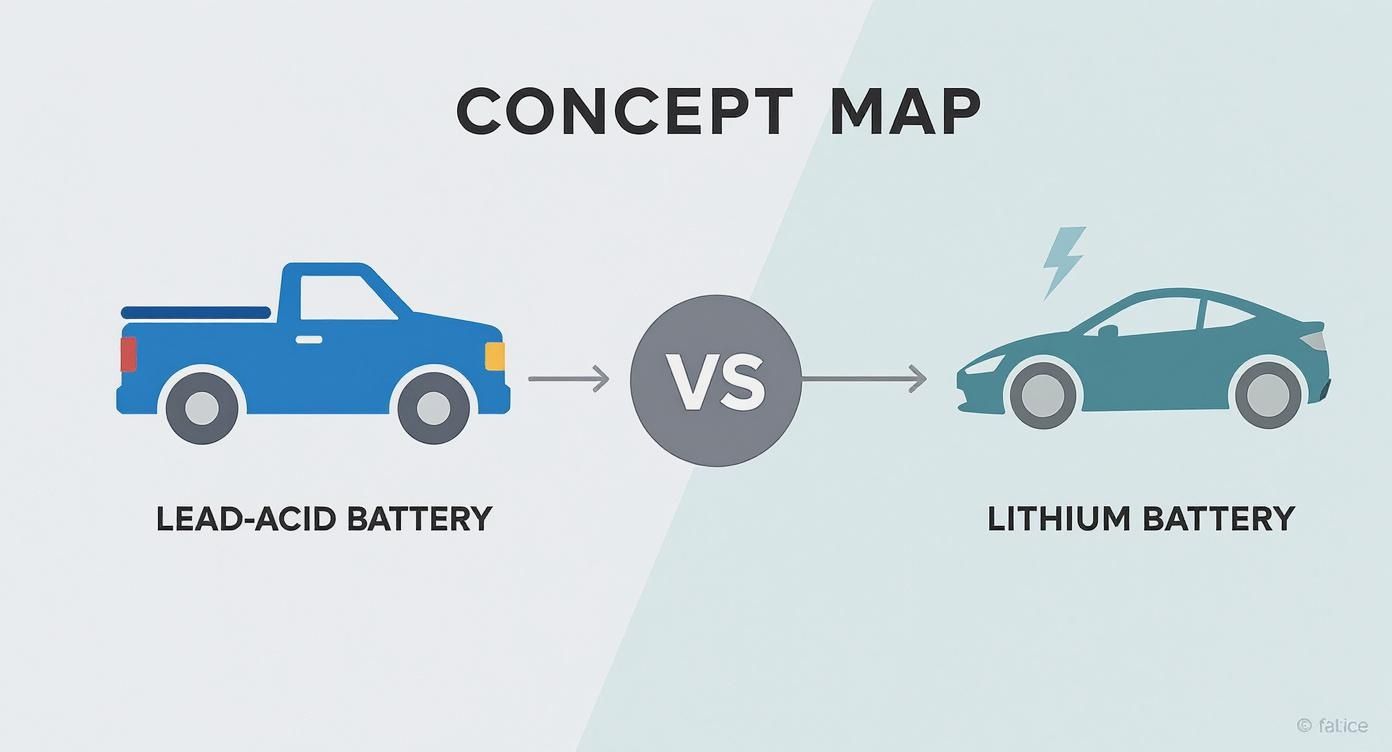
As you can see, the lead-acid battery is the heavy-duty workhorse, while the lithium battery is a lightweight performance machine. It’s all about the trade-offs in weight, power, and how long they last.
Amp-Hours (Ah): Your Battery’s Fuel Tank
While voltage is the power, Amp-hours (Ah) is the battery's endurance—think of it as the size of its "fuel tank." This number tells you how much energy the battery can store, and in turn, how long it can go before needing a recharge. A higher Ah rating simply means more gas in the tank.
For example, a battery with an 18Ah rating is perfect for a standard 18-hole round on a mostly flat course. But if you’re someone who plays longer rounds or tackles hilly, demanding courses, a battery with 22Ah or more gives you that extra capacity to confidently finish 27 or even 36 holes.
Think of it this way: Voltage gets you up the hill, but Amp-hours make sure you can keep climbing hills all day long. A battery with high voltage but low Ah might start strong and fade fast, while one with the right Ah will go the distance.
Matching Specs to Your Game
The perfect battery isn't just the one with the biggest numbers; it's the one that fits your playing habits and home course like a glove. Your choice should be a direct reflection of the demands you put on your trolley.
Here’s what you need to think about:
- Course Terrain: A flat, links-style course is a walk in the park compared to a hilly parkland course. If your home track has serious elevation changes, you’ll want a battery with a higher Ah rating to handle the extra workload.
- Trolley and Bag Weight: The heavier your setup, the more juice your battery will burn. If you carry a big tour bag or have a feature-packed trolley, go for a battery with more capacity to compensate.
- Round Length: Do you stick to 18 holes, or are 36-hole days your thing? An "extended range" battery with a higher Ah is a must-have for those marathon golf sessions.
- Ground Conditions: Pushing through wet, soft turf takes a lot more power than rolling on firm, dry fairways. If you play year-round, you need to factor in those tougher conditions.
By thinking through these variables, you can look past the technical specs and make a practical choice. Making sure your battery has enough capacity is fundamental. If you're ever questioning your current battery's health, our guide on how to test battery capacity offers practical steps to check its real-world endurance. This knowledge will empower you to pick a power source that won’t quit on you at the 18th green.
Mastering Battery Care for a Longer Lifespan
Even the best golf trolley batteries need a little TLC to perform at their peak and last for years. Think of your battery as a key piece of equipment—it’s a significant investment, and just like your clubs, some routine care goes a long way. Following a few simple rules for charging, handling, and storage can dramatically extend its life, ensuring it’s ready for every round and saving you from a premature, costly replacement.
Make battery care part of your post-round routine, just like cleaning your clubs or airing out your shoes. For both Lithium and Lead-Acid types, these habits prevent wear and tear and keep your trolley running strong.
The Golden Rules of Charging
Proper charging is the single most important thing you can do for your battery’s health and longevity. If you want to maximize its lifespan and get reliable power from the first tee to the 18th green, getting this right is non-negotiable.
The most critical rule? Charge your battery as soon as possible after every single use, whether you played 9 holes or a full 18. Letting a battery sit in a discharged state is especially harmful to Lead-Acid chemistry and can cause irreversible damage over time.
Here's a simple checklist to run through every time:
-
Use the Correct Charger: Always use the manufacturer-approved charger that came with your battery. Chargers are specifically calibrated for your battery’s voltage, chemistry, and capacity. Using a mismatched charger is a recipe for disaster and can permanently damage your battery.
-
Complete the Full Cycle: Never unplug the charger mid-cycle. Modern smart chargers are designed to run a full cycle and will often switch to a maintenance or "trickle" mode once the battery is full. Let it finish the job to ensure the cells are properly balanced and conditioned.
-
Charge in a Safe Environment: Always charge your battery in a dry, well-ventilated area on a non-flammable surface. Steer clear of extreme temperatures—both excessive heat and cold can hurt charging efficiency and the battery’s overall health.
Smart Maintenance and Handling
Beyond charging, how you handle and store your battery plays a huge role in its lifespan. Lithium batteries are famously low-maintenance, but they still benefit from proper care. Lead-Acid batteries, on the other hand, need a bit more attention to stay in top shape.
If you own a Lead-Acid battery, periodically check the terminals for corrosion. A quick clean with a wire brush and a solution of baking soda and water can prevent buildup that blocks the flow of power. Keeping the battery case clean and dry also helps prevent premature wear.
Proper maintenance isn't just about extending life; it's about consistency. A well-cared-for battery delivers predictable power, meaning you won’t get hit with unexpected slowdowns on the back nine or that final steep hill.
Off-Season Storage Best Practices
If you’re packing your trolley away for the winter or any long break, you can't just leave the battery and forget about it. Improper storage is one of the fastest ways to kill an otherwise healthy battery.
For a Lithium battery, the best approach is to store it with a partial charge—somewhere between 50% and 70% is ideal. Storing it fully charged or completely dead for months can strain the cells. Just keep it in a cool, dry place away from direct sunlight.
For a Lead-Acid battery, the opposite is true: you must store it fully charged. A discharged Lead-Acid battery will start to sulfate, a process where lead sulfate crystals build up on the plates and permanently reduce its capacity. It's a good idea to top it off every month or two during the off-season to keep it healthy.
Getting these maintenance steps right is crucial, and so is using the right equipment. If you want to dive deeper, our guide on choosing the right lithium battery charger for your golf cart has some great insights that also apply to trolleys. By following these simple but effective tips, you’ll ensure your battery remains a reliable partner on the course for many seasons to come.
Finding the Perfect Fit for Your Trolley
You’ve crunched the numbers and picked the right power for your game. Now for the last piece of the puzzle: making sure the battery actually fits your trolley. A battery with world-class stamina is completely useless if it doesn’t physically sit in the tray or plug into the motor.
This compatibility check is simple, but it's the one step that keeps you from making a costly mistake. Think of it like buying new shoes. You wouldn't just grab a pair based on looks; you’d make sure they’re the right size. It's the exact same logic here—the right physical and electrical fit is non-negotiable.
The Three Pillars of Compatibility
Before you hit "buy," you need to lock down three key compatibility points. Get these right, and your new battery will slide in and work perfectly from day one.
-
Physical Dimensions: Start with the obvious. Get out a tape measure and check your trolley’s battery tray, then compare it to the specs of the battery you’re eyeing. While many batteries follow standard sizes, there are always variations, especially when moving from a bulky Lead-Acid model to a sleeker Lithium one. You want it to sit snugly, not slide around or have to be wedged in.
-
Connector Type: Your trolley has a specific plug, and your new battery needs to have the matching one. The two most common connectors you’ll see are the T-Bar and the Torberry (which usually has a red and black plug). A mismatched connector will stop you dead in your tracks, so double-check this detail.
-
Voltage Match: This is the most critical check of all. Your trolley’s motor is built to run on a specific voltage, which is almost always 12V. Hooking up a battery with the wrong voltage can fry the motor and electronics in an instant, causing serious, expensive damage. Always confirm your trolley’s required voltage and make sure the new battery is an exact match.
A mismatched voltage is the fastest way to turn a simple upgrade into an expensive repair. Never assume a battery will work; always verify that its voltage matches what your trolley’s manufacturer specifies.
Innovations in Battery Integration
The world of golf trolley batteries is always moving forward, pushing beyond simple drop-in replacements. The global golf cart battery market was recently valued between USD 140.91 million and USD 184.45 million, which shows just how much is being invested in this tech. This growth is what drives innovations that help every golfer out on the course. You can dig into more insights about the expanding golf battery market.
One of the coolest advancements is the shift toward fully integrated power systems. Instead of dealing with a separate, clunky battery that you have to place on a tray, manufacturers are now designing trolleys where the battery is built right into the frame. The result is a sleeker, better-balanced machine that’s far easier to handle and transport.
The Caddie Wheel system is a perfect example of this modern approach. Its high-capacity battery is part of the core design, and it even comes with a portable charger so you don't have to haul a heavy power source around. This kind of integrated thinking is where the industry is headed—making the whole process of powering your round smarter and simpler than ever.
Solving Common Battery Problems on the Course
There’s nothing worse than having your electric trolley give up on you mid-round. One minute you’re enjoying a relaxing walk, and the next you’re wrestling a dead-weight cart up the back nine. It’s frustrating, and it can completely throw off your game.
The good news is that most common battery issues are surprisingly easy to figure out and often simple to fix right there on the spot. You just need to know what to look for. Is your trolley gasping for air on hills, or did it just quit on a flat fairway without warning? Let's walk through the most frequent problems and how to get your trolley moving again.
Why Your Trolley Loses Power on Hills
This is a classic sign of a battery on its last legs. The trolley works fine on the flats but slows to a crawl the second it hits an incline. Why? Hills demand a sudden surge of power, and a weakened or aging battery just doesn’t have the juice to deliver the necessary voltage under that kind of load.
If this sounds familiar, run through this quick mental checklist:
- How old is the battery? An older lead-acid battery is the usual suspect. As they age, their ability to hold and deliver sustained power drops off a cliff.
- Was it fully charged? Did the battery get a full, uninterrupted charging cycle before you headed out? A partial charge simply won’t have the stamina for a challenging course.
- Are the terminals clean? Take a look at the connection points. Any corrosion or grime on the battery terminals can choke the flow of electricity, creating a bottleneck right when the motor needs power most.
This kind of power drop-off is a clear warning that your battery is nearing the end of its useful life. Cleaning the terminals might give you a temporary boost, but if it keeps failing on hills, it’s time to start thinking about a replacement.
What to Do When Your Battery Dies Prematurely
Another all-too-common headache is a battery that doesn't make it a full 18 holes, even after you charged it overnight. This premature power loss can be caused by a few different things, and often it’s a combination of factors.
A battery's rated capacity—say, for 18 holes—is always based on ideal conditions. Hilly terrain, soft or wet ground, and a heavy golf bag all force the motor to work harder, which can slash its real-world runtime by 20-30%.
When your battery dies too soon, a simple process of elimination can help you pinpoint the issue without needing to be an electrical engineer.
The Troubleshooting Flow
- Check All Connections: Always start here—it’s the easiest fix. Make sure the battery cable is plugged in securely at both ends (the battery and the trolley). A slightly loose connection can cause intermittent power cuts that feel exactly like a dead battery.
- Examine the Charger: Is your charger actually working properly? Look for the indicator lights that confirm it's delivering a charge. A faulty charger can sometimes signal that the battery is full when it's really only half-charged.
- Assess the Conditions: Think about your round. Was the course unusually tough? Playing in wet, soft turf or on a very hilly course demands a lot more power and can drain a battery much faster than you’d expect.
- Test the Battery Itself: If you’ve checked everything else, the battery is the likely culprit. It may have a dead cell or has just lost too much of its capacity over time. If your battery is more than a couple of years old, this is almost certainly the reason.
Frequently Asked Questions About Golf Trolley Batteries
When it comes to golf trolley batteries, a few questions pop up time and time again. Let's clear up some of the most common ones so you can feel confident about managing your trolley's power source.
How Many Years Should My Golf Trolley Battery Last?
This one really comes down to the type of battery you have and how well you look after it. A traditional Lead-Acid battery is the old-school option, and you can expect it to last somewhere between 1-3 seasons with regular play. It's best to think of them as a consumable item that gets you through a couple of years before it’s time for a replacement.
On the other hand, a modern Lithium battery is a true long-term investment in your game. With the right care, these powerhouses are built to last over 5 years and can often handle more than 1,000 charge cycles. That kind of durability means less time worrying about battery replacements and more time focused on your round.
For a deeper dive into battery longevity, our guide on how long golf cart batteries last breaks it all down.
Can I Use My Car Battery Charger?
In a word: no. This is one of the most common—and dangerous—mistakes a trolley owner can make. Using a car battery charger on your golf trolley battery is a recipe for disaster.
Here’s exactly why it’s such a bad idea:
- Voltage and Amperage Mismatch: Car chargers are designed for the big, beefy batteries found under the hood of a car. They push out a powerful current that will overwhelm and fry the smaller, more sensitive cells in a trolley battery.
- Serious Safety Hazard: Forcing that much power into a battery not built for it can cause it to overheat, swell up, or worse. It’s simply not safe.
- Instant Warranty Void: The moment you use an incompatible charger, you can say goodbye to your battery’s warranty.
Always, always use the specific charger that came with your golf trolley battery. It’s calibrated to deliver the precise voltage and amperage for a safe and efficient charge, protecting both you and your investment.
Is It Okay To Leave The Battery Charging Overnight?
With the vast majority of modern lithium golf trolley batteries, the answer is a confident yes. Today's smart chargers are designed with battery health and safety as the top priorities, and they have built-in microprocessors that act like a brain.
Once your battery hits 100% capacity, the charger automatically cuts off the main charging current. It then switches to a low-power "trickle" or "maintenance" mode. This keeps the battery topped off without any risk of overcharging, which was a huge problem with older, less intelligent charging systems.
That said, for ultimate peace of mind and as a good habit, it’s still wise to unplug it once you know it’s fully charged.
Ready to upgrade your push cart with effortless power? The Caddie Wheel integrates a high-capacity battery that lasts up to 36 holes, so you can walk the course without the strain. Discover the difference at https://caddiewheel.com.
Share:
Your Guide to Battery Power Golf Cart Performance
Your Guide to Finding the Lightest Golf Push Cart