
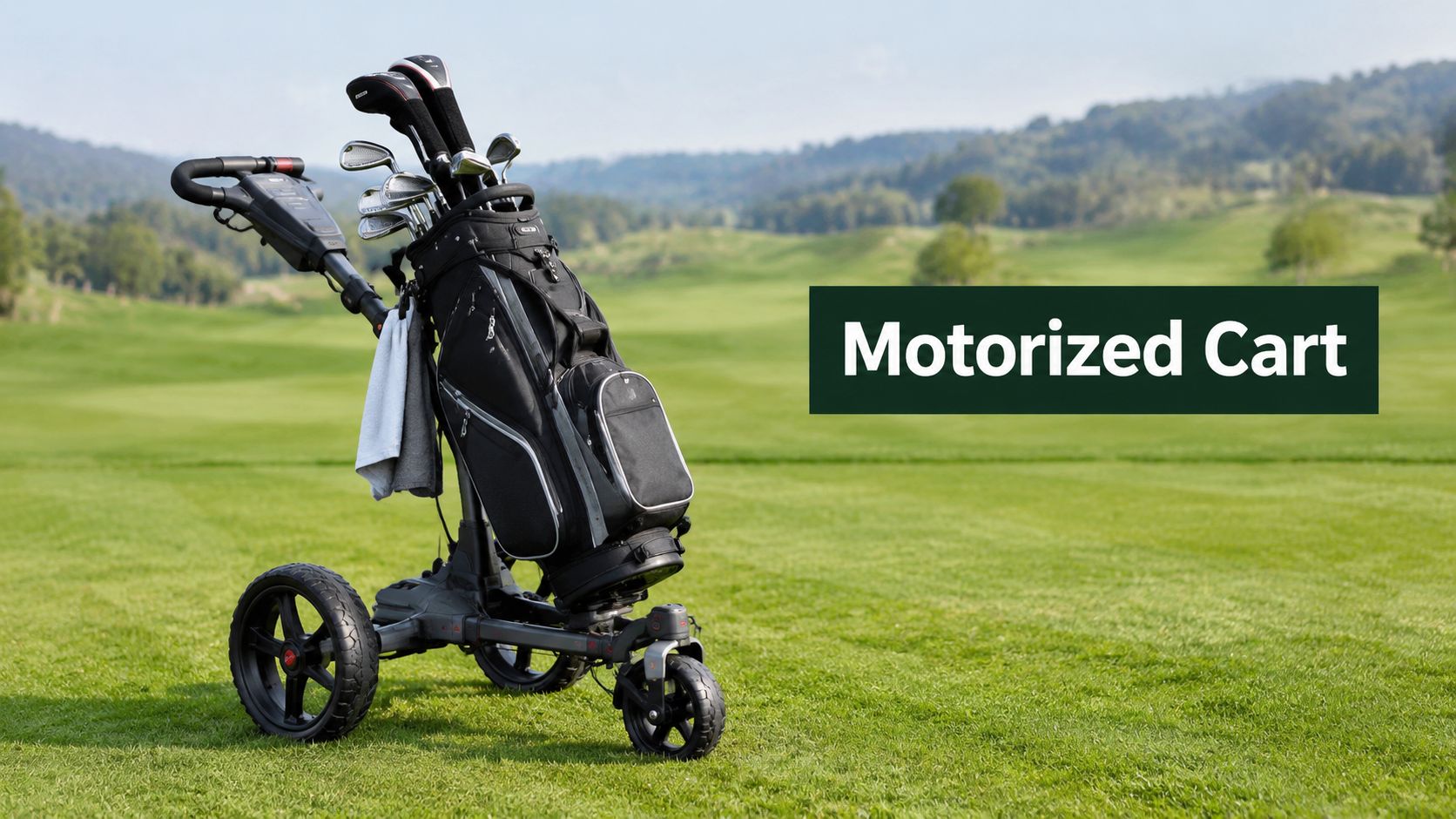
A motorized wheel retrofit is the smarter buy if you already own a compatible push cart, while a full electric caddy is the better choice if you want an all-in-one package. Modern lithium systems can support up to 36 holes, but the right purchase still depends more on terrain, compatibility, storage, and control than on the longest feature list.
You're probably searching for a motorized push cart for sale after reaching the same unpleasant conclusion many walking golfers reach. The front nine feels manageable, then the hills arrive, your shoulders tighten, and the final holes become an exercise in getting the bag to the clubhouse rather than enjoying the round. A motor can remove that repeated strain, but it doesn't automatically make every electric option a good purchase.
The key decision is simple. Keep your existing cart and add powered wheels, or replace it with a purpose-built electric caddy. This guide takes the practical route, focusing on what affects your round, your garage, and your long-term costs.
What Walking Golfers Really Want on the Back Nine
The fourteenth fairway is where a manual push cart starts telling the truth. The sun is high, your shirt is sticking to your back, and the bag feels heavier than it did at the first tee. You lean into the handle to get the cart up the slope, your knees complain, and the group behind you waves through for the third time.

Now change one detail. The cart rolls beside you under motor power, climbing the same rise without a shove. You still walk, read the course, and make your shot, but you arrive at the green with enough energy to think about distance control instead of nursing your legs.
The back nine is the stress test. Early hills can feel optional because you're fresh enough to absorb them. Late-round slopes expose weak brakes, poor torque, awkward steering, and batteries that don't match the golfer's routine. A motorized cart earns its place when it preserves your pace and concentration after fatigue would normally take over.
Practical rule: Buy for the hardest hole you regularly play, not the easiest hole on your home course.
That leaves three honest choices:
- Keep pushing: Best for golfers on flat courses who value low weight and zero charging.
- Switch to riding: Sensible when walking itself has become unsafe or impractical, though it changes the rhythm of the round.
- Add electric assistance: The strongest middle ground for golfers who still want to walk but don't want the bag to dictate how the final holes feel.
Electric assistance isn't about laziness. It can protect sore joints, maintain a steady pace, and help older or mobility-limited golfers keep walking. Motorized golf-cart technology has established roots, with the first custom-made electric golf cart widely traced to 1932, broader acceptance among U.S. golfers by the mid-1950s, and commercial milestones from Marketeer in 1951, E-Z-Go in 1954, Cushman in 1955, and Club Car in 1958. This history of electric golf trolley development shows that electric assistance is an established mobility category, not a novelty.
The decision ahead is between a retrofit wheel upgrade and a complete electric caddy. Your terrain, budget, storage space, and existing cart will decide which route makes sense.
What a Motorized Push Cart Actually Is
A motorized push cart is a push-style golf cart that moves through an electric motor instead of relying entirely on you to push or pull it. The golfer still walks alongside the bag, but the cart supplies the propulsion.
The category has two useful sub-types.
Retrofit wheels work like an e-bike conversion
A retrofit system adds a motorized wheel or wheel assembly to a manual push-cart frame. Think of it as an e-bike conversion kit. You keep the frame, bag cradle, seat, and accessories you already know, then attach powered hardware to a compatible cart.
That approach makes sense when your current push cart folds well, holds your bag securely, and fits your vehicle. The main question isn't whether the motor works in isolation. It's whether the bracket, axle, frame width, and battery position create a stable, balanced setup.
Full electric caddies are matched systems
A full electric caddy is designed around its battery, motors, controls, wheels, and frame from the beginning. The components are engineered as one package, more like replacing an older car with a hybrid than modifying the vehicle you already own.
Purpose-built units usually deliver a cleaner fit between the drive system and chassis. They may also offer remote control, electronic downhill management, follow functions, or integrated accessory mounts. The trade-off is that you're buying an entirely new cart, even if your manual one still works perfectly.

Both formats remove the golfer from the role of engine, but they don't deliver the same ownership experience. A retrofit preserves familiarity and can reduce waste. A full caddy gives you matched components and fewer compatibility decisions.
The label on a listing can still be misleading. “Electric push cart” might describe a simple powered wheel, a handle-controlled trolley, or a premium remote-control system with advanced braking. Look past the name and inspect the drive layout, battery housing, braking system, folded dimensions, and support arrangements.
Your bag also matters. A stable cart needs a bag that sits securely in its cradle, whether you use a stand bag or cart bags for golfers on a cart. Don't assume a powered frame will compensate for a poorly balanced or loosely mounted bag.
Key Features Worth Comparing Before You Buy
A long product page can make every feature sound essential. Most aren't. The specifications that change your round are battery endurance, wheel torque, controls, braking, weight, and compatibility.
Battery capacity is only useful in context
Battery claims are often expressed in holes rather than minutes or miles. Modern motorized caddies commonly pair a lithium battery rated around 10,050 mAh with up to 36 holes of runtime and roughly 6-hour charging, according to independent technical reporting on golf-cart systems. The golf-cart battery factsheet provides useful context for comparing capacity and charging expectations.
Treat that rating as a configuration claim, not a promise for every course. Hills, heavy bags, repeated stops, and cold conditions can all change practical endurance. A golfer who plays one round on a flat course has different needs from someone who walks two rounds or regularly climbs long slopes.
Torque matters more than a dramatic wattage figure
Power reaches the ground through the wheel. A motor's headline wattage tells you less than its torque delivery, gearbox, wheel traction, and ability to maintain speed under load.
Higher-power systems can use dual rear motors rated around 240 W each and claim slope handling up to 25%. Those figures come from the same independent technical reporting, which also makes the important point that battery capacity and motor torque influence hill-climbing performance. Review the underlying golf-cart technical data before treating a wattage number as a guarantee.
Controls should match your attention span
Handlebar control is the simplest. You walk beside the cart and adjust speed or direction from the handle. A handheld remote gives you more freedom to send the cart ahead or reposition it, but it introduces another device to charge, carry, and avoid losing.
Bluetooth or app control can be convenient, but I wouldn't pay extra for an app you won't use. A reliable physical control is more valuable than a clever interface that becomes frustrating in wet weather or with gloves.
Braking is the safety specification
A motorized cart needs a way to manage descents. Some systems use regenerative braking, some use mechanical braking, and others combine both. Independent review coverage of the Bag Boy Volt explains how these braking approaches support speed management and control on course. Bag Boy's Volt product information is a useful reference when you compare braking designs.
| Feature | What to Look For | Why It Matters |
|---|---|---|
| Battery | Lithium capacity, charge time, and realistic hole rating | Determines whether the cart finishes your normal routine |
| Drive system | Strong wheel torque and balanced motor placement | Controls hill performance and traction |
| Controls | Handle, remote, or app with simple speed adjustment | Determines how much attention the cart demands |
| Braking | Mechanical, regenerative, or electronic downhill control | Prevents runaway descents and awkward stopping |
| Weight and fold | Manageable lifting weight and compact folded shape | Decides whether storage becomes a daily nuisance |
| Compatibility | Correct bracket, axle, frame width, and bag position | Determines whether a retrofit is safe and stable |
Don't chase GPS, USB ports, or decorative trim before these basics are settled. If the cart can't climb, stop, fit your trunk, or hold your bag securely, the extras won't rescue the purchase.
For a broader primer on electric systems and buying criteria, use this electric golf push cart buying guide as a reference, then return to your own course rather than shopping from the feature list alone.
Retrofit Wheels Versus Full Electric Caddies
Retrofit wheels win when your existing cart is already a good fit. Full electric caddies win when you want matched engineering and don't want to troubleshoot whether a conversion will sit correctly on your frame.
The retrofit route is usually the more rational choice for an owner of a compatible three-wheel or four-wheel cart. You keep the folding pattern, bag support, seat, and accessories. You also avoid replacing a frame that may have years of useful life left. The downside is that the motor, bracket, and battery can alter weight distribution, and the result may not feel as integrated as a purpose-built caddy.
A full electric caddy is the cleaner purchase for hilly courses, golfers who want remote navigation, and buyers who value a finished product over reuse. The drive system, battery tray, wheelbase, and controls are designed together. You'll pay for that integration with more equipment to store and a larger initial purchase.
| Criteria | Retrofit Wheels | Full Electric Caddies |
|---|---|---|
| Upfront decision | Add power to a cart you already own | Replace the manual cart with a complete system |
| Terrain handling | Depends heavily on the original frame and mounting position | Designed around the motor and chassis |
| Hill performance | Strong when the wheel kit has adequate torque and traction | Usually more consistent across the matched platform |
| Battery integration | May add weight or occupy existing storage space | Battery tray and wiring are built into the frame |
| Folding and storage | Retains the original cart's folding behavior | Depends on the dedicated caddy's design |
| Best buyer | Existing-cart owner seeking practical assistance | Golfer wanting remote control and an all-in-one experience |
The total-cost question matters more than the sticker price. A retrofit can be the better value if your frame is compatible and you don't need new accessories. A full caddy may be the better value if buying separate brackets, batteries, controls, and replacement parts would narrow the gap while leaving you with a compromise.
A retrofit isn't automatically the budget option, and a full caddy isn't automatically excessive. Compare the complete setup, including battery, charger, mounting hardware, shipping, support, and likely replacement parts. This electric golf push-cart conversion guide is useful for understanding what a conversion involves before you assume every manual frame will accept the same hardware.
My recommendation is direct. If your existing cart is sturdy, comfortable, and listed as compatible, start with a retrofit. If your cart is worn out, unstable, or awkward to fold, buy the full electric caddy instead of powering a frame you already dislike.
Matching the Cart to Your Course and Budget
Start with the course, not the shopping page. A flat municipal layout, a rolling parkland course, and a mountainous track place very different demands on the same motorized system.
Step 1, assess the terrain
Walk your home course. If the difficult sections are short and gradual, a single powered wheel or modest motor system may be enough. If long climbs and side slopes dominate the round, prioritize torque, traction, stability, and downhill braking over screens and app features.
For demanding terrain, higher-power configurations can use dual rear motors rated around 240 W each and claim slope handling up to 25%, as documented in independent golf-cart technical reporting. The technical overview of motor and battery systems is more useful here than a generic “all-terrain” label.
Step 2, define your actual routine
Ask yourself four questions:
- Round length: Do you normally walk one round, or do you need capacity for extended use?
- Bag load: Are you carrying a light setup or a fully equipped cart bag?
- Walking pace: Will the cart need to keep up with a quick walker?
- Storage: Does the folded unit need to fit a compact sedan, or do you have room in an SUV?
A lithium system commonly rated for up to 36 holes can suit golfers who want reserve capacity for longer use, while a smaller setup may be sensible for occasional play on flat ground. Battery and charge figures vary by configuration, so confirm the exact pack included with the listing.

Step 3, set the budget around priorities
Don't spread the budget evenly across every feature. Spend first on reliable drive power, braking, battery support, and compatibility. Treat GPS, follow mode, and premium finishes as optional upgrades unless you know you'll use them every round.
My buying rule: If you already own a compatible cart, price the retrofit first. If the frame fails the terrain or storage test, stop trying to save it and move to a full caddy.
Step 4, choose the configuration
A flat-course golfer with limited storage should favor a compact, uncomplicated system. A hill-playing golfer should accept some added equipment if it buys dependable torque and descent control. Someone managing joint pain or reduced mobility should prioritize predictable speed control and easy loading, not merely the lightest advertised motor.
A motorized cart should also preserve pace. Golfers who want to think more about rhythm and less about holding up the group can find useful practical guidance in this resource on better golf flow with 2ndShotMVP. The right powered setup helps you walk consistently, but it still needs courteous course management.
Pricing, Warranty, and What Happens After the Sale
A motorized push cart purchase doesn't end at checkout. The total cost includes the battery, charger, mounting hardware, replacement wheels, support, and the inconvenience of downtime if a key component fails.
The market spans simple powered assistance, integrated full caddies, and premium remote-control systems. Exact prices change by brand, configuration, and retailer, so I wouldn't trust a bargain listing until you've confirmed what the package includes. A low headline price may exclude the battery, remote, charger, or compatible bracket that makes the cart usable.
Read the warranty line by line
Separate the coverage into three parts:
- Battery coverage: Check whether the battery has its own term, whether capacity loss is excluded, and whether shipping is covered.
- Frame coverage: Confirm protection for the chassis, folding hardware, wheels, and mounting points.
- Electronics coverage: Look for exclusions involving water, impact, misuse, unauthorized modifications, and remote-control faults.
Don't assume the warranty treats the battery like the frame. It often doesn't. Save the receipt, register the product where required, and keep the original charger because support teams may ask for details before approving a replacement.
Battery selection deserves special attention because capacity, charging behavior, storage conditions, and replacement access all affect ownership. This electric trolley battery explainer is a useful resource before you compare packs that appear similar on a product page.
Support beats flashy packaging
Ask whether the manufacturer stocks brackets, chargers, remotes, wheels, and battery connectors. Firmware updates matter for Bluetooth-enabled systems, but physical parts matter more when you use a cart for years. A company that answers pre-sale questions clearly is more likely to be manageable when you need a replacement part.
Resale value is difficult to predict and depends on battery health, cosmetic condition, brand reputation, and whether the original accessories remain. Premium branding may help, but it doesn't make a worn battery or missing remote disappear. Buy the cart you'll use, not the one you hope will become an investment.
Smart Questions to Ask Before You Click Buy
Will it survive rain? Don't treat “weather resistant” as permission to leave the battery exposed in a downpour. Look for a sealed battery housing, protected connectors, and clear cleaning and drying instructions. Ask the manufacturer what happens if water enters the control system.
Can it climb wet grass? Motor strength alone won't prevent wheel spin. Wet slopes require useful tread, balanced weight, controlled speed, and a brake that holds when traction drops. If your course becomes slippery after rain, prioritize stability over top speed.
Will it fit the car you drive? Measure the folded cart, then measure the trunk opening rather than the trunk volume. A cart can technically fit inside a sedan and still be miserable to load because the opening is narrow or the folded handle catches.
Can you travel with the battery? Lithium packs may face airline restrictions and carrier-specific paperwork. Check the battery rating, removable-pack rules, and the airline's current policy before booking travel. Never assume a retailer's shipping method answers the question for passenger baggage.
What will resale look like later? Expect condition and battery health to matter more than the original feature list. Keep the charger, remote, brackets, and manuals, and store the battery properly. Those details make a used unit easier to evaluate.
Is a retrofit still sensible? If your manual frame folds badly, wobbles, or doesn't accept the mounting hardware, don't force the conversion. A complete electric caddy is usually the cleaner answer. If the frame is compatible and already suits your game, powered wheels can deliver assistance without replacing the whole cart.
Caddie Wheel offers a motorized add-on that attaches to compatible standard push carts, using a bracket and variable-speed remote for forward, reverse, and braking control. If you want to compare a retrofit with a full electric caddy, visit Caddie Wheel and check whether your current cart fits the supported setup.
Share:
Electric Assist Wheel for Golf: What It Is and How It Works
Used Golf Push Cart for Sale: Your 2026 Buyer's Guide