

A hilly course can expose the weakness in an otherwise reliable walking setup. By the back nine, your legs are heavier, your shoulders are working harder, and the final climb to the next tee can cost more energy than the shot itself. Pushing a loaded cart uphill at that point doesn't just feel inconvenient. It can change your walking rhythm and leave less control for the next swing.
A power assist wheel sits between a fully manual push cart and a ride-on golf cart. It adds propulsion when the course demands it, while allowing you to keep walking, carry your familiar bag, and decide how much assistance you need. Used properly, it's a fatigue-management tool, not a mere luxury accessory.
The Case for Motorizing Your Manual Push Cart
The most convincing reason to motorize a manual push cart usually arrives late in a round. You've already walked several fairways, crossed long transitions between holes, and pushed your bag over changing ground. The cart may not feel especially heavy on level turf, but a steep incline turns every step into a short strength exercise. By the time you reach the tee, your breathing is harder and your concentration has narrowed to managing the climb.
That doesn't mean walking is the problem. Walking is part of the appeal for many golfers. It creates a steady rhythm between shots, keeps you engaged with the course, and provides more activity than sitting in a ride-on cart. The problem is that a manual cart asks you to provide the same pushing effort whether the ground is flat or sharply inclined.
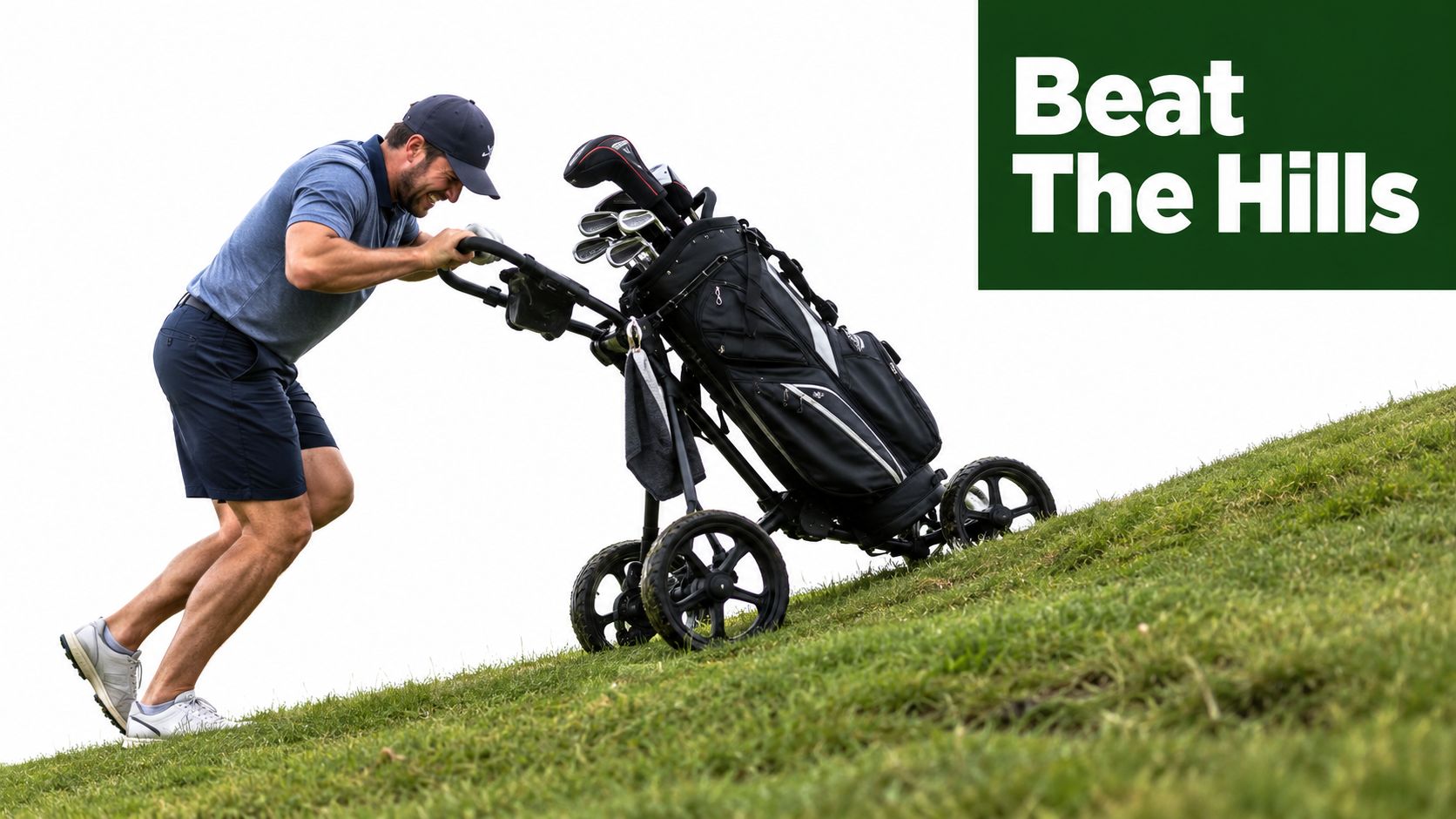
Assistance where it matters most
A retrofit power assist wheel changes that workload selectively. On a flat fairway, you can keep the cart moving at a pace that matches your normal stride. On a hill, the motor supplies traction and reduces the force required through your arms and shoulders. At the end of a long transition, you can let the cart do more of the work without abandoning the walking experience.
That distinction matters for golfers who want to preserve the exercise stimulus of walking but don't want every climb to become a test of endurance. A practical overview of motorized push carts shows how these systems fit between traditional manual carts and complete electric caddies.
Practical rule: Use assistance to smooth out the difficult parts of a course, not to make every part of the round feel motorized.
The retrofit format also avoids replacing equipment that already works. Your bag support, scorecard holder, umbrella mount, and storage routine can stay familiar, provided the cart's axle and frame accept the attachment system. That makes a drop-on wheel attractive to golfers who like their existing cart but have reached the point where pushing it uphill costs too much.
What the upgrade doesn't do
A power assist wheel won't remove every physical demand from golf. You still walk from the cart to the ball, manage uneven lies, carry yourself through the round, and steer the equipment around bunkers, rough, and narrow paths. It also won't compensate for a poorly balanced bag or a cart that was already unstable before the motor was added.
The benefit is more specific. The system reduces the highest-cost energy moments, such as steep climbs, long links between holes, and the final part of a tiring round. That can help you arrive at the next shot with a more consistent gait and better control, without turning the game into a passenger experience.
How Power Assist Wheel Technology Actually Works
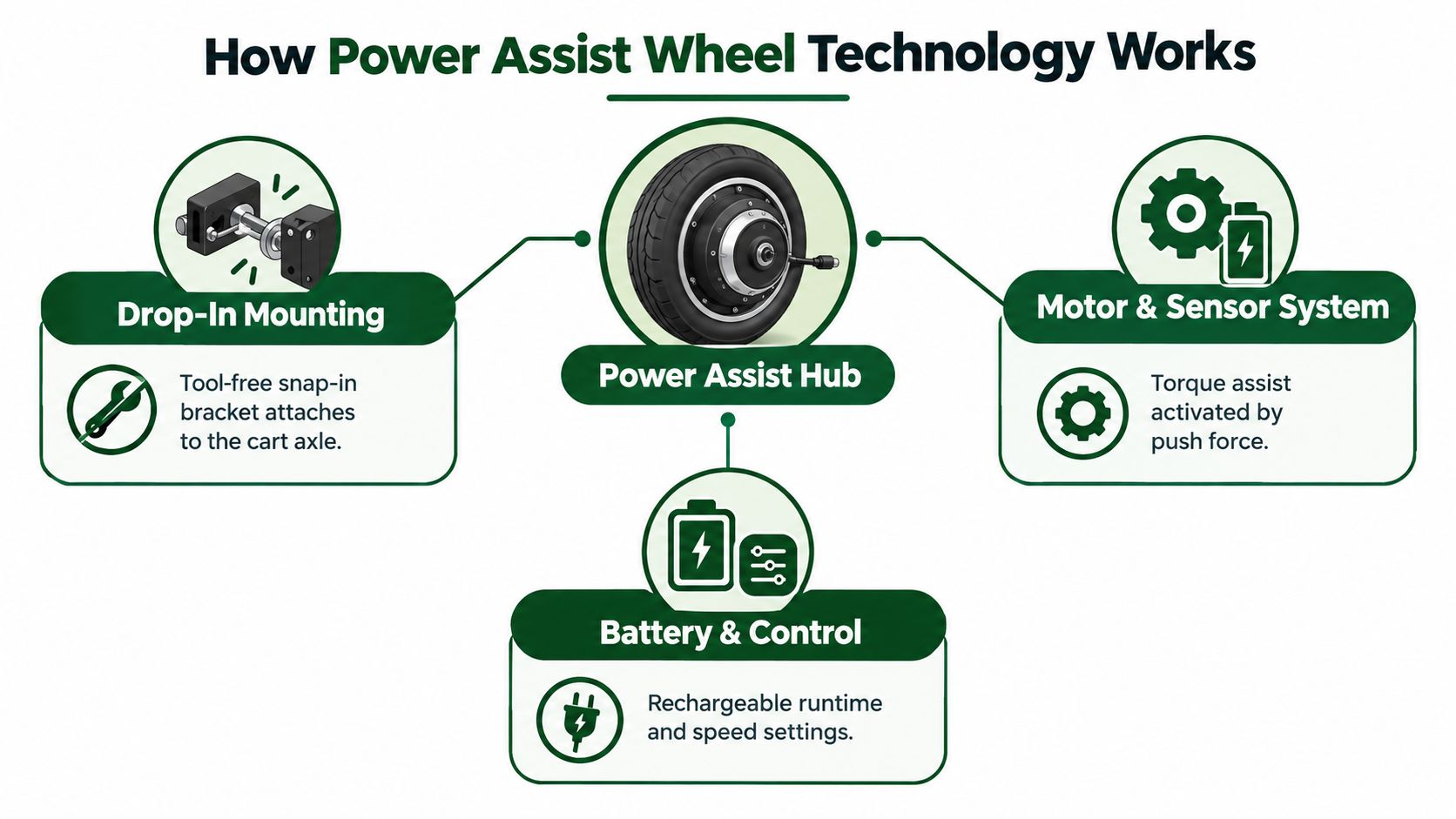
Most retrofit systems are easier to understand than their product pages suggest. Think of the device as a powered replacement or add-on wheel, a mounting interface, a rechargeable battery, and a control system that regulates speed and direction. The useful engineering is in how those parts cooperate without making the cart awkward to fold, lift, or steer.
The mounting interface
A snap-in or adjustable bracket is designed to secure the motorized wheel to the rear axle of a compatible push cart. The useful design goal is a firm connection without a complicated installation process. You want the wheel to sit squarely, remain aligned under load, and come off without turning routine storage into a workshop project.
Before buying, check the axle shape, available clearance, and the way the cart folds. Compatibility isn't just a question of whether the bracket can be attached. The wheel must also have room to rotate freely, avoid the frame during turns, and remain properly positioned when the bag is loaded.
The motor and battery
Modern systems commonly use compact brushless hub motors. The motor sits inside the wheel assembly, which keeps the drive unit close to the ground and avoids a large external gearbox. That compact arrangement can deliver useful torque while keeping the system visually and mechanically simple.
Lithium batteries have become the dominant battery type in electric golf push-cart purchases. A recent market report valued the sector at USD 0.32 billion in 2024 and projected USD 0.57 billion by 2034, with a 6% CAGR. The same electric golf push-cart market report reported that lithium batteries accounted for 68% of purchases, brushless hub motors appeared in 44% of models, and smart features influenced over 40% of consumer adoption worldwide.
The report also placed North America at more than 34% of global demand, followed by Europe at 29%, Asia-Pacific at 27%, and the Middle East and Africa at 10%. Those figures point to a broader equipment direction, lighter energy storage, compact drive systems, and controls designed for ordinary golfers rather than specialist users.
The control system
A remote control should do more than start and stop the motor. Forward, reverse, and braking functions are useful when positioning the cart beside a tee, recovering it on a slope, or making a tight correction near a green. A guide to remote-controlled electric golf caddies describes the practical value of speed and direction control, including an electronic brake for steep inclines and close maneuvering.
Variable speed is especially important. A cart that surges ahead forces you to shorten your stride or reach forward to regain control. A system that lets you set a steady pace is easier to live with because the cart follows your walking pattern instead of dictating it.
This video gives a visual look at how a motorized wheel integrates with a golf push cart:
The best setup feels predictable. Attach the wheel securely, switch on the system, select a modest pace, and test the brake before taking it onto a steep section. If the cart behaves consistently at walking speed, the technology becomes something you use without thinking about it.
Physiological Benefits and Energy Management on the Course
The key physiological question isn't whether a motor makes golf easier. It does. The more useful question is which effort you want to keep and which effort you want to remove.
A ride-on cart reduces the physical workload of moving between shots. A 2025–2026 research review found that golfers using carts expend less energy, record lower heart rates, and lose less sweat than golfers who walk. Those effects can help manage fatigue, but they also reduce the exercise stimulus that walking provides, as explained in the research review of golf-cart use and physiological load.
A power assist wheel occupies the middle ground. You still walk the course and maintain a normal walking gait, but the motor can reduce the sharp effort spike created by a hill or a long transition. That makes the system more strategic than setting the cart to move on its own for the entire round.
Preserve the walking rhythm
Walking golf works best when the cart stays with you. If it runs too fast, you end up chasing it. If it crawls, you have to keep reaching for the handle. Both problems create small interruptions that can become tiring over a full round.
Variable-speed control lets you match the cart to your stride length and the ground beneath it. On a level path, a moderate setting may feel natural. On a descent, reducing speed and using the brake gives you more control. On an incline, increasing assistance can prevent the cart from falling behind while you continue walking normally.
The right pace is the one that lets your arms guide the cart without making your legs follow it.
This approach also protects the purpose of walking. You're not trying to eliminate every muscular demand. You're trying to avoid wasting a disproportionate amount of energy on pushing equipment, especially when that effort arrives immediately before a shot.
Manage fatigue, don't chase maximum power
A motor with more output isn't automatically better. Excessive power can produce surging, abrupt direction changes, or a cart that feels difficult to restrain on a slope. The practical target is enough torque to maintain controlled movement when the bag is loaded and the ground rises.
This matters late in the round. Fatigue can affect posture, grip pressure, balance, and patience before it obviously affects your score. Offloading a difficult climb may not transform your swing, but it can help you reach the next shot with less accumulated strain.
The same logic applies to golfers managing age-related fatigue or reduced tolerance for repetitive pushing. A power assist wheel doesn't make medical promises, and it shouldn't replace professional advice for anyone with a health condition. It does offer a controllable way to reduce the mechanical demand of moving a cart while preserving the activity of walking.
A better workload split
Manual pushing creates a mixed workload. Some of it comes from walking, while some comes from repeatedly accelerating, stopping, and resisting the cart. A full electric cart removes much more of that work. Power assistance lets you choose where the boundary sits.
A sensible routine is to use low assistance on flat sections, increase it for sustained climbs, and slow the cart before corners or descents. That pattern keeps the round active without forcing the hardest physical demand to occur at the worst possible time.
Cart Compatibility and Stability Considerations
A power assist wheel can only perform well if the cart beneath it remains stable. Adding propulsion changes how the frame reacts to hills, side slopes, turns, and a shifting bag. The right choice depends as much on the cart's geometry as on the motor.
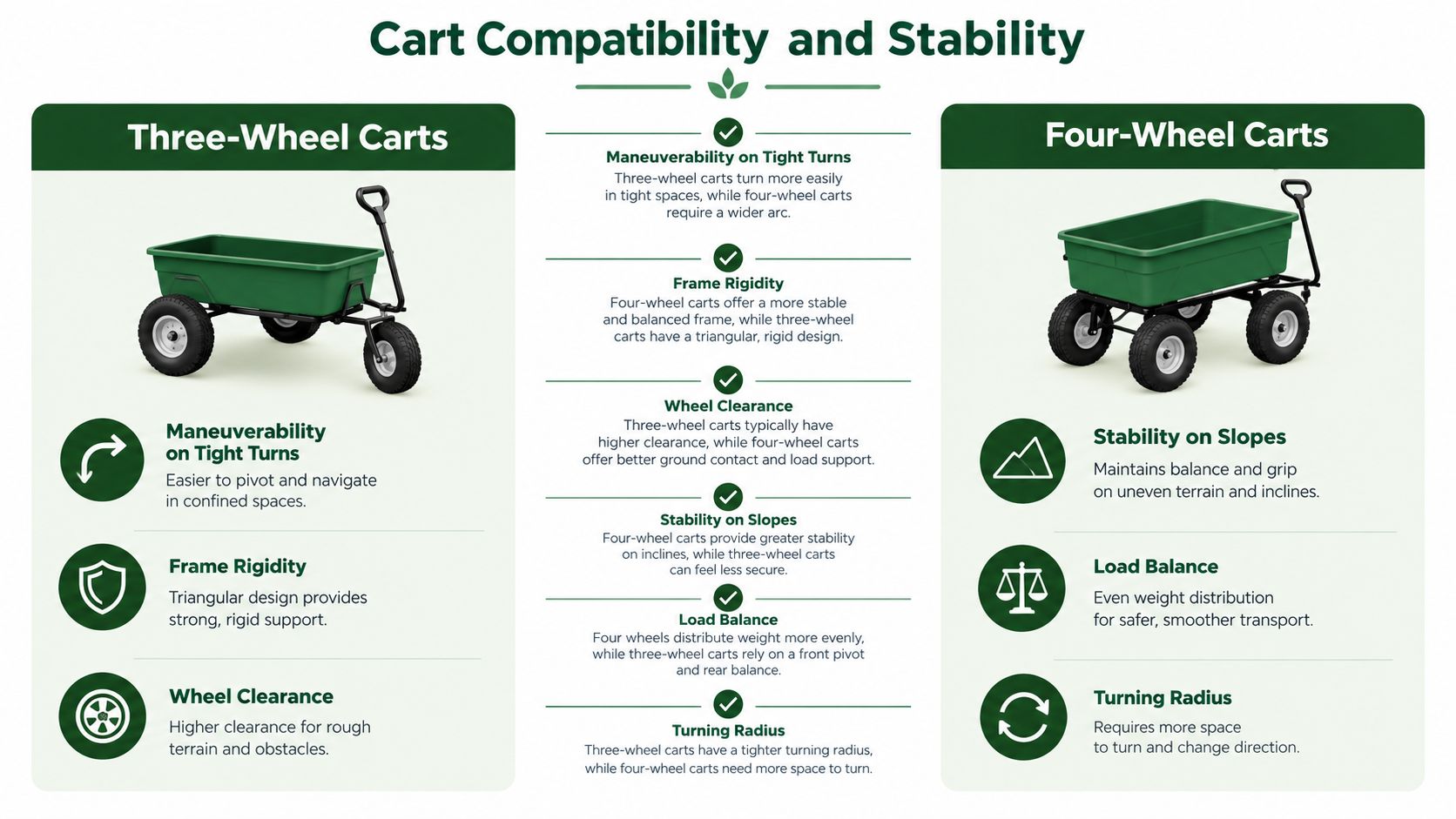
Three-wheel and four-wheel designs make different compromises. Independent guidance on three-wheel and four-wheel golf push carts describes three-wheel carts as generally lighter and more maneuverable, while four-wheel carts provide more stability and are preferred on hilly courses or side slopes.
Three wheels or four
A three-wheel cart usually pivots easily around tight turns. That's useful on narrow paths and around crowded practice areas, and the lighter frame can be easier to lift into a vehicle. The trade-off is that the cart may demand more active steering when the ground slopes sideways.
A four-wheel cart spreads its support across a broader footprint. That tends to improve confidence on undulating terrain and side slopes, particularly when the bag sits high or the surface changes abruptly. The trade-off is a larger turning radius and, in some designs, more weight to handle when the motor is removed.
| Cart design | Main advantage | Main concern |
|---|---|---|
| Three-wheel cart | Quick maneuvering and a lighter feel | Requires more attention on side slopes |
| Four-wheel cart | Greater stability and load balance | Less nimble in tight turns |
The motor doesn't erase those differences. It can make a cart easier to propel, but it can't correct a frame that tips easily or a bag that is badly positioned.
Check the axle and bracket
A snap-in bracket should fit the rear axle securely and keep the powered wheel aligned with the cart's centerline. Published compatibility guidance notes that some power-assist wheels use a snap-in or adjustable bracket intended for the rear axle of most major three-wheel and four-wheel push-cart brands. Even so, “fits most” isn't a substitute for checking your specific frame.
Use a cart compatibility test checklist before ordering. Confirm the axle dimensions, wheel clearance, folding mechanism, and attachment points. Then load the cart as you normally would and inspect whether the bag shifts backward, presses against the motor assembly, or changes the cart's balance.
Read the slope realistically
On a hill, stability depends on more than the motor's advertised output. Wheel placement, bag height, tire contact, frame rigidity, and the direction of travel all influence how the cart feels. A motor that maintains traction while climbing can still make a poorly balanced cart uncomfortable across a side slope.
Start testing on a gentle incline. Keep one hand near the handle, verify that the brake engages cleanly, and avoid making the first trial on a narrow path beside a steep drop. If the cart begins to lean, slow down and reposition the bag before increasing assistance.
A stable, predictable cart with moderate assistance is more useful than a powerful motor attached to an unstable frame.
Battery Life, Maintenance, and Long-Term Ownership
Battery performance determines how confidently you can use a power assist wheel across a full round. Advertised range depends on terrain, bag weight, speed settings, tire resistance, temperature, and charging habits. Treat the stated range as a guide under specific conditions, not a promise for every course.
Published electric golf push-cart guidance commonly discusses 27 to 36 holes per charge, while noting that heavy bags, higher speeds, and hilly ground can reduce practical range. This electric golf push-cart battery guidance also covers spare-battery planning for long events and the limits of water-resistant equipment in heavy rain. For fatigue management, that margin matters most on courses where steep climbs arrive late in the round. Preserving battery capacity can offload the highest-cost pushes without removing the walking workout from flatter stretches.
Build a charging routine
Recharge the battery after use according to the manufacturer's instructions instead of leaving it empty for extended periods. If the cart sits between rounds, check the battery regularly and store it in the condition specified by the manufacturer. Keep the charger, battery, and control components away from damp conditions.
Cold weather can reduce apparent range and make the system feel less responsive under load. That does not necessarily indicate permanent damage. Allow the battery to reach a suitable operating temperature, and avoid judging its condition from one cold outing.
Range expectations and degradation over charge cycles are explained in this guide to golf cart battery lifespan. Use that information when deciding whether a spare battery is justified for long or hilly rounds.
A practical ownership routine includes:
- After a round: Inspect the wheel, bracket, cable connections, and housing for grass, grit, or moisture.
- Before storage: Clean contact areas and keep the battery in the recommended environment.
- Before a hilly round: Begin with a full charge, then consider whether course length and terrain warrant a spare.
- After unusual behavior: Stop using the system if you hear unfamiliar noises, feel inconsistent movement, or notice the wheel losing connection.
Diagnose before replacing parts
Inconsistent movement often results from a low charge, loose connection, or debris around the wheel rather than a failed motor. Check the battery level first, then inspect plug connections and bracket seating. Test the remote at close range and confirm that the brake is not partially engaged.
Unusual noise deserves attention. Surface debris may affect operation, but grinding, repeated clicking, or visible damage calls for careful inspection and manufacturer support. Do not continue a steep descent when the control system responds unpredictably.
Total cost of ownership
Ongoing costs include the charger, battery care, storage space, and possible replacement components. A retrofit setup can still cost less and cause less disruption than replacing an entire cart, but it requires more ownership work than a manual model. Occasional golfers should weigh that responsibility against their limited use. Frequent walkers on hilly courses may value the reduced effort during repeated climbs more than golfers who play mainly flat layouts.
Choose the system when it addresses a recurring physical demand. The battery earns its place when it preserves your walking routine while taking over the moments that create disproportionate fatigue.
Buying Guidance for Walking Golfers
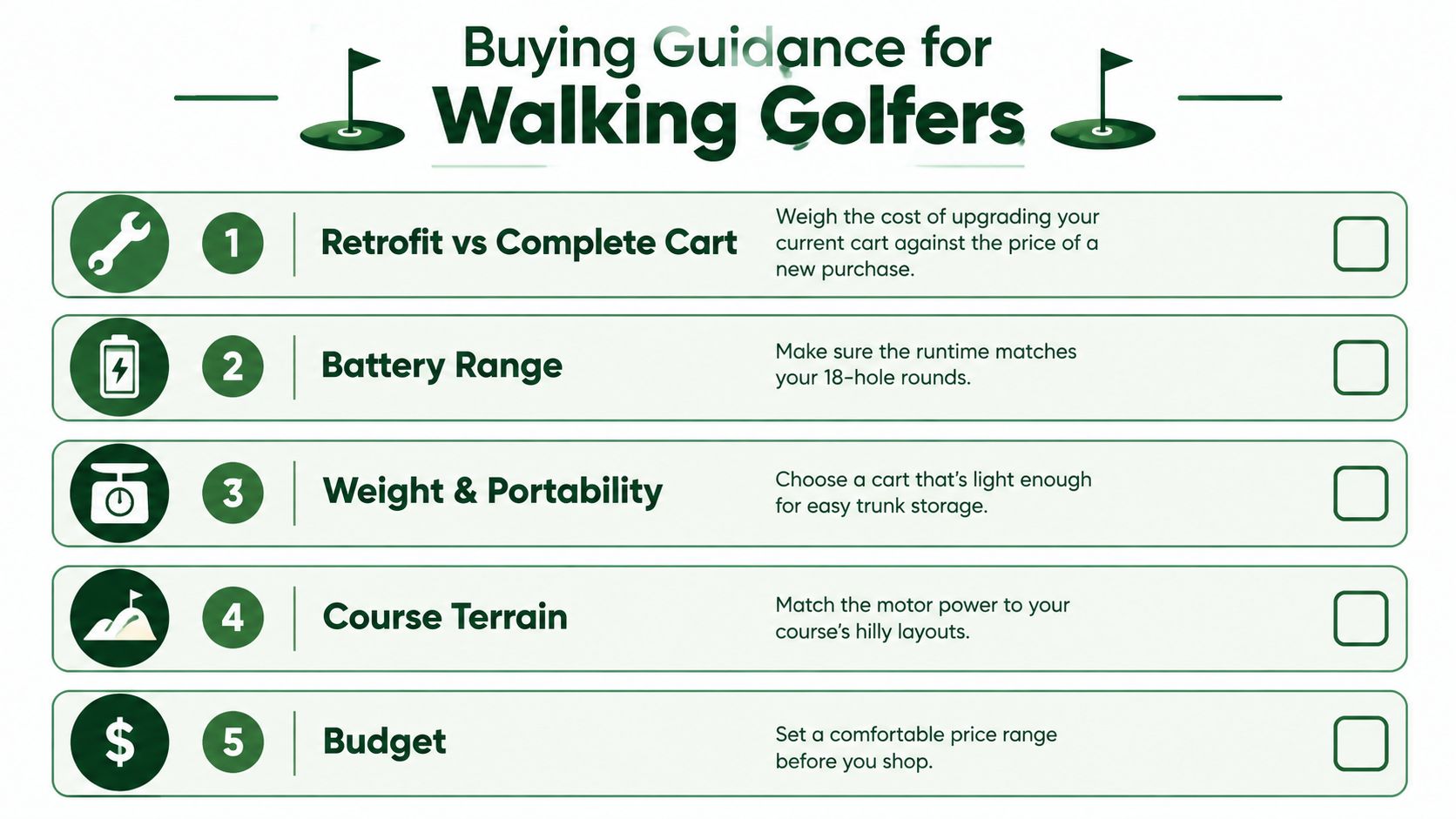
Start with the course, not the brochure. A golfer who walks mostly flat parkland may prioritize light weight, folding convenience, and precise low-speed control. Someone who regularly plays steep, undulating layouts should place more emphasis on traction, stability, braking, and the ability to maintain pace under load.
The central choice is retrofit versus complete electric cart. A retrofit power assist wheel preserves the push cart you already know and can be removed when you want a fully manual round. A complete electric cart may offer a more integrated design, but it also means replacing more of your existing equipment and accepting the storage and transport demands of a larger system.
Prioritize controllability over headline power
Independent 2026 reviews identify dual-motor architecture and variable-speed control as important differentiators for hilly courses. One review reported that a two-motor design delivered more torque than any single-motor cart tested and maintained uphill speed while carrying a 30-pound stand bag. Another noted that speed ranges such as 1–20 allow golfers to match cart pace to stride length and terrain, as described in this independent electric golf push-cart review.
Those findings point to a useful buying order:
- Hill behavior: Look for verified evidence that the system maintains controlled movement on inclines, not just a large wattage claim.
- Speed adjustment: Choose controls that let you make small pace changes instead of offering only slow and fast settings.
- Braking: Test how the cart stops and holds on a slope before trusting it near a green or path edge.
- Fitment: Confirm that the bracket matches the rear axle and doesn't interfere with folding or steering.
- Stability: Match the wheel system to the cart's three-wheel or four-wheel geometry and your usual terrain.
Match the system to your routine
If you store equipment in a small trunk, total weight and removal time matter. If you play long weekend events, battery planning matters more than a compact remote. If you regularly walk in wet conditions, check the manufacturer's water-resistance guidance rather than assuming every component tolerates heavy rain.
Remote holders, charging equipment, warranty coverage, and replacement-part availability also affect daily ownership. A package that looks inexpensive can become frustrating if the battery is difficult to charge, the control is easy to lose, or the bracket requires tools every time you fold the cart.
The most useful test is whether the power assist wheel helps you walk the way you want to walk. It should reduce the strain of steep climbs and long transitions without forcing you to chase the cart, fight the steering, or give up the familiar equipment that already fits your game.
For a retrofit solution that attaches to standard golf push carts and provides remote-controlled forward, reverse, and braking assistance, visit Caddie Wheel. Its drop-on motorized wheel is designed for golfers who want to conserve energy on demanding terrain while keeping the walking experience intact.
Share:
Electric Golf Caddy Price: What Drives Cost in 2026
Electric Assist Motor Guide: Install, Use, and Maintain