

You've probably felt the moment on a long round when the push cart stops being convenient and starts taking energy from your swing. The first few holes feel easy, but a steep fairway, a heavy bag, and repeated stops can leave your arms and shoulders working harder than your golf game requires. You still want to walk, though. Riding changes the rhythm of the round, while carrying can make the course feel harder than it needs to.
An electric assist motor offers a middle path. It adds controlled power to the cart you already use, helping it move over starts, slopes, and uneven ground while you continue walking beside it. The retrofit question is more practical than glamorous: will the motor fit, will the controls feel natural, and will it perform consistently for a full round?
What an Electric Assist Motor Does for a Golf Push Cart
Halfway up a hill, a familiar push cart can change from convenient to demanding. One hand pulls against the frame while the other steadies the clubs. By the next tee, your arms have done work that has little to do with playing better golf.
A wheel-mounted electric assist motor reduces that load without turning the cart into a self-driving vehicle. It powers one wheel while you remain responsible for direction, pace, and positioning. The retrofit keeps the cart you know, but adds force when its weight, your equipment, or a slope makes manual pushing inefficient. Fit and control feel matter as much as the motor itself. A system that mounts awkwardly or surges at low speed can make the cart harder to manage, not easier.
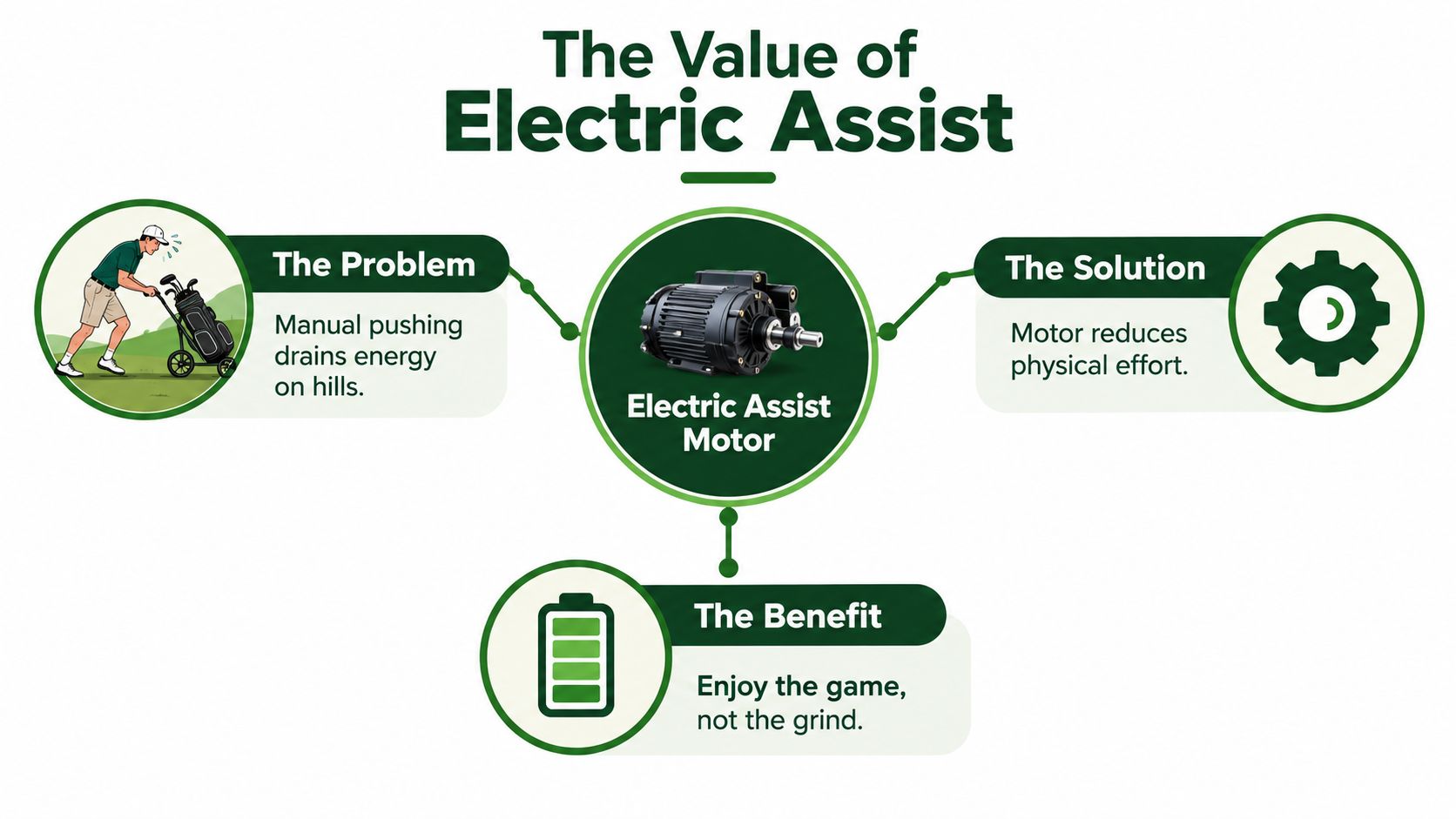
The benefit varies by golfer. A senior player may want to keep walking without fighting every incline. A fitness-minded golfer may value the movement and fresh air while avoiding the accumulated strain that makes the final holes less enjoyable. Someone returning after an injury may use assistance to stay active while reducing stress on a sensitive joint.
On the course, good assistance feels measured. It helps the cart start, maintain pace, and handle a rise without pulling away from you. You should still feel connected to the cart and able to correct its line.
Practical rule: Electric assistance should conserve effort, not remove your connection to the round.
The category has moved beyond experimental gadgets. The global electric golf push cart market was estimated at USD 0.32 billion in 2024 and is projected to reach USD 0.57 billion by 2034, implying a 6% compound annual growth rate. Within that market, brushless hub motors appear in 44% of models, while lithium battery packs account for 68% of purchases versus lead-acid batteries, according to Global Growth Insights' electric golf push cart market analysis.
A retrofit assist system sits between carrying and riding. Carrying is simple but puts the bag's weight on your body. Riding removes more physical work but changes the rhythm of the round. Motorizing your existing push cart preserves familiar walking habits and adds power only where the course demands it.
How Electric Assist Motors Work and What Specs Matter Most
Motor specifications can make a brochure look more impressive than the cart feels on a course. Peak wattage attracts attention, but low-speed torque, controller behavior, wheel size, and heat management usually determine whether the cart starts smoothly and climbs without hesitation.
A brushed DC motor is a useful example because its behavior is straightforward. Torque is approximately proportional to current, while speed is approximately proportional to supply voltage. That creates a near-linear speed-torque relationship that a controller can manage with pulse-width modulation, or PWM. For a push cart, predictable torque matters more than dramatic top speed because the motor must start a loaded cart, handle a gradient, and respond to changing resistance.
The engineering trade-off is efficiency. Well-designed brushed DC coreless motors can reach up to about 90% efficiency, with one representative example showing 81% efficiency, while typical brushed DC motors are often cited around 75% to 80% under rated conditions, as explained in Portescap's brushed DC motor reference. Those figures aren't a promise of what every installed system will achieve. They show why motor selection and controller quality affect runtime, heat, and the battery capacity needed for a given course.
Read the useful specifications
For a retrofit, I'd assess the specification sheet in this order:
- Rated torque: This tells you more about starts and inclines than a peak power headline. Torque must be considered alongside wheel diameter, cart load, and how often the motor works under resistance.
- Operating voltage: Compact assist systems commonly use 12 V or 24 V, with motor power in the 30 W to 250 W class, rated torque from 1.5 Nm to 5 Nm, and low-speed operation around 300 to 650 rpm, according to Exedy's mobility-assist motor guidance.
- Controller response: A good controller meters power progressively. Poor control can create a lurch at startup, an annoying delay, or a speed change that feels awkward when you're walking close to the cart.
- Motor architecture: Brushless hub motors are appearing in a substantial share of current models, but brushless isn't automatically better for every retrofit. The motor still needs to match the wheel and the intended duty cycle.
- Protection: Outdoor equipment needs resistance to dust and moisture. A motor specification that includes environmental protection is more useful than an impressive peak figure with no information about sealing.
A neutral benchmark from the same engineering reference lists a 250 W, 24 V direct-drive unit rated at 5 Nm and 650 rpm, with IP54 protection. It illustrates the central point: a compact motor can provide useful assistance when torque is matched to the wheel rather than selected only for maximum power.
PWM also matters because it lets the controller regulate delivery instead of forcing the motor to operate at full output whenever assistance is active. Better control can reduce unnecessary electronic heating and help preserve battery energy. Every 1% drop in motor or electronics efficiency requires about 1% more battery power to deliver the same output, so small losses become meaningful when the cart works repeatedly on hills.
Integrating Motor, Battery, Remote, and Braking for Safe Control
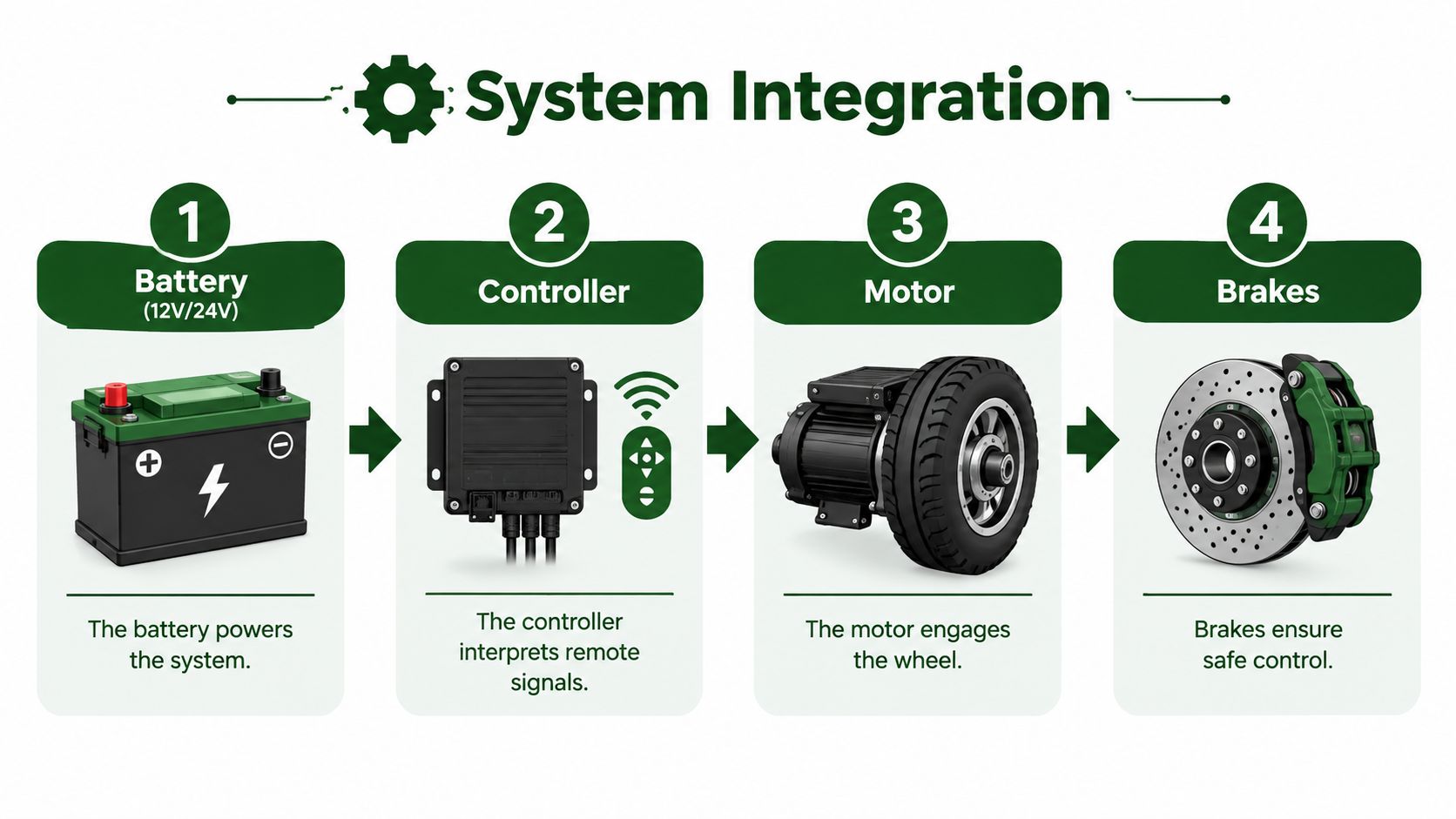
A motor alone doesn't make a push cart easy to use. The walking experience depends on the relationship between the battery, controller, remote, wheel, and braking system. If one part responds badly, the whole conversion feels unfinished.
Start with the battery. Compact systems commonly operate at 12 V or 24 V, and battery chemistry affects weight, charging behavior, and usable distance. Lithium packs have become a preferred choice in the market, but the chemistry label doesn't tell you how the system will perform on your course. Load, slopes, stops, and braking activity all influence how much energy remains at the end of the round.
The controller interprets commands from the remote and converts them into motor output. A variable-speed control should let you make small changes while walking on level ground, then add power for a climb without an abrupt surge. Forward and reverse are useful for positioning the cart near a tee or green, but the controls should remain easy to understand when you're carrying a club or concentrating on the next shot.
Judge braking by behavior, not description
Automatic downhill braking is a core safety feature. The motor or electronic braking system engages when the cart stops or descends, helping prevent rollaways and allowing the cart to remain parked on a slope, as described in BetterBike's electric golf push cart guidance.
That behavior should feel controlled rather than dramatic. On a hill, you want the cart to slow predictably when you release the control, not continue gathering momentum until you reach for a separate brake. Test the system on a gentle slope before using it on a demanding course, and check whether the cart holds position when you stop walking.
The battery, controller, and brake system also need to be treated as one system. A motor that has enough torque but a poorly calibrated controller can be tiring to manage. A large battery with inefficient electronics may add weight without delivering the expected usable distance. A responsive remote with weak downhill control creates a safety problem rather than a convenience.
For a practical explanation of forward, reverse, and brake behavior, review this guide to controlling a golf cart motor. The right setup feels quiet and predictable. You shouldn't need to think about the electronics during every step of a round.
Retrofit Assist Versus a Full Electric Push Cart
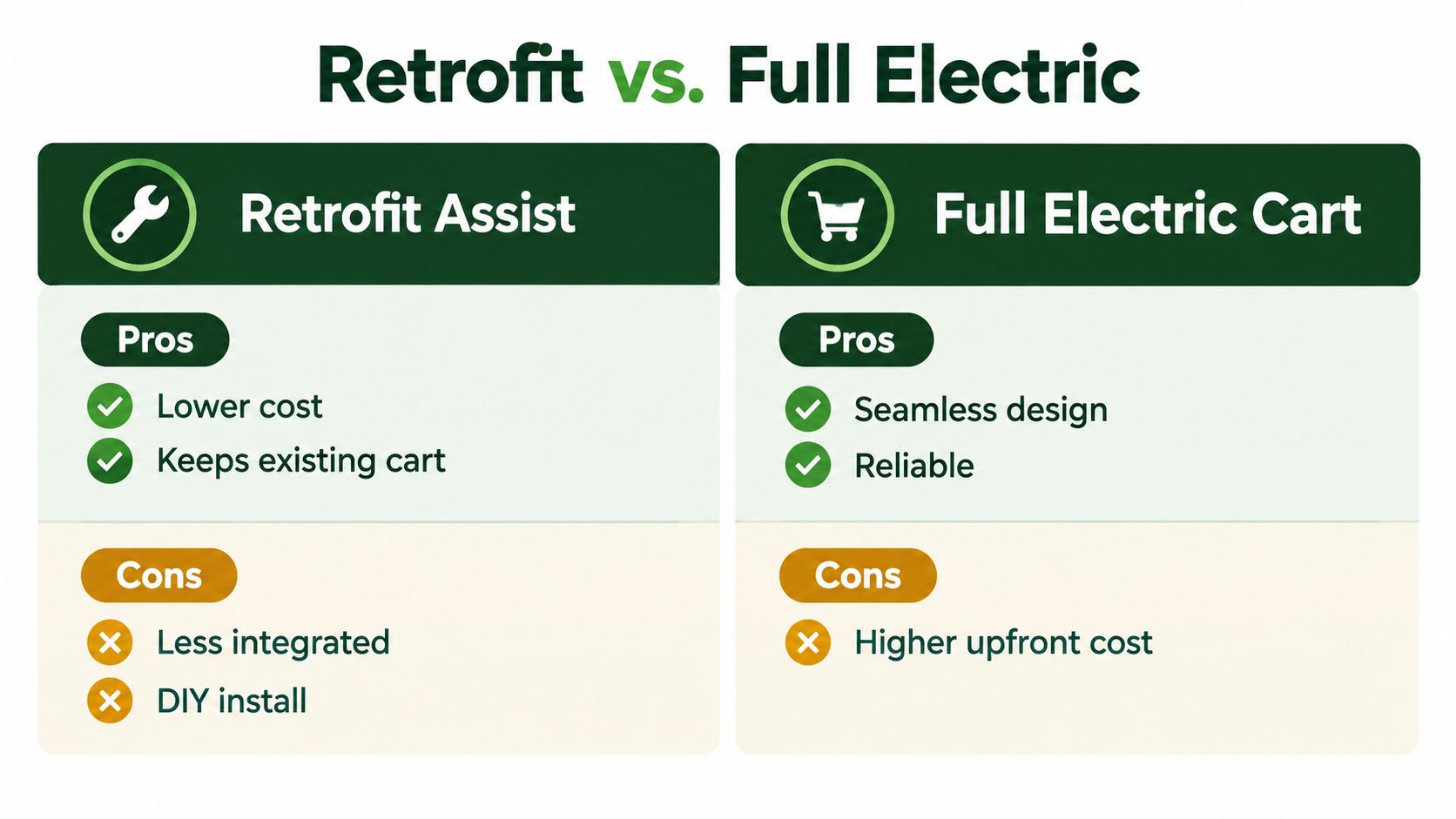
You reach the first tee with a push cart you already understand. It folds into your car, holds your bag and accessories where you expect them, and tracks predictably beside you. Retrofitting adds powered assistance without forcing you to relearn the frame, storage routine, or walking position that already works.
A full electric push cart provides factory integration. The motor, battery, wiring, controls, and frame are selected as one product, which can reduce compatibility questions and produce a neater setup. You also replace the entire cart, even if your current frame, wheels, and accessories remain in good condition.
A retrofit conversion requires more checking before purchase. Confirm axle dimensions, bracket fit, wheel clearance, cable routing, and battery placement. A drop-on or snap-in kit may install quickly, but a poorly matched system can create movement at the mount, awkward weight distribution, or extra work every time you fold the cart. For a concrete look at what a kit includes, see this electric golf push cart conversion kit guide.
Complexity versus continuity
A retrofit generally suits a golfer who:
- Already likes the current cart: The frame, folding method, storage, and accessories remain familiar.
- Wants to keep walking: Assistance reduces pushing effort while preserving a walking round rather than changing to a riding cart.
- Prefers targeted spending: You add powered support to the part of the setup causing the problem instead of replacing every component.
- Can verify compatibility: You are prepared to check measurements and follow the installation instructions carefully.
A complete electric cart can make more sense when the existing frame is worn, the wheel arrangement is unusual, or available retrofit kits cannot provide a secure fit. It also suits golfers who want integrated features and accept buying a new platform, storing a larger product, and adapting to different control behavior.
Published range claims of 27 to 36 holes should serve as comparison points, not guarantees for your terrain. They rarely show how hills, bag weight, golfer weight, walking pace, or repeated braking affect usable distance. Broader market analysis discusses lithium batteries, brushless hub motors, and AC systems in relation to efficiency, hill climbing, and regenerative braking. Review those claims in Market Intelo's electric golf cart analysis, but look for course-specific testing before treating them as a buying decision.
The most useful conversion is often the one that removes installation friction while preserving the cart you already trust.
Test the system with your actual load and terrain. A straightforward retrofit with clear fit guidance may deliver more practical value than a feature-heavy cart that adds storage problems, weight, or a new learning curve.
Choosing the Right Electric Assist Motor for Your Push Cart
Start with fit, not power. A motor that cannot mount securely to your axle is irrelevant, and a bracket that shifts under load will affect tracking, braking, and confidence on a slope.
Most retrofit systems use an adjustable or snap-in bracket designed to fit many three-wheel and four-wheel push carts. Manufacturers commonly recommend checking a compatibility list or axle-measurement guide before purchase, as explained in this guide to four-wheel golf push cart compatibility. Measure the cart as instructed rather than relying on the brand name alone. Two carts with similar layouts can use different axle dimensions or clearance around the frame.
Use this buying checklist
Check the mounting interface first. Confirm the bracket type, axle measurement, wheel position, and clearance when the cart folds. Ask whether the motor stays attached during storage or needs to be removed.
Then assess control feel. Look for variable-speed operation, forward and reverse control, and a braking response that doesn't surprise you. A remote should be usable without staring down at it, especially when you're walking over uneven ground.
Match battery capacity to the course. A flat municipal course and a hilly championship layout place different demands on the same cart. Think about bag weight, accessories, your own walking pace, and how frequently the motor will be asked to climb rather than cruise.
Ask about support before payment. Warranty length matters, but so does the availability of replacement parts, setup guidance, and a clear route for diagnosing remote, battery, or motor faults. A system with understandable support is easier to keep in service than one that leaves every problem to the owner.
Look beyond the brochure
A practical test should include starting from rest, making a slow turn, stopping on a gentle slope, reversing into position, and walking beside the cart while changing speed. Listen for grinding, watch for bracket movement, and notice whether the cart tracks straight when the motor engages.
Don't treat published range as a guarantee. Use it as a comparison point, then temper it with course conditions and load. The right electric assist motor is the one that fits securely, responds smoothly, brakes predictably, and supports the way you play.
Installing and Maintaining Your Electric Assist Motor System
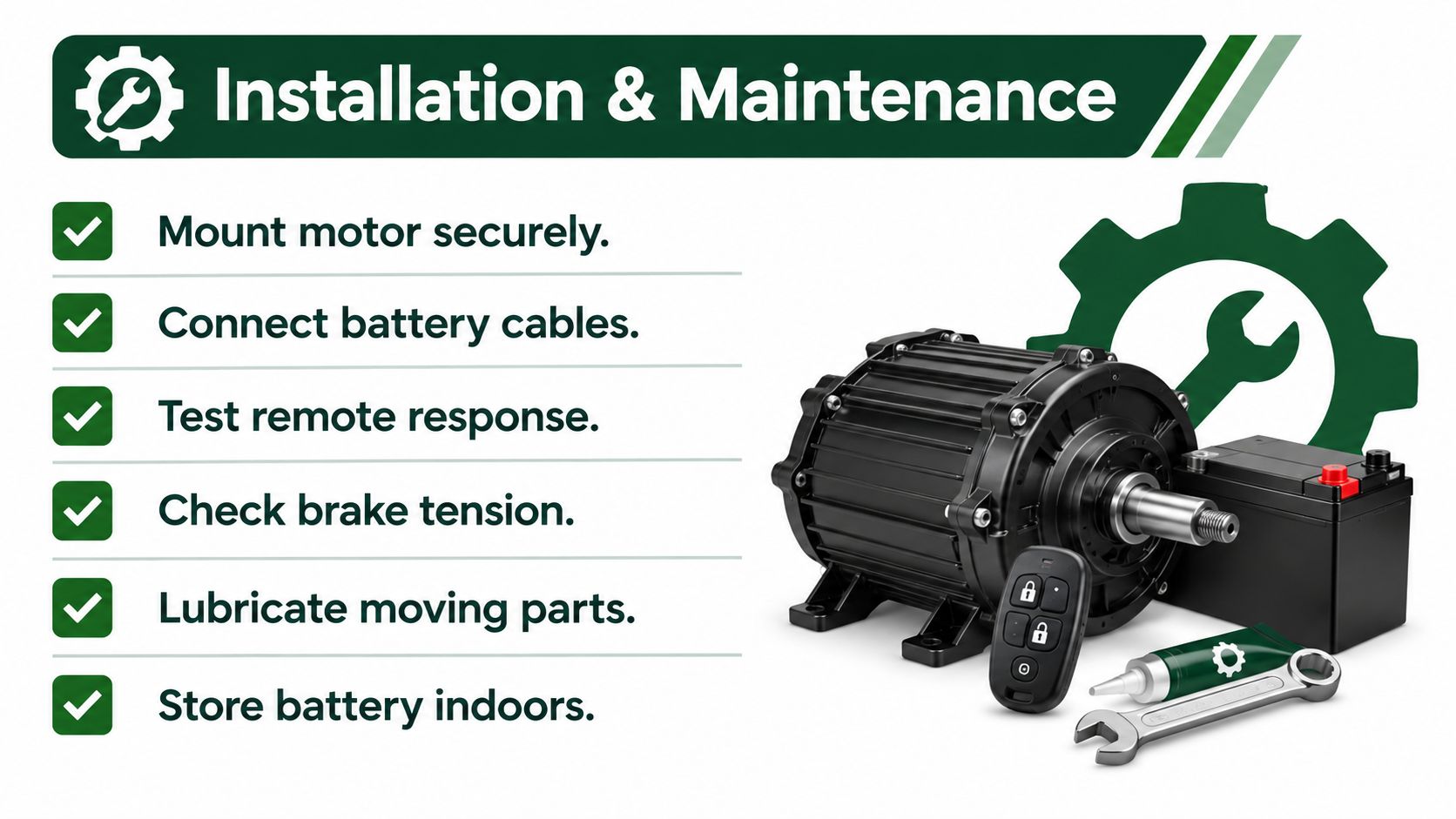
A drop-on design can make installation approachable, but simple doesn't mean careless. Begin with the cart unfolded on a stable surface, then check the axle and bracket interface before connecting the battery. The motor wheel should sit squarely, the fasteners should be secure, and nothing should rub when the cart moves or folds.
Connect the battery only after the motor and controller are mounted. Keep cables away from moving joints and sharp frame edges, and check that the remote pairs correctly before taking the cart to the course. Test forward, reverse, gradual speed changes, and braking with the cart unloaded first.
Build a short pre-round routine
- Inspect the bracket: Look for looseness, movement, or altered alignment after using the cart on rough ground.
- Check the wheel: Remove grass and debris, then confirm that the wheel seats correctly and rotates without unusual noise.
- Test the remote: Make sure commands register immediately and that the stop or brake response feels consistent.
- Examine connections: Keep plugs clean and protected from moisture. Don't leave damaged insulation or loose connectors for another round.
- Charge sensibly: Recharge according to the manufacturer's instructions, avoid repeatedly running the battery completely flat, and store it in a suitable indoor location during the off-season.
Reduced runtime can come from a depleted or aging battery, extra cart load, drag at the wheel, poor connections, or a motor that is working harder than it should. Inconsistent braking deserves attention before the next round, particularly if the cart no longer holds securely on a slope.
For mechanical symptoms that go beyond basic inspection, use a structured golf cart motor repair guide rather than repeatedly cycling the system and hoping the issue disappears. Cleaning, secure mounting, sensible charging, and regular inspection usually prevent small problems from becoming course-day failures.
Whether an Electric Assist Motor Is the Right Upgrade for You
An electric assist motor is a strong fit when the cart you own is still comfortable, stable, and worth keeping. The upgrade makes particular sense if you want to walk for the health and enjoyment of it, but manual pushing has started to affect your energy, pace, or concentration late in the round.
The retrofit route also suits golfers who prefer a simpler change. You don't have to learn a new frame, reorganize your storage, or replace accessories that already work. A properly matched motor adds help where you need it, while the familiar cart continues to handle the bag and follow your usual walking pattern.
The answer is less obvious when the existing cart is damaged, awkward to fold, or difficult to match with a secure bracket. In that situation, a complete electric push cart may provide a cleaner starting point. It can also be the better option for someone who wants a fully integrated design and doesn't want to handle any conversion work.
Prioritize the experience over the biggest specification
The market's direction supports the importance of control. Remote-control electric golf push carts accounted for 58.4% of global revenue in 2025, equal to about USD 1.05 billion, according to DataIntelo's electric golf push cart market report. Another estimate placed electric carts at 41.6% of push-cart revenue in 2025, with an 8.0% compound annual growth rate projected through 2034, from the same source. These figures describe a growing category, but they don't tell you whether a particular system will feel natural beside your cart.
Your decision should come down to four practical tests:
- Fit: Does the bracket attach securely to your cart and leave adequate clearance?
- Control: Can you make small speed changes, reverse smoothly, and stop without a lurch?
- Course performance: Does the system remain composed with your bag on the hills and surfaces you play?
- Ownership: Are the battery, remote, motor, and mounting parts supported by a clear warranty and repair process?
Don't buy on peak power alone. A well-matched motor with predictable control can be more useful than a larger unit that adds weight or drains the battery quickly. Before committing, verify the fit, test the remote response, observe the downhill braking, and ask how support handles a fault after the sale.
Caddie Wheel offers a lightweight motorized wheel with a drop-on design and snap-in bracket for standard golf push carts, plus a variable-speed remote with forward, reverse, and braking control. If you want to preserve your walking routine while reducing manual pushing, visit Caddie Wheel to review the retrofit option.
Share:
Power Assist Wheel Guide for Golf Push Carts
What Is Controlled Braking: A Complete Guide