
You're halfway through the back nine, your legs are starting to complain, and the game you still love is suddenly feeling longer than it should. That's the moment many golfers start looking at single seater golf buggies, not as a luxury, but as a way to keep playing without feeling wrecked by the walk. A good one can change the pace of a round, but the wrong one can become expensive storage with a battery attached.
The key decision isn't just “should I buy one?” It's whether the buggy fits your course, your body, your transport setup, and your club's rules. If you're weighing that against a lighter option, a useful place to start is this guide to electric push carts for golf, because the best choice depends on how much support you need.
Rediscover Your Love for the Game Without the Fatigue
A lot of golfers don't stop enjoying the game, they just start dreading the walk between shots. I've seen players arrive fresh, hit the front nine well, and then spend the back nine bargaining with their own knees, hips, or lower back. Once the round becomes a survival exercise, concentration slips, tempo changes, and the scorecard usually shows it.
That's where single seater golf buggies matter. They don't change the swing for you, but they can preserve enough energy that the swing you already have stays usable for longer. The practical payoff is simple, you arrive at each shot with more of your attention left for the decision in front of you.
Practical rule: if walking the course is already costing you shots, don't treat the buggy as a convenience purchase. Treat it as equipment that protects your round.
There's also a mental side to this. Golfers who spend less energy between shots tend to stay more engaged with club selection, line reading, and course management. That matters on courses where the hardest part isn't the golf, it's getting from tee to green without burning out before the turn.
If you're trying to extend your golfing years, the question becomes less emotional and more practical. Can you keep playing the courses you enjoy, at a pace that still feels like golf rather than rehab? If the answer is no, a single-seat buggy deserves serious consideration.
What Exactly Is a Single Seater Golf Buggy
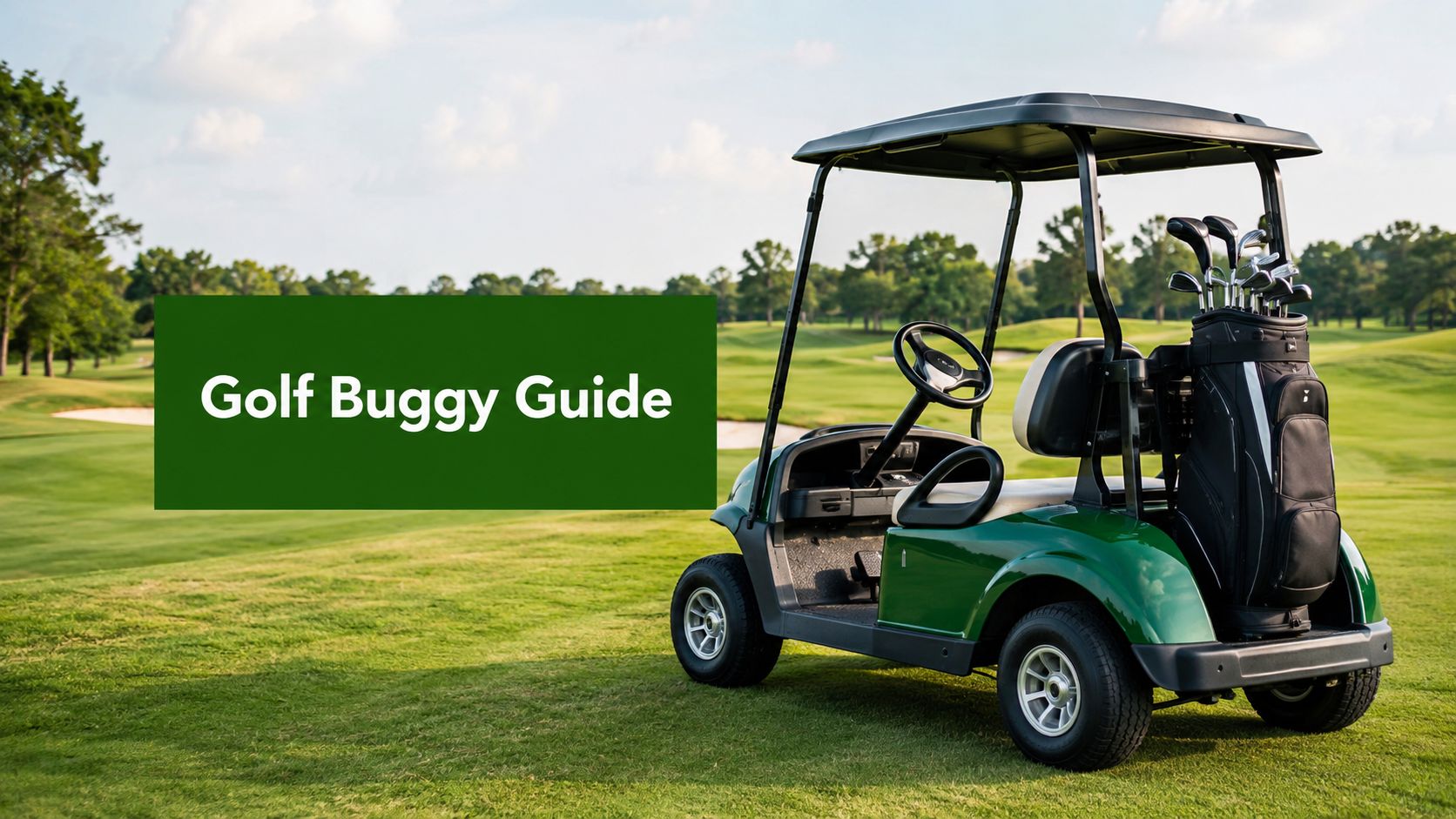
A single-seat golf buggy is a compact electric vehicle designed for one golfer and a set of clubs. It carries you and your equipment around the course, while a trolley still leaves you walking beside or behind it. Many models also break down into a few pieces, which makes them easier to lift into a car boot and store between rounds. That difference matters, because it tells you what the machine is meant to do. It is personal transport on the course, not just a powered way to haul a bag, as explained in this overview of single seat golf buggies.

What it is not
It is not a two-person rental cart made smaller. Those larger carts are built around shared transport, different weight distribution, and club logistics, while a single-seater is designed for the solo golfer who wants independence and a smaller footprint. It is also different from a push trolley with a motorised helper, because you are sitting and driving rather than walking behind the bag.
The portability angle is one reason golfers buy them. Many models split into sections so they can be loaded into a vehicle, which helps members who move between clubs or do not have permanent buggy storage at their home course. That portability also changes who can realistically own one, because storage and transport stop being a problem for many golfers.
A push trolley helps you carry less. A single-seater buggy helps you physically do less. That is the fundamental divide between the two, even if both are trying to address walking fatigue.
If you are comparing models, it helps to read a plain-English breakdown like this golf cart buggy guide before you buy, because the details around size, handling, and course use matter more than the marketing.
A buggy can also be part of a wider mobility conversation. For golfers who are dealing with movement limits, a qualified healthcare provider or a local mobility specialist can help assess what level of support makes sense, and a resource like Aspen Falls Wellness can be useful when you are trying to understand how those limits affect day-to-day comfort and activity choices.
On the course, the practical question is simple. If you need to arrive at the tee less tired, and you want a machine built around one rider rather than one bag, you are looking in the right category.
Who Benefits Most from a Personal Golf Buggy
The strongest case is for golfers who still want to play often, but whose body has started charging rent for every mile walked. Senior players are obvious candidates, but so are anyone dealing with sore joints, limited stamina, or a medical issue that makes a full round harder than it used to be. A buggy doesn't replace fitness, it keeps golf accessible when walking every hole stops being realistic.
Another group gets overlooked, players on long or hilly courses. A buggy can help you move through awkward paths and slopes with less strain, which means you reach the next shot with more focus and less irritation. That's especially useful when the course itself, not the golf, is what drains you.
If a golfer wants to keep pace with friends or play more holes in a day, the time-saving side matters too. Some single-rider buggies are promoted for faster round times, but the bigger benefit is that the round feels manageable instead of punishing.
For golfers with mobility challenges, it's worth speaking with a qualified healthcare provider or a local mobility specialist about what level of support makes sense. A resource like Aspen Falls Wellness can be helpful if you're trying to understand how movement limits affect day-to-day comfort and activity choices.
A buggy is most useful when the walk, not the golf, is the problem.
That's the dividing line. If you like walking and only want a lighter load, a different solution may suit you better. If you're choosing between skipping rounds and sitting down to play them, a personal buggy is often the stronger answer.
Key Features and Technologies to Scrutinize
The spec sheet looks technical, but the useful questions are plain. Can it climb your home course without dragging? Will the battery last long enough for your usual round? Can you load it without treating every golf day like a gym session?

Power, battery, and hill performance
The broad technical picture is clear from single-seat model specifications. One electric single-seater lists a 36V 50Ah lithium battery, a 3 to 4 hour recharge time, 50 km maximum travel distance, 200 kg carrying capacity, and a 30-degree slope climbing capacity, while another is advertised with 36 holes on a single charge and up to 45 km of range as shown on the product page for the i-M4 electric single-seater golf buggy.
That tells you the category has moved beyond novelty. These are built to cover a full day, but you still need to read those numbers in context. Range in golf is never just battery size. It's also terrain, rider weight, stop-start driving, and how hard the buggy is working on climbs.
For that reason, look closely at drivetrain details as well as battery claims. A model with a 1200W transaxle motor and 25:1 reduction ratio is being marketed for stronger climbing and control, which is exactly the sort of spec that matters on uneven ground. Torque at the wheel usually tells you more about real performance than a shiny top-speed claim.
Comfort, materials, and maintenance
This is also where buyers should think beyond power. Seat design, control placement, chassis stability, and tyre choice all affect how tiring the buggy feels after several holes. If a machine is awkward to mount, hard to steer, or harsh over uneven turf, the supposed convenience evaporates fast.
For maintenance-minded buyers, it helps to understand the same way you'd look at batteries, tires, and scooter motors in another mobility product. Those parts aren't just repair items, they're the components that determine how the vehicle behaves over time.
A simple buying rule helps here.
- Battery type: lithium usually suits golfers who want lower weight and faster charging.
- Motor and gearing: focus on climbing ability, not just headline speed.
- Tyres: choose what fits your course, especially if the ground gets soft or damp.
- Ease of stripping down: if you'll load it often, this can matter as much as range.
If you're shopping by spec alone, you'll miss the real issue. The best buggy is the one that handles your course without drama and still feels manageable when you're tired.
Navigating Golf Course Rules and On-Path Etiquette
A common pitfall for buyers is overlooking critical details. A buggy can be perfect on paper and still be awkward at your club if the course has restrictions, wet-weather limits, or local rules about where it can go. You should check those rules before you buy, not after the delivery van leaves.

What to confirm with the club
Start with the simplest questions. Is the buggy allowed on the course every day, only on paths, or only when conditions are dry? Are there holes where access is restricted? Does the club treat single-seat models differently from larger carts?
Competition golf can be even stricter. One published policy allows use only with a Medical Exemption Certificate in certain competitions, forbids standing on the back, requires occupants to remain seated with hands, feet, and head inside while moving, bars use on tees and greens, and sets a 2-metre buffer from bunkers or ditches except at designated bridges as set out in this competition policy. That's a good reminder that “allowed on the course” and “allowed in competition” are not the same thing.
Why pavement compliance matters too
Some models blur the line between golf transport and mobility vehicle. One speed-limited single-seat buggy is described as being in a 4 mph mode that is fully compliant with Class 2 regulations for pavement use on this buggy page. That means the buyer isn't only thinking about fairways, they're also dealing with public-path rules and local expectations.
The etiquette side is just as important. Keep speed sensible near walkers, stay off sensitive ground, and don't assume the buggy can go everywhere a person can. If the club asks for a specific path, follow it. If they say keep distance from certain areas, don't test that rule on your first round.
A buggy should make you easier to host, not harder. The better you understand the club's rules before buying, the fewer awkward conversations you'll have later.
Single Seaters vs Other On-Course Mobility Options
A single-seater buggy makes the most sense when you want your own seat, your own pace, and less strain than walking the full round. It sits between a push cart and a standard two-seat cart, so the right choice depends on how you play, not on which option sounds most impressive.

Where they beat the alternatives
Against walking or carrying, a single-seater buggy cuts out most of the physical strain. You still control your own round, but you are not spending energy on every move between shots, and that matters on courses with long walks between green and tee. Against a standard two-seat rental cart, you gain more personal control, easier transport in many cases, and a smaller presence on the course.
That smaller presence matters for the market as well. Data from 2025 showed the golf cart market was valued at USD 2.12 billion in 2025 and was projected to reach USD 3.70 billion by 2034, implying a 6.40% CAGR, while North America held a 52.86% share in 2025 according to Fortune Business Insights. That market context helps explain why rider-style mobility products have become a real category rather than a niche purchase.
Where they lose out
A single-seater buggy still asks for more commitment than a powered wheel on a push cart. A lighter assist setup can be easier to store, simpler to lift, and more flexible if you like walking most of the course while only reducing the strain on your legs and back. A single-seater buggy also carries only one person, so it is not a good fit if you often play with someone who wants the same setup.
That trade-off is why some golfers start by comparing used options before buying new. If you are trying to keep costs under control, a look at refurbished golf buggies can help you judge whether a seated machine is the right level of investment or whether a lighter assist solution makes more sense for your routine.
Here is the simplest comparison.
| Option | Best for | Main drawback |
|---|---|---|
| Single-seater buggy | Independent riders who want seated transport | More expensive and more to store |
| Walking with a push cart | Golfers who want exercise and simplicity | Highest physical effort |
| Electric push cart assist | Players who want lighter effort without sitting | Less comfort on long or hilly rounds |
| Two-seater rental cart | Shared transport or club-provided convenience | Less personal control and often less portability |
A single-seater buggy is the better fit if you want a seated, course-ready machine that follows you around the course and keeps the effort down. A powered push-cart aid is the smarter choice if you still like walking and only want enough help to take the edge off the round.
A Practical Checklist for Buying Your First Buggy
Start with the course, not the brochure. If your home track is flat and forgiving, you can buy differently than someone who plays a hilly layout every week. If you'll need to load it into a hatchback, measure the space accurately before you get seduced by a glossy specification page.
Then think about your own limits. If the walk itself is what's costing you enjoyment, a seated buggy makes sense. If you mainly want to reduce effort while staying on foot, a lighter support option may be enough, and it's worth looking at refurbished golf buggies if you're trying to balance cost with usability.
A quick buying checklist helps keep emotion out of it.
- Check club rules first: ask about path access, wet-weather restrictions, and competition policy.
- Match the machine to your terrain: hills, soft ground, and long rounds need better torque and battery discipline.
- Confirm transport and storage: car boot size, lifting weight, garage space, and charging access all matter.
- Ask about battery life in real use: range claims are helpful, but your course conditions decide the outcome.
- Compare service support: parts, warranty, and after-sales help are more important than a shiny paint finish.
- Buy new or used with open eyes: used can save money, but battery age, wear, and charger condition need scrutiny.
The right buy feels boring in the best possible way. It loads easily, fits the club's rules, covers your round, and doesn't make you think about it once you've teed off.
A CTA for Caddie Wheel is to compare your own course demands with the options above, then choose the setup that keeps you playing comfortably, whether that means a single-seater buggy or a simpler electric assist for your push cart.
Share:
Electric Golf Cart Rental: A Practical How-To Guide
Battery Charging Box: Choose, Charge, and Store It Safely