
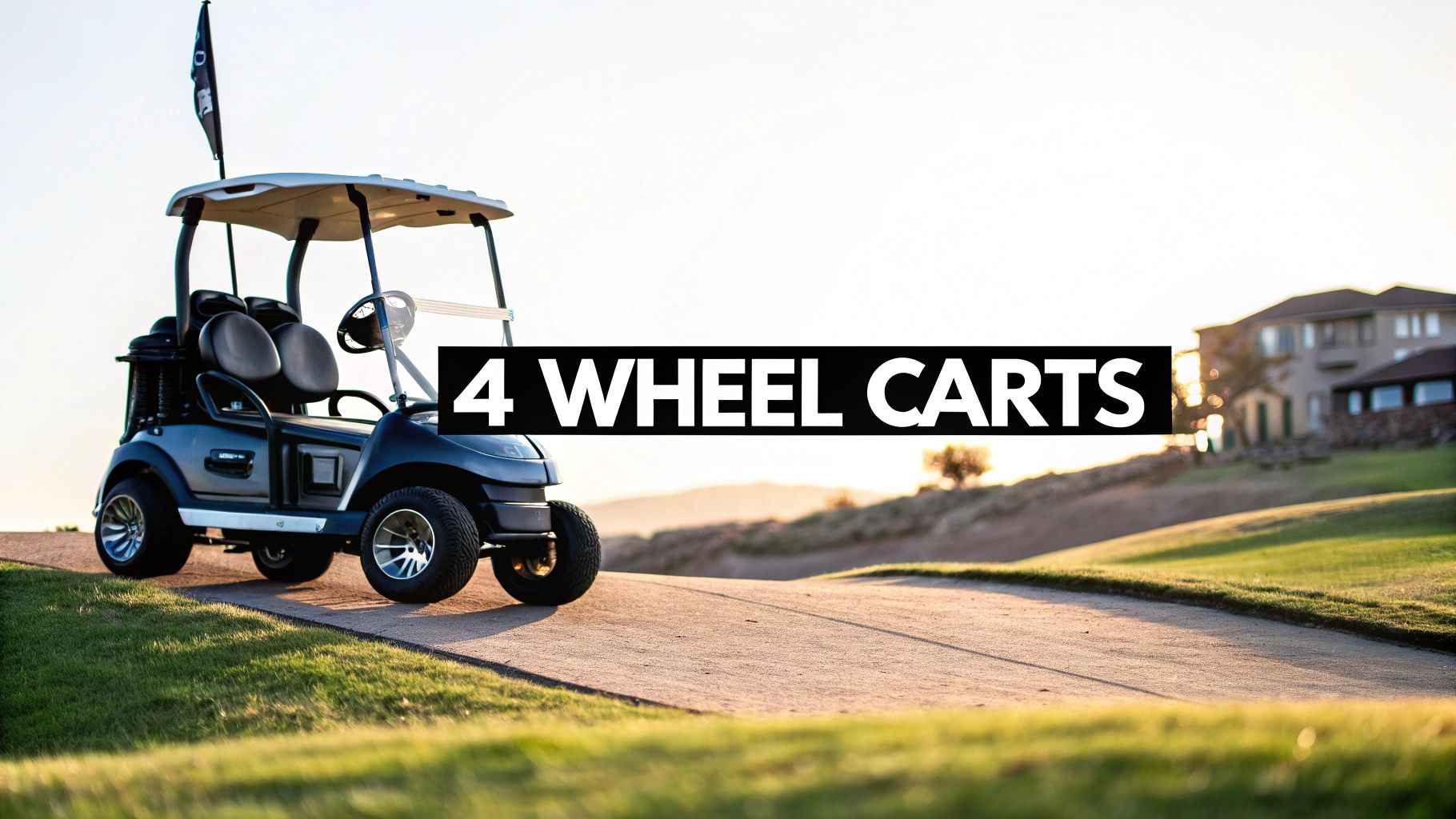
Take a look around any popular golf course these days, and you'll start to see a pattern. More and more golfers are making the switch to 4 wheel push golf carts. The reason is pretty simple but incredibly powerful: they offer unmatched stability. That means a solid, tip-proof base that handles uneven lies and steep hills without breaking a sweat.
Why 4 Wheel Carts Are Taking Over The Fairway

The days when a push cart was just a niche accessory are long gone. Golfers of all ages are rediscovering the benefits of walking the course, and they're choosing equipment that delivers on comfort, efficiency, and pure reliability. This shift has pushed the 4 wheel cart from a curiosity to the new gold standard for serious walking golfers.
Unlike their 3-wheel cousins, which can get a little wobbly on side slopes, a four-wheel design gives you a stable, rectangular foundation. Think of it like the difference between a tricycle and a small wagon—that wider base and better weight distribution make it far less likely to tip over when you're navigating tricky terrain. All this translates to a more relaxed and less physically demanding round.
The Rise of Stability and Convenience
This isn't just something we're noticing on the course; it’s a real market trend. The global Golf Push and Pull Carts market is on track to hit US$817.0 million by 2030, and industry reports point to four-wheel models as a key reason for that growth. Their incredible stability makes them a huge draw for amateur and senior golfers who just want to get through a round without the headache of a cart tipping over.
This rock-solid foundation has also made 4 wheel carts the perfect platform for the next big thing in walking golf: electric motor upgrades. Their built-in stability provides the ideal base for adding a motorized wheel, turning a standard push cart into an effortless, remote-controlled caddy.
This evolution in cart design lets golfers save their energy for what actually matters—the next shot. Instead of wrestling with your gear, you can just focus on your game.
What This Means for Your Game
At the end of the day, choosing a 4 wheel push golf cart is about stripping away distractions and physical strain from your round. It doesn't matter if you're playing a casual weekend game, competing in a tournament, or taking part in charity golf events—having gear you can count on is crucial.
For a quick overview, here are the core advantages that a 4-wheel cart brings to your game.
4 Wheel Push Cart Advantages at a Glance
| Feature | Benefit for the Golfer |
|---|---|
| Superior Stability | Prevents tipping on hills and uneven ground, keeping your bag and clubs secure. |
| Reduced Physical Effort | Requires less energy to balance and control, saving your strength for your swing. |
| Enhanced Focus | Allows you to concentrate on your game strategy instead of managing your equipment. |
| Upgrade-Ready Design | Provides a perfect, stable base for adding motorized add-ons like a Caddie Wheel. |
Ultimately, these benefits come together to directly impact your performance and how much you enjoy your time on the course.
- Reduced Physical Strain: You'll spend less effort balancing and muscling the cart, especially on hills.
- Enhanced Focus: Your mind stays on club selection and shot strategy, not on whether your gear is secure.
- Greater Confidence: You can navigate any terrain without worrying about your bag and clubs spilling onto the fairway.
- Future-Proof Design: The stability makes these carts the perfect investment for future upgrades, like adding a Caddie Wheel for motorized assistance.
Why 4 Wheels Offer Unbeatable Stability
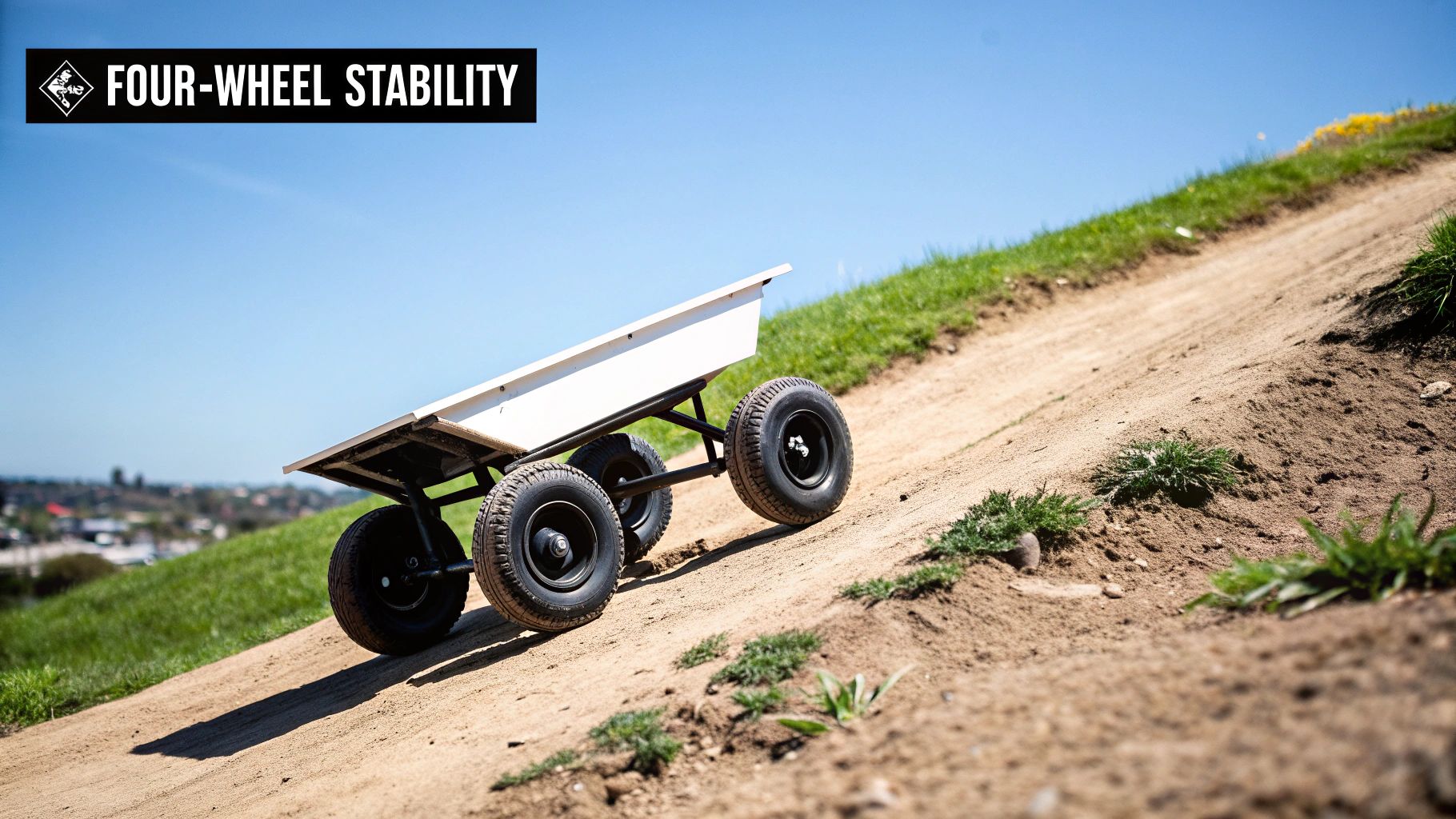
So, what makes a 4-wheel push cart so much more stable than a 3-wheeler on the golf course? It really just comes down to basic physics. The difference isn't just about adding an extra wheel—it's about fundamentally changing the cart's foundation and how it supports the weight of your bag.
Think about a classic tricycle. It's perfectly fine on a flat sidewalk, but that triangular wheelbase makes it prone to tipping if you hit a bump or take a turn too fast. This is the exact same principle that plagues many 3-wheel push carts, especially when you're dealing with the hills and uneven lies of a golf course.
Now, picture a sturdy little wagon. Its rectangular wheelbase creates a wide, solid footprint with a low center of balance. That’s the secret behind the superior stability of 4 wheel push golf carts. This design spreads your bag’s weight evenly across four points of contact, creating a much more secure and grounded platform.
How a Wider Base Prevents Those Annoying Tip-Overs
The stability advantage really comes from creating a larger "support polygon"—the area made by connecting the points where each wheel touches the ground. A 4-wheel cart’s rectangular base gives you a significantly bigger and more balanced support area than a 3-wheel cart’s triangle.
This wider base means the cart’s center of gravity stays safely inside its footprint, even when you’re on a tricky side-hill lie. When a 3-wheel cart gets on a slope, its center of gravity can easily shift outside that narrow triangular base, which leads to that frustrating—and all too common—tip-over.
A 4-wheel push golf cart is built to resist the rotational forces that cause tipping. Its four-corner support acts just like the legs of a sturdy table, making sure that even when one side is higher than the other, the whole thing stays planted.
This simple design difference gives you the confidence to focus on your next shot, not on whether your gear is about to spill down the fairway.
Real-World Scenarios Where Stability Is a Game-Changer
That theoretical advantage of a 4-wheel design becomes incredibly practical in a few key situations every walking golfer knows well.
- Navigating Side Slopes: This is where 4-wheel carts really earn their keep. While you might have to wrestle with a 3-wheeler to keep it upright, a 4-wheel cart tracks straight along the hill with almost no effort.
- Crossing Cart Paths: That jarring transition from grass to pavement can easily throw a less stable cart off balance. The four points of contact on these models soak up the bump without losing control.
- Pushing Through Thick Rough: Deep grass loves to grab a wheel and pull a cart sideways. The wider stance of a 4-wheel model helps it power through tough lies without tipping.
- Parking on a Hill: A good brake system combined with four wheels on the ground means your cart stays exactly where you left it, preventing a runaway disaster while you line up your putt.
For a deeper look into how they handle differently, you can learn more about what separates three-wheel carts from their more stable cousins in our detailed comparison.
The Perfect Foundation for Electric Upgrades
Beyond just preventing tip-overs, this built-in stability makes 4 wheel push golf carts the best platform for powerful electric upgrades. When you add a motorized wheel, you're introducing new forces and weight to the frame. A cart has to be inherently stable to handle that addition without any issues.
The solid, four-point foundation ensures that the power from a motorized add-on is transferred directly into the ground for smooth, steady propulsion. This prevents the motor's torque from twisting the frame or making the cart wobbly, which can be a real risk with less stable designs. It’s this dependable platform that lets you confidently turn your manual push cart into a remote-controlled electric caddy.
What to Look for in a High-Performance Cart
Picking the right 4-wheel push golf cart goes way beyond just counting the wheels. A truly great cart is all about the little things that make your walk more enjoyable—it should blend convenience, durability, and smart design so seamlessly you barely notice it's there. Understanding the key features will help you find a model that feels like it was made just for you.
The first thing you’ll interact with every single time you play is the folding mechanism, and it can make or break your experience. For golfers who value speed, nothing beats the one-click or one-step systems that collapse the frame in a literal second. Simple is almost always better here.
On the other hand, some carts use a multi-fold process. It might take an extra click or two, but these models often shrink down to an incredibly compact size. If you're working with limited trunk space or a crowded garage, that super-compact fold might be the winning feature, even if it adds a few seconds to your setup and teardown.
Decoding Wheel and Frame Construction
The wheels are where the rubber meets the fairway, and how they're built directly affects how the cart feels to push. You’ll generally find two types of tires out on the course.
- Maintenance-Free Foam Tires: This is the go-to for most golfers, and for good reason. They’re lightweight, they never go flat, and they handle just about any course condition you can throw at them. They are the definition of a worry-free option.
- Air-Filled Tires: Just like bicycle tires, these offer a slightly smoother, more cushioned ride. You'll really feel the difference over bumpy cart paths or rough ground. The trade-off? You'll need to check the air pressure occasionally, and there's always the risk of a puncture.
No matter which tire you choose, make sure the wheels have sealed ball bearings. This is completely non-negotiable for a cart that’s built to last. Sealed bearings keep dirt, sand, and grass clippings out of the axle, ensuring that smooth, effortless roll for years to come. A cart without them will start to feel like you're pushing it through mud in no time.
Think of the frame as the cart's skeleton—its material determines both the weight and its toughness. The overwhelming majority of top-tier carts use lightweight aluminum. It’s the perfect sweet spot between strength and portability, so you can easily lift it without worrying about its integrity.
Braking Systems and Onboard Storage
A reliable brake is a must-have, especially if you play on a course with even the slightest hill. Trust me, watching your cart and clubs roll away down a slope is a disaster you only want to experience once. Most 4-wheel push golf carts use one of two systems.
- Hand Brake: You'll find this style right on the handle, making it super convenient to engage without breaking your stride or bending over. It feels natural, a lot like the brake on a stroller.
- Foot Brake: This is usually a small pedal near one of the rear wheels. A simple tap with your foot locks it securely in place. These systems are often incredibly sturdy and have fewer moving parts to worry about.
Which one is better really just boils down to what you prefer. The hand brake offers quick convenience, while the foot brake is all about simple, rock-solid security.
Beyond the basics, the storage console is where a good cart becomes a great one. A well-designed console keeps everything you need right at your fingertips. Look for dedicated spots for your scorecard, a pencil, tees, and a couple of golf balls. Most also include a drink holder and a small, covered compartment—perfect for stashing your phone, keys, or rangefinder and keeping them safe from a sudden rain shower.
You should also check for accessory mounts. Many high-end carts come ready to clip on an umbrella holder (an absolute game-saver) and sometimes offer add-ons like a seat or a sand bottle holder. These are the thoughtful touches that turn a simple bag carrier into a true on-course partner that has your back, round after round.
How to Upgrade Your Push Cart to an Electric Caddy
Picture this: you're strolling down the fairway, your clubs gliding silently beside you, leaving all your energy for that critical birdie putt. That's not some far-off dream reserved for pricey, fully integrated electric caddies. You can get that same effortless experience by upgrading the stable 4‑wheel push golf cart you already own.
The secret is in the innovative drop-on electric conversion kits. These are self-contained, motorized wheel units designed to clip onto your existing push cart frame in just a few minutes. It’s the perfect approach—you get the best of both worlds, combining the rock-solid stability of a four-wheel base with the convenience of remote-controlled electric power.
Understanding Electric Conversion Kits
Think of an electric conversion kit as adding a powerful, remote-controlled engine to your trusty cart. The heart of the system is a motorized wheel powered by a compact, high-capacity lithium battery. This unit either replaces one of your cart's rear wheels or clamps directly onto the rear axle, instantly transforming your manual cart into a motorized one.
The process is surprisingly simple. Most kits, like the Caddie Wheel, use a simple snap-in bracket system that doesn't require any special tools or technical skills. Once it's on, a small remote control gives you complete command over speed and direction, letting you tackle steep hills and long fairways without breaking a sweat. For a detailed walkthrough, check out our guide on how to convert your push cart to electric with an easy DIY guide.
This decision tree infographic helps visualize how different golfer needs lead to specific cart choices, including those that are perfect for an upgrade.
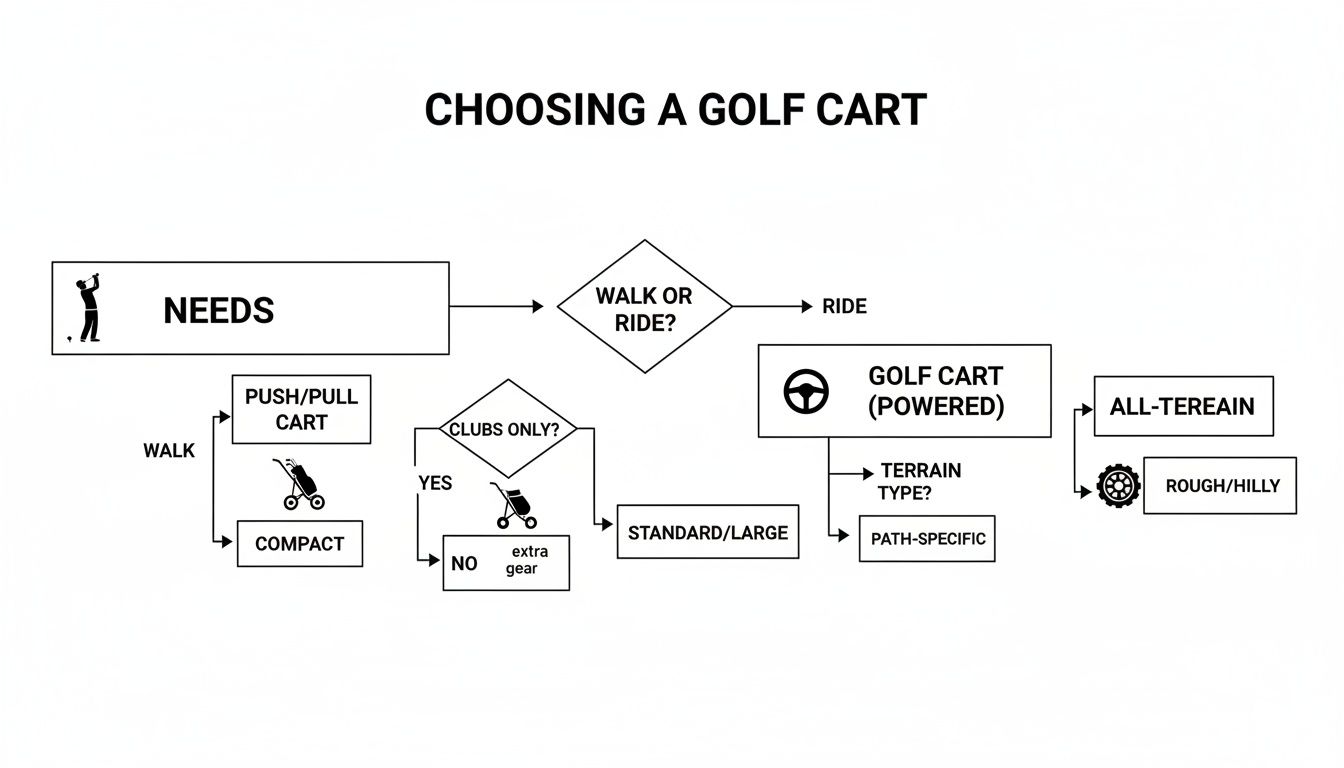
As the flowchart shows, a golfer's needs—like course terrain and storage space—are key factors in picking the right cart, with stable platforms being the ideal base for motorized add-ons.
The Real-World Benefits of Going Electric
Upgrading isn't just about convenience; it's about fundamentally improving your stamina and focus during a round. Pushing a cart over 18 holes often means covering four to five miles, and that burns a lot of energy. By removing that physical strain, you can keep your mental and physical performance sharp from the first tee to the final green.
An electric upgrade is more than a gadget—it's a performance tool. It reduces fatigue, minimizes strain on your back and shoulders, and makes the game more accessible for golfers of all ages and fitness levels.
The market is taking notice, too. Industry reports project the electric push-cart segment will grab a dominant share of market growth, with revenue expected to hit approximately US$450.6 million by 2030. This shows a clear shift toward battery-powered convenience and reduced physical effort on the course.
Is Your 4-Wheel Cart Ready for an Upgrade?
Before you jump in and buy a conversion kit, it's smart to double-check compatibility. While most modern kits are designed for a universal fit, there are a few key things to look at on your 4‑wheel push golf cart.
- Axle Design: Take a look at the rear axle. Most kits are made to clamp onto a standard square or round tube axle.
- Frame Clearance: Make sure there’s enough room around the rear wheels for the motor unit to be mounted without rubbing against the frame or bag holder.
- Structural Integrity: Confirm your cart's frame is solid and in good shape. The extra torque from a motor needs a sturdy foundation, which is a major advantage of four-wheel designs.
By checking these simple points, you can confidently turn your reliable push cart into a high-performance electric caddy. You’ll make every walk on the course a more enjoyable and less strenuous experience.
Simple Maintenance for a Long-Lasting Cart
Your 4 wheel push golf cart is a workhorse, and just like your clubs, it needs a little TLC to perform at its best season after season. The good news is that a few simple habits are all it takes to prevent common issues, extend its life, and guarantee a smooth roll every time you hit the links.
Think of it like checking the air in your car’s tires—these small actions prevent bigger headaches down the road. You don’t need to be a mechanic; just a few minutes of attention will keep your investment in peak condition for years.
Your Basic Maintenance Routine
Most performance issues stem from the stuff you can't avoid on a golf course: grass, dirt, and moisture. A quick clean and inspection is your best defense against wear and tear.
-
Clean the Wheel Axles: After a round, especially a wet one, take a second to wipe down the axles. Grass clippings and mud love to wrap around them, creating friction that makes the cart harder to push. A clean axle ensures your wheels spin freely.
-
Check and Tighten Key Bolts: All that folding, unfolding, and rolling over uneven ground can loosen things up over time. Give the main bolts on the frame, handle, and wheel mounts a quick check. A simple tighten with a wrench keeps the cart feeling solid and secure.
-
Lubricate Folding Joints: If the folding mechanism starts feeling stiff or sticky, a little spray of silicone lubricant will work wonders. Apply it sparingly to the hinges and joints for a smooth, one-click collapse every time.
A well-maintained cart feels effortless. Neglecting simple cleaning and lubrication is like trying to run in shoes caked with mud—it just makes everything harder than it needs to be.
Caring for Electric Conversion Kits
If you've upgraded your 4 wheel push golf cart with an electric motor like a Caddie Wheel, your maintenance list now includes some simple battery care. Honestly, how you treat your battery is the single most important factor in the long-term health and performance of your motorized unit.
Following a few best practices will maximize your battery’s capacity and lifespan, guaranteeing you have enough juice for 18 holes, 27, or even a full 36.
Essential Battery and Electrical Care
-
Charge After Every Use: Lithium batteries are happiest when they aren't completely drained. Make it a habit to charge your battery after every single round, no matter how many holes you played. This keeps the cells healthy and ready for your next tee time.
-
Use the Correct Charger: This one's a biggie. Always use the charger that came with your electric conversion kit. Using a mismatched charger can fry your battery by feeding it the wrong voltage or amperage, which is a quick way to shorten its life.
-
Store Properly in the Off-Season: If you're packing your cart away for a few months, charge the battery to about 50-60% first. Store it somewhere cool and dry, and try to avoid extreme heat or cold, as both can seriously degrade battery performance.
-
Keep Electrical Contacts Clean: Every now and then, take a look at the connection points between the battery and the motor. A quick wipe with a dry cloth will keep them free of dirt and moisture, ensuring a solid and reliable power connection.
To keep your cart in top shape year-round, here's a simple checklist to follow.
Seasonal Maintenance Checklist
This table breaks down the essential tasks to perform at the start and end of your golf season to ensure your cart is always ready to roll.
| Task | Frequency | Why It's Important |
|---|---|---|
| Deep Clean | Beginning & End of Season | Removes built-up grime and prevents long-term corrosion. |
| Inspect Wheels | Beginning of Season | Checks for tread wear and ensures bearings are running smoothly. |
| Tighten All Bolts | Beginning & End of Season | Prevents rattling and keeps the frame structurally sound. |
| Lubricate Joints | Beginning of Season | Ensures the folding mechanism operates smoothly all year. |
| Check Battery Health | Beginning of Season | Confirms the battery holds a full charge before your first round. |
| Proper Storage Prep | End of Season | Protects the battery and frame from damage during long-term storage. |
A little bit of proactive care goes a long way. Taking these steps ensures that when the season starts, your cart is as ready to go as you are.
For a more detailed breakdown, check out this comprehensive list of 6 essential golf cart maintenance tips for 2025. These simple steps will keep your cart—whether manual or electric—rolling smoothly for thousands of holes to come.
Got Questions About 4-Wheel Push Carts? We’ve Got Answers.
Even after you're sold on the benefits, it’s smart to have a few questions before pulling the trigger on new golf gear. When it comes to 4-wheel push golf carts—and the possibility of motorizing them—a few common themes always seem to pop up. We’ve rounded up the most frequent ones to give you clear, straight-up answers.
This section gets into everything, from how these carts handle tricky lies on the course to whether your specific golf bag will fit. Our goal is to iron out any last-minute wrinkles so you can make a choice with total confidence.
Are 4-Wheel Carts Harder to Steer Than 3-Wheelers?
This is probably the number one question we hear, and the answer really depends on what you mean by "steer." A three-wheel cart, especially one with a front wheel that swivels 360 degrees, is going to have a tighter turning radius. Think of it like a sports car—super agile and great for whipping around sharp corners or squeezing between trees.
But 4-wheel push golf carts bring a different kind of maneuverability to the table: dead-straight tracking and stability. They are incredibly easy to push right down the fairway with almost zero effort needed to keep them on track. This saves a ton of energy over a long round. While you do need a little more room to make a wide turn, most golfers find it’s a small price to pay for the massive boost in stability.
The difference isn't about one being "harder" than the other; they just have different strengths. A 3-wheeler is nimble in tight spots, while a 4-wheeler is your steady, reliable partner for effortless tracking on fairways and hills.
Will My Stand Bag Fit on a 4-Wheel Push Cart?
Yes, you bet. Modern cart design has evolved so much, and today’s top 4-wheel push golf carts are built to be universally compatible. They come with adjustable upper and lower brackets—often with bungee-style cords—that can securely lock down just about any golf bag you can find.
So whether you’re using a lightweight stand bag or a beefier cart bag, those brackets can be cinched down for a snug fit. In fact, the wider, more stable base of a four-wheel model is a huge plus for stand bags because it keeps the bag from twisting or shifting while you’re walking over bumpy ground.
Do 4-Wheel Carts Fold Down as Small as 3-Wheel Carts?
In the past, three-wheel carts definitely had the edge when it came to folding down into a compact package. Their simple triangular frame just collapsed more efficiently. But cart makers have made some serious leaps in folding technology for their four-wheel models.
While some of the entry-level 4-wheel carts might still be a bit on the bulky side, many of the high-performance models now have these incredibly clever multi-fold mechanisms. These designs let them collapse into a size that’s right there with—and sometimes even smaller than—their three-wheel cousins. It’s always smart to check the folded dimensions of the specific model you’re eyeing, but you no longer have to give up a compact fold to get that four-wheel stability.
What's the Main Advantage of Four Wheels on a Hilly Course?
Stability. That’s the undisputed champion here. On a hilly course, you’re constantly dealing with two big challenges: pushing your cart across a side-slope and parking it on an incline without it taking off on you.
- On a Side-Slope: A four-wheel cart’s wide, rectangular footprint gives it a solid base that fights off tipping. It keeps all four wheels planted firmly on the ground, so the cart doesn't feel like it’s about to roll away downhill.
- When Parked: When you combine that four-point stance with a good braking system, you get a rock-solid platform. You can park it with complete confidence while you hit your shot, without that nagging fear of a runaway cart disaster.
That superior stability means you spend less energy—both physical and mental—just managing your gear, which frees you up to focus completely on your game. It's a huge advantage that makes walking hilly courses a whole lot more fun.
Can Any 4-Wheel Push Cart Be Upgraded to Electric?
While a ton of 4-wheel push golf carts are perfect for adding an electric conversion kit, they aren't all built the same. The single most important thing to look at is the design of the rear axle and the frame around it.
Most drop-on conversion kits, like the Caddie Wheel, are made to clamp onto a standard square or round tube axle. Before you buy a kit, just take a quick peek at your cart to make sure of a few things:
- A Clear Axle: There’s an open, accessible spot on the rear axle where the motor unit can attach without any obstructions.
- Enough Clearance: There’s plenty of space around the wheel and axle so the motor won’t be rubbing up against the cart’s frame or your bag.
- A Solid Frame: The cart has a sturdy, well-built frame that can handle the extra torque from a motor. This is an area where four-wheel designs naturally shine.
A quick check on these three points will tell you if your cart is ready for a seamless and powerful electric upgrade.
Ready to experience that effortless stability and convenience for yourself? The Caddie Wheel is designed to transform your reliable push cart into a remote-controlled powerhouse, making every round easier and more enjoyable. Explore how you can upgrade your game today at https://caddiewheel.com.
Share:
A Golfer's Guide to the Golf Cart Battery Gauge
Your Guide to Golf Cart Lithium Battery Upgrades