
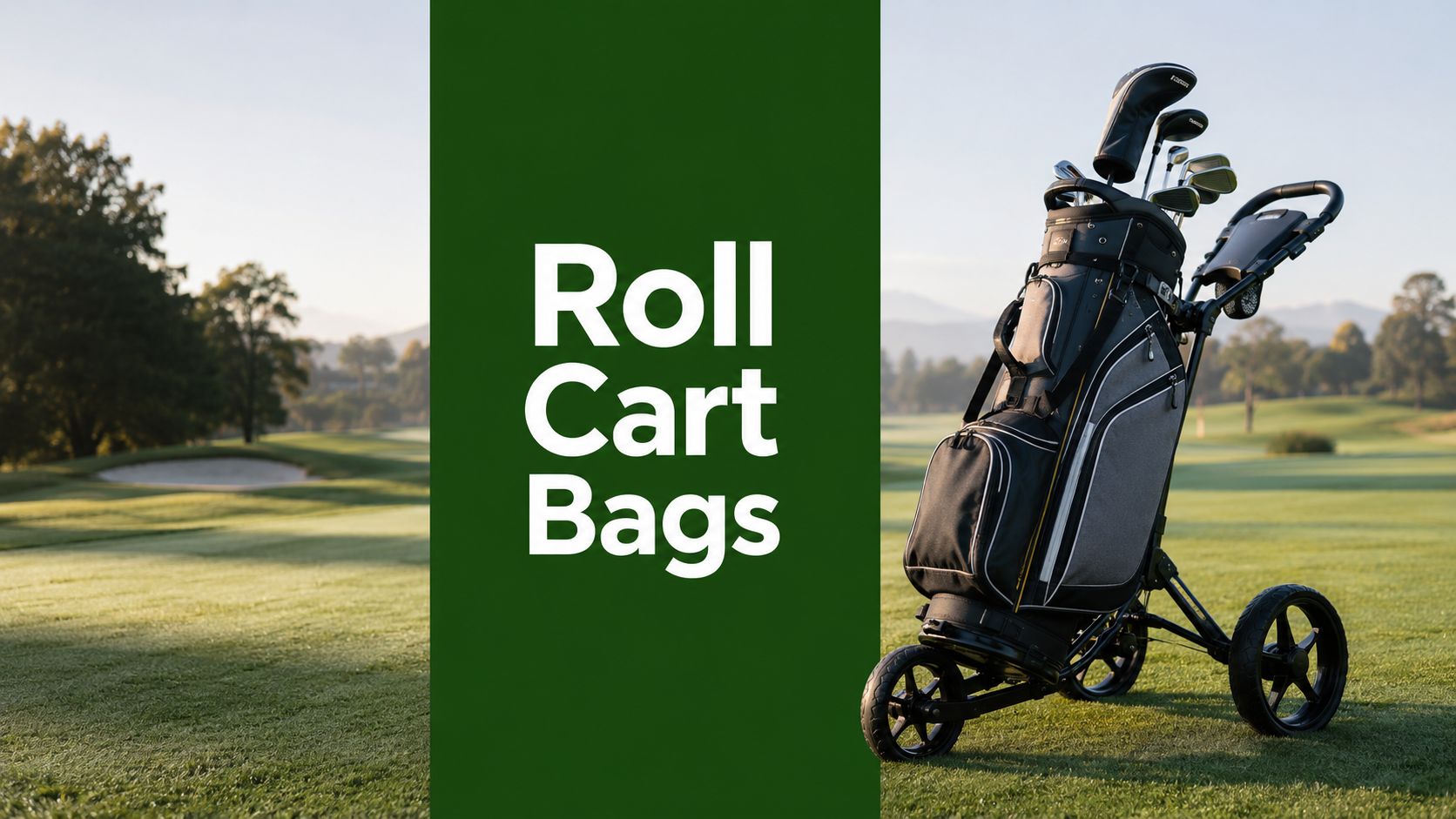
You know the round before the round starts, the one where you're already annoyed because the bag keeps twisting on the cart, the clubs snag when you reach for a wedge, and the whole setup feels heavier than it should. That's usually the moment a golfer stops shopping for “more storage” and starts looking for a bag that behaves on a push cart or riding cart. Roll cart bags are built for that problem, they live on a moving platform, stay accessible while strapped in, and punish sloppy design fast.
The tricky part is that most buyers still judge them by pocket count alone. That's the wrong lens. Base shape, strap interface, weight distribution, and how the bag sits on uneven ground matter more once you're walking 18 and the terrain stops being friendly.
What Is a Roll Cart Bag Anyway
The easiest way to understand a roll cart bag is to stand next to a cart on a sloped fairway and watch what happens to the wrong bag. A carry bag wants to live on your shoulder, so it's built around portability first. A roll cart bag, by contrast, is meant to sit squarely on a push cart or golf cart, keep its shape, and let you reach pockets without wrestling the frame.

Why the shape matters more than the slogan
Cart bags are usually taller and heavier than stand bags, with contemporary examples commonly around 6 to 10 pounds according to a cart-bag comparison guide from Lynx Golf USA, and that extra mass buys structure, pocket access, and cart stability Lynx Golf USA cart bag guide. Another guide places cart bags around 1.5 to 3 kg and about 36 to 38 inches tall, which is a useful reminder that the geometry is built around being strapped in rather than carried all day Golf Support cart bag guide.
That design choice shows up in the details. The bag needs a base that sits flat, pockets that remain reachable when the bag faces forward on a cart, and dividers that keep grips from turning into a mess when the cart bumps across rough ground. A good roll cart bag doesn't just hold clubs, it behaves like a piece of mobility equipment.
Practical rule: if a bag feels great standing in a shop but starts rocking, leaning, or hiding the zipper openings once it's strapped to a cart, it's the wrong shape for real play.
The category also makes sense historically. Golf bags evolved into clearer cart-first and carry-first branches because golfers wanted one setup for walking and another for carrying. Roll cart bags sit firmly in the cart-first branch, and that's why they're a better fit for players who walk with a trolley than for players who want the lightest possible shoulder carry.
Types and Materials That Actually Matter
A cart bag can look premium and still fail quickly if the materials and internal structure don't match the way you play. The two fabric families you'll see most often are nylon and polyester, and the question isn't which one sounds tougher in marketing copy. It's which one keeps its shape, resists scuffing against a cart frame, and handles repeated damp rounds without turning soft at the seams.
Fabric and construction trade-offs
Nylon usually earns its reputation for abrasion resistance and a slightly more technical feel, while polyester often gives a stiffer, more budget-friendly shell. In practice, fabric weight, coating, and stitching matter more than the label on the hang tag. A lightly coated polyester bag with weak seams can age faster than a better-built nylon model, and a well-finished polyester shell can still be the smarter buy if you're not abusing it in bad weather every weekend.
| Roll Cart Bag Material Comparison | Water Resistance | Durability | Weight Impact | Best For |
|---|---|---|---|---|
| Nylon | Good with coating | Strong against abrasion | Often moderate | Golfers who want a tougher-feeling shell |
| Polyester | Good to very good with coating | Solid for regular use | Often moderate | Buyers looking for structure and value |
| Heavier fabric builds | Better when paired with sealing | Usually more rigid | Higher | Cart users who prioritize shape retention |
| Lighter fabric builds | Depends on coating quality | Can wear sooner | Lower | Golfers who keep loads modest |
Divider layouts change how the bag plays on course
The inside of the bag matters just as much. Full-length dividers protect shafts better and reduce tangling, which is a real benefit when the bag bounces around on a cart. Semi-divider layouts can save weight and space, but they usually make club management messier. Open-cube designs are easy to stuff and unload, yet they're also the most likely to let grips and shafts tangle when the course gets bumpy.
If you want a deeper look at how push-cart compatibility shapes buying choices, this guide to the best push cart golf bags is worth reading alongside the material specs.
The best shell in the world won't save a bag that sags under its own load or lets clubs jam together every time the cart hits a rut.
The market context matters too. The broader bag market was valued at USD 45.8 billion in 2025 and is projected to reach USD 68.3 billion by 2036, growing at 3.7% CAGR over 2026 to 2036, according to Future Market Insights Future Market Insights bags market. That projection doesn't tell you which bag to buy, but it does show how mature the category is. The winners are usually the ones that balance structure, weight, and cart compatibility instead of chasing the lightest possible shell.
Key Features to Look For in a Roll Cart Bag
A cart bag should earn its place by making the round easier, not by looking busy in a product photo. Pocket count helps, but pocket placement matters more. A cooler pocket that opens into the cart frame is a nuisance. A valuables pocket that sits where you can reach it while the bag is strapped down is useful every single round.

Pocket strategy should follow how you play
Start with the pockets you use in motion. Cooler pockets, valuables compartments, scorecard sleeves, and glove storage all matter, but they need to be placed where they can be opened while the bag is mounted. Cart-facing pockets are not the same thing as shoulder-facing pockets, and that distinction is why some bags feel brilliant on a shop floor and clumsy on a fairway.
Weight is a mechanical issue, not a style issue
The weight of the bag matters because every extra kilogram increases the work your cart has to do, especially on slopes or rough turf. That doesn't mean lighter is always better. It means the weight has to be justified by better structure, better organization, or better weather protection. A flimsy bag that saves a little weight but sags on the cart is a false economy.
Hardware decides how long the bag stays usable
Look for reinforced handles, sturdy attachment points, and anti-swing features that keep the bag from moving side to side. Water-resistant zippers and a rain hood are useful, but they shouldn't replace good pocket access. Seam construction matters too, because repeated strap pressure tends to reveal weak stitching long before the fabric itself fails.
Keep this in mind: a bag that's easy to load but hard to access on the course will slow you down more than a slightly heavier bag with better layout.
One example of a cart-compatible assist system in the same ecosystem is Caddie Wheel, which attaches to an existing push cart and helps move it over the course. That's useful context because it reinforces the same buying rule, the bag and the cart need to work as one system, not as separate products.
Measuring Your Cart and Checking Bag Compatibility
The most common mistake is buying the bag first and measuring later. That's backwards. If the base doesn't sit properly on the cart platform, you'll get tilt, handle interference, strap stretch, and club snagging that no amount of pocket space will fix.

The five-minute fit check that saves a season of annoyance
- Measure the cart width between wheel wells. A useful reference range is 10 to 14 inches from the infographic brief, and that gives you a quick sense of whether the bag base will sit securely.
- Check the bag base length front to back. A typical range is 8 to 12 inches, which helps you judge how much support the cart platform provides.
- Verify that the bag sits flush without tilting. A bag that leans puts extra strain on straps and can make pockets harder to reach.
- Simulate a full load. Put the clubs in, then check how the bag behaves under real weight before you commit to a full round.
- Watch the handle clearance. If the cart handle binds or crowds the top of the bag, steering gets annoying fast.
The reason this matters is simple. A golf bag that fits a ride-on cart can still be awkward on a push cart, and a bag that works well on a three-wheel platform may not sit the same way on a four-wheel frame. Push-cart geometry and ride-cart geometry aren't interchangeable, even when the bag category looks identical from the outside. For cart measurements, this golf cart dimensions guide is a useful companion read.
| Cart Platform vs Bag Base Compatibility | Cart Type | Wheel Count | Recommended Base Style | Common Fit Issues |
|---|---|---|---|
| Three-wheel push cart | 3 | Triangular or contoured | Handle crowding, side sway |
| Four-wheel push cart | 4 | Flat, stable base | Narrow support contact, strap slip |
| Ride-on cart | Varies | Cart-first footprint | Pocket access blocked by rails |
| Motorized assist platform | Varies | Secure, centered base | Mounting point mismatch |
If you're using a helper cart for moving heavy items around the house, a lightweight hand truck for home use shows the same principle in a different setting. The load matters, but so does the way the load sits on the frame.
Installation and Fit Adjustment Guide
Even a well-matched bag can feel wrong if it's mounted carelessly. The goal is to stop swinging without distorting the bag shape, because overtightening usually creates a new problem while solving the old one. The bag should sit planted, not pinched.

Strap systems reward patience
Start by loosening every strap completely. Then set the base on the platform and align the bag so the lower support lines up with the cart's wheel well or base cradle. If the bag is even slightly off-center here, the final fit usually gets worse as you tighten.
Secure the top strap first, then the lower one. That sequence usually pulls the bag into position more evenly than cranking both ends at once. With rigid bracket mounts, the same principle applies in a different form, the bag needs to seat correctly before the clamp is fully locked.
What bad fit actually looks like
Handle interference shows up as steering resistance or a bag that crowds the cart's turning zone. Bag tilt shows up on cambered terrain, where one side of the cart shoulder-loads more than the other. Divider pressure shows up when grips snag or lift as you pull clubs.
If the bag shifts when you shake it gently at the course edge, it'll annoy you more once the round starts.
A quick walk behind the cart tells you almost everything you need to know. If the bag rocks, squeaks, or shifts after a few steps, stop and reset the straps before the first tee. You'll save yourself from tightening mid-round, which almost always ends badly.
For golfers comparing bracket-style attachments, the Caddie Wheel golf cart bracket is another example of why fit is a system, not a guess. The mounting point, the cart frame, and the bag base all have to agree with one another.
Maintenance and Care for Long-Term Performance
A cart bag fails in small ways first. Zippers get sticky, strap loops soften, and the base starts to deform where it rubs the cart frame. If you catch those signs early, the bag lasts longer and stays more stable on the cart.
Clean for function, not just appearance
Wipe down the exterior fabric after wet rounds so dirt doesn't grind into the weave. Pay attention to the seams, the base, and the lower pockets, because those areas collect the most grit and road moisture. If the bag uses water-resistant fabric, let it dry fully before storage so the coating doesn't stay damp and break down faster.
Check the hardware that keeps the bag planted
Inspect D-rings, buckle sliders, strap loops, and attachment points every few rounds. You're looking for fraying, bent hardware, and loosened stitching. The same goes for zippers and pocket pulls, because a jammed zipper on a cart-facing pocket is more than an inconvenience when you need a rangefinder quickly.
Rotate and rest the bag when you can
If you always mount the bag the same way, one side wears faster than the other. Rotating orientation where the cart design allows it helps spread that load across the shell and straps. Store the bag upright in a dry space, not crammed in a trunk where the base stays compressed.
Maintenance rule: treat the bag like equipment that carries weight in motion, not like storage furniture that only needs to look neat.
Minor fabric tears are worth repairing early. Once a small split starts opening near a high-stress seam, it usually grows quickly under strap tension. A little care here protects the exact features that make roll cart bags worth buying in the first place.
Your Roll Cart Bag Decision Checklist
The right choice usually becomes obvious when you stop comparing feature lists and start checking whether the bag solves real-course problems. Use this order and eliminate anything that fails early.
Buy for fit first, then features
- Cart compatibility first: If the base doesn't sit flush on your cart, move on.
- Stable geometry next: The bag should resist wobble without aggressive strap tension.
- Material durability after that: Choose the shell that matches how often you play and how wet your rounds get.
- Pocket layout last: Prioritize the pockets you can reach while the bag is mounted.
- Weight budget: Heavier is acceptable only when the extra weight buys better structure and access.
- Hardware quality always: Weak straps, loose loops, or flimsy zippers shorten the bag's useful life.
If you walk hilly courses often, put stability and base shape ahead of extra pockets. If your routes are flatter and you value easy access more than rugged construction, a lighter bag with sensible layout can be the smarter pick. The point is to choose a roll cart bag that behaves like part of the cart, not a loose object riding on it.
A good bag disappears into the round. A bad one keeps asking for attention.
If you're building a smoother walking setup, Caddie Wheel focuses on lightweight electric power assist for existing push carts, which pairs naturally with the same stability and compatibility concerns that matter in a roll cart bag. Visit Caddie Wheel to see how its cart-assist approach fits into a more efficient walking round.
Partager:
Top Tips for Long Distance Walking: Gear, Pacing & Safety
Best Motorized Golf Push Cart Compared for Every Golfer 2026