
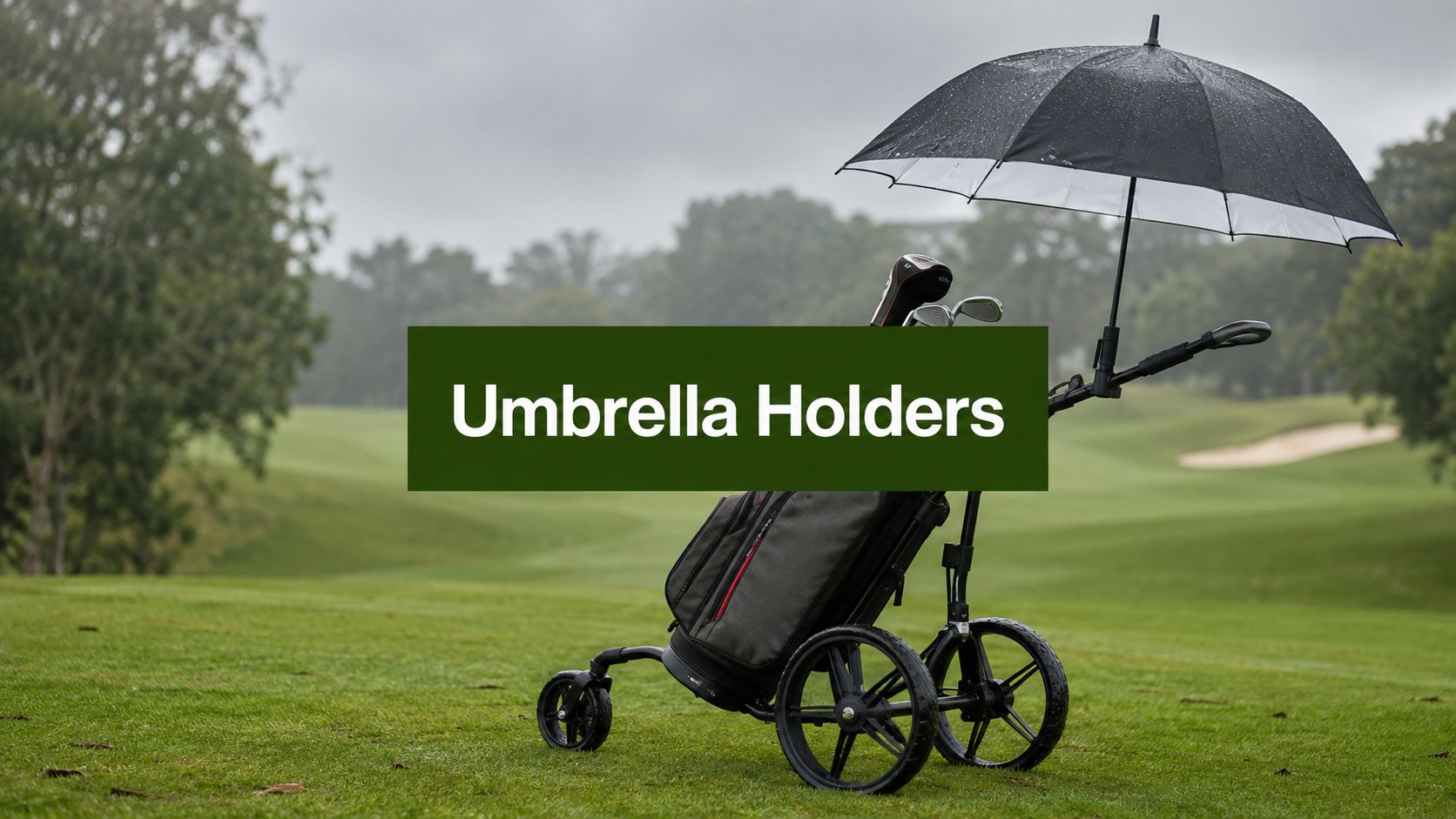
Rain rarely arrives at a convenient point in a golf round. You're halfway down the back nine, the wind is pushing across the fairway, and the umbrella that looked secure in the car park is now twisting inside its holder. Your clubs get wet, your glove loses its grip, and the next shot demands more attention than it should. A well-fitted umbrella holder won't improve a poor swing, but it can remove one avoidable distraction from every hole that follows.
For walking golfers, the holder belongs to the whole cart system. The frame tube, bag position, folding joints, storage layout, and any motorized assist all affect where the umbrella can sit and how securely it can work. The best choice starts with measurements and ends with a realistic test of clearance, stability, and storage.
Why the Right Umbrella Holder Changes a Walking Round
On the 14th tee, a crosswind exposes weak hardware quickly. The umbrella canopy catches a gust, the clamp rotates a few degrees, and the shaft starts snapping against the holder instead of staying aligned. You close it before hitting, but the damage is already done. Your grips are damp, your towel is working overtime, and you're choosing clubs while thinking about whether the umbrella will fall into the bag well.
That kind of interruption rarely appears as one dramatic failure. It shows up as a rushed pre-shot routine, a slippery grip, or an umbrella that blocks access to the club you need. A loose mount can also force you to hold the handle while steering, which defeats the point of fitting a holder in the first place. Practical advice for managing wet conditions appears in this guide to golfing in the rain, but the hardware decision comes earlier, when the cart is still dry and easy to inspect.
The holder affects the entire cart
A holder needs to do more than accept an umbrella shaft. It must preserve access to the handle, avoid the bag's top opening, clear the scorecard or GPS mount, and stay out of the folding path. On a powered setup, the umbrella also needs to avoid wheel housings, control cables, and any remote accessory.
That's why “universal” should be treated as a starting description, not a fit guarantee. Retail guidance often qualifies universal claims with requirements such as round tubing, particular frame dimensions, or an adapter, as shown by the Bag Boy umbrella-holder listing.
Practical rule: Buy the holder for the cart you actually own, with its bag loaded and folded, not for a generic photograph of a push cart.
The reliable setup is quiet. The umbrella stays where you aim it, the shaft doesn't rattle against the collar, and the cart still folds without a fight. That's the standard worth applying to every umbrella holder golf shopper considers.
The Long Design History of Golf Umbrella Holders
Umbrella holders have a longer design history than their simple appearance suggests. An issued U.S. patent published on December 22, 1908 covered a stand for umbrellas, walking-sticks, golf-clubs, brushes, and other articles, establishing an early recorded link between umbrellas and golf equipment in a broader holder concept. Later patents moved toward dedicated golf-cart use, including a golf cart umbrella attachment filed on October 23, 1961 and another issued in 1967, documenting an evolution that spans more than a century in the U.S. patent record.

From general holders to golf-specific mounts
The modern accessory category became more explicit in the 1990s. A U.S. patent titled “Golf umbrella mounting clamp” was filed on September 3, 1998, while “Golf umbrella and support” was published on October 18, 1996 and issued in 1998. Both addressed the practical problem of keeping an umbrella attached to a bag or cart, rather than making the golfer carry it separately, as documented in the golf umbrella mounting clamp patent.
The push-cart designs golfers recognize today developed through several practical stages. Side-mounted tube holders established the familiar sleeve beside the handle. Bracket systems adapted that idea to frames with flatter sections, while pivoting heads solved the fixed-angle problem that becomes obvious in changing wind.
Why older trade-offs still matter
Early plastic clamps could feel fine in calm weather but became vulnerable at hinges, threads, and folding points. Later designs introduced stronger polymers, metal brackets, locking collars, and quicker release mechanisms. Each improvement added a trade-off, usually more weight, more parts, or a larger folded profile.
The current market looks crowded because the basic requirement is stable and mature. A shopper is choosing among different answers to the same questions: how the holder attaches, how far it swivels, how it behaves when the cart folds, and whether the umbrella stays clear of the golfer and the bag.
Main Holder Types and How They Attach
The attachment method determines both fit and failure mode. A holder that works neatly on a round Clicgear-style tube may be awkward on a flat crossbar, while a quick-release system that suits a rental cart may not tolerate repeated transport in a packed trunk.
| Holder Type | Attachment | Best For | Watch Out For |
|---|---|---|---|
| Clip-on tube holder | Plastic or metal U-clamp with thumb screws | Round tubing on three-wheel and four-wheel push carts | Clamp slip, hinge stress, and interference with folding |
| Bracket-mount holder | Rubber-lined bracket bolted through a flat bar | Flat-frame carts and fixed accessory rails | Requires suitable holes or a compatible adapter |
| Telescoping holder | Extending shaft with a locking collar | Taller canopies and golfers who need extra head clearance | More leverage in wind and more parts to loosen |
| Magnetic or strap-on quick mount | Magnets, hook-and-loop straps, or a fast-release base | Rental, loaner, and temporary setups | Usually less secure under strong canopy torque |
Clip-on tube holders
These are the most common choice for ordinary push carts. The clamp wraps around a round frame tube, usually with a rubber insert or molded contact surface, and the umbrella sits in a separate sleeve. They're easy to move between positions and work well when the cart's upper frame provides a clean, accessible mounting point.
Brackets and telescoping arms
Bracket mounts make sense when the frame is flat or when the cart includes a dedicated accessory bar. They can distribute pressure more evenly than a narrow clamp, but they're less forgiving if the mounting holes, bar width, or folding joint don't match.
Telescoping holders solve height and canopy-position problems. They're useful for taller golfers or large umbrellas, but the extended arm creates more force, so collar quality and frame stiffness matter more.
Quick mounts and hybrids
Magnetic and strap-on holders prioritize convenience. They can be useful on shared carts, but I wouldn't treat a lightly tensioned strap as equal to a properly clamped frame mount during sustained wind.
Hybrid designs combine a tube clamp with an articulating joint. That combination has become the practical default for golfers who use one cart in different conditions, because the clamp handles attachment while the joint handles canopy angle.
Measuring Cart Tubes and Umbrella Handles
Compatibility comes down to two interfaces. The first is the outer diameter of the cart tube. The second is the usable diameter and depth of the umbrella handle or shaft inside the holder.
Market examples show frame-mount ranges around 0.7 to 1.3 inches and umbrella-handle fits up to approximately 1.8 inches, while other holders specify internal diameters near 35 to 40 mm. Those figures come from a universal aluminium umbrella-holder example, and they demonstrate why “universal” doesn't remove the need to measure.
A reliable measuring routine
- Measure the cart tube. Use calipers where possible. If the tube is too large for calipers, wrap fabric tape around it and calculate the diameter from the circumference, or use the manufacturer's frame specification.
- Check the cross-section. A round tube suits a round-bore clamp. A flattened oval or rectangular section may need a slotted bracket or a shaped adapter.
- Measure the umbrella handle. Measure the part that enters the holder, not the widest rubber cap or decorative grip.
- Check taper and release buttons. A tapered handle can bottom out early, while a button-release shaft may need enough internal depth for the button to clear.
- Measure usable insertion depth. A wide opening doesn't help if the shaft only seats shallowly and begins to rock.
A 22 mm umbrella shaft and a 28 mm cart tube can work together when the holder offers separate interfaces or an appropriate adapter sleeve. A holder with a collar that is too tight may grip firmly at first, but repeated stress can crack a plastic collar or damage the shaft finish.
| Component | Typical Diameter | Common Fit |
|---|---|---|
| Cart frame tube | Around 0.7 to 1.3 inches in market examples | Clamp must match the outside diameter and shape |
| Umbrella handle interface | Up to around 1.8 inches in some listings | Collar must accept the widest usable handle section |
| Umbrella shaft interface | Near 35 to 40 mm on some holders | Suitable for larger shaft or handle sections |
Before opening a product page, write down cart-tube outside diameter, tube shape, and umbrella-handle diameter with usable depth. Those three notes prevent most avoidable returns.
Fitting Holders on Three Wheel, Four Wheel, and Motorized Carts
Cart geometry decides whether a holder is merely attached or genuinely usable. A mount can fit the tube perfectly and still block the bag well, catch the folding joint, or place the canopy directly over the steering handle.

Three-wheel push carts
On a three-wheel cart, start with the upper crossbar above the handle. It usually gives the holder a strong attachment point while keeping the umbrella away from the front-wheel pivot and bag well. Open and close the cart with the bag removed, then repeat the test with the bag loaded. A holder that clears an empty frame may strike the bag top once clubs are installed.
Four-wheel push carts
Four-wheel frames often provide more side structure, but that extra geometry creates more places for interference. Mounting on the side of the main frame tube can work well, provided the holder clears the folding joint, rear axle, scorecard holder, and beverage tray. Rotate the head forward rather than inward if the umbrella shaft crowds the handle stem.
The push-cart umbrella-holder guidance for walking setups is useful as a reminder that the cart's accessory layout matters as much as the holder's clamp range.
Motorized assistance
A motorized add-on changes the balance and clearance checks. With Caddie Wheel, the powered wheel occupies space on one side of a standard push cart, so the umbrella should be mounted high enough to clear the wheel assembly and biased toward the unpowered side where that creates a cleaner path. Don't allow the shaft to swing across the control area or snag a remote or throttle cable during a turn.
Run four tests before playing:
- Fold test: The handle folds fully without crushing the collar.
- Bag test: Clubs and bag pockets remain accessible.
- Wheel test: The canopy shaft clears the wheel housing through a turn.
- Cable test: No cable catches when the umbrella is open, tilted, or stored.
Materials, Adjustment Range, and Build Quality
A holder's weak point is usually easy to identify once you separate it into three assemblies: the frame clamp, the pivot, and the umbrella collar. Each part sees a different kind of stress. The clamp handles vibration and transport, the pivot absorbs canopy torque, and the collar must resist twisting without marking the shaft.
Glass-filled nylon is a useful upgrade over ordinary ABS because reinforcement improves resistance to cracking and deformation. Stamped aluminium can add stiffness around a bracket without making the whole cart feel burdened. Neither material fixes poor geometry, though. A strong clamp fitted to the wrong tube is still a bad installation.

Collar and pivot choices
A screw-style collar generally holds a shaft more rigidly than a light spring grip, especially when the umbrella is exposed to gusts. The compromise is speed. You'll spend more time loosening and tightening it when changing umbrellas.
Adjustment range matters just as much. A restricted pivot can leave the canopy over the bag instead of over your shoulders. By contrast, the full-swivel push-cart holder is advertised with 180-degree or full-swivel adjustment, giving the golfer more control over canopy placement.
Look for:
- Stainless fasteners that tolerate wet storage.
- Captive washers that don't disappear during adjustment.
- Knurled knobs that provide grip when your hands are wet.
- Stress ribs molded around the clamp hinge.
- Rubberized contact surfaces that protect the frame and reduce vibration.
An adjustable Stewart holder raises the umbrella approximately 80 mm above its standard tube and provides 360-degree rotation plus angle adjustment, as described by Axglo's Stewart holder listing. That extra height can solve head clearance, but it also increases force on the mount, so the mounting point must be solid.
Installing and Adjusting a Holder on Course
Start with the cart parked on level ground and the bag removed. Position the clamp or bracket where it clears the folding joint, then hand-tighten both sides evenly. Tightening one side fully before the other can pull the holder out of alignment and create a false sense of security.

The installation graphic specifies 2.5 Nm for tightening with a torque wrench. Use that figure only when it matches the holder and cart manufacturer's guidance, because frame materials and fastener sizes vary. Over-tightening can crush a tube, strip a plastic thread, or distort a clamp that was designed to sit squarely.
Seat the shaft correctly
Insert the umbrella until the ferrule sits 1 to 2 cm above the holder base, as shown in the installation guidance graphic. That small gap prevents the ferrule from rattling directly against the base while leaving enough shaft engaged for stability. Lock the collar, then tighten the tilt and swivel joints with the canopy open.
Set the shaft so it clears your head and shoulders during the swing and doesn't cross the handle at a steering angle. Test both the open position and the folded position before loading the bag.
Parking-lot drill: Open the umbrella fully, walk 10 paces, check for rotation or wobble, and retighten the collar after a practice hole if the nylon clamp settles during first use.
For a visual reference on setup and adjustment, use this golf cart umbrella-holder installation video.
Quick Reference Checklist Before You Buy
A good product page should let you answer specific questions before you spend money. If the listing only says “fits most carts,” treat that as incomplete information and measure your own equipment.
Cart-fit verification
- Tube diameter: Do you know the cart tube's outside diameter in millimetres or inches?
- Tube shape: Is the tube round, oval, or flat?
- Folding clearance: Does the holder stay clear of the folding hinge and folded handle height?
- Motorized clearance: If you use an assist wheel, does the umbrella avoid the wheel unit, battery area, and control cables?
- Bag access: Can you reach the top divider, towel loop, and side pockets with the holder installed?
Umbrella-fit verification
- Shaft diameter: Does the collar match the actual shaft section entering the holder?
- Handle depth: Is there enough usable insertion depth below the ferrule or release button?
- Grip shape: Is the handle straight, tapered, or crooked?
- Collar protection: Does the holder grip with rubber or another non-marring surface?
Use-case matching
- Mount style: Is a clip-on tube clamp suitable, or does your frame need a bracket?
- Height: Would a telescoping or raised holder improve head and shoulder clearance?
- Shared use: Will the holder move between push and powered carts without changing the mounting point?
- Storage: Can you remove or fold the holder without taking off other accessories?
The golf cart umbrella-holder buying guide is most useful when you compare its fit details with these measurements, rather than relying on the word “universal.”
Care and Maintenance for Season Long Use
Wet rounds leave more behind than water. Dirt works into clamps, dissimilar metals can encourage galvanic corrosion, and grit inside a pivot turns a smooth adjustment into a stiff one. Wipe the holder after each wet round, paying attention to the clamp contact surfaces and fastener heads.
Before the season begins, inspect nylon or polymer bushings for flattening, splits, or excess play. Check the umbrella shaft for burrs that can score the inner collar, then remove loose dirt before inserting it again. Apply silicone spray sparingly to pivot joints, and keep lubricant away from gripping surfaces.
A simple service rhythm
- After rain: Wipe and dry the clamp, collar, and pivot.
- Before regular use: Inspect bushings, threads, washers, and hinge ribs.
- After transport: Check that knobs and collars haven't loosened in the trunk.
- After the first three rounds: Retighten hardware after the initial settling period.
- During the off-season: Store the holder indoors, away from prolonged sun and freezing moisture.
That retightening step matters because a small amount of settling can become noticeable wobble in a crosswind. Replace damaged collars or stripped fasteners instead of compensating by overtightening the remaining hardware.
Frequently Asked Questions About Umbrella Holders
Does one universal holder fit every push cart?
No. Universal holders usually cover a range of round tubes, but frame shape, tube diameter, bag position, and folding layout still decide the result. Measure the cart and check the holder with the bag installed.
Can a plastic clip handle wind?
A plastic clip can work in moderate conditions when the clamp is correctly sized and the pivot is locked. In stronger wind, the failure usually starts with rotation or hinge flex, not an immediate break. A reinforced clamp, rigid collar, and broad adjustment joint give you more control, but no holder makes an open umbrella immune to wind torque.
Will a telescoping arm block a scorecard or GPS mount?
It can. The extended shaft may cross the handle area or sit directly beside a scorecard pocket. Test the arm at its lowest and highest positions, then fold the cart with the GPS and scorecard accessories still attached.
How should I transport the holder?
Remove the umbrella, close the collar, and protect the pivot from pressure inside the trunk. If the holder can be detached quickly, store it separately rather than leaving the shaft or clamp to bear against luggage.
What if the clamp cracks mid-season?
Photograph the crack, keep the broken parts, and record the cart and holder model details. Warranty handling depends on the manufacturer, but a clear fit history helps distinguish a material failure from overtightening or an incompatible frame.
The practical answer remains simple: measure first, test folded clearance, and treat the umbrella holder as part of the cart ecosystem. A holder that fits your frame, bag, storage layout, and power-assist hardware will serve you better than one chosen only because its packaging says universal.
If you're building a walking setup around a standard three-wheel or four-wheel push cart, visit Caddie Wheel to see how its lightweight electric assist integrates with existing cart accessories, including the mounting and clearance considerations covered here. Check your umbrella-holder position alongside the wheel, cables, and folded frame before setting up your next round.
Partager:
3 Wheel Golf Trolley Reviews That Actually Help You Choose
Charger Fast Charging Explained for Your Caddie Wheel