
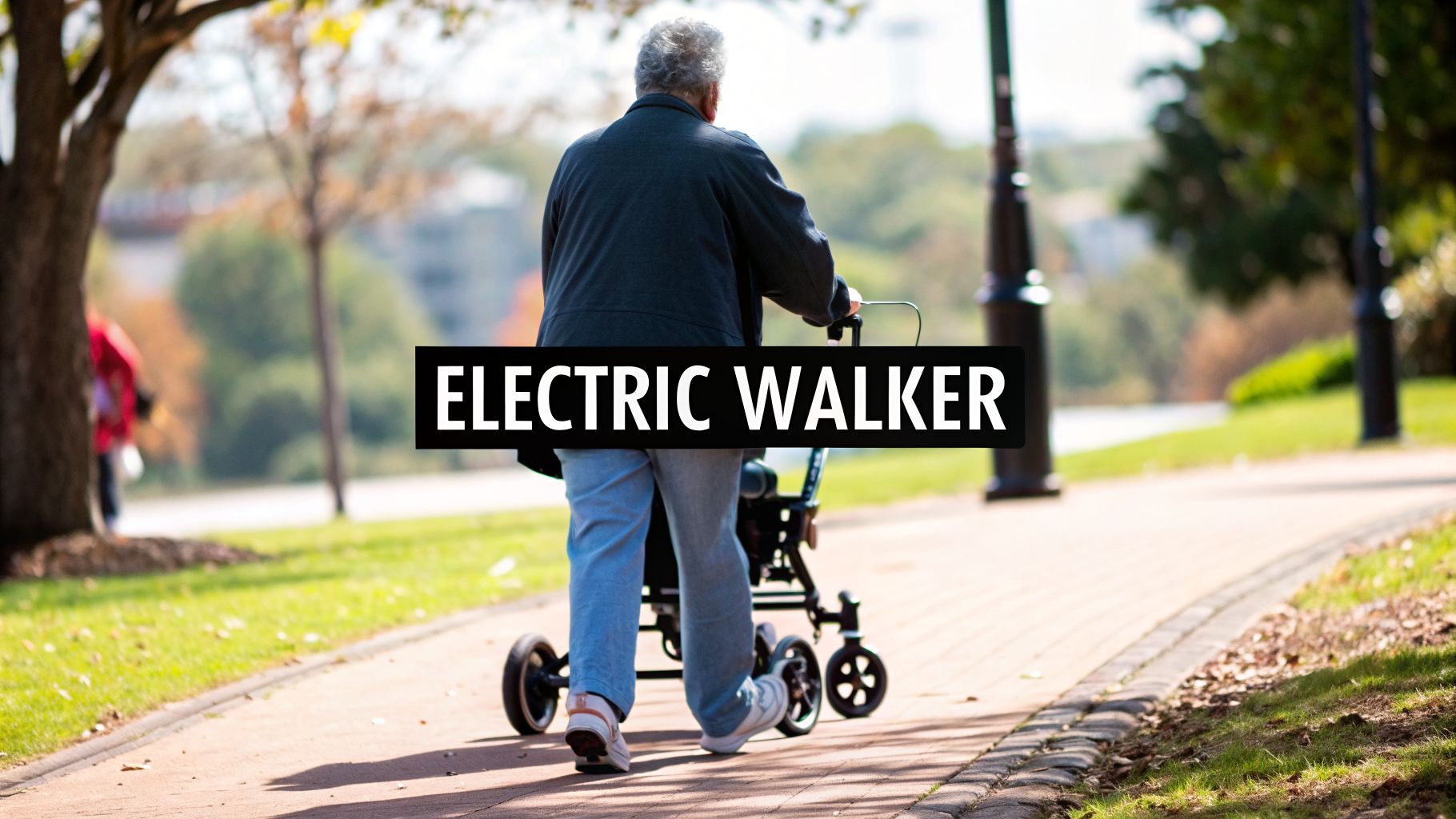
An electric walker is a game-changing mobility aid that blends the sturdy support of a traditional walker with a quiet, built-in electric motor. Think of it like an e-bike for walking—it doesn't do the work for you, but it gives you a gentle boost to make getting around much easier. These devices provide powered assistance, helping you walk further and tackle small hills without getting worn out.
The Next Step in Personal Mobility

It’s best to see an electric walker as a smart companion for your daily strolls. It’s not about replacing the act of walking but enhancing it. By giving you a subtle forward push, these walkers empower you to stay active with a renewed sense of confidence and safety.
This forward-moving assistance is a huge leap from standard walkers, which you often have to lift or shove with every single step. An electric walker for adults moves right along with you, sensing your pace and kicking in with support exactly when you need it. This is a lifesaver for anyone dealing with conditions that bring on fatigue or joint pain.
Who Is It For
The perfect person for a powered walker is someone who can still get around but feels like physical challenges are starting to make their world smaller. It perfectly bridges the gap between walking unassisted and needing a full-on mobility scooter. These devices are incredibly helpful for:
- Seniors who want to keep enjoying daily walks around the neighborhood or in local parks without worrying about getting too tired.
- People recovering from surgery or an injury who need steady support as they go through rehabilitation.
- Individuals with chronic conditions like arthritis or mild COPD that make walking long distances a real struggle.
By taking the edge off the physical effort, an electric walker can turn what was once a daunting outing into a genuinely pleasant one. This newfound freedom is great for physical health, but it also does wonders for mental well-being by encouraging social time and independence.
"An electric walker does more than just aid movement; it restores confidence and empowers users to reclaim their daily routines with newfound energy and peace of mind."
A Growing Market for Empowerment
The need for smarter mobility solutions is skyrocketing, largely thanks to some big changes in our population. The global market for electric mobility aids, which includes the electric walker for adults, is seeing incredible growth. A related market, the electric wheelchair sector, is expected to jump from USD 14.9 billion in 2026 to USD 38.4 billion by 2036.
This boom is driven by a simple fact: the world is getting older. The World Health Organization predicts that by 2050, more than 2.1 billion people will be over 60. Many of them will be looking for tools to help them stay active and independent. You can explore the market trends shaping mobility tech to learn more about what’s driving this shift.
Who Truly Benefits from a Powered Walker

While the concept of an electric walker sounds great, it’s fair to ask who really needs one. The answer lies not just in a diagnosis, but in the daily routines and personal goals that become challenging over time.
Think of someone who adores their daily walks in the park, but arthritis in their knees and hips turns every step into a negotiation with pain. A standard walker offers stability, but pushing it across uneven pavement quickly becomes draining. For them, an electric walker for adults isn't a luxury; it’s a lifeline. The motor takes over the hard work, letting them enjoy the fresh air and stay connected without paying for it later.
Or consider someone recovering from hip replacement surgery. Their physical therapist wants them walking to rebuild strength, but the fear of a fall and a sheer lack of energy can feel overwhelming. A powered walker provides a steady, self-propelling platform that moves with them. It’s more than just a mobility aid—it’s a recovery partner that lets them focus on their gait and healing.
Restoring Confidence and Daily Routines
Beyond just helping people move, these devices are incredible tools for restoring confidence. For many older adults, the fear of falling is a major barrier that leads to a less active, more isolated lifestyle. By providing powered stability, electric walkers can dramatically reduce that anxiety.
That feeling of security empowers people to reclaim the small, everyday tasks they may have given up, from a trip to the grocery store to visiting a friend down the street. It’s about getting back to life on their own terms.
This isn't just a feeling; the numbers back it up. We know that 15-20% of adults over 70 rely on walkers, and powered models can slash fall risks by up to 50% because of their built-in stability. These devices are part of a booming market for powered mobility, valued at an impressive USD 4.49 billion in 2024.
Supporting Health and Social Engagement
An electric walker for adults does something remarkable: it turns what felt like a chore into a pleasant activity. That light, consistent exercise is vital for everything from cardiovascular health to maintaining muscle mass.
When movement becomes easier, people are far more likely to get out and about. This renewed mobility is key to breaking the cycle of isolation that so often comes with physical challenges. The right powered walker can make a world of difference for several groups of people.
- Individuals with Chronic Conditions: For those managing conditions like arthritis, neuropathy, or COPD, a powered walker makes staying active possible. Physical therapy often shows how a device like this eases arthritis pain and improves mobility.
- Active Seniors Seeking to Conserve Energy: Many seniors are perfectly mobile but find their energy wanes quickly. A powered walker helps them save that energy for the things that matter most, whether it’s playing with grandkids or, for some, enjoying a walk on the golf course. You might be interested in our guide on how electric push carts are a game-changer for senior golfers.
How to Choose the Right Electric Walker
Picking out the right electric walker isn't about finding the one with the most bells and whistles. It's a lot more personal than that. Think of it like finding the perfect pair of walking shoes—the best ones are those that fit your life, your stride, and where you plan to go. The goal is to find a model that feels like a natural extension of you, boosting your confidence and independence.
We're going to cut through the marketing fluff and get down to what really matters. A feature that’s a game-changer for one person might just be an extra button to ignore for another. Let's walk through the key considerations to help you find the electric walker for adults that will genuinely make your day-to-day life easier.
Assess Your Daily Environment
First things first: where will you be using this walker? A sleek, nimble model designed for gliding over smooth hardwood floors is going to have a tough time on a cracked sidewalk or a grassy park path. On the flip side, a rugged, all-terrain walker might feel like driving a tank inside a small apartment.
Picture your average day. Do you need to navigate tight corners in the hallway? Squeeze through narrow doorways? Weave through crowded aisles at the grocery store? If so, you’ll want to prioritize a slimmer frame and a sharp turning radius.
For anyone focused on staying safe and independent at home, an electric walker can be a cornerstone of that strategy. Resources like a comprehensive aging in place checklist can provide a bigger picture of how mobility aids fit into creating a secure living space.
Key Features to Compare
Once you have a clear picture of your environment, it's time to dig into the specs. Don't get overwhelmed. The trick is to focus on the features that will directly impact your freedom and comfort.
- Weight and Portability: How heavy is the walker itself? If you plan on taking it with you in a car, a lightweight, foldable model is non-negotiable. Look at how it folds—some collapse with a simple pull, while others are more involved. Always check the folded dimensions to make sure it will actually fit in your trunk.
- Battery Life and Range: Manufacturers measure this in miles or hours. Be realistic about your daily travels. A range of 5-7 miles is pretty standard, but if you love long outings, some models offer beefed-up batteries that can push past 10 miles on a single charge.
- Controls and Braking: The controls need to feel second nature. Most walkers use a simple joystick or thumb levers, which should be intuitive from the get-go. A non-negotiable safety feature is an automatic braking system. This means the walker stops the second you let go of the controls, preventing it from rolling away on a ramp or slope.
A walker's true value is measured in the confidence it gives you. The best model isn't the one with the most features, but the one with the right features that make you feel secure and in control in your environment.
Finally, don’t forget about comfort and adjustability. The handles must adjust to your height to ensure you can maintain good posture, which saves your back and shoulders from strain. A built-in seat can also be a lifesaver, giving you a place to take a quick rest wherever you are.
To help you sort through it all, this table breaks down the most critical features and why they matter.
Electric Walker Feature Comparison
Choosing a walker is a personal decision, and this table is designed to help you weigh which features are most important for your unique lifestyle and needs.
| Feature | What to Look For | Why It Matters for You |
|---|---|---|
| Portability | Weight under 35 lbs and a one-step folding mechanism. | Essential for users who frequently travel by car and need to lift the walker independently. |
| Battery Range | A minimum of 8 miles per charge. | Provides peace of mind for full-day outings without worrying about recharging. |
| Controls | Intuitive joystick or thumb controls with automatic electronic braking. | Ensures immediate, simple operation and prevents accidental rolling, especially on inclines. |
| Wheels | Larger, all-terrain wheels (8-10 inches). | Offers a smoother, more stable ride over uneven surfaces like park paths or bumpy sidewalks. |
By focusing on these core elements, you can confidently compare different models and find the one that truly supports your independence and daily activities.
Why a Golf Walker Is Not a Mobility Walker
While a standard electric walker for adults is a fantastic tool for getting around on sidewalks and at home, it’s just not cut out for the unique world of a golf course. This is a common point of confusion for active golfers who want a little assistance during their weekly round. The two devices might both offer powered help, but they're built for completely different environments.
A medical mobility walker is all about stability on flat, predictable surfaces. Its smaller wheels and wide, sturdy frame are perfect for navigating hallways or store aisles. But take it onto the soft, uneven turf of a fairway, and those same features become a huge liability. They simply don't have the power, traction, or durability to handle wet grass, steep hills, and sandy paths.
Different Tools for Different Jobs
Trying to use a mobility walker on a golf course is like trying to drive a compact city car through a muddy field. Sure, it might get you a short distance, but it’s going to be inefficient, probably get stuck, and wasn't designed for that kind of punishment. Plus, the walker's design can easily damage delicate greens, and its brakes aren't meant to hold firm on a steep, grassy hill.
This is where a purpose-built golf solution makes all the difference. A device like the Caddie Wheel isn't a medical aid; it’s an electric caddie that attaches to your existing push cart. Its only goal is to save your energy for the game itself, not just to help you walk. It’s about enhancing your performance in your sport, not supporting your daily mobility.
The key distinction is purpose. A mobility walker helps you perform daily life activities safely. A golf-specific electric assist helps you perform your sport better by removing the physical burden of pushing a heavy cart.
Made for the Course, Not the Corridor
A specialized golf walker shines exactly where a medical walker fails, bringing features tailored specifically for the golfer.
- Terrain Capability: It’s built with a powerful motor and a rugged wheel designed to tackle hills and all kinds of turf conditions without breaking a sweat.
- Remote Control Operation: Instead of you pushing it, it uses a remote. This is a game-changer, letting you send your cart ahead to the next tee or guide it around a bunker while you walk freely.
- Exceptional Battery Life: A standard electric walker for adults might give you a few hours of use. A golf solution like the Caddie Wheel is a marathon runner—its battery can power you through 36 holes on a single charge.
- Energy Conservation for Sport: The real benefit isn't just about making walking easier. It’s about arriving at your ball with enough energy left to make a confident, powerful swing. You get all the health benefits of walking the course without the exhausting push.
This decision tree helps visualize how to choose the right type of electric walker based on your primary needs.

The flowchart makes it clear: if your main goal involves tackling the rugged terrain and long distances of a golf course, a specialized solution is by far the smarter choice. If you're a walking golfer looking to upgrade your game, check out our complete buyer's guide for electric walking golf carts.
Simple Maintenance for Your Electric Walker

Think of your electric walker like a trusted car. A little bit of routine care goes a long way in making sure it’s ready to go whenever you are and runs smoothly for years. Following a simple maintenance plan is the best way to protect your investment and keep your walker safe, reliable, and prepared for any outing.
Proper care is what makes sure your electric walker for adults stays a dependable partner in your day-to-day life. And just like with any electric device, the battery is the most critical component to look after—it's the heart of your machine.
Maximizing Your Battery Life
The battery is your walker's power source, and its lifespan really comes down to good charging habits. Much like your cell phone, you don't want to constantly run the battery down to zero. Instead, get into the habit of recharging it after each significant use to keep it in top shape.
Try to avoid leaving it plugged in for days after it's already full. And definitely never store the walker with a completely dead battery, especially if it's cold out. Smart charging habits translate directly to more reliable performance and a much longer-lasting battery. If you want to go deeper, many of the same principles apply to our guide on golf cart battery maintenance.
A well-maintained battery is the key to a walker you can always count on. Consistent charging after use prevents premature aging and ensures you have the power you need, when you need it.
Routine Checks for Safety and Performance
Beyond the battery, a few quick checks before you head out can stop problems before they even start. These simple steps take just a few minutes but make a huge difference in the safety and longevity of your electric walker.
A Quick Pre-Walk Checklist:
- Tires and Wheels: Give the wheels a quick spin. Do they turn freely without any wobbling or grinding sounds? Check the tires for visible wear, cracks, or any little rocks stuck in the tread that could make for a bumpy ride.
- Frame and Connections: Glance over the frame for any loose screws or bolts, paying close attention to folding joints. A quick tighten now and then is all it takes to keep the entire structure solid and secure.
- Cleaning the Electronics: Keep the control panel and charging port clean from dust and grime. Just use a dry, soft cloth to wipe them down. Never use water or any harsh cleaning sprays directly on the electronic parts.
Got Questions About Electric Walkers? We’ve Got Answers.
Stepping into the world of electric walkers can feel a little overwhelming. It’s natural to have questions pop up as you start exploring your options, from how you’ll pay for one to whether it can handle your daily adventures. Getting straight answers is the best way to feel confident about your choice.
Let's tackle some of the most common questions we hear from people just like you.
Are Electric Walkers for Adults Covered by Insurance?
This is a big one, and the answer is: it depends. For an electric walker to be covered by insurance, it usually has to be classified as durable medical equipment (DME). This means getting a prescription from your doctor that shows a clear medical need for the device.
The catch is that many of the newer, consumer-friendly models—especially those built for an active lifestyle rather than strict medical use—often don't fall under that DME umbrella. Your best bet is to have a direct conversation with both your doctor and your insurance provider to see what your specific policy covers and what paperwork you'll need.
How Heavy Are Electric Walkers and Can I Travel with Them?
Weight and portability are huge factors for most people. The good news is, there’s a wide range. Lighter, foldable models can weigh less than 30 pounds, making them pretty simple to lift into the back of a car. On the other hand, more heavy-duty units with bigger batteries and stronger motors might weigh over 50 pounds.
Most modern electric walkers are designed with travel in mind and fold down into a surprisingly compact shape. If you’re planning on flying, you absolutely have to check with the airline first. They have strict rules for mobility devices with batteries, especially lithium-ion types, so you’ll want to know their exact requirements before you get to the airport.
An electric walker is all about promoting active walking and helping you maintain an upright posture. It’s for people who can walk but just need some powered assistance. A scooter, in contrast, is a seated vehicle for those who can’t walk longer distances.
Can I Use an Electric Walker on Hills and Uneven Ground?
For the most part, yes. Most electric walkers are built to handle gentle slopes and moderately uneven surfaces like sidewalks or paved park trails. How well a specific model performs really comes down to its motor power, wheel size, and frame design.
Always check the manufacturer’s specs to see the maximum incline they recommend—it’s a crucial safety guideline. However, if you're thinking about taking it on seriously hilly or rugged terrain like a golf course, you’ll be much better off with a device specifically built for that environment. A standard electric walker just isn’t designed for those kinds of challenges.
Are you a golfer looking to walk the course without the strain? The Caddie Wheel transforms your push cart into an effortless electric caddie. Learn more and get your free extra remote at https://caddiewheel.com.
Share:
Basket for golf cart: A Complete Guide to Extra Storage
Your Guide to Installing a Push to Start Conversion Kit