
Your phone is sitting at 8%. The GPS app has already dimmed the screen to save power. Your rangefinder is flashing low battery. The wheel on your push cart feels a little less eager than it did on the front nine. That's the moment most golfers start thinking about portable chargers.
The mistake is focusing only on the biggest mAh number on the box.
If you want a portable charger long lasting enough for golf, the better question is simpler. Will it still work well after lots of rounds, lots of top-ups, summer heat, and months riding around in your bag? That shifts the conversation away from marketing labels and toward the three things that matter: usable capacity, battery chemistry, and care habits.
Why Long Lasting Matters on the Course
By the 14th hole, battery anxiety gets real fast. A phone that looked fine at breakfast is suddenly in power-saving mode. A GPS watch is hanging on. A cart accessory that seemed fully charged during the warm-up now feels like it's asking for help.

That's why long lasting doesn't just mean “big enough for one emergency phone refill.” On a golf course, it means a charger that can keep doing the job over many rounds, not just one good weekend. A one-season battery can look fine on paper and still become the weak link in your setup.
More gear is competing for one charger
Years ago, a portable charger mostly had to bail out a phone. Now the golf bag often carries a phone, rangefinder, speaker, launch monitor, and cart-related electronics. One USB output starts feeling like one water fountain for the whole foursome.
If you're sorting through options, a practical starting point is this portable battery charger guide for golfers. It helps frame the buying decision around actual on-course use instead of generic travel specs.
Practical rule: A charger that survives hundreds of charging sessions is usually more useful than one that looks huge on day one but fades early.
The difference between a helper and a habit
Think of two portable chargers. One lives in the side pocket, gets used twice a week, and still has reliable output after multiple seasons. The other starts strong, runs hot, spends too much time empty or fully topped off, and gradually becomes the gadget you stop trusting.
That difference usually comes from three levers, not one. Capacity tells you how much energy is available. Chemistry tells you how well the battery ages. Care habits decide how much unnecessary stress you put on it. Before you open a spec sheet, think about your own routine. Are you a once-a-week walker, a range regular, or the golfer who wants one charger ready for every round and every backup job?
Reading Capacity in mAh and Watt Hours
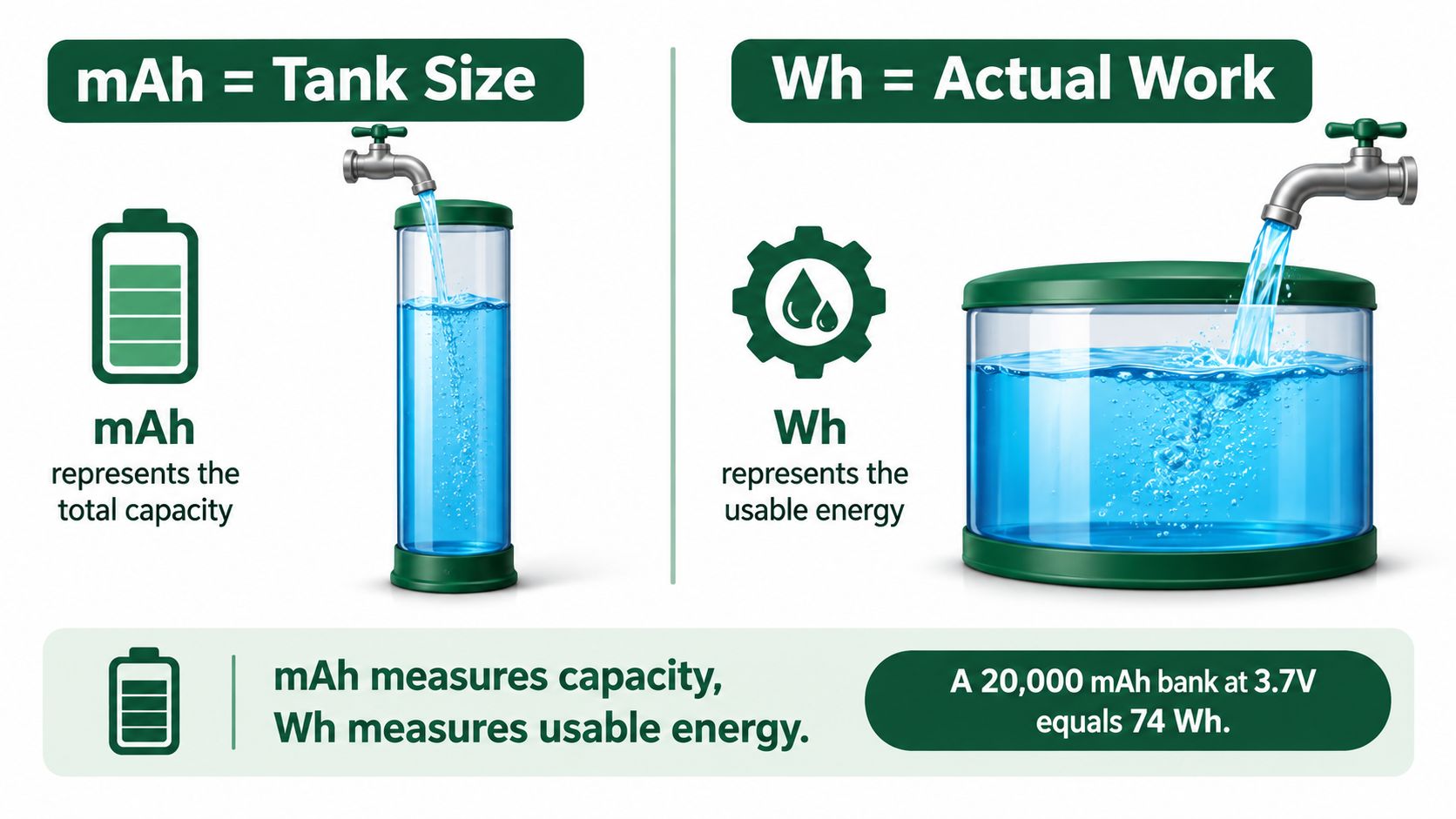
Battery labels confuse a lot of people because they mix two ideas that sound similar but aren't. The easiest way to understand them is with a water-tank analogy.
mAh is the size of the tank. Wh is how much work the water can really do once it flows through the system.
Why mAh alone can mislead you
A power bank may advertise 20,000 mAh, but that figure is usually tied to the internal battery cells. In plain English, that number doesn't equal the exact amount your phone or golf accessory will receive through the USB port.
A useful shortcut is to convert capacity into watt-hours. A 20,000 mAh bank built around 3.7V cells works out to about 74 Wh. That gives you a better apples-to-apples way to compare battery packs and estimate how much useful energy is really available.
What reaches your device
Voltage conversion matters. Internal cells commonly sit at one voltage, while USB output runs at another. Some energy gets spent in that conversion, so you should expect only part of the rated mAh to show up at the device end. That's why a “huge” power bank can still feel less impressive on the course than the label suggested.
For readers who want a broader shopping framework, this branded power bank buyer's guide does a good job showing the kinds of specs buyers should compare beyond the front-of-box number.
Here's a clean way to approach it.
- mAh is the headline number: It's useful for quick comparisons inside the same product category.
- Wh is the truth-teller: It reflects actual stored energy more clearly.
- Output losses are normal: A portion of the stored energy never reaches your device because conversion and control electronics use some of it.
A golf-friendly rule of thumb
If you're checking whether a bank fits your routine, estimate your round-day demand first, then choose some buffer above that. Don't buy only for the emergency 9th-hole phone scare. Buy for repeated use over time.
If you want to verify whether a charger is still delivering what it should, this battery capacity testing guide is useful when an older bank starts feeling weaker than it used to.
A portable charger that looks oversized on the shelf can feel ordinary once USB conversion, cable losses, and multiple devices enter the picture.
Battery Chemistry and Real Service Life
Two chargers can have similar capacity and feel completely different after a few seasons. That usually comes back to chemistry.
Most power banks use lithium-ion cells. They're common for a reason. They pack good energy into a compact size and fit easily in a golf bag pocket. Under normal use, portable chargers typically last 2 to 4 years, and many lithium-ion power banks are rated for about 300 to 500 full charge cycles before noticeable capacity loss begins, according to Mordor Intelligence on the power bank market.
The golfer's trade-off
Li-ion is the lightweight all-rounder. It's the usual choice when you want a compact charger for weekly rounds, travel, and everyday phone duty. But if your charger gets used a lot, the cycle rating becomes the story.
LiFePO4 is a different animal. Higher-end portable power stations using that chemistry are often rated for 3,000 to 6,000+ cycles, translating to about 8 to 15 years in real-world use, according to Anker SOLIX on portable power station lifespan. The trade-off is simple. They're usually bulkier and heavier, but they're built for much more repetition.
Lithium-Ion vs LiFePO4 for Golf Use
| Chemistry | Cycle Life (to 80%) | Energy Density | Heat Tolerance | Best For |
|---|---|---|---|---|
| Lithium-Ion | About 300 to 500 full cycles | Higher | Moderate | Golfers who want lighter size and everyday carry |
| LiFePO4 | Higher cycle life than standard Li-ion, often used when repeat longevity matters | Lower | Better | Golfers who care more about long-term durability than pocket-size convenience |
Golfers don't need a chemistry degree to use this well. If you play occasionally and value a slim charger, Li-ion usually makes sense. If you charge gear constantly, store gear for long stretches, or want a battery solution that ages more gracefully, it's worth learning why some batteries last longer in real use.
What 300 to 500 Cycles Really Mean
“Rated for 300 to 500 cycles” sounds technical until you translate it into ordinary use.
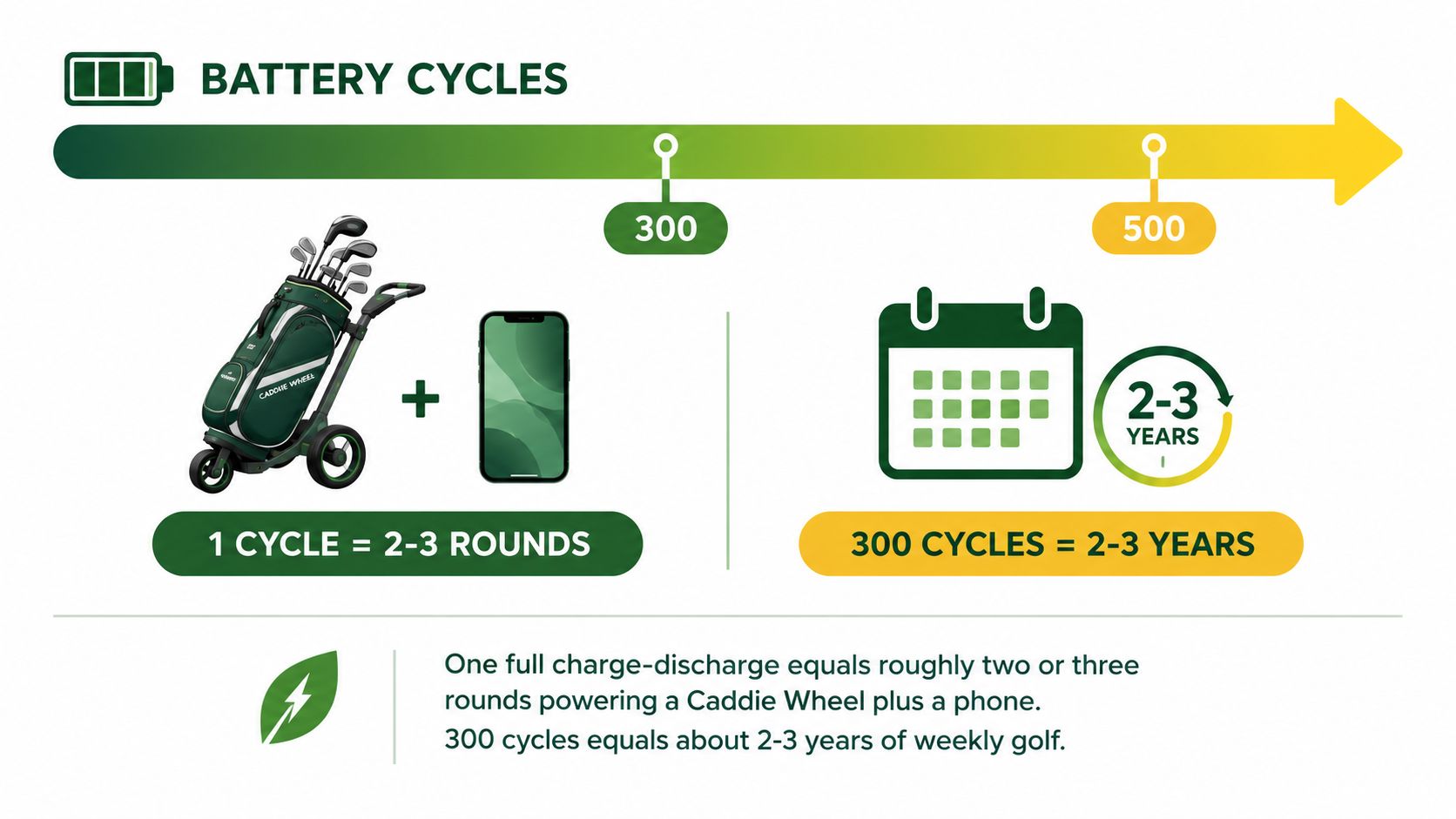
A cycle is not one plug-in session. It's one full use of the battery's capacity. Independent guidance explains that two 50% top-ups or four 25% top-ups still add up to one cycle, as explained by Canyon's guide to power bank lifespan.
Why that matters more than most buyers realize
Most portable chargers use lithium-ion cells rated for about 300 to 500 full charge cycles before capacity drops noticeably, and many consumer units reach around 60 to 80% of original capacity by the end of that range, according to Anker's battery lifespan guide.
That doesn't mean the charger suddenly dies on cycle 301. It means the pack gradually loses punch. You'll notice it as fewer device top-ups, more voltage sag under load, and less confidence that the bank will finish the round.
What partial charging does
Partial top-ups are generally easier on the battery than repeated deep drains. That's good news for golfers, because course use often comes in bursts. You charge a phone a bit after nine holes, top off another device later, and maybe recharge the bank that evening without running it flat.
Keep these two ideas in mind:
- Shallow use is usually gentler: Topping up before the battery gets drained reduces stress.
- Cycles accumulate: Small charges still count. They just count in fractions.
- Capacity fade affects trust: A charger that still technically works can still stop being dependable for long rounds.
Don't think in terms of “how many times did I plug it in?” Think in terms of “how much of the battery did I use over time?”
Voltage, Ports, and Golf Accessory Compatibility
A charger can be healthy, full, and still be the wrong fit for your gear. That's usually a ports-and-voltage problem, not a battery problem.
Phones are forgiving. Many golf accessories are not. A phone might sip power happily from a basic USB output, while a motorized accessory may expect a steadier current and shut down if the bank can't provide it cleanly.
The quick compatibility check
Before buying a charger for golf accessories, check four things:
- Connector type: USB-A and USB-C aren't interchangeable without the right cable.
- Required output: Some devices tolerate modest charging speeds. Others need stronger output to avoid warnings or weak performance.
- Simultaneous charging behavior: Not every bank handles pass-through charging well, which is when the bank itself is charging while also powering another device.
- Total port budget: Multi-port chargers may advertise several outputs but still limit the combined power available at once.
Pass-through charging deserves extra caution. It's convenient in a cart or clubhouse, but it can create more heat and complexity. That's not ideal if your priority is long service life.
One practical golf example
If you're pairing a charger with a remote, rangefinder, speaker, or cart-related device, read the accessory's power requirement before assuming any power bank will work. The same goes for browsing supporting gear. A collection like shop caddie gear can be helpful because it reminds you how many golf add-ons now depend on USB charging in one way or another.
Some buyers also get tripped up by specialty golf gear that needs something outside normal USB output. If a device expects a different voltage than a standard consumer bank supplies, you may need a converter or a dedicated charger instead of a generic power bank.
Where people usually get burned
The common failure points are boring, but they're the ones that matter:
- You match capacity but ignore output requirements.
- You use a weak or worn cable.
- You assume every USB-C port behaves the same.
- You depend on pass-through charging as your everyday setup.
A portable charger is only “long lasting” if it stays useful with the devices you carry.
Estimating Runtime for a Full Round
The easiest runtime estimates start with your day, not the product listing.
Say you walk 18 holes, keep your phone on for GPS and messages, and want a portable charger to support cart-related electronics during the round. You don't need laboratory precision. You need a realistic buffer.
A simple way to estimate demand
Use this three-step method:
- Identify the device wattage or charging demand from the device label or manual.
- Multiply by hours of use during the round.
- Add extra headroom for conversion losses, cable inefficiency, and the fact that real-world use is never perfectly clean.
That buffer matters because chargers don't deliver every stored bit of energy to the device. Real bags, real heat, and real cable swaps all nibble at the total.
Runtime Estimates by Power Bank Capacity
| Scenario | Devices Used | Effective mAh Needed | Recommended Bank |
|---|---|---|---|
| Light 9-hole round | Phone and one small accessory | Lower demand | Compact bank if you only need occasional top-ups |
| Typical 18-hole walk | Phone plus golf electronics | Moderate demand | Mid-capacity bank with reserve |
| 36-hole day or repeated weekend use | Multiple devices across long sessions | Higher demand | Larger bank with comfortable headroom |
One on-course example is the Caddie Wheel, which provides electric power assist for standard push carts and is relevant here because it adds another charging-related decision to the bag. If you're planning for a full day of walking and charging multiple devices, your power bank should be sized for the whole ecosystem, not just the phone.
A smart estimate is better than a giant guess. Buy enough reserve for your longest normal day, not just your shortest one.
Why Bigger Capacity Is Not Always Better
A lot of buyers assume the biggest battery is automatically the most durable. That's not how it plays out on the course.
A larger bank may give you more stored energy, but that doesn't guarantee a longer useful life. In fact, it can create trade-offs that matter more for golfers than headline capacity does.
Bigger packs bring their own problems
First, bigger batteries often create more heat during charging and discharging. Heat is bad for battery longevity. Research on lithium-ion cells shows that higher storage and charging temperatures accelerate aging compared with room-temperature conditions, according to ACS Energy Letters research on temperature and battery aging.
Second, oversized power banks are often heavier and more awkward in a golf bag. That doesn't sound like a battery issue, but it changes behavior. Golfers stop carrying them regularly, leave them in bad storage spots, or use them inconsistently.
Capacity is only one part of the story
There's also the quality problem. A modest-capacity bank with good battery management, better thermal handling, and healthier charging habits can stay useful longer than a giant low-cost brick that runs hotter and ages faster.
The market is also shifting. Coverage of newer battery products notes that some brands now market longer life through better cycle retention and thermal control, not just bigger capacity numbers. One example highlighted by Gadget Review's reporting on Belkin BoostCharge solid-state claims is that shoppers increasingly need to ask how a charger holds up after repeated cycles, heat exposure, and fast charging, not just how large the printed mAh number is.
The better buying mindset
Ask these questions instead of staring at one number:
- How often will I recharge this bank?
- Will it live in a hot bag or car?
- Do I need pocketable size or long-term cycle endurance?
- Will I use the extra capacity, or just carry the weight?
That's the portable charger long lasting mindset. Match the charger to your use pattern. Don't buy a battery billboard.
Care Habits That Stretch Service Life
Most batteries don't wear out because someone bought the wrong number on the box. They wear out because of heat, neglect, and charging habits that add stress every week.
A few boring routines make a bigger difference than most upgrades.
The habits that help most
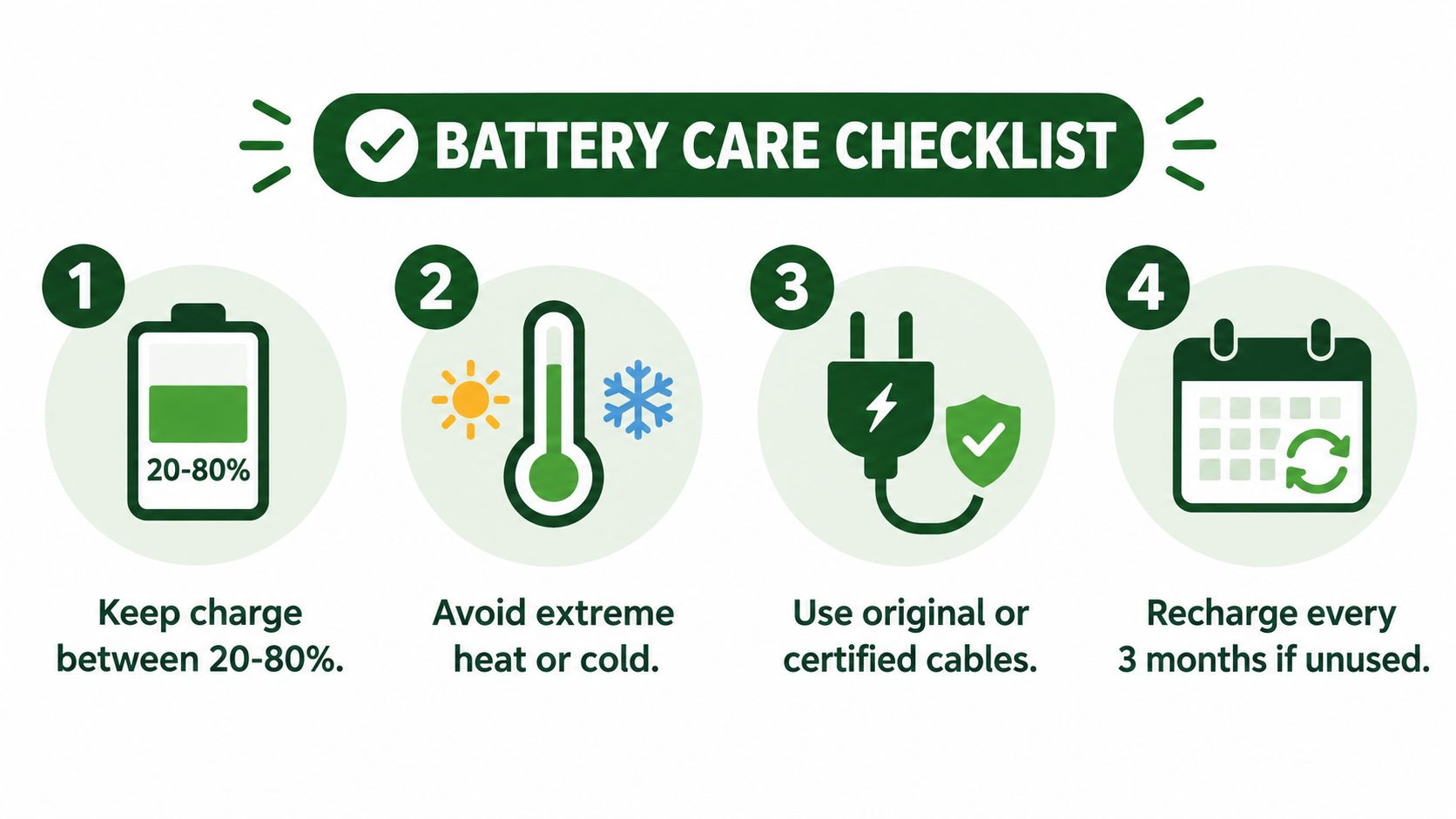
Practical maintenance guidance recommends keeping power banks in moderate temperatures and avoiding hot cars, direct sunlight, and extreme heat or cold because those conditions reduce performance and shorten lifespan, according to Growatt's portable charger maintenance advice.
A few habits are worth making automatic:
- Avoid extreme heat: Don't leave the bank baking in a trunk after the round.
- Let it cool down first: If the charger is warm from use, give it time before plugging it in again.
- Store it part-charged: If it's sitting for a while, don't stash it completely empty.
- Use good cables: Weak or damaged cables create charging issues that look like battery problems.
What storage really means for golfers
Storage is where many “backup” chargers disappoint. Some guidance notes that a power bank may hold a functional charge for only 3 to 6 months in storage, which is one reason “long lasting” can mean very different things depending on whether you use the charger weekly or keep it for emergencies, as discussed in Anker's discussion of calendar life, cycle life, and storage behavior.
That's a useful reminder for golfers in the off-season. A charger that sits untouched in the garage or locker for months may not be ready just because it was full last time you looked.
Here's a solid routine for the golf bag:
- Before the round: Check charge level and cable condition.
- After the round: Let the bank cool before recharging.
- During long breaks: Top it up periodically rather than forgetting it for months.
- In winter storage: Keep it indoors in moderate conditions.
This short video gives a good visual refresher on battery care basics before you pack your gear away for the season.
If you want to walk more comfortably without overcomplicating your setup, Caddie Wheel offers electric power assist for standard golf push carts in a simple drop-on format. It fits naturally into the kind of battery planning covered here, especially if you're building a reliable bag setup for full rounds and repeat use over multiple seasons.
Share:
Golf Cart Attachment Guide to Upgrade Your Push Cart
Golf Trolley Lithium Batteries Explained and How to Choose