
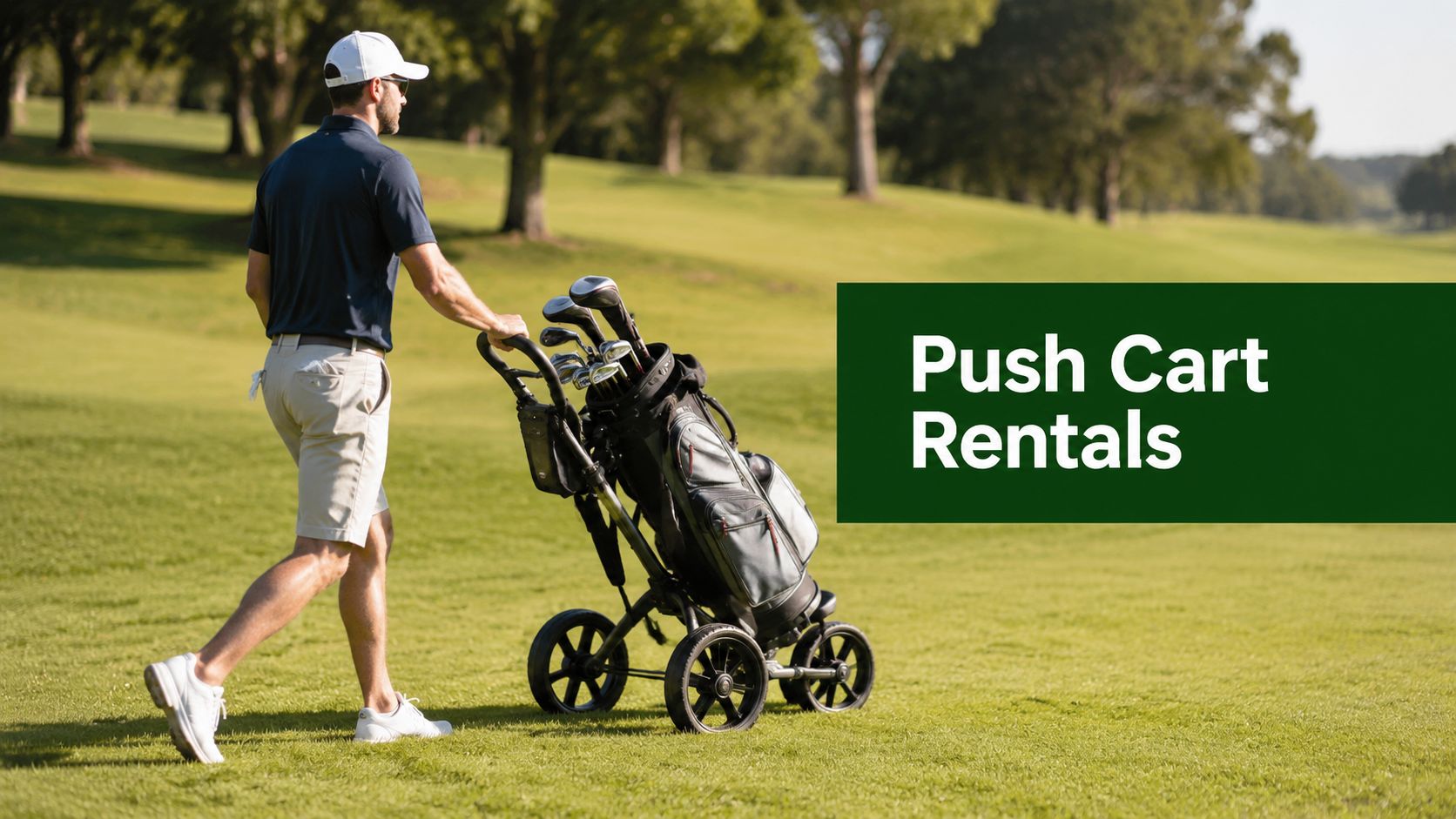
You've arrived for a round, your clubs are ready, and the course looks ideal for walking. Then you notice the rental counter has only a few push carts left, or the available cart has a loose wheel and a brake that barely holds on a slope. Buying your own solves that problem, but it also means storage, transport, maintenance, and committing before you know which setup suits your game.
Push carts rental gives you a practical middle ground. You can walk without carrying your bag, test manual or electric-assisted equipment, and avoid a long-term purchase when you're traveling or playing occasionally. The smart approach is to check availability early, understand the total price, and inspect the cart before leaving the shop.
Navigating Push Cart Rentals at the Course
A golfer arriving without a plan usually starts at the pro shop, asks for a push cart, and accepts whatever is available. That works on a quiet day. On a busy weekend, it can mean waiting, settling for a worn frame, or discovering that the course's “cart rental” means a powered riding cart rather than a walking cart.
Start with the course website, then call the pro shop if the policy isn't clear. Some facilities list push carts beside their riding-cart fees. Others handle them as first-come, first-served equipment. The University Golf Course at the University of Georgia, for example, lists pull carts for $7 for 9 holes and $14 for 18 holes, while stating that push carts are available first come, first served. Those rates and policies are published on the University Golf Course rental page.

What to confirm before tee time
Ask four direct questions:
- Is a push cart available for your date and tee time?
- Is the fee per round, per day, or per calendar period?
- Are manual and electric-assisted models both available?
- What happens if you return the cart late or find damage during the round?
The distinction between a walking cart and a riding cart matters. Bobby Jones Golf Club lists an all-day push cart rental at $10 per cart, compared with $30 per cart for a riding cart, as shown in its Tempo Walks rental information. That's a useful reminder to use precise language when calling. Say “manual push cart” or “electric push cart,” not just “golf cart.”
For broader planning, this guide to golf push cart rentals can help you compare the equipment category before you arrive. During peak periods, reserve anything the course allows you to reserve, and arrive early enough to inspect the unit without rushing to the first tee.
Finding Where to Rent a Push Cart
The course itself is usually the first place to check, but it isn't the only option. A reliable search follows the way you'll use the cart, whether that's one round, a golf trip, or repeated play at the same club.
Start with the facility
Search the course name plus “push cart rental,” “pull cart rental,” or “walking cart.” Read the rental policy rather than relying on a search-result summary. Oak Hills Park Golf Course lists a walking push cart at $10, and its policy separately lists riding-cart charges, including $20 for 18 holes per rider, $13 for 9 holes, and $40 for a single golfer requesting an individual cart. The same policy says drivers must be at least 18 and hold a valid driver's license. Those details appear in the Oak Hills Park golf-cart rules.
Call the pro shop when the website doesn't state whether carts can be reserved. Ask whether the cart waits at check-in, the bag drop, or the first tee. That small logistical detail can matter if you're carrying a travel bag, arriving close to your tee time, or walking from a distant parking area.
Check local pro shops and rental suppliers
Independent pro shops may rent equipment directly or refer golfers to a local supplier. This route can provide better access to electric-assisted models, especially when the course keeps only basic manual carts. Ask about delivery, collection, cleaning, and whether the supplier provides a replacement if the unit fails during play.
A dedicated rental provider may price by round or event rather than by course visit. Broader rental services can also be useful for golf trips, but confirm that the provider serves your destination and that the cart fits your bag and course conditions. If electric assistance interests you, compare the practical differences in this electric golf cart rental guide.
Use online listings carefully
Online marketplaces can connect golfers with local owners or equipment companies. Before paying, verify the pickup location, return deadline, deposit terms, cancellation rules, and support contact. A low advertised rate isn't useful if the cart is several miles from the course or the return process is unclear.
Practical rule: Confirm the cart, the pickup point, and the return time in writing before you pay.
Understanding Push Cart Rental Pricing
Push-cart pricing usually reflects a short, low-ticket equipment transaction rather than a vehicle rental. Manual carts commonly appear around $5 to $15 per player per round, while electric or remote-controlled options are often cited around $20 to $40. Those ranges are presented in this push-cart rental pricing guide, but individual facilities can set different rates.
The course's location, terrain, cart quality, and booking model all influence the final price. A manual cart on a flat municipal course may be priced for quick turnover. An electric unit requires battery charging, controls, inspection, and a process for handling faults, so the premium can reflect more than the motor itself.
| Cart Type | Per-Round Rate | Additional Fees |
|---|---|---|
| Manual push cart | $5 to $15 | Ask about deposits, cleaning, and late return terms |
| Electric or remote-controlled push cart | $20 to $40 | Confirm charging, damage, delivery, and late return policies |
| Riding golf cart, broader rental market | Not a push-cart rate | Daily rates commonly sit at $50 to $100, with weekly pricing often at $300 to $600 |
The broader riding-cart figures come from Rentinno's golf-cart rental business guide. They're useful for context, but you shouldn't use them as a direct substitute for a walking-cart quote.
Read the agreement, not just the headline rate
Ask whether the fee includes the full day or only one round. Also check whether the supplier charges for a late return, missing accessories, visible damage, or a failed payment. A publicly posted agreement from Play Away Push Carts says the rental runs from the effective date until the equipment is returned, and requires return after the final round of the event unless the agreement ends earlier. It also states that an installment payment more than 30 days late incurs a 20% per month surcharge, according to the Play Away Push Carts rental agreement.
For a single round, manual rental is usually the simplest value calculation. For a golf trip or repeated walking, compare the complete rental total with ownership, including transport and upkeep.
Renting vs Buying a Push Cart
Renting wins when your need is temporary. Buying wins when the cart becomes part of your normal golf routine.
A visitor flying to a destination course doesn't want to check a bulky frame, find storage at a hotel, or repair a wheel after a rough transfer. A local golfer who walks regularly may feel the opposite. Repeated rental fees, inconsistent availability, and unfamiliar handles eventually become more irritating than ownership.
Renting suits occasional use
Renting keeps the initial commitment low and shifts most maintenance responsibility to the operator. You can choose a cart at the course, play your round, and return it without worrying about where to store it between visits. It also lets you test whether walking fits your stamina, the course's hills, and your preferred bag setup.
The trade-off is control. You may receive a cart with a different wheel layout, bag strap, brake arrangement, or folding mechanism each time. Electric-assisted inventory can be especially limited, so the model you want may not be available when you need it.
Buying suits a consistent walking habit
Ownership gives you a known setup. You can adjust the handle, learn the brake, add accessories, and keep the cart ready in your vehicle. Regular golfers also avoid the uncertainty of first-come inventory and can select a frame that matches their bag and storage space.
Don't assume a purchase automatically saves money after an arbitrary number of rounds. The correct break-even point depends on the purchase price, rental rate in your area, how often you play, maintenance, and how long you keep the cart. Write down your actual local rental fee and compare it with the complete ownership cost.

A lightweight electric-assist system can change the decision for golfers who like walking but dislike constant pushing. Caddie Wheel is one example. It attaches to compatible three- and four-wheel push carts with a drop-on design and snap-in bracket, then uses a variable-speed remote for forward, reverse, and braking control. The stated battery capacity supports up to 36 holes per charge, and the product includes a 12-month warranty, according to the publisher's product information.
Before buying, test a rented cart on the kind of course you play. Flat fairways won't reveal how the frame tracks on slopes, how the brake holds, or whether the handle height suits you. A purchase makes more sense when the equipment solves a repeated problem, not because ownership sounds economical.
Inspecting Your Rental Push Cart
Spend a few minutes inspecting the cart before your bag goes on it. Rental equipment gets folded, loaded, unloaded, pushed over uneven ground, and handled by golfers with different habits. A quick check can identify a problem while the pro shop can still replace the unit.

Check the rolling hardware
Lift or tilt the cart slightly and spin each wheel. It should rotate smoothly without wobbling, scraping, or clicking. Look for cuts, severe flattening, trapped debris, and loose fasteners. Push the empty cart across the parking surface and listen for a repeating knock that could become worse on the course.
Test the brake on level ground. Engage it, lean gently against the handle, and confirm that the cart stays put. A brake that slips in the car park won't become trustworthy on a downhill path.
Test the frame and folding points
Open every latch and joint fully. The frame should lock without excessive play, and the handle shouldn't twist when you apply normal pressure. Check bag straps, accessory mounts, scorecard holders, and any quick-release parts. These components may seem minor, but a loose strap can let a bag shift and make the cart harder to steer.
For electric-assisted equipment, confirm the battery indicator, remote response, forward and reverse controls, and braking function. Don't leave the counter until you understand how to stop the unit manually if the remote loses power.
Document existing damage
Photograph scratches, bent brackets, worn tires, and missing accessories before play. Tell the rental desk and ask for the condition to be noted on the agreement. That record protects both sides, particularly when the contract makes the renter responsible for returning the equipment in an agreed condition.
A rental inspection isn't distrust. It's the fastest way to turn a vague handoff into a clear record.
Maximizing Your Push Cart Rental Experience
The best rental fades into the background once the round starts. If you are still adjusting the handle on the third hole or questioning the brake before every slope, the setup is costing you attention. Choose the cart for the course and for the pace you expect to keep.
Reserve early if the course accepts bookings, particularly for a busy weekend or destination event. For first-come, first-served rentals, call ahead and arrive with time to check the equipment. Pack only what you will use. Extra balls, clothing, drinks, and accessories add weight and make steering harder.
Match the cart to the terrain
A compact manual cart suits a fairly level layout. Hills, long walks between greens and tees, and repeated elevation changes put more pressure on wheel stability and braking. Electric assistance can help when fatigue starts affecting your swing late in the round, but the battery, controls, and stopping system require a proper check before play.
Walking changes the physical demand of golf. The PGA's walking-golf guidance describes the added activity involved in walking a course. Use the cart to manage the bag, while still planning for water, suitable footwear, and a pace you can maintain through the final holes.
A practical adjustment is to keep frequently used items within easy reach. Put balls, tees, gloves, and a drink in the cart's accessible storage instead of repeatedly stopping to open the golf bag. Keep heavier items low and centered so the cart tracks predictably on uneven ground.
Use rentals as a test bench
A rental gives you a controlled way to compare three-wheel and four-wheel designs, manual braking, and electric support. Test steering effort, bag stability, folding speed, and how closely the cart follows your line. Those details matter more on the course than a feature list viewed online.
If you return to the same club, ask about repeat-renter rates, membership benefits, or partnerships with equipment suppliers. Some facilities may have electric-assist units within their existing push-cart fleet, letting you try powered support before committing to a purchase. Record what worked after each round, including terrain, load, and fatigue. That simple comparison makes your next rental faster to choose and easier to assess.
Making the Right Choice for Your Game
A push cart rental is a tool, not a lifestyle commitment. It makes sense when you want to walk but need flexibility, when you're traveling, or when you're still deciding whether manual or electric assistance belongs in your regular setup.
Start with availability. Course pro shops and rental counters offer the simplest handoff, but inventory can be limited. Local suppliers and online services may provide more choice, although delivery, pickup, and return terms require closer attention. Confirm the exact cart type before you assume a quoted “golf cart” is a walking model.
Price the complete transaction. Manual push carts generally occupy the low-cost end of the rental market, while electric-assisted models command a higher fee because they include powered hardware and battery management. Deposits, late charges, damage policies, and event-length agreements can matter as much as the advertised round rate.
Your playing pattern should decide whether you keep renting. Occasional golfers gain convenience and avoid storage. Frequent walkers gain consistency and customization from ownership, but only after comparing the purchase price with local rental costs and expected maintenance. A cart that stays in the garage isn't a saving, and a rental that repeatedly leaves you with poor equipment isn't good value.
The golfer's condition matters, too. Walking can deliver a stronger workout, while a stable push cart reduces the need to carry a bag. Players managing knee or back strain, navigating hills, or trying to preserve energy for a long round should test the equipment under realistic conditions rather than choosing from price alone.
Rent one before you buy. Check the wheels, brake, folding joints, bag fit, and steering on the course. If the setup helps you walk comfortably and keeps your attention on golf, repeat the rental or investigate a suitable ownership option. That simple trial is more reliable than an impulse purchase.
Caddie Wheel offers lightweight electric power assist for compatible standard push carts, with a drop-on bracket, variable-speed remote control, and a battery designed to support up to 36 holes per charge. Visit Caddie Wheel to explore an electric-assist option before your next push-cart rental or purchase decision.
Share:
Battery Remote Control for Caddie Wheel: Replacement
Drift Golf Cart Guide: Designs, Legality, and Smarter