
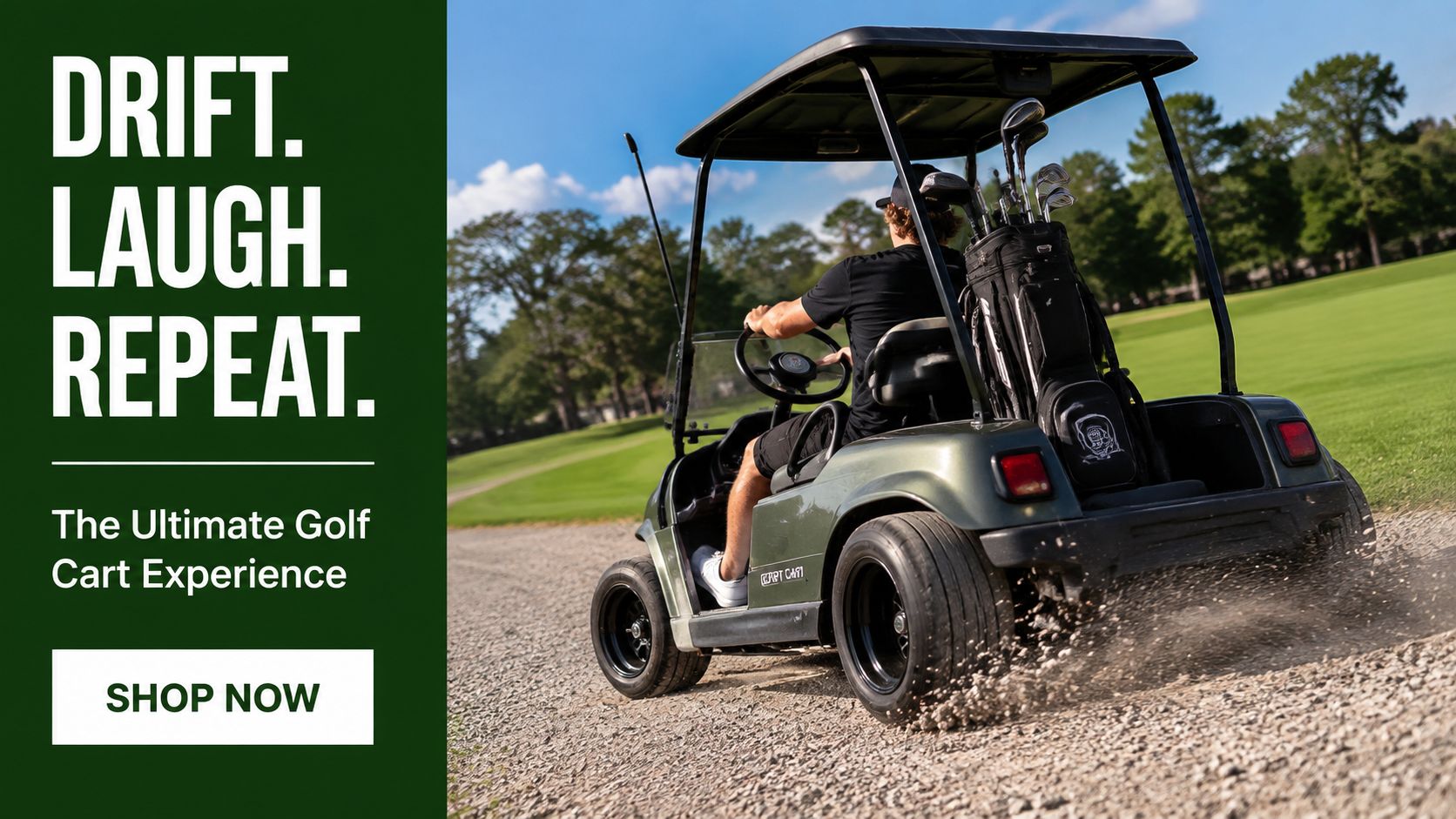
The most popular advice about a drift golf cart starts with the wrong question. “Can you make a golf cart slide?” is easy to answer. The more useful question is whether you need a stunt vehicle at all, or whether you're trying to move a push cart more comfortably across hills, damp grass, and uneven paths.
A purpose-built drift kart can be entertaining on a suitable private surface. A normal golf cart can also lose traction unexpectedly. Those are very different situations, with different demands on steering, brakes, tires, batteries, turf, and local rules. For most walking golfers, controlled propulsion and dependable braking matter far more than holding a dramatic slide.
What Most People Get Wrong About Drift Golf Carts
Drifting a golf cart isn't automatically the same as motorsport drifting. In motorsport, a driver deliberately manages throttle, steering angle, weight transfer, and tire slip to create a controlled cornering display. A golf course presents a less predictable environment. Damp grass, loose gravel, sand, turning aprons, slopes, and uneven transitions can make the rear wheels break traction without any planned stunt.
That distinction changes the buying decision. Online clips often show purpose-built rear-steer karts with specialized tires, altered differentials, and compact frames. Those machines are designed around rotation. A standard golf cart or push cart is designed to carry equipment and move steadily, not to sustain oversteer.
Two meanings hide behind one phrase
When a walking golfer searches for a drift golf cart, the phrase may describe either of these ideas:
- A modified ride-on kart: A compact hobby vehicle built for sliding on an appropriate private surface.
- Brief traction loss on a push cart: A powered or unpowered cart whose rear wheels slip while crossing a hill or low-grip patch.
The first is recreational equipment. The second is a handling and safety problem. Treating both as the same product category can lead you to choose hard tires, aggressive steering changes, or excess power when what you need is better hill control.
The surface matters just as much as the vehicle. A setup that slides on smooth concrete may behave unpredictably on wet turf. A rear tire that releases easily can also increase stopping distance, damage grass, or make a loaded cart difficult to correct.
Practical rule: If your main goal is to walk a round with less pushing effort, prioritize controlled forward movement and braking before you consider traction loss.
Electric mobility has made this confusion more common because compact battery vehicles can be adapted into many forms. The broader golf cart category grew from practical transport, not stunt driving. A drift build is an offshoot of that architecture, not a universal upgrade for golfers.
Defining the Drift Golf Cart and Its Core Designs
A drift golf cart can refer to two very different designs. Separating them first prevents a common mistake, buying a sliding platform when you really need powered assistance for a standard push cart.
The first category is the ride-on modified drift kart. It usually has a shortened chassis, a low seating position, rear-wheel steering or altered steering geometry, and hard rear tires intended to reduce grip. The driver controls the vehicle directly, often using throttle and brake inputs to start and manage rotation. Purpose-built examples show why steering hardware matters. One drift kart configuration uses 720 degrees of lock-to-lock steering, more than 75 degrees of steering angle, and an adjustable Ackermann knuckle, according to the manufacturer's drift kart specifications.

Why steering geometry changes the result
Ackermann geometry controls how the inside and outside front wheels follow different paths through a turn. A drift-focused setup tunes that relationship for rear-tire breakaway and sustained oversteer, rather than making the cart turn more sharply. Hydraulic foot brakes and a hydraulic handbrake can help the driver manage weight transfer and rotation, but they also add mechanical complexity.
Electric drift karts often keep speed modest while emphasizing repeatable rotation. One published dual-motor configuration uses two 25,000 RPM motors, a 24V battery pack, plastic rear drift tires, and a drift-mode speed of about 9 mph. Another 36V configuration reaches up to 14 mph with a 500-watt motor and a 1:1 steering ratio, as shown in these published drift kart configurations.
The second category is a powered push cart that occasionally loses rear grip. Here, the front wheels lead and the rear wheels support the load. A wet slope, loose material, or an abrupt turn can make the rear wheels slide briefly. The golfer isn't seeking a sustained drift. They need the cart to recover smoothly and stop predictably.
For a buyer, the simplest test is intent. Choose a ride-on drift kart only if you have a suitable private setting and want a recreational machine. Choose power assist when the problem is fatigue, hills, or the effort required to push clubs.
How Drift Carts Fit Into the History of Golf Mobility
Golf mobility began with the simple problem of carrying equipment around a large course. The first human-pulled golf cart is commonly dated to 1932 in Clearwater, Florida, while the first commercially viable electric golf cart emerged in 1951, when Marketeer produced an electric model in Redlands, California. By the mid-1950s, manufacturers including E-Z-GO, founded in 1954, Cushman, founded in 1955, and Club Car, founded in 1958, had entered the market, according to this history of golf cart innovation.

A branch, not a replacement
That history explains why modern specialty carts still look familiar. Compact chassis, small wheels, low-speed electric propulsion, and controlled movement became the foundation for products used on courses and in other controlled-access environments. Drift-oriented platforms borrow those fundamentals, then tune steering, tires, braking, or weight distribution toward a different purpose.
Remote-controlled golf carts represent another branch of the same tree. A documented Cart-Tek GR-1000 configuration uses a dual 12-volt SLA battery pack and can support a round of 27 to 36 holes depending on course conditions, with flatter or less demanding courses supporting the longer runtime, according to the Cart-Tek GR-1000 product documentation. The important lesson isn't that every powered cart will match that result. Terrain changes the workload, and battery claims must be tied to a specific system.
Remote control also changes how the golfer interacts with the machine. A documented remote system uses dedicated forward and reverse selection, a throttle button, and a stop function when the control is released, as described in this remote-control golf cart manual.
For golfers assessing how their body handles walking, equipment choice can sit alongside a professional movement assessment. Aspen Falls Wellness offers a movement screen Aspen Falls Wellness resource that can help players think about mobility, balance, and movement demands before adding more vehicle complexity.
A drift golf cart therefore belongs in the wider history of golf transport, but it doesn't replace the practical designs that came before it. It changes the priority from carrying and assisting to sliding and rotating.
Drift Carts Compared to Standard and Electric Golf Carts
The clearest comparison uses four questions: What is the vehicle for? How does it respond to control? Where can it operate predictably? Who is it meant to serve?
A drift-style ride-on is built around rear traction loss and rotation. A standard gas cart prioritizes carrying people and equipment with a stable, linear response. An electric golf cart occupies the middle ground for many users, offering quiet propulsion and a controlled driving experience while remaining more suitable for ordinary paths and grass than a stunt-oriented setup.
| Feature | Drift-Style Cart | Standard Gas Cart | Electric Golf Cart |
|---|---|---|---|
| Primary purpose | Recreational sliding on an appropriate private surface | Transporting golfers and equipment | Quiet transport and controlled electric mobility |
| Control feel | Tuned for rotation and rear-wheel breakaway | Linear throttle and predictable steering | Smooth throttle with electric motor response |
| Best terrain | Smooth, hard, open surfaces | Grass, paths, and course terrain suited to the vehicle | Paths and course terrain where the cart is permitted |
| Main user | Hobbyist, tuner, or content creator | Traditional golfers and facility operators | Golfers seeking quiet, low-speed transport |
| Main trade-off | Reduced practicality, added modification risk | More mechanical service and operating noise | Battery charging and terrain-dependent range |
The same hill can produce different outcomes
Wide turf tires and moderate torque help a standard cart cross grass without tearing at the surface. A drift setup needs lower grip, which can make a slope more difficult rather than more fun. An electric cart can provide smooth low-speed control, but it still loses traction when the surface, load, and incline exceed what the tires can manage.
The target user separates the categories even more sharply. A hobbyist may value steering angle and rotation. A traditional golfer may value seats, storage, and carrying capacity. A walking player often wants enough torque to handle hills without turning the round into a strength test.
A cart that is exciting on a smooth practice surface may be the wrong cart for a wet fairway, a crowded path, or a full set of clubs.
A drift-style cart rarely satisfies the practical requirements of a normal round. It may lack the carrying layout, turf-friendly tires, predictable braking, or facility approval that ordinary golf mobility requires. The comparison isn't about declaring one design universally superior. It's about matching the vehicle's behavior to the surface and the golfer's actual objective.
Safety, Legality, and Battery Stress in Drift-Style Use
The most important drift golf cart question isn't whether the rear tires can break loose. It's whether the battery enclosure, controller, brakes, tires, and chassis remain within their intended operating conditions after repeated high-slip use.
Battery systems are regulated components, not novelty accessories. Golf carts fall under IEC 62485-3, and lead-acid systems require attention to hazardous materials, charging, and ventilation. Lithium systems also bring certification questions involving UL 2271, UL 2580, and UN 38.3, depending on the battery's application and transport context. The IEC 62485-3 battery safety guidance, together with the electrical precautions in Caddie Wheel's electrical safety guidelines, provides a better framework than casual stunt videos.
Why repeated slipping changes the load
A drift doesn't turn the vehicle. It changes the relationship between motor torque, tire grip, braking, and heat. Repeated starts and stops can increase current demand, heat the controller, and place additional stress on battery connections and enclosures. The exact effect depends on the motor, controller, battery chemistry, enclosure, surface, load, and duty cycle, so a generic “drift-ready” label isn't enough.
Braking deserves equal attention. A handbrake that helps initiate rotation may not provide the same proportional control as the original braking system. A loaded cart on damp grass can respond very differently from a light kart on smooth pavement.
Rules are local and facility-specific
Course permission is separate from mechanical capability. A facility may restrict modified vehicles, prohibit recreational sliding, limit access to cart paths, or refuse responsibility for equipment that no longer matches its original safety configuration. Municipal rules can also differ by location, especially where low-speed vehicles, public roads, lighting, restraints, and equipment certification are involved.
Independent guidance identifies surface condition, tire grip, weight distribution, and speed as major factors in whether a cart will slide safely. It also emphasizes slow operation, no passengers during risky maneuvers, and open areas away from people and obstacles, as discussed in this golf cart drifting safety overview.

Don't use a public course, shared path, or wet slope as a test facility. If a cart repeatedly loses grip, stop treating the behavior as entertainment and inspect the tires, brakes, steering, battery enclosure, wiring, and controller before the next use.
Common Modifications and Maintenance Trade-Offs
Modifying a ride-on cart creates a chain reaction. A change that improves slide initiation can also alter steering loads, tire scrub, axle shock, brake balance, or warranty coverage. Evaluate the complete system rather than judging each part in isolation.
Six changes buyers commonly see
- Lift kits: Raising the chassis can improve clearance, but it also changes suspension geometry and increases stress on wheel bearings and steering joints.
- Steering-angle adapters: More steering angle can help initiate rotation, while increasing the turning envelope and accelerating wear in tie rods and related hardware.
- Locking differentials: A locked differential forces the rear wheels to rotate together. That can make breakaway more consistent, but it transfers shock loads into axle housings and drivetrain parts.
- Aftermarket controllers: A higher-output controller can make a motor respond more aggressively. The trade-off is additional heat and greater risk of operating the motor beyond its rated limits.
- Wheel spacers: A wider stance changes appearance and may affect stability, but it also changes scrub radius and can load bushings unevenly.
- Pedal or hydraulic handbrakes: These can help manage rotation, yet they may bypass the vehicle's original proportional rear-brake behavior.
The modification itself isn't the only maintenance concern. Alignment, fasteners, wheel bearings, steering joints, brake lines, tire condition, battery terminals, and controller temperatures all deserve regular inspection after a build changes the original load paths.
Warranty and service implications
A modified powertrain can shift responsibility from the original manufacturer to the owner or installer. Warranty coverage may no longer apply to affected components, and the owner must understand which parts were changed, who installed them, and what inspection schedule the vehicle needs.
The electric golf cart mods guide is useful background for thinking about upgrades as system changes rather than isolated accessories. Before buying a controller, tire, brake, or steering kit, ask what other components will carry the added force.
Maintenance question: Don't ask only, “Will this make the cart drift?” Ask, “Which part absorbs the extra load, and how will I inspect it?”
For a walking golfer, this cascade is usually a poor trade. A low-complexity assist system can address propulsion without asking the owner to redesign steering, braking, and drivetrain behavior.
Why Lightweight Power-Assist Often Beats Modified Drifting
Most walking golfers don't need a cart that breaks traction. They need a cart that moves when they want it to, slows when they release control, and handles a hill without turning the walk into a pushing contest.
A lightweight power-assist system attaches to a compatible push cart and adds propulsion without converting the golfer into a ride-on driver. The useful design elements are straightforward: a compact motor, a battery, a remote or dial control, a mounting bracket, and a braking function that lets the player manage movement while still walking beside the clubs.
Range should be judged by golf use
A documented remote golf cart system supports 27 to 36 holes on a single charge depending on course conditions, with flatter or less demanding terrain supporting the longer use, according to the Cart-Tek GR-1000 documentation. That benchmark illustrates why terrain matters more than a battery label alone. Hills, wet ground, starts, stops, cart weight, and club load all affect practical runtime.
A compatible Caddie Wheel setup adds a motorized wheel and remote control to a standard push cart. Its published product information describes forward, reverse, and braking control, a drop-on design with a snap-in bracket, compatibility with many three- and four-wheel push carts, and a battery rated for up to 36 holes per charge, as stated on the electric golf walking carts guide. Compatibility still depends on wheel layout, spacing, bracket fit, and the manufacturer's approved list.

The practical middle ground
Power assist preserves the walking format. You still choose your line, walk at your pace, and stay connected to the round. You avoid the bulk and liability of a modified ride-on while reducing the effort required to push clubs over uneven ground.
The buying process should begin with fit, not horsepower. Manufacturers may request the distance between rear wheels and photographs from behind and from the side because wheel count, spacing, and bracket shape determine whether an add-on will mount securely. This powered push-cart compatibility guidance shows why a universal assumption can lead to an unsuitable purchase.
For most walking golfers, reliable assistance solves the actual problem more directly than a drift modification. It improves movement without making traction loss the product's central feature.
Choosing the Right Cart Setup for Your Round
Your best setup depends on where you play, how you move, and what kind of maintenance you're willing to accept.
The private-land hobby tinkerer may choose a dedicated ride-on drift kart. This is the right fit for someone who wants to explore steering geometry and controlled sliding away from public roads, courses, pedestrians, and sensitive turf. The trade-off is accepting more inspection, more responsibility, and less everyday golf practicality.
The facility-regular walker will usually get more value from a quiet power-assist push cart. Look for compatible wheel spacing, secure mounting, forward and reverse control, dependable braking, and a battery system with clear charging guidance. The compromise is that the setup still depends on terrain and course permission.
The resort or course owner should evaluate fleet suitability rather than viral appeal. Prioritize safety documentation, serviceability, battery handling, tire behavior, storage, and facility rules before considering novelty features.
Use this quick checklist before buying:
- Terrain: Identify hills, wet grass, gravel, slopes, and cart-path restrictions.
- Storage: Confirm that the complete setup fits your vehicle, garage, or locker.
- Battery care: Check charger compatibility, ventilation needs, enclosure protection, and inspection access.
- Fit: Measure wheel spacing and confirm whether the bracket matches your push cart.
- Rules: Ask the course or local authority whether powered or modified carts are allowed.
A drift golf cart can make sense as a controlled recreational project. For an ordinary walking round, lightweight power assist is usually the more practical bridge between carrying clubs manually and using a full ride-on cart.
If you want to walk with less strain while keeping your existing push cart, explore the compatible motorized wheel and remote-control options from Caddie Wheel. Check your cart's wheel layout, review the fit requirements, and choose a power-assist setup built around steady movement rather than unnecessary traction loss.
Share:
Push Carts Rental: The Smart Way to Walk the Course
How to Control a Motor on a Golf Push Cart